
- About Us

- Our Services
- Your Industry
- Resources
- News & Blog
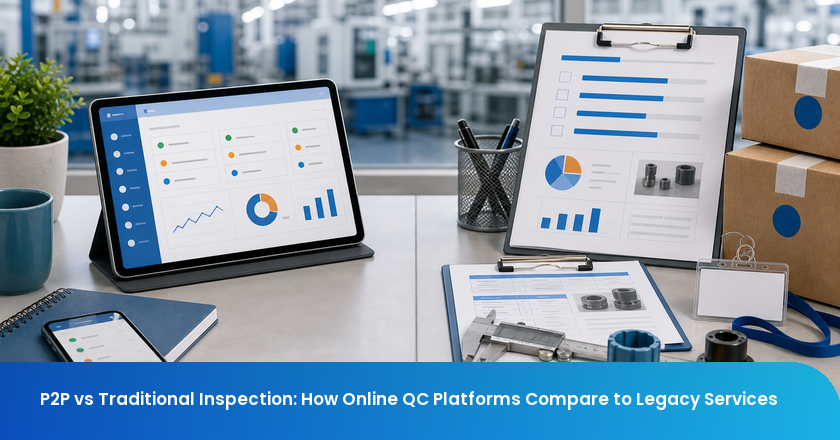
Online QC platforms improve speed and visibility, while traditional inspection services often provide more managed scope control; the best choice depends on product risk, evidence needs, and buyer involvement.
Importers are comparing online QC platforms with traditional inspection services because the old model of sending an email, waiting for scheduling confirmation, and receiving a static report days later feels slow. Digital workflows promise faster booking, live evidence, easier communication, and better report access. But speed alone does not decide inspection quality.
The real comparison is about control. Who defines the scope? How are product requirements translated into checks? Can the buyer see evidence during inspection? How are ambiguous defects handled? Does the report support a release, hold, rework, or reinspection decision? These questions matter more than whether the workflow looks modern or traditional.
Key Takeaways
- Definition: Online QC platforms digitize booking, communication, reporting, and evidence flow; traditional services usually rely on a more managed offline process.
- Strength: Digital workflows can improve speed, visibility, and buyer participation during inspection.
- Risk: A fast booking tool is weak if product scope, defect classes, and release rules are unclear.
- Standard: Inspection evidence should still be competent, consistent, and traceable, regardless of workflow style.
- TradeAider use case: The strongest model combines real-time digital reporting with managed inspection planning and buyer-specific release evidence.
Compare Workflow, Not Just Booking Style
The useful comparison between online QC platforms and traditional inspection services starts with workflow. A buyer should ask how the service turns a product file into inspection evidence, not only how quickly the inspection can be booked.
Online workflows can reduce communication lag
Digital workflows help when the buyer needs fast scheduling, live photo or video evidence, direct clarification, and centralized report access. They reduce the friction of scattered emails and make it easier to monitor inspection progress while the visit is happening. This is valuable when the buyer is overseas and the factory decision window is short.
Managed workflows can reduce scope drift
Traditional managed inspection services may be useful when the product is complex, the inspection scope is technical, or the buyer needs help translating requirements into a checklist. The risk with a self-service workflow is that the buyer may book the visit quickly but leave the inspector with unclear defect classes, missing sample files, or weak release rules.
The best workflow combines speed and control
The strongest inspection workflow is not purely digital or purely traditional. It uses digital tools to improve speed and visibility, while still applying managed quality-control discipline to scope definition, sampling, defect classification, report review, and release decision. The buyer should choose the workflow that closes the evidence gap for the order.
A practical way to choose is to classify the order into three risk levels before booking. Low-risk repeat products can prioritize speed and report access. Medium-risk products need a standard checklist plus buyer-specific defect classes. High-risk products need managed scope review, special checks, possible testing coordination, and a clear escalation rule if defects appear during the visit.
Online QC Platform Vs Traditional Inspection Table
A side-by-side comparison shows that the difference is not simply modern versus old. Each workflow type has advantages, but each can fail if the buyer chooses based on convenience without matching the inspection method to product risk.
| Decision Area | Online QC Platform Strength | Traditional Service Strength | Buyer Checkpoint |
|---|---|---|---|
| Booking and scheduling | Fast request, centralized status, easier updates | Coordinator-managed scheduling and follow-up | Can the visit date match production readiness? |
| Scope definition | Templates and uploadable product files | More guided checklist development | Are defect classes and special checks clear? |
| Live visibility | Real-time photos, videos, chat, and progress view | Often less real-time unless added to service | Can the buyer clarify issues during the visit? |
| Technical depth | Depends on how well the scope is configured | Can be stronger when managed by category specialists | Does the report answer the release question? |
| Report usability | Digital archive, easy sharing, faster review | Formal report package and account follow-up | Does evidence support hold, rework, release, or retest? |
| Cost comparison | May look efficient for straightforward checks | May justify cost for complex or high-risk orders | Compare cost against product and channel risk |
ISO/IEC 17020:2026 is useful because it frames inspection around competence, impartiality, and consistent operation of inspection bodies. ISO 2859-1:2026 is relevant when the inspection uses AQL sampling for lot-by-lot decisions. The technology layer should support those principles, not replace them.
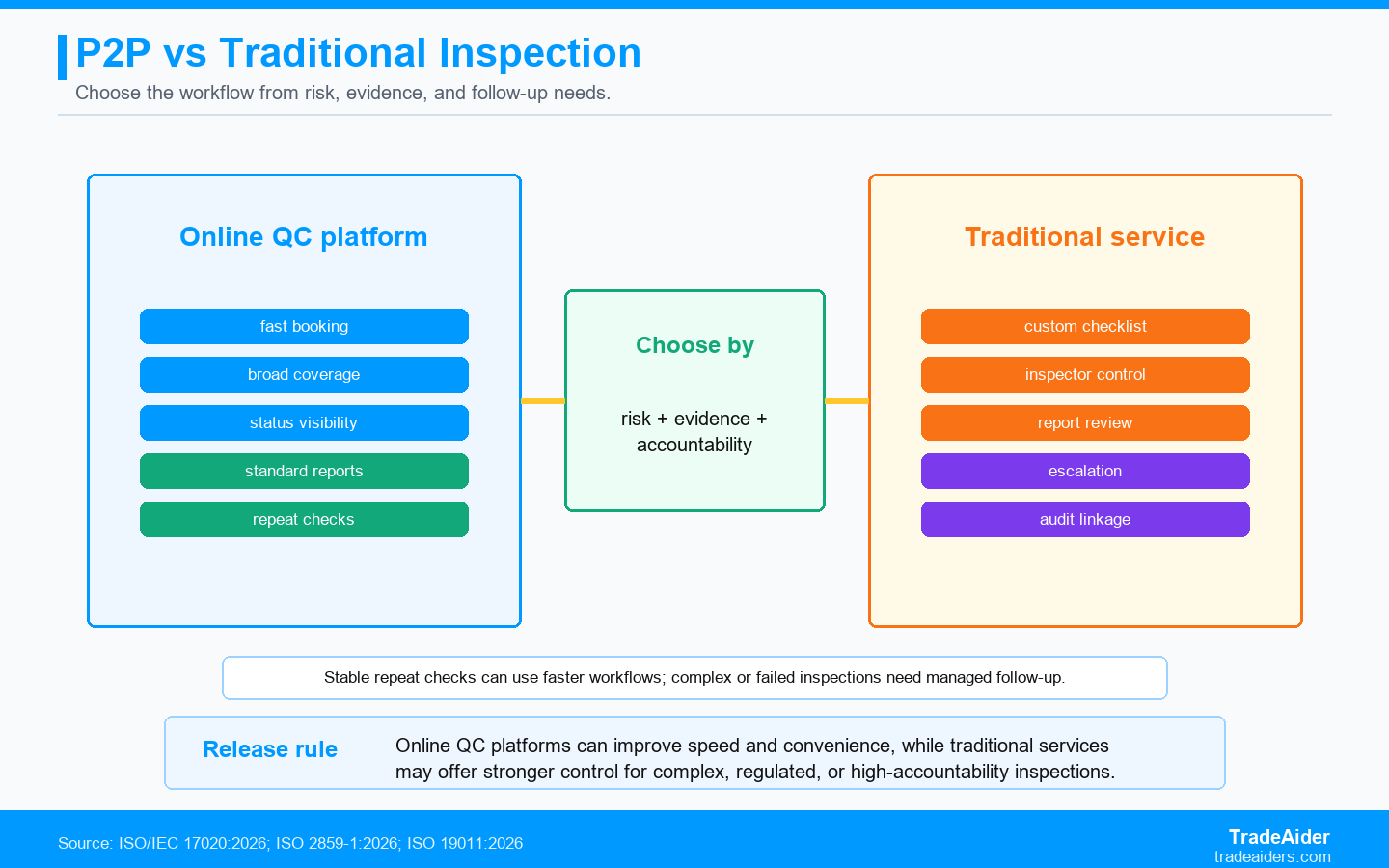
The right workflow depends on whether the buyer needs speed, live visibility, managed scope, technical depth, or release-ready evidence.
A faster inspection workflow is only better if it produces clearer release evidence.
Where Online QC Platforms Help
Online QC platforms help most when the product is straightforward, the buyer already has a clear product file, and the decision window is short. Their value comes from faster coordination, better visibility, and easier access to inspection evidence.
They help buyers react during inspection
Real-time evidence changes the inspection experience. If the inspector finds a questionable defect, the buyer can ask for a closer photo, compare with the approved sample, request an extra function check, or ask the factory to segregate affected cartons while the visit is still active. This can prevent a small ambiguity from becoming a post-report dispute.
They help teams centralize inspection records
Digital archives are useful for overseas teams managing many suppliers. A buyer can compare reports, track defect patterns, review photos, and share release evidence internally without digging through email chains. This matters when purchasing, QA, logistics, and customer-service teams need the same shipment file.
They help repeat products with stable requirements
For repeat products with stable suppliers, an online workflow can be efficient. The buyer already knows the product, approved sample, defect classes, and inspection scope. The digital workflow then becomes a way to execute and monitor the known standard faster.
Where Traditional Inspection Still Matters
Traditional inspection support still matters when the buyer needs more help defining scope, reviewing technical risk, coordinating complex requirements, or interpreting the report. A digital interface does not automatically solve unclear product expectations.
Complex products need scope discipline
Electrical goods, toys, cookware, textiles with claims, smart devices, mechanical products, or products with destination-market labeling requirements need careful scope design. If the buyer only uploads a generic checklist, the inspection may miss the exact feature or evidence that determines release.
New suppliers need more than a quick booking
A new supplier can pass a basic visual check and still have weak process control, missing testing evidence, poor packaging discipline, or unstable corrective action. In these cases, a managed workflow may need to combine factory audit, during-production inspection, pre-shipment inspection, and testing review.
High-risk failures need decision support
When the report shows critical or repeated major defects, the buyer needs a clear next step. The decision may be hold, rework, reinspection, split shipment, additional testing, or supplier escalation. A workflow that only delivers a report may be insufficient if no one translates findings into a release decision.
This is especially important for products with regulatory labels, electrical components, food-contact surfaces, children's-use claims, chemical restrictions, or retailer-specific packaging. A buyer may need evidence that sits outside a normal visual inspection, such as test report alignment, rating-label comparison, manual version review, or carton-range traceability. Those decisions require more than a fast appointment slot.
Cost Should Be Compared With Evidence Risk
Inspection cost should be compared with the evidence risk left after the workflow is chosen. A cheaper online booking can be a good decision when the product file is mature and the inspection question is simple. It can be a poor decision when the buyer saves on coordination but later pays for reinspection, delay, rework, or customer complaints because the scope missed the real risk.
Low-risk repeat orders can prioritize efficiency
A repeat product from a stable supplier may not need heavy workflow design every time. If the approved sample, defect classes, AQL level, packaging file, and prior reports are consistent, the buyer can use an efficient digital workflow and focus on confirming that the current shipment still matches the known standard.
New or changed orders should prioritize evidence depth
A new product, new supplier, new component, new packaging file, or new destination-market requirement changes the decision. The buyer may need a more guided workflow because the inspection scope has not yet been proven. In that case, the cost of missing a key check can be higher than the cost difference between workflow types.
High-risk categories should include escalation rules
High-risk categories should define what happens if a critical defect, repeated major defect, label mismatch, or missing test evidence appears. The inspection plan should say who decides, what extra photos are needed, whether cartons should be segregated, and whether the shipment is held for rework, retest, or reinspection.
How TradeAider Combines Digital Visibility With Managed QC
TradeAider is positioned for buyers who want digital visibility without losing inspection discipline. Its workflow combines real-time reporting, buyer communication, and practical service planning across inspection, audit, and testing needs.
Use real-time reporting for active decisions
TradeAider's online real-time reporting helps buyers see inspection evidence while the work is happening. That is useful when the buyer needs to clarify an issue, ask for extra photos, confirm a label detail, or decide whether the factory should start immediate sorting or rework.
Use managed scope for product-specific risk
A buyer can use TradeAider's Pre-Shipment Inspection, During Production Inspection, and factory audit service when the order needs more than a quick visual check.
Use testing coordination when inspection cannot prove compliance
If the product has chemical, electrical, toy, textile, food-contact, or certification evidence requirements, digital inspection photos are not enough. TradeAider can connect inspection with product testing services. Buyers can share the product file, PO, destination market, and risk points to choose the right workflow.
SPAR Scenario: Fast Booking Was Not Enough
Situation: An importer booked a fast online inspection for a smart lighting accessory. The product looked simple, and the buyer expected a standard visual and function check to be enough.
Problem: The shipment included a new remote control, updated label, and revised manual. The booking was fast, but the uploaded scope did not clearly require pairing checks, rating-label comparison, manual version review, or accessory count by carton range.
Action: The buyer paused release and rebuilt the inspection scope around the product file. The inspection added function, accessory, label, manual, and carton-range checks, then requested extra evidence for the changed remote-control batch.
Result: The digital workflow still saved time, but only after the scope was corrected. The lesson was not that online inspection failed; it was that speed without product-specific evidence can leave the real release question unanswered.
Who Is TradeAider?
TradeAider is a quality inspection, testing, and certification service provider in China. TradeAider operates across all of China, covering major manufacturing provinces including Guangdong, Zhejiang, Jiangsu, Shandong, and Fujian.
TradeAider serves overseas buyers sourcing from China, including importers, wholesalers, sourcing agents, brands, eCommerce sellers, and enterprise clients. Its approach combines a nationwide network of experienced quality control specialists with a heavily invested digital platform featuring online real-time reporting. Clients can monitor inspections live, communicate directly with inspectors, and address issues during production rather than after shipment - a proactive model focused on problem-solving and prevention, not just defect identification.
Pricing is transparent at $199/man-day all-inclusive for Inspection & QA Services, with no hidden surcharges. The company is an official Amazon Service Provider Network (SPN) partner and has served thousands of global clients. Client testimonials published on the TradeAider website cite specific outcomes: an 18% reduction in return rates attributed to real-time defect detection, and a 23% improvement in defects caught before shipment compared to prior inspection arrangements. These are client-reported figures.
Frequently Asked Questions
Are online QC platforms always cheaper?
Online QC platforms are not always cheaper when risk is included. They may reduce coordination cost for simple inspections, but unclear scope, missed defects, reinspection, or shipment delay can make the total cost higher.
Are traditional inspection services always better?
Traditional inspection services are not always better. They can provide stronger managed scope for complex orders, but they may be slower or less visible if they lack real-time reporting and digital evidence access.
When should I use a managed inspection workflow?
Use a managed inspection workflow when the product is new, technical, safety-sensitive, compliance-sensitive, or tied to strict retailer requirements. The workflow should define defect classes, special checks, sampling, testing evidence, and release rules before inspection.
What matters most when choosing inspection services?
The most important factor is whether the inspection service produces evidence that supports the shipment decision. Speed, price, and platform convenience matter only after the scope and release criteria are clear.
Related Articles
Grow your business with TradeAider Service
Click the button below to directly enter the TradeAider Service System. The simple steps from booking and payment to receiving reports are easy to operate.

