
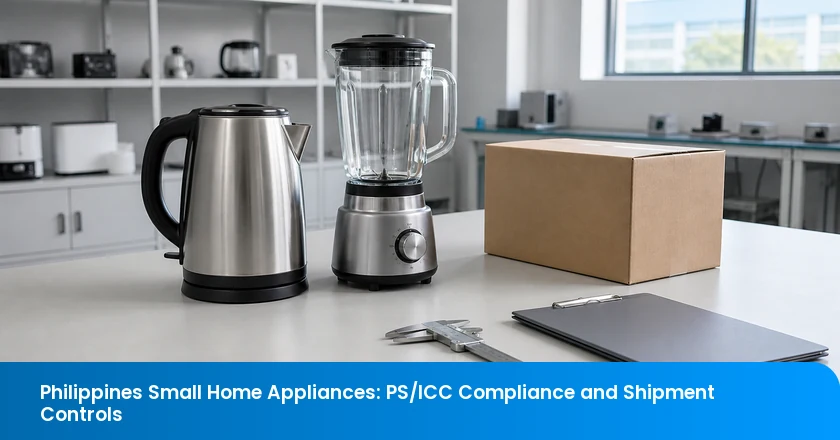
A Philippines appliance shipment is not ready because a supplier sends a certificate. It is ready when the applicable PS or ICC route, the current appliance build, its mark or sticker, the package, and the defined cartons can be read as one record. That distinction matters when a kettle, blender, fan, or cooker has a late cord, label, manual, or accessory revision: the retail SKU may look unchanged while the evidence no longer clearly identifies the goods about to ship.
For an importer, the practical goal is not to turn a factory inspection into a certification decision. It is to make the regulatory route, technical records, physical checks, and carton population specific enough that the responsible importer and Philippine parties can resolve a mismatch before the order becomes harder to separate. The following sequence is a shipment-control method, not legal advice or a substitute for a current BPS determination on a particular appliance.
What Must Match Before a Philippines Appliance Shipment Moves?
- Before releasing a Philippines-bound appliance shipment, make the PS or ICC route, current appliance build, mark or sticker, corresponding package, and carton range point to the same goods.
- Confirm the actual appliance category, model attributes, supplied accessories, and applicable PNS rather than relying on a broad sales name.
- Link the current evidence to the physical unit, its mark or sticker, the corresponding package, and a defined carton range.
- Hold only the identifiable changed subset when records and goods diverge; do not let an unchanged SKU name hide the difference.
Start With the Applicable PS or ICC Route
PS licensing and ICC certification are different BPS routes, so a Philippines shipment plan must identify the responsible manufacturer or importer path before it treats a certificate as release evidence. The Bureau of Philippine Standards product-certification guidance distinguishes a PS Quality and/or Safety Certification Mark license for a manufacturer from an Import Commodity Clearance certificate for an importer whose imported product has been evaluated through the BPS process. That is the first ownership question to settle: who holds the route, and what exact product evidence is being submitted or relied upon?
Use the terms precisely. In this context, a PS license is the BPS licensing route for a manufacturer that meets the relevant product and quality-system requirements. An ICC certificate is the BPS route used for an importer and its imported goods. Neither term means that a supplier's generic test report, factory brochure, or old product-family file automatically describes the item currently packed for the Philippines.
That route decision should happen before the factory starts a final document chase. If the party, product category, or evidence route is still unclear, label the shipment file as an open scope question. A clean hold at this point is usually cheaper than trying to explain later why the paperwork names one configuration while the cartons contain another.
Confirm the Exact Appliance and Supply Configuration
Small home appliances are not one regulatory category: the BPS mandatory-product list separates household appliances such as electric fans, blenders, kettles, rice cookers, toasters, ovens, washing machines, refrigerators, and air conditioners. Start with the exact appliance category, then record the model code, rated voltage, power input, supplied plug and cord, included accessories, manual revision, and retail-pack description. Those facts make it possible to ask whether the current product fits the relevant route instead of asking whether it is merely a “small appliance.”
Product pages show why that precision matters. The BPS page for electric rice cookers describes a defined portable cooker or warmer scope and names a specific PNS IEC reference. Its page for electric fans also identifies attributes and exclusions, including battery-operated and handheld types. A PNS, or Philippine National Standard, is the country’s product standard reference; it must be connected to the appliance being supplied, not just to a nearby product family.
Do not decide that a report covers a variant simply because its product name sounds close. Put the scope questions in a one-page configuration record: what the buyer ordered, what the factory will ship, what is on the rating label, and what is inside the retail box. If any one of those answers changes, the importer has a visible trigger for a current BPS, laboratory, or certification-path review.
Build a Shipment Evidence File That Names the Lot
An ICC-ready shipment file must reconcile commercial documents, a batch or serial summary, manufacturer quality evidence, and the relevant test report instead of treating any one PDF as the whole record. The published BPS PS and ICC application requirements list a packing list, commercial invoice, bill of lading or airway bill, batch or serial summary, manufacturer ISO 9001 certificate, and valid test report among the ICC requirements. The decision value is the connection: an evidence file should allow a reviewer to move from the commercial shipment to a defined population of appliances without guessing which build the report describes.
Start the file with one controlled configuration line: brand or SKU, factory model, appliance category, rating information, plug and cord description, product label revision, manual revision, report reference, and the cartons or serial range it is intended to cover. Then place the invoice, packing list, and transport records behind that line. The BPS index of ICC operations manuals includes separate material for imported kitchen machines and for imported heating appliances, reinforcing the point that an adjacent appliance file is not a safe substitute for the current category route.
This is also the right point to separate testing from a finished-goods comparison. If the question is whether the report or sample evidence actually matches the current appliance configuration, TradeAider can review the appliance test evidence before packing as a defined product-evidence task. The useful input is not “please confirm compliance.” It is the actual model list, report references, rating-label artwork, supplied accessories, and any change log that could alter the scope.
Turn the Evidence File Into Factory Controls
Factory controls should turn the evidence file into a comparison between the current appliance build and a defined carton population, rather than leaving documents and goods under separate ownership. The most common failure is a responsibility gap: the documentation owner assumes the factory build is unchanged, while the production owner assumes the old report will absorb a practical change. Assign one person to maintain the configuration line and one person to identify which cartons contain that configuration.
Lock the Model Match Before Final Packing
A useful factory control is to freeze the model identity, rating information, supplied accessories, manual revision, and retail-pack reference before final packing, then compare that record with the evidence file. The check is physical as well as documentary: inspect the model marking, plug and cord, visible label, accessories, instruction booklet, and carton artwork against the controlled line. Do not leave an unexplained “same as approved sample” note where a product revision, material substitution, or accessory swap could create a different build.
For mixed-SKU orders, make the record granular enough to identify the retail configuration rather than the purchase order alone. A factory model can be shared across several retail packs, and a retail name can conceal different supplied adapters, plugs, cords, or manuals. The buyer does not need to invent a new certification conclusion; the buyer needs a factual record that gives the responsible Philippine party a usable question.
Then Control the Carton Population
When a component, label, plug, instruction, or configuration changes, the buyer should isolate the affected cartons until the changed build can be mapped to the current evidence and shipment records. Carton control is the answer to the question left by the model check: where are the units that differ? Record carton numbers, production dates or shifts when available, quantities, and the reason for separation. A verbal assurance that “only a few were changed” is not a release boundary.
A defined subset gives the buyer proportionate options. It may be possible to pause only the identified cartons, correct a label or record, request a scope review, and keep the documented unaffected population separate. If the factory cannot identify the affected range, the risk is no longer the six units or one carton that first raised concern; it is the uncertainty around the entire packed population.
Inspect the Mark, Package, and Release Boundary Together
For covered goods, the PS mark or ICC sticker and the product or corresponding package should be checked as a traceable pair, because BPS marking guidance permits package placement in limited practical cases and requires the package to be available for verification. This is not a cosmetic label check. The mark or sticker, the corresponding package, and the defined carton lot are the physical points that connect the PS or ICC route to the current appliance build actually ready for release.
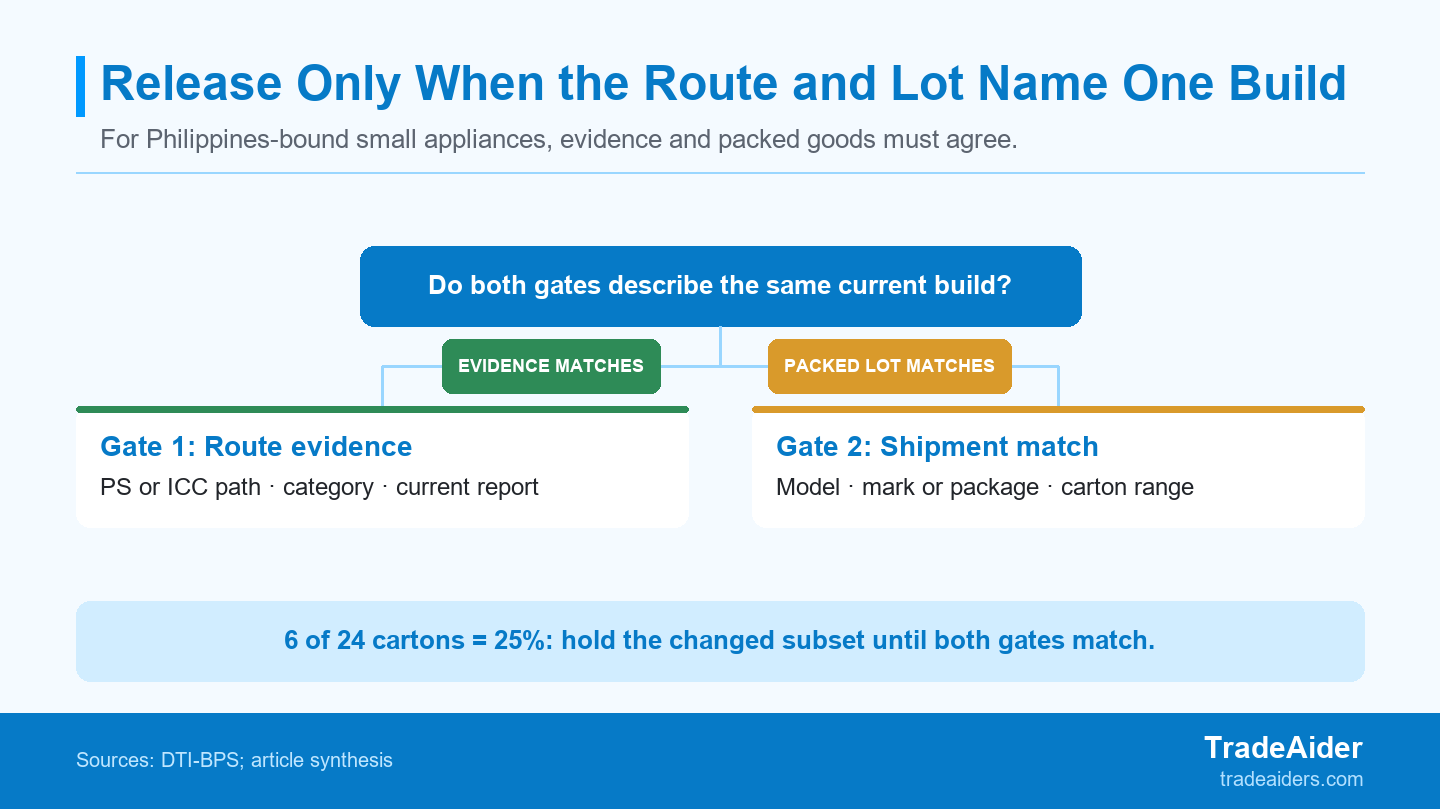
A certificate route and a physical shipment check meet only when they describe the same current appliance build and carton population.
Use one cohesive comparison sequence: confirm the current configuration line; observe the product marking and the corresponding package; verify that the package and packing list identify the same defined carton lot; then record any conflict as an open decision rather than a failed legal conclusion. That approach gives a factory or independent inspector a clear task. It also respects the boundary: an inspection can report whether goods and packaging match the declared evidence, but it cannot issue a PS license or ICC certificate.
When the goods are complete and the importer needs a physical comparison before shipment, verify the packed appliance lot before shipment against an agreed list of observable identifiers. The inspection request should name the current model, evidence references, label or package placement expectation, carton population, and the escalation rule for a mismatch. It should not ask an inspector to pronounce on an approval that belongs to BPS and the responsible certification route.
Illustrative Scenario: Six Changed Cartons in a 24-Carton Kettle Order
In an illustrative 240-unit kettle order packed in 24 cartons, a changed cord found in six cartons creates a 25% defined subset; that subset should not inherit the earlier build's release logic until its evidence and carton identity are reconciled. The importer has one retail SKU, but the six later cartons were packed after a cord revision and the earlier report still names the first build. The fact that the carton artwork has not changed does not make the current cord part of the documented configuration.
The factory can identify the six cartons in the packing record, and the current cord is visible on the product, yet the existing model line does not name it. That is enough to create a useful decision boundary. The buyer does not need to declare the goods non-compliant; the buyer needs to acknowledge that the evidence file no longer establishes one clearly described build for all 24 cartons.
The practical decision is to isolate the six-carton subset, preserve its carton identity, update the configuration record, and obtain the responsible category and evidence review before allowing that subset to inherit the earlier route logic. The other 18 cartons should not be casually released either; they should remain distinguishable as the documented population while the importer decides the next step for the changed build.
Before either population moves, compare the current appliance configuration, mark or package reference, document revision, and carton range in one review. This is an illustrative scenario, not a TradeAider client case and not a finding that any kettle is non-compliant. Its purpose is to show why six cartons can be a meaningful control boundary when the factory can prove exactly where the change occurred.
Hand Off One Release Packet Before Shipment
A shipment-control handoff is strongest when it names the responsible importer, exact model, document revision, carton population, inspection observations, and the open decision rather than merely attaching certificates. Call this a release packet: the current set of product, evidence, package, and carton records used for one shipment decision. It is not a BPS application form. It is the concise record that keeps the factory, importer, and inspection team from working from different versions of the same order.
| Release-Packet Field | What It Must Identify | Shipment-Control Use |
|---|---|---|
| Route owner | Manufacturer or importer path and current BPS question | Prevents a generic certificate from becoming the release decision |
| Configuration line | Model, rating, plug, cord, accessories, label, and manual revision | Creates the product reference for document and goods checks |
| Evidence references | Relevant report, quality record, and commercial shipment documents | Shows what evidence belongs to the current lot |
| Physical observations | Mark or sticker, product or package, and visible configuration facts | Separates a physical mismatch from a certification decision |
| Carton boundary | Numbers, quantities, and changed or unaffected ranges | Supports a targeted hold, correction, or escalation |
Send that packet before the inspection booking or the shipping deadline turns the review into a rushed approval request. If you have the current model list, report references, packing status, and carton range, you can ask TradeAider to request a Philippines shipment evidence review.
Frequently Asked Questions
Are PS and ICC the Same Certificate for Appliances?
PS licensing and ICC certification are distinct BPS routes, so the correct path depends on the responsible manufacturer or importer context. The route names are not interchangeable labels for a supplier file. Before using either as evidence for shipment control, identify the current appliance category, the party responsible for the process, and the product configuration the record actually describes.
Does Every Small Appliance Need a PS or ICC Mark?
Not every product described commercially as a small appliance should be assumed to follow the same PS or ICC requirement. Check the current BPS mandatory-product scope and the exact appliance configuration, including category, power characteristics, and supplied components. A nearby product family, an old listing, or an unchanged retail name is not a reliable substitute for that confirmation.
Can a Pre-Shipment Inspection Issue an ICC Certificate?
A pre-shipment inspection can compare declared evidence with finished goods, labels or packages, and the defined carton population, but it cannot issue an ICC certificate or PS license. Its value is factual: it can document what was observed in the packed shipment and flag mismatches that the importer or responsible Philippine route owner needs to resolve.
What Should Change After a Plug or Cord Revision?
Treat a plug or cord revision as a scope and traceability question, then isolate the affected cartons and update the configuration record. Confirm whether the current evidence, markings, package reference, and shipment documents still describe that build. If the factory cannot identify the affected range, expand the review boundary instead of assuming the earlier record covers the whole order.
Related Articles


Grow your business with TradeAider Service
Click the button below to directly enter the TradeAider Service System. The simple steps from booking and payment to receiving reports are easy to operate.

