
Skipping inspection saves $199–$320 upfront. But when 10% of a 5,000-unit order is defective, that's 500 units generating returns, negative reviews, and potential platform suspension — costs that routinely run 10–50× the price of the inspection you skipped. This article runs the actual numbers on both sides of that decision so you can make it with accurate information, not assumptions.
Key Takeaways
- Cost comparison: A standard PSI costs $199–$320 per man-day. A defective shipment at 10% defect rate on a 5,000-unit order typically generates $2,000–$15,000+ in returns, rework, and platform fees.
- Risk: In FY2023, the CPSC negotiated 308 voluntary recalls covering 97 million consumer product units — a sharp increase from 250 recalls of 19 million units the prior year.
- Statistical: China executed 1,100 consumer product recalls in 2024 covering over 4.5 million products, reflecting increasing enforcement reach.
- Bottom line: For most importers, inspection is not an expense — it's a risk transfer mechanism. The question is not whether to inspect, but how often and at what level.
- Common mistake: Calculating inspection as a cost-per-order without calculating the expected cost of a defective shipment, weighted by defect probability.
The Real Cost of Skipping Inspection
Importers who skip inspection aren't saving money — they're self-insuring against quality risk. That's fine if the probability of defects is genuinely near zero and the consequence of defects is low. For most importers sourcing consumer goods from China, neither condition reliably holds.
Here is the cost structure of a defective shipment, broken down by category:
Direct Costs: Returns, Rework, and Disposal
When defective goods arrive at your warehouse or fulfillment center, the options are expensive regardless of which you choose. According to industry analysis of importer mistakes, a 10% defect rate on 5,000 units generates 500 defective units. If your product sells at $25 and return rate for defective units runs 60%, that's 300 returns at an average processing cost of $8–$15 each — plus refunds of $25 each. Direct return cost alone: $9,900–$12,000 on that single shipment.
Rework in-country (sorting, repair, repackaging) is cheaper — typically $0.50–$2.00 per unit — but requires engaging the factory, which may not cooperate post-payment, and delays your sell-through timeline. Disposal of non-reworkable defective units means paying freight twice (inbound and to landfill) while recovering nothing.
Platform and Marketplace Costs
For Amazon FBA sellers, defect-driven customer returns trigger additional costs that aren't visible in a simple refund calculation. Amazon's return processing fee applies to each returned unit. If your account's return rate climbs above category thresholds, your listing can be suppressed or your selling privileges suspended pending an appeal process that typically takes 2–4 weeks. According to analysis of e-commerce quality failures, a batch with significant defects can result in a flood of negative reviews that tanks a listing's ranking — a loss that persists well beyond the original shipment.
Regulatory and Recall Costs
For products subject to CPSC jurisdiction — which covers approximately 15,000 categories of consumer products used in and around the home — a safety-related defect triggers mandatory reporting obligations. In FY2023, the CPSC negotiated 308 voluntary recalls covering 97 million consumer product units — a significant increase from 250 recalls of 19 million units the prior year. Each recall requires a corrective action plan, consumer notification, and often free repair, replacement, or refund to all purchasers. For an importer of 5,000 units, a full recall plus corrective action commonly runs $50,000–$200,000 depending on the hazard severity and distribution reach. A pre-shipment inspection that would have caught the defect costs $199–$320.
The Cost of Inspection: What You Actually Pay
A standard Pre-Shipment Inspection (PSI) in China costs between $199 and $320 per man-day all-inclusive, depending on provider and service model. Most consumer goods orders of up to 5,000 units can be inspected in one man-day. Market rates span $130–$320/man-day across providers, with the gap driven primarily by pricing transparency and hidden fee structures rather than service quality differences.
TradeAider's PSI at $199/man-day all-inclusive with real-time reporting represents the inspection investment side of this calculation. Here is what that $199 buys:
- Full AQL sampling under ISO 2859-1 (200 units sampled for a typical 3,000–5,000 unit order at Level II)
- Appearance, dimensions, and workmanship check against golden sample
- Quantity and packaging verification
- Barcode and labeling compliance check
- Functional tests appropriate to product category
- Real-time photo and video documentation during inspection
- Official report delivered within 24 hours
Side-by-Side Cost Comparison: Inspection vs. No Inspection
We modeled the cost of inspection versus no inspection across three order scenarios — small, medium, and high-value — at a 10% defect rate, which is within the range commonly seen on first orders from new suppliers.
| Scenario | Order Value | Inspection Cost | Defective Batch Cost (10%) | ROI of Inspection |
|---|---|---|---|---|
| Small order 1,000 units @ $15 | $15,000 | $199 | ~$1,500–$3,000 (returns + refunds + fees) | 7–15× inspection cost recovered |
| Mid order 5,000 units @ $25 | $125,000 | $199 | ~$10,000–$18,000 (returns, listing damage, rework) | 50–90× inspection cost recovered |
| High-value order 3,000 units @ $80, safety-regulated | $240,000 | $199–$398 (1–2 man-days) | $50,000–$200,000+ if recall required | 250–1,000× inspection cost recovered |
Based on this comparison, the data shows that inspection ROI scales with order value and defect consequence. Even for small orders, the cost of a defective batch exceeds the inspection cost by 7× at a modest 10% defect rate. The comparison reveals that for safety-regulated categories — electronics, children's products, personal care — skipping inspection is not a cost-saving decision; it is a risk assumption with asymmetric downside.
When Skipping Inspection Is Defensible
There are circumstances where skipping a formal PSI is a reasonable risk management decision — not negligence:
- Order value below inspection break-even: For orders under $1,000, a $199 inspection represents 20%+ of order value. At this scale, requesting supplier photos, video inspection, or factory self-inspection may be proportionate.
- Repeat orders from proven suppliers: If a supplier has passed 5+ consecutive inspections without issues, reducing inspection frequency (every 3rd order, or moving to DPI only) can be a deliberate, documented risk management decision rather than neglect.
- Simple, low-risk products from established factories: Commodity items with low defect consequence (non-functional decorative goods, basic packaging materials) where defect costs are easily absorbed and no safety regulations apply.
In all other cases — new suppliers, first orders, any product with safety requirements, and orders above $5,000 — the cost math consistently favors inspection.
A Real-World Cost Calculation
Situation: A Shopify brand importing 3,000 units of a silicone kitchen tool from a new Guangdong supplier. Order value: $18,000. Selling price: $22 per unit on Amazon. No inspection booked — the founder decided to trust the supplier's quality promise and the approved sample.
Problem: The shipment arrived with 340 units (11.3%) having a mold flash defect that created a sharp edge — a functional and safety issue. Amazon customer returns began within 10 days of launch. Seven customers reported minor cuts. Amazon suspended the listing after 23 negative reviews, requiring a CPSC Section 15 assessment before reinstatement.
Action: The brand engaged a product liability attorney ($3,500), filed a voluntary CPSC report, and issued a corrective notice to 340 customers. Defective units were disposed of at a cost of $680. Amazon reinstatement took 19 days, costing approximately $8,300 in lost sales at the product's run-rate. Total documented cost: $14,200 — not including the listing's long-term ranking damage from the review cluster.
Result: A TradeAider Pre-Shipment Inspection (PSI) at $199 — standard AQL sampling with functional and safety checks — would have identified the mold flash defect in the inspection sample. The inspection report would have triggered a supplier rework at zero additional cost to the buyer before shipment. The $199 inspection would have prevented $14,200+ in documented losses: an ROI of 71× on the inspection investment. See why importers choose TradeAider for consistent, documented inspection results.
How to Calculate Your Own Inspection ROI
Use this formula before every sourcing decision:
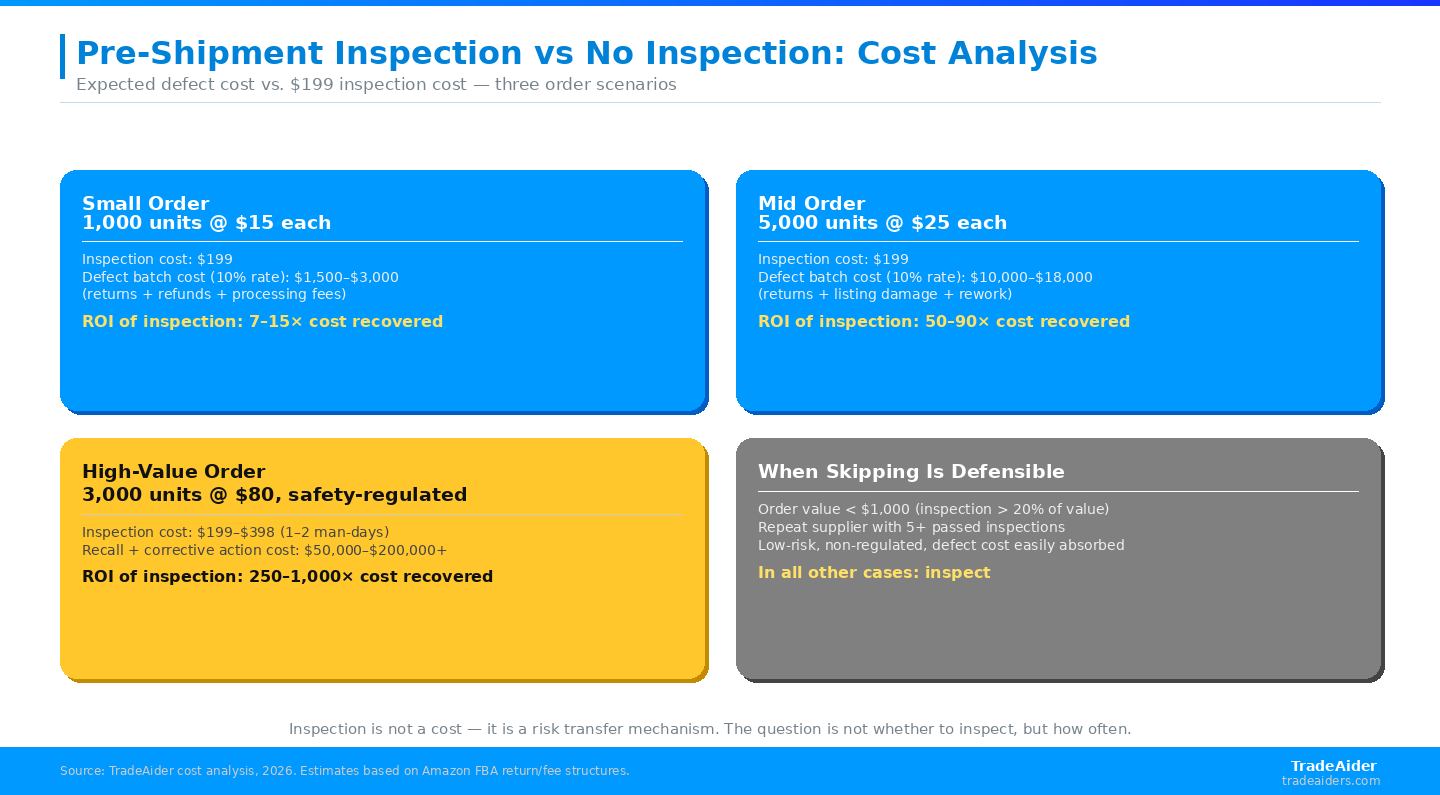
Inspection ROI framework: expected defect cost vs. inspection cost across order value and defect probability. Source: TradeAider analysis, 2026.
Expected defect cost = Order value × Estimated defect rate × Cost per defective unit ratio
For a first-time supplier with unknown quality history, a conservative defect rate estimate is 8–15%. For a supplier with 3 passed inspections, 2–5% is more appropriate. Cost per defective unit ratio (returns + fees + rework ÷ unit value) typically runs 60–120% for Amazon consumer goods.
If expected defect cost > inspection cost, inspect. In practice, this threshold is crossed for the vast majority of orders above $3,000 from suppliers with less than five passed inspections. Use TradeAider's inspection cost calculator to model your specific order before booking.
Who Is TradeAider?
TradeAider is a quality inspection, testing, and certification service provider under the ShiningHub Group, headquartered in China. Founded in 2010 by Justin Chen — an industry veteran with over 30 years of experience in global trade, manufacturing, and quality control — TradeAider operates across all of China, covering major manufacturing provinces including Guangdong, Zhejiang, Jiangsu, and Fujian.
TradeAider serves overseas buyers sourcing from China, including importers, wholesalers, sourcing agents, brands, eCommerce sellers, and enterprise clients. Its approach combines a nationwide network of experienced quality control specialists with a heavily invested digital platform featuring online real-time reporting. Clients can monitor inspections live, communicate directly with inspectors, and address issues during production rather than after shipment — a proactive model focused on problem-solving and prevention, not just defect identification.
Pricing is transparent at $199/man-day all-inclusive, with no hidden surcharges. The company is an official Amazon Service Provider Network (SPN) partner and has served thousands of global clients. Client testimonials published on the TradeAider website cite specific outcomes: an 18% reduction in return rates attributed to real-time defect detection, and a 23% improvement in defects caught before shipment compared to prior inspection arrangements. These are client-reported figures.
Frequently Asked Questions
How much does skipping a pre-shipment inspection actually cost on average?
There is no universal average because defect rates and consequence costs vary by product and supplier. However, a useful benchmark: for a $20,000 order with a 10% defect rate, post-arrival defect management (returns, refunds, platform fees, disposal) typically costs $3,000–$10,000 — compared to $199–$320 for a PSI. The CPSC logged 308 voluntary recalls covering 97 million units in FY2023, with recall execution costs running from tens of thousands to millions of dollars for importers depending on scope. For safety-regulated products, the inspection-vs-recall cost ratio is often 1:500 or higher.
Is pre-shipment inspection required by law for US importers?
Pre-shipment inspection is not legally mandated for most product categories in the US. However, CPSC regulations require importers of covered consumer products to certify compliance with applicable safety standards — and in practice, PSI is the standard method used to document that compliance. For children's products under CPSIA, third-party testing and certification are mandatory. The CPSC oversees approximately 15,000 product categories, and importer responsibility for product safety does not end at customs clearance. Inspection creates the documentation trail that demonstrates due diligence if a product safety issue arises.
Does inspection guarantee zero defects in my shipment?
No. Pre-shipment inspection under AQL sampling does not guarantee zero defects — it provides statistical confidence that the overall defect rate is within your specified limit. Under ISO 2859-1, lots at AQL 2.5 have approximately 95% probability of acceptance, meaning the accepted lot may still contain up to 2.5% defective units. What PSI does guarantee is that a batch significantly worse than your AQL threshold will be identified and rejected before shipment. For near-zero-defect requirements on specific functions, supplement PSI with targeted 100% functional testing on the critical component. TradeAider's inspection standards documentation explains how to specify supplemental tests for your product category.
What is the cost of a pre-shipment inspection from China in 2026?
A standard pre-shipment inspection from China costs $199–$320 per man-day depending on the provider and whether the rate is all-inclusive. According to market pricing data, PSI rates across the industry range from $230–$280/man-day for standard providers, with TradeAider's transparent rate at $199/man-day with no hidden fees. Most single-product consumer goods orders can be completed in one man-day. TradeAider's inspection cost calculator gives an instant estimate based on your order size and product type.
Ready to run the numbers on your next shipment? Contact TradeAider for a same-day quote at $199/man-day all-inclusive — or use our free inspection cost calculator to estimate ROI before you book.
Related Articles
Grow your business with TradeAider Service
Click the button below to directly enter the TradeAider Service System. The simple steps from booking and payment to receiving reports are easy to operate.

