
Amazon product compliance mistakes become suspension risk when sellers list or ship products before they can prove the product is allowed, correctly labeled, properly tested, honestly described, and traceable to compliant supplier evidence. The most dangerous mistakes are not only legal mistakes; they are evidence mistakes that make the seller unable to answer Amazon's documentation request quickly and consistently.
Amazon sellers often think compliance is something to handle after a product sells. That is backward. Compliance evidence should be ready before listing, manufacturing, labeling, and FBA shipment. A seller may believe the supplier has handled compliance, but Amazon asks the seller to provide documents, labels, certificates, test reports, invoices, safety files, or other evidence when risk appears.
A product can be commercially attractive and still be operationally dangerous if compliance is unclear. The seller may face suppressed listings, stranded inventory, blocked ASINs, delayed launches, customer safety complaints, refund spikes, or account health damage. The cost is not only one product; a compliance failure can affect cash flow, supplier negotiation, and future category approvals.
- Mistake 1: listing before confirming whether the product is restricted, regulated, or category-gated.
- Mistake 2: relying on supplier claims instead of valid test reports and certificates.
- Mistake 3: shipping labels, warnings, instructions, or packaging that do not match the destination market.
- Mistake 4: letting product changes, material changes, or supplier changes break the compliance file.
- Mistake 5: treating inspection as a substitute for lab testing or legal compliance review.
The Direct Answer
The top Amazon compliance mistakes are evidence gaps: wrong category assumptions, weak supplier documents, bad labels, uncontrolled changes, and confusing inspection with testing.
Amazon announced that product and food safety compliance tasks moved into Account Health as of May 29, 2025, with Manage Your Compliance pages becoming view-only for certain tasks. That change reinforces the need to monitor compliance requests inside the seller account. Source: Amazon Account Health compliance update.
Amazon public restricted-products guidance reminds sellers that customers trust Amazon for safe and compliant products and that sellers are responsible for compliance with laws, regulations, and Amazon policies. Source: Amazon restricted products guidance.
The operational lesson is simple: do not wait for Amazon to ask. Build a product compliance file before the first shipment. That file should connect the product, supplier, batch, labels, test reports, certificates, user instructions, warning text, invoices, and marketplace claims. If Amazon asks for evidence, the seller should not be reconstructing it from old supplier chats.
The Five Mistakes Compared
Most compliance failures start before the product reaches FBA.
| Mistake | How It Shows Up | Why Amazon Reacts | Prevention Control |
|---|---|---|---|
| Wrong category assumption | Seller lists a restricted or regulated product as ordinary goods | Amazon cannot verify eligibility or safety | Check restrictions and compliance before listing |
| Weak supplier documents | Supplier sends old, mismatched, or incomplete reports | Evidence does not prove the exact product | Match reports to model, material, supplier, and date |
| Bad labels or warnings | Packaging misses age mark, warning, importer info, rating, or language | Customer safety and destination rules are unclear | Approve label artwork before production |
| Uncontrolled product changes | Material, factory, battery, coating, or packaging changes after testing | Old evidence may no longer apply | Retest or update compliance file after change |
| Inspection replaces testing | PSI checks workmanship but no lab test exists | Visual checks cannot prove chemical, electrical, or safety standards | Use lab testing plus on-site inspection when needed |
The common thread is traceability. Amazon does not only need a document; it needs a document that clearly belongs to the product being sold. A test report for a similar product, a certificate from a different factory, a label from another market, or a report with missing model numbers can fail the evidence test.
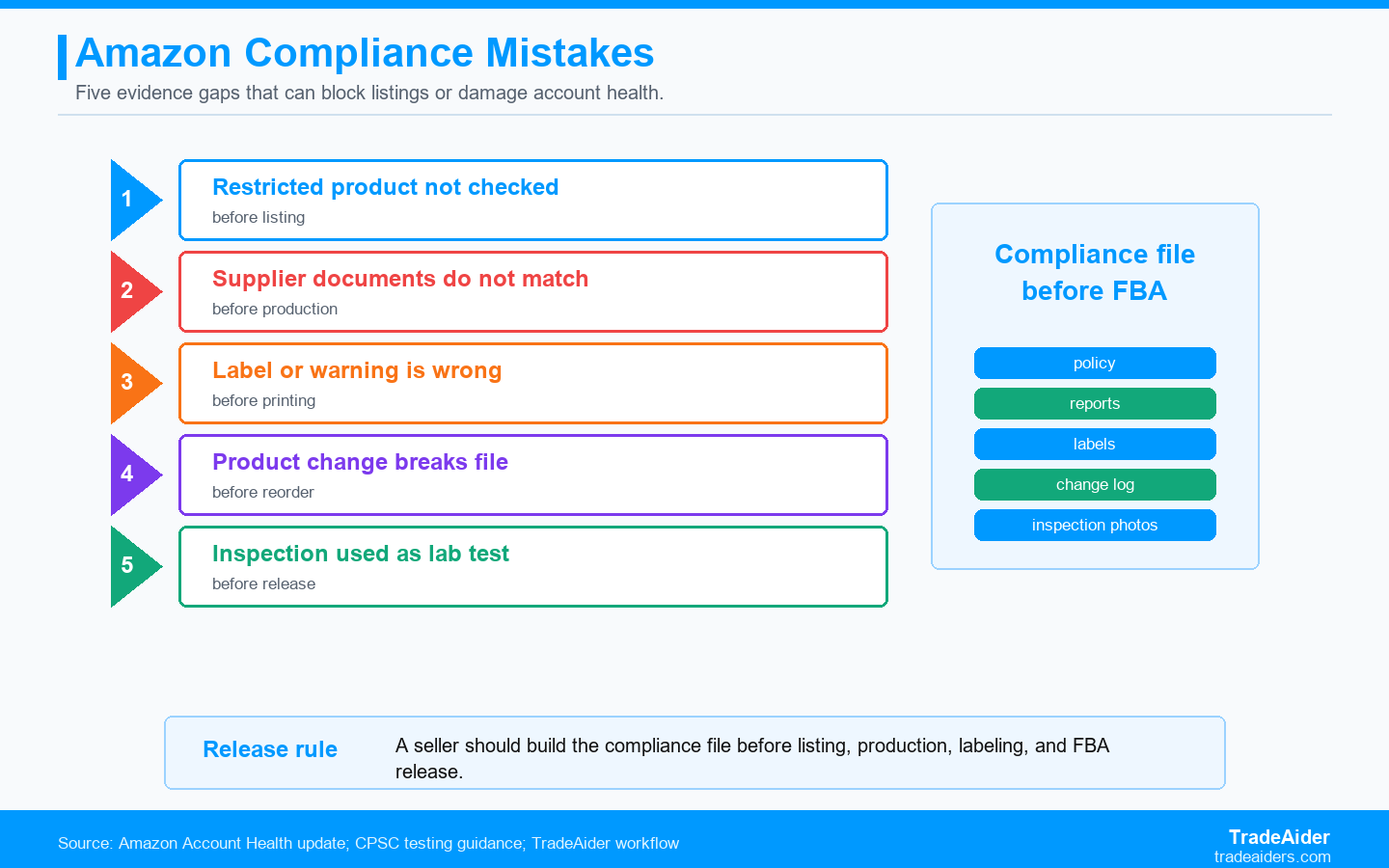
A seller should build the compliance file before listing, production, labeling, and FBA release.
Mistake 1: Listing Before Checking Restrictions
Amazon compliance risk begins at product selection, not after inventory arrives.
Some products look simple but sit inside restricted, safety-sensitive, age-sensitive, chemical, electrical, food-contact, children's, battery, medical-adjacent, cosmetic, pesticide, or claims-sensitive territory. A seller may think the supplier has sold similar products before, but that does not prove the product is allowed under the seller's marketplace, category, claims, or destination law.
Before listing, the seller should check Amazon policy, category requirements, destination regulations, and claim language. The seller should also decide whether the product needs third-party lab testing, certification, warning labels, age grading, tracking labels, technical files, invoices, or product safety documentation.
The risky pattern is buying inventory first and asking compliance questions later. When inventory already exists, the seller has less leverage over the supplier and may discover that labels, packaging, or test evidence must be redone.
Mistake 2: Accepting Supplier Documents Without Matching Them
A document is only useful if it belongs to the exact product, supplier, and market.
Suppliers may share test reports, certificates, declarations, or compliance summaries that appear helpful. The seller should still match model number, product name, material, factory, applicant, standard, test date, report scope, photos, and destination market. A report for a related product may not cover the seller's version.
A common issue is private-label customization. The seller changes packaging, accessories, materials, colors, batteries, charger, coating, or intended use, but keeps the supplier's old compliance file. If the change affects risk, the old report may not support the new listing.
The seller should maintain a compliance register by ASIN, SKU, supplier, factory, version, market, report number, and expiration or review date. This turns compliance from a messy folder into a controlled release file.
Mistake 3: Treating Labels As Decoration
Labels, warnings, instructions, and packaging text are compliance evidence.
Amazon customers see the package before they see the seller's internal file. Labels may need to show warnings, age statements, country of origin, importer information, tracking labels, electrical ratings, FCC or CE marks, recycling symbols, language requirements, batch codes, or other market-specific information. The exact requirements depend on the product and market.
Label errors often happen because production starts from old artwork. A factory may use last year's packaging, a different market version, or a generic carton mark. The seller should approve artwork before printing and require inspection photos of the actual produced labels, not only PDF files.
For FBA, the seller also needs operational label control: barcode, FNSKU or manufacturer barcode logic, suffocation warnings where relevant, set labels, carton marks, and prep requirements. Marketplace logistics and product compliance meet on the same package.
Mistake 4: Letting Changes Break The Compliance File
A compliant first batch does not automatically make later batches compliant.
Suppliers change materials, components, molds, coating, battery cells, packaging vendors, labels, subcontractors, or assembly processes. Sometimes the change is intentional and sometimes it happens quietly under cost pressure. The seller should treat material and design changes as compliance events, not only quality events.
A change-control process should require the supplier to notify the buyer before changing critical materials, components, factory, labels, or manufacturing process. The buyer should decide whether new testing, updated documents, or stronger inspection is needed before release.
Inspection can help detect visible changes, but it cannot catch every chemical, electrical, or performance compliance issue. That is why change control should connect supplier communication, lab testing, and on-site inspection.
Mistake 5: Confusing Inspection With Lab Testing
Inspection and lab testing answer different questions.
A pre-shipment inspection can verify quantity, workmanship, packaging, labeling, carton marks, barcode, visible defects, dimensions, simple function, and order match. It cannot prove chemical migration, flammability, electrical safety, radio compliance, restricted substances, food-contact suitability, or many product-specific standards unless paired with appropriate testing.
CPSC explains testing and certification obligations for consumer products, including that children's products subject to children's product safety rules generally require testing by a CPSC-accepted laboratory. Source: CPSC testing and certification.
Amazon sellers should decide early whether the product needs lab testing, inspection, or both. For regulated products, the answer is often both: test the product to prove compliance, then inspect the shipment to prove the produced lot matches the tested and approved version.
Where TradeAider Fits In Amazon Compliance Control
TradeAider fits by checking whether the physical shipment matches the compliance file.
TradeAider's Amazon FBA Inspection Solutions can verify labels, warnings, packaging, barcode, carton marks, accessories, product version, model number, and visible construction against the seller's approved compliance file before release.
When the seller needs process control before packing, During Production Inspection can check whether the factory is using approved materials, labels, components, and packing controls before the whole lot is finished. For new suppliers, factory audit service can check whether the supplier has basic document and change-control discipline.
The business fit is evidence alignment. TradeAider does not replace legal counsel or a lab, but it helps sellers prove that the real goods being shipped match the approved files that Amazon may later ask to see.
SPAR Scenario: The Seller Had A Report, But Not For This Product
The problem was not absence of paper; it was mismatch between paper and inventory.
Situation: An Amazon seller launches a private-label household device with a supplier-provided test report, new packaging, and a modified accessory kit.
Problem: Amazon requests compliance documents after listing. The report names a different model and the product photos do not match the current packaging. The warning label on the produced units also differs from the approved file.
Action: The seller updates the compliance file, asks the lab whether retesting is needed, and uses TradeAider to verify model, label, accessory, warning, and carton evidence before the next shipment.
Result: The seller stops treating supplier documents as a one-time attachment and builds a controlled release file for each product version.
Action Card: Build A Pre-Listing Compliance File
The safest Amazon compliance workflow starts before production.
- Check whether the product is restricted, regulated, claims-sensitive, or category-gated.
- Match every report and certificate to the exact model, material, supplier, factory, and market.
- Approve label, warning, instruction, and packaging artwork before printing.
- Create change-control rules for materials, components, labels, factory, and claims.
- Use lab testing for standards evidence and on-site inspection for shipment evidence.
A seller should also keep compliance evidence searchable. When Amazon asks for documents, response time matters. The seller should not be hunting through supplier messages, old folders, and unrelated reports. Each ASIN should have a clean evidence package.
The package should include supplier details, invoice or purchase evidence, product specification, approved sample photos, label files, test reports, certificates or declarations where applicable, inspection reports, batch or lot identifiers, and any Amazon request history. The goal is to make the product explainable.
Amazon compliance risk is easier to control before the product is manufactured. After labels are printed and goods are packed, every correction becomes slower, more expensive, and more emotional.
If your Amazon product needs a cleaner compliance release workflow, send TradeAider the ASIN plan, supplier files, label artwork, test reports, and shipment timeline. The next step is to ask TradeAider to check the shipment against your compliance file before release.
Frequently Asked Questions
Can Amazon suspend a listing for missing compliance documents?
Amazon can suppress or restrict listings and request documents when product safety, restricted-product, or compliance concerns arise. Sellers should monitor Account Health and prepare evidence before listing.
Is a supplier certificate enough?
Only if it matches the exact product, factory, model, standard, market, and version. Many compliance failures come from mismatched or outdated supplier documents.
Does inspection replace lab testing?
No. Inspection verifies the physical shipment; lab testing verifies standards that cannot be proven by visual inspection alone.
What should Amazon sellers check before production?
Restrictions, claims, applicable standards, lab-test needs, label artwork, warning text, product version, supplier documents, and change-control rules.
Related Articles

Grow your business with TradeAider Service
Click the button below to directly enter the TradeAider Service System. The simple steps from booking and payment to receiving reports are easy to operate.

