
- About Us

- Our Services
- Your Industry
- Resources
- News & Blog
Product recall cost is the combined cost of identifying affected goods, stopping sale, notifying the chain, remedying customers, handling logistics, protecting the brand, and proving corrective action.
Inspection cost is visible before shipment. Recall cost is often invisible until the buyer has no cheap options left. A pre-shipment inspection, lab test review, or focused reinspection may cost a few hundred dollars, while a recall can involve stop-sale action, reverse logistics, refunds, replacement goods, retailer communication, legal review, customer support, and long-term review damage.
The point is not that inspection prevents every recall. It does not. The point is that many recall triggers begin as preventable release failures: missing warning labels, wrong components, failed safety checks, incorrect age grading, mixed lots, wrong certification evidence, or known defects that were not contained before export. The math becomes obvious once the buyer compares inspection cost with the first credible layer of recall exposure.
Key Takeaways
- Cost comparison: Inspection is a known upfront cost; recall is a multi-layer cost that often expands after goods enter the market.
- Risk trigger: Safety, labeling, electrical, toy, food-contact, textile, and children's products deserve stronger release evidence.
- Regulatory reality: CPSC guidance shows recall work includes reporting, stop-sale, identification, notification, remedies, and follow-up.
- Inspection role: AQL inspection, testing coordination, and lot identity checks reduce preventable recall exposure before shipment.
- Decision: The buyer should compare inspection cost with the first avoided failure scenario, not only with the product's factory price.
Recall Cost Starts Before The Public Announcement
Recall cost starts when a buyer has to investigate whether distributed goods are unsafe, noncompliant, mislabeled, or materially defective. The public recall notice may be the visible event, but the cost begins earlier with complaint review, lot tracing, legal analysis, distribution mapping, inventory isolation, and decision meetings.
Reporting and evaluation can become urgent
For US consumer products, CPSC Duty To Report Questions states that companies must report to the Commission within 24 hours of obtaining reportable information, while 16 CFR Part 1115 explains that firms should not delay reporting to determine certainty when information reasonably supports a reportable issue. Importers should get legal advice for specific obligations, but the operational lesson is clear: late discovery is expensive discovery.
A shipment release file that includes inspection evidence, testing status, product identity, carton range, and corrective action history gives the buyer a stronger starting point if a potential defect appears. Without that evidence, the buyer may lose time reconstructing what shipped, where it went, and whether the issue affects one carton range or the whole order.
Stop-sale and inventory isolation create immediate cost
The CPSC Recall Checklist includes practical steps such as stopping production, identifying affected UPCs, date codes, and model numbers, isolating inventory, notifying the distribution chain, and determining remedies. These actions may be necessary, but they are rarely cheap. They pull staff away from normal operations and can freeze sellable inventory while the company investigates.
The cost rises when lot identity is weak. If the buyer cannot determine which cartons, production dates, models, or shipment batches are affected, the response area expands. What might have been a limited hold becomes a broad stop-sale because the evidence cannot safely narrow the scope.
Customer remedy and brand damage are the slow costs
CPSC recall guidance compiles recall materials and obligations for businesses conducting recalls. In commercial terms, the remedy cost can include refund, repair, replacement, customer communication, retailer portals, logistics, disposal, and follow-up reporting. The slower cost is trust: poor reviews, retailer scrutiny, marketplace account warnings, and higher internal approval requirements for future launches.
The Recall Cost vs Inspection Cost Model
The Recall Cost vs Inspection Cost Model compares one known prevention cost with several plausible failure layers. It does not require a buyer to predict a full recall with certainty. It only requires the buyer to estimate whether a reasonable inspection or testing step could prevent the first expensive failure scenario.
| Cost Layer | Recall-Side Exposure | Inspection-Side Control | Release Question |
|---|---|---|---|
| Identification | Find affected UPCs, date codes, models, cartons, and destinations | Check labels, carton marks, lot identity, packing list, and shipment range | Can we identify exactly what is being released? |
| Containment | Stop sale, isolate stock, contact logistics partners and retailers | Hold shipment before export when critical or major defects appear | Can the issue be contained at factory before distribution? |
| Remedy | Refund, repair, replace, relabel, or dispose of affected goods | Find defect pattern before goods reach customers | Is rework still cheaper in China than after arrival? |
| Compliance evidence | Prove testing, warning label, age grade, and standard alignment | Review test reports, labels, instructions, and destination requirements | Does the release file match the destination market? |
| Brand and channel cost | Reviews, retailer restrictions, account warnings, repeated audits | Document release evidence and corrective action before shipment | Will this shipment survive customer and channel scrutiny? |
For physical goods, ISO 2859-1:2026 supports sampling procedures indexed by acceptance quality limit for lot-by-lot inspection. That does not make inspection a guarantee, but it gives buyers a structured way to inspect samples, classify defects, and make a release decision. ISO/IEC 17020:2026 adds the broader expectation that inspection activity should be competent, impartial, and consistent.
A simple expected-cost model can start like this: inspection cost is fixed; preventable recall exposure equals the probability of a release failure multiplied by the credible cost of identification, containment, remedy, and channel damage. If the expected preventable exposure is greater than inspection cost, inspection is financially justified even before considering peace of mind.
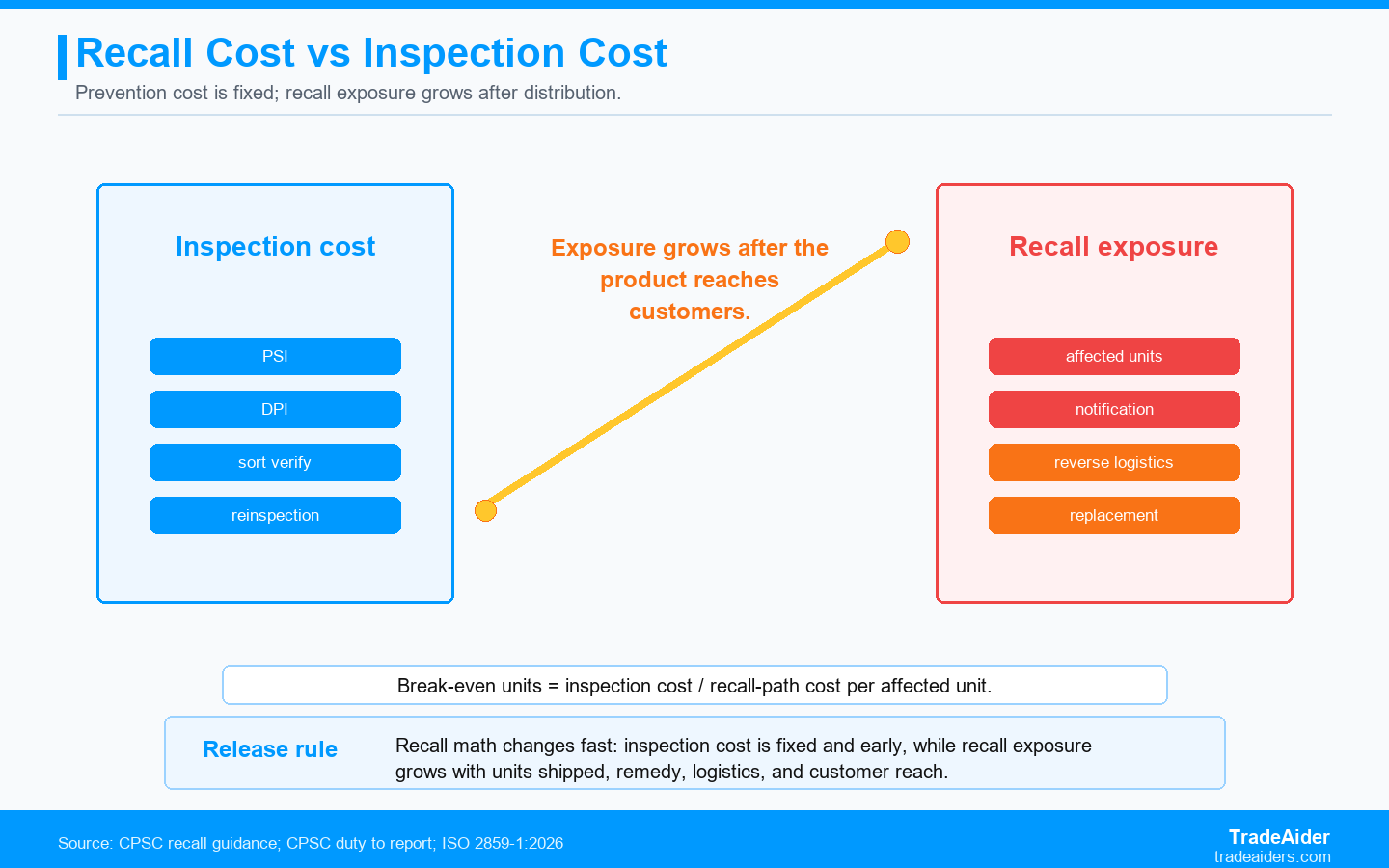
Inspection cost is a known prevention cost; recall cost expands through identification, containment, remedy, channel impact, and corrective action.
The cheapest recall is the one narrowed to a factory hold before the goods leave the origin country.
When Inspection Cost Is A Small Risk Premium
Inspection cost becomes a small risk premium when the product has safety, compliance, label, or channel exposure that is larger than the inspection fee. The buyer does not need to believe a recall is likely. The buyer only needs to recognize that the cost of missing one preventable release failure may be far higher than the cost of checking.
Safety-sensitive categories need stronger evidence
Children's products, toys, electrical goods, batteries, smart devices, cookware, food-contact items, textiles with chemical requirements, and products with warnings or instructions deserve stronger release evidence. In these categories, a visible defect, missing label, failed functional check, or mismatched report can become more than a return problem. It can become a compliance and safety problem.
The inspection scope should match the risk. A toy order may need age labeling, warning statement, small parts review, packaging checks, and test report alignment. A smart device may need rating label, function check, charging accessory, manual, and regulatory marking review. A cookware item may need food-contact evidence, surface workmanship, and label consistency.
Lot identity can reduce the size of a response
Lot identity is one of the most underrated recall-cost controls. If the buyer can tie defects to a production date, carton range, component batch, or shipment lot, the response may be narrower. If records are weak, the buyer may have to treat a larger population as potentially affected. Inspection can help by checking carton marks, labels, production codes, quantities, and packing list consistency.
This is why recall math should include traceability quality. Two shipments with the same defect can have very different cost profiles if one has clear carton range evidence and the other has mixed SKUs, missing production codes, and inconsistent packing records. Inspection evidence cannot solve every downstream issue, but it can make the affected population easier to define.
Document review can be enough for lower-risk repeats
Not every order needs the same level of inspection. For a stable low-risk repeat product, the buyer may use document review, reduced inspection frequency, or targeted checks. But that reduction should come from evidence: clean complaint history, consistent prior reports, unchanged product design, unchanged supplier process, and no new destination-market requirement.
How TradeAider Reduces Recall Exposure Before Shipment
TradeAider provides inspection and quality assurance services covering the whole procurement and production process before shipment to help buyers lower the risk of product recalls.
Use PSI to stop release failures at the factory
A Pre-Shipment Inspection can check workmanship, function, quantity, carton marks, labels, accessories, packing, and defect classification when production is complete and goods are mostly packed. For recall-risk categories, the inspection scope should explicitly include destination-market labels and known safety-critical checks.
Use DPI when defects can multiply during production
A During Production Inspection is useful when the buyer needs to catch process drift before the full order is finished. If the same incorrect component, label, or assembly error repeats through production, early discovery can reduce the affected quantity and preserve rework time.
Use testing coordination when inspection cannot prove compliance
Visual inspection cannot replace lab testing or certification evidence. When chemical, electrical, toy, food-contact, textile, or other compliance requirements apply, TradeAider can help coordinate product testing services and connect the report to the inspected lot. Buyers can share the PO, product file, destination market, and testing status to build a release plan before shipment.
SPAR Scenario: The $199 Check That Changed The Recall Math
Situation: An importer prepared to ship a batch of LED desk lamps to the US. The supplier provided a previous test report, and the buyer assumed the order was low risk because the product had shipped before.
Problem: The new batch used a different adapter supplier and updated retail packaging. If the rating label, manual, and adapter evidence did not match the shipment, the buyer could face returns, retailer holds, or a compliance review after goods arrived.
Action: A pre-shipment inspection checked function, adapter label, rating information, packing, carton marks, and document consistency. The inspector found that part of the order used outdated manuals and carton labels from the prior model. The buyer held the affected carton range for correction.
Result: The inspection did not prove every regulatory requirement. It prevented a mismatch from entering distribution and narrowed the issue to a defined carton range. The buyer's recall math changed because the preventable exposure was contained before export.
Who Is TradeAider?
TradeAider is a quality inspection, testing, and certification service provider in China. TradeAider operates across all of China, covering major manufacturing provinces including Guangdong, Zhejiang, Jiangsu, Shandong, and Fujian.
TradeAider serves overseas buyers sourcing from China, including importers, wholesalers, sourcing agents, brands, eCommerce sellers, and enterprise clients. Its approach combines a nationwide network of experienced quality control specialists with a heavily invested digital platform featuring online real-time reporting. Clients can monitor inspections live, communicate directly with inspectors, and address issues during production rather than after shipment - a proactive model focused on problem-solving and prevention, not just defect identification.
Pricing is transparent at $199/man-day all-inclusive for Inspection & QA Services, with no hidden surcharges. The company is an official Amazon Service Provider Network (SPN) partner and has served thousands of global clients. Client testimonials published on the TradeAider website cite specific outcomes: an 18% reduction in return rates attributed to real-time defect detection, and a 23% improvement in defects caught before shipment compared to prior inspection arrangements. These are client-reported figures.
Frequently Asked Questions
How much can a product recall cost?
A product recall can cost far more than the factory value of the goods because it includes identification, stop-sale, logistics, remedies, customer communication, legal review, retailer handling, and brand damage. The exact cost depends on product risk, distribution size, and remedy type.
Can inspection prevent a product recall?
Inspection cannot guarantee that a recall will never happen, but it can reduce preventable recall exposure. It is most useful for finding visible defects, label issues, lot identity problems, packing errors, and shipment evidence gaps before goods leave the factory.
Which products need stronger inspection before shipment?
Products with safety, labeling, regulatory, electrical, chemical, toy, food-contact, textile, child-use, or marketplace account risk need stronger inspection before shipment. These categories usually require a combination of inspection evidence and testing or certification review.
Is inspection cheaper than recall insurance?
Inspection and recall insurance solve different problems. Inspection is a prevention and release-evidence tool before shipment, while insurance may help with covered losses after an incident. Buyers should not use insurance as a substitute for product evidence.
Related Articles
Grow your business with TradeAider Service
Click the button below to directly enter the TradeAider Service System. The simple steps from booking and payment to receiving reports are easy to operate.

