
- About Us

- Our Services
- Your Industry
- Resources
- News & Blog
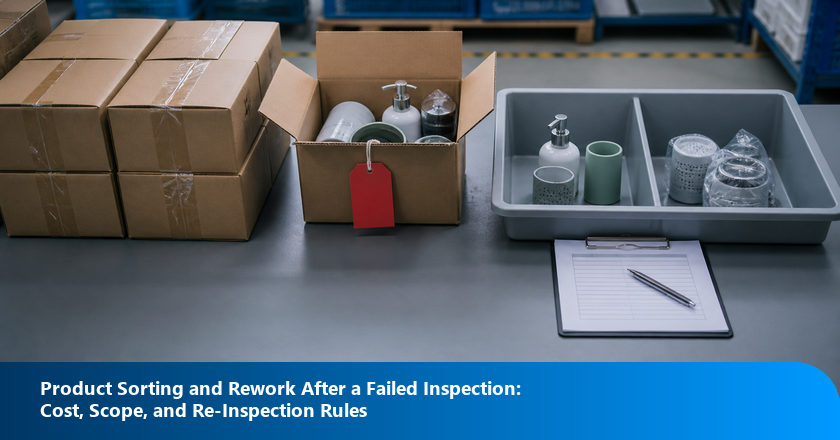
A failed inspection should trigger a recovery decision before it triggers a supplier argument. The immediate task is to hold the right population, define the sorting scope, record what will be reworked, and decide what a re-inspection must prove. A buyer who skips those four decisions can pay for a broad sort yet still have no defensible basis for release.
That distinction matters because the failed result is evidence from a stated sample and rule, not a census of every unit. The practical aim is neither to assume the whole lot is defective nor to accept a verbal promise that everything is fixed. It is to turn the failed inspection into a controlled path from containment to verified disposition.
A Failed Inspection Needs a Controlled Recovery Decision
A failed sample is a disposition signal, not a map of every defective unit in the order. NIST explains that acceptance sampling is used to make a lot decision rather than estimate the quality of the whole lot. A failed result therefore justifies a hold and a recovery plan; it does not, by itself, reveal how far the defect travels through cartons, SKUs, dates, or production stations.
A recovery plan needs a stated containment scope, responsibility, and data-collection path before correction can be verified. That is the operational difference between reacting to a report and controlling a nonconformity. A supplier may begin checking units quickly, but the buyer still needs one agreed answer to three questions: what is held, who owns the correction record, and what proof will decide whether the held goods can move.
A failed inspection needs a controlled recovery decision before any shipment release, because a sample verdict does not map every affected unit. The decision can be compact, but it should be explicit enough to survive a handoff between the buyer, factory, inspector, and freight team.
- Scope: Start with the defect mechanism and the lot map, not the supplier's preferred repair count.
- Proof: Treat a completed rework claim as an input to verification, not as a release certificate.
- Cost: Price the population to check, correct, repack, document, and verify—not only the labor to touch a unit.
- Release: Use re-inspection to answer a new question about the corrected population.
A Failed Sample Signals a Lot Decision, Not a Defect Count
Product sorting is the controlled act of checking a defined population and separating conforming from nonconforming units. The definition matters because a sort has to begin with a population: a carton range, SKU, color, supplier batch, assembly-station output, packing shift, or the full lot. If the population cannot be named, the supplier is not yet sorting; it is searching.
Use the failed report as the first evidence record. Identify the defect class, its observed location, the sample context, the related reference requirement, and any pattern in the photos or measurements. Then ask whether the finding is likely tied to a specific input or whether it may have crossed the order. A wrong accessory packet can be bounded by packing records; a function failure with no serial, date, or station traceability may not be bounded at all.
A buyer who needs a fuller report-to-action sequence should start by identifying the report rule, the observed defect pattern, and the lot records available for follow-up. The useful point here is narrower: do not convert an AQL failure into a recovery scope until the lot structure and the defect mechanism are documented.
There are two different decisions. The inspection verdict decides that the original release condition was not met. The recovery-scope decision decides how much product, packaging, or documentation must be contained before a new release condition can be tested. Keeping those decisions separate prevents both overreaction and wishful release.
Use the Scope-and-Proof Recovery Framework Before Ordering Any Rework
The recovery scope should expand only as far as the defect mechanism and traceability evidence require. Use the buyer-side Scope-and-Proof Recovery Framework to contain the population, define the correction, collect proof, and then verify the corrected scope. The commercial release authority remains with the buyer's agreed requirements and contract terms.
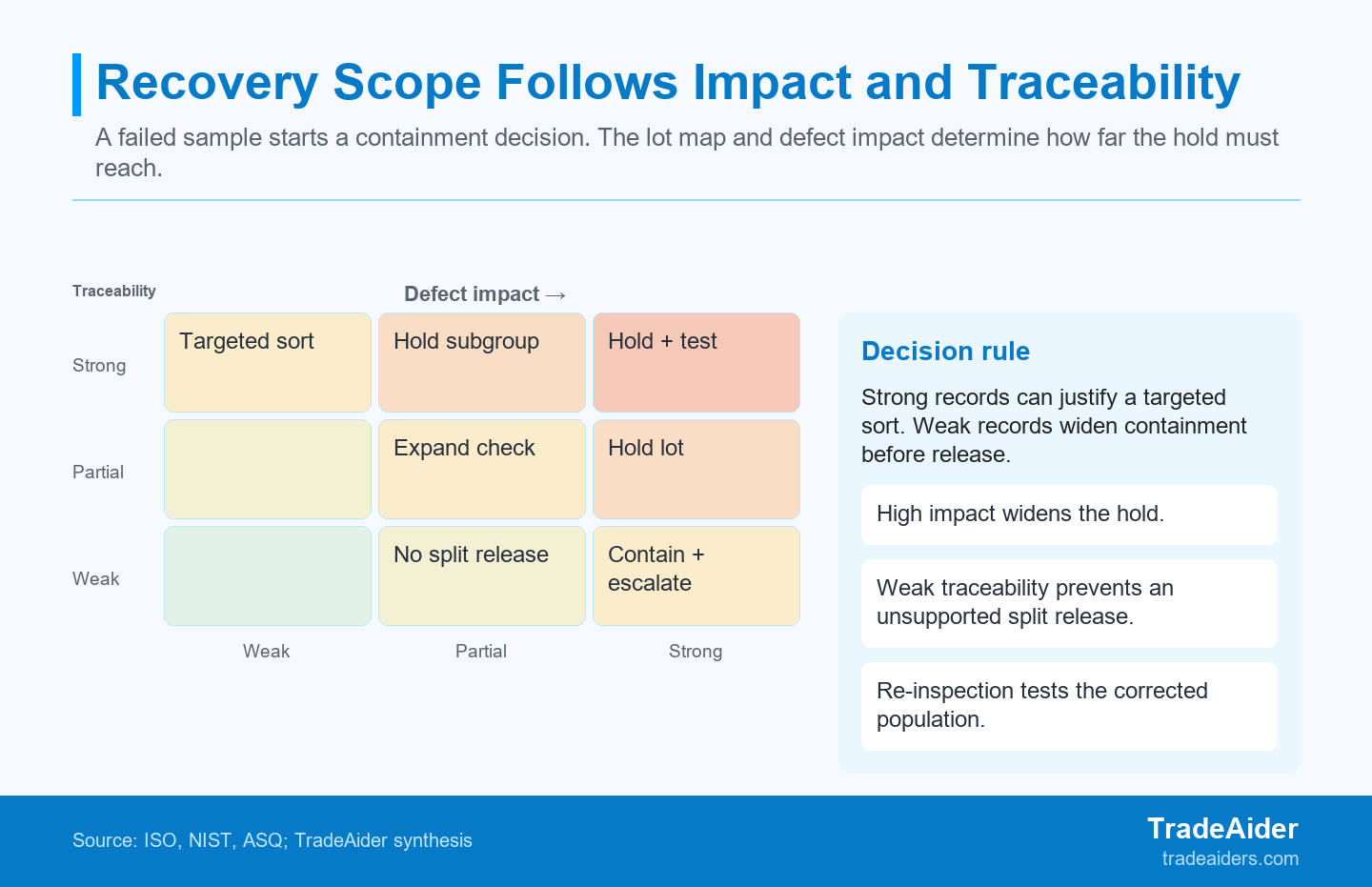
Recovery scope should expand when impact is high or the affected population cannot be traced. Sorting and rework need a bounded population plus proof of correction.
The framework avoids a common false choice between “sort everything” and “trust the factory.” A targeted sort can be sensible when records prove where the exposure begins and ends. A wider hold is more sensible when the same component, label, setting, or work method may have reached an untraceable population. Impact matters as well. A safety-related, regulatory, functional, or identity defect deserves more caution than an isolated cosmetic defect, even when a carton map exists.
A recovery instruction should state the original requirement, defect examples, contained population, sorting method, rework method, evidence owner, completion deadline, and re-inspection trigger. NIST's process-planning guidance similarly emphasizes a defined objective, process model, sampling approach, responsibility, and data collection. The buyer can adapt those planning elements to the recovery record without implying that a generic standard dictates the commercial remedy.
The Scope-and-Proof Recovery Framework has one practical rule: a supplier assurance cannot narrow an unknown scope. When the evidence is weak, containment expands first. When the evidence is strong, the buyer can inspect a defined subgroup, examine correction evidence, and make a limited decision without pretending that the rest of the lot has been proven conforming.
Step 1: Set the Sorting Population From the Defect Mechanism
Sorting is credible only when the affected population can be identified, segregated, and checked with a defined disposition rule. ISO/IAF audit guidance on nonconforming outputs discusses identification, segregation, replacement, and feedback to corrective action; that guidance supports the control principle, while the exact commercial scope remains the buyer's decision.
Start with a simple exposure map. For each finding, write the suspected input, the earliest affected point, the latest affected point, and the record that proves the boundary. A dye-lot issue may follow color and fabric records. A missing accessory may follow packing-line records. A wrong barcode can follow artwork version and carton range. If the records are incomplete, the gap is not a minor paperwork problem; it is a reason to widen the hold.
Full sorting is one possible rectification path, not an automatic punishment. NIST describes full inspection and replacement of defectives as a common rectifying approach in an appropriate non-destructive acceptance-sampling context. That does not mean every failed consumer-goods lot must receive the same treatment. It means the buyer should name the procedure, population, and replacement rule before calling the work complete.
Step 2: Treat Rework as a New Conformity Check
A rework record should link a nonconforming outcome to the corrective action and the subsequent verification decision. A repair may be simple—replace an accessory, restitch a seam, relabel a carton, repack a mixed SKU, or tighten an assembly step—but the release question remains the same: did the corrected unit now meet the current approved requirement?
Write the rework instruction against the version that governed the failed inspection. Include the drawing, approved sample, label artwork, packing reference, functional method, or photo standard that applies. Then require counts for units checked, units corrected, units rejected, units replaced, cartons relabeled, and exceptions that could not be corrected. ISO/IAF guidance highlights the need to connect nonconforming outcomes with corrective action; the buyer's record should make that connection inspectable.
Do not ask a visual sort to prove a requirement it cannot observe. A corrected warning label can be visually checked. A hidden material change, electrical behavior, migration requirement, or durability claim may need a test method, sample plan, or document review. In that situation, coordinate product testing when a visual sort cannot prove the requirement rather than using a clean-looking carton as a substitute for evidence.
| Recovery action | Scope trigger | Proof before verification | Release effect |
|---|---|---|---|
| Targeted sorting | Traceable carton, SKU, batch, or station boundary | Sort count, rejects, replacements, and boundary record | Only the defined subgroup can move toward verification |
| Rework | Known correctable failure against an approved reference | Work instruction, version reference, and completion record | No release until the correction is verified |
| Wider hold or remake | Unknown scope, high impact, or unreliable correction | Root-cause evidence and an agreed revised disposition | Commercial release stays blocked pending buyer direction |
Based on the comparison, the recovery action is not chosen by the word “fail.” It is chosen by whether the buyer can bound the exposure, observe the correction, and verify the requirement afterward.
Cost the Recovery Scope Before Negotiating the Fix
The relevant recovery cost includes the scope to be checked and the evidence needed to release it, not only repair labor. A useful buyer worksheet separates sorting labor, rework materials, replacement units, relabeling or repacking, disposal, travel or re-inspection time, shipping delay, and the internal time required to reconcile records. These are decision categories, not market price benchmarks.
Cost becomes clearer once scope is visible. A supplier may quote a low per-unit repair price while omitting the time to open cartons, identify the affected range, rebuild mixed packs, produce count sheets, and present the goods for verification. Conversely, a wider hold may look expensive until the buyer sees the cost of releasing an untraceable defect into retailer receiving, marketplace fulfillment, or a customer-return stream.
Use the recovery event to decide whether the next order needs an earlier control. NIST includes review after meaningful process adjustment among uses of process characterization. If the same component, label, or assembly setting keeps creating late recovery work, place a during-production inspection at the recurring control point rather than making final sorting the permanent operating model.
The buyer should decide cost allocation in the purchase order or quality agreement before a failure occurs. The article cannot determine who must pay in a particular dispute. It can identify the records that make an allocation discussion more concrete: the agreed defect rule, report photos, lot map, recovery instruction, supplier completion record, and re-inspection result.
Re-Inspection Must Answer a Different Question Than the Failed Visit
Re-inspection should test the defined corrected population and the process input connected to the original finding, not simply reproduce the failed sample unchanged. The first visit asked whether the original lot met its release condition. The next visit asks whether the documented correction worked across the population the buyer has agreed to recover.
Write that question before booking the visit. It may include a full check of the held carton ranges, a fresh random sample from corrected assembly output, a recheck of the original defect examples, accessory or label verification, carton identity, count reconciliation, and a check that the supplier did not mix corrected goods with untouched goods. The right mix depends on the product, defect, records, and commercial decision—not on a fixed number of samples.
A defect investigation should also reconnect the observed output to the relevant inputs. NIST describes process models in terms of inputs that influence measurable outputs. In practical recovery work, that means the re-inspection should not only look for the repaired defect; it should examine whether the suspect material, setting, work instruction, or packing control still creates exposure.
When the corrected order is again finished and ready for an independent final check, a buyer can scope a pre-shipment inspection for the corrected finished goods. The service timing and the buyer's release rule still matter. A re-inspection is evidence for a stated decision; it is not a blanket warranty for every unit or every downstream requirement.
Worked Example: A Mixed Carton Lot Needs a Split Recovery Plan
A lot map and a correction record can support a split release when the evidence genuinely separates a corrected subgroup from an unaffected subgroup. This example is illustrative, not a client case or a measured TradeAider result.
Trace the Lot Before You Promise a Partial Release
A partial release requires records that separate the corrected subgroup from the rest of the held lot before verification. A U.S. ecommerce buyer has an illustrative 4,800-unit home-goods order across six carton ranges and three color variants. The order is finished, but shipment release has not been issued.
The failed final inspection finds a loose fastener on one color variant and a screw packet in two sampled cartons that differs from the approved accessory reference. The buyer does not treat the two observed cartons as the whole problem. Instead, it asks the supplier for carton labels, daily packing records, accessory issue records, and the assembly-station history. Those records identify two carton ranges that used the suspect packet and one assembly station connected to the fastener finding.
The buyer holds the two (2) documented carton ranges plus the output from one (1) assembly station. The supplier sorts the held ranges, replaces the wrong packets, tightens the assembly control, and records cartons opened, units rejected, units corrected, replacement packets issued, and supervisor sign-off. The other carton ranges remain held in status, not released by assumption, until the buyer decides whether the records genuinely separate them from the risk.
Result: in this illustrative example, the focused re-inspection checks the recovered carton ranges, a fresh sample from corrected assembly output, accessory packs, carton identity, and the correction records. The result is a decision boundary, not proof that every untouched carton is acceptable: a split release is considered only if that evidence agrees with the approved requirement. If the carton map conflicts with the physical findings, the hold expands. Any safety, regulated-claim, unknown-traceability, or broader process-change issue could instead require testing, remake, or another contractual remedy.
Put the Recovery Rules in the PO and Inspection Brief
A failed-inspection clause works best when it predefines evidence, authority, timing, cost allocation, and the re-inspection trigger. It should say who can place a hold, which defect rules govern the decision, which records define the affected population, which corrective evidence is required, and when the buyer may authorize a new inspection.
Use the following action card before the next order enters final packing:
- Freeze release: name the held lot, cartons, SKUs, or process window.
- Map exposure: link each defect to records that prove its boundary.
- Authorize correction: issue a version-controlled sorting and rework instruction.
- Require proof: collect counts, photos, exceptions, and supervisor sign-off.
- Verify and decide: book the stated re-inspection scope before release.
If the report and supplier records cannot explain how far the failure traveled, do not treat the present lot as an isolated repair task. Consider whether to add a focused factory audit when records cannot explain the failure, especially when the same control gap may repeat on the next run.
Before the supplier begins, send one controlled recovery instruction rather than a stream of chat messages. It should identify the purchase-order line, finished-goods status, approved reference, defect photographs, hold labels, population boundary, correction method, and counting sheet. Ask the supplier to number every exception instead of silently absorbing it into a total. That makes it possible to compare the physical work with the original defect, the carton map, and the verification scope. It also makes a late commercial decision less dependent on memory or a verbal assurance.
Give the supplier a decision deadline as well as a correction deadline. The decision deadline is when the buyer will decide whether the submitted lot map and completion record are enough to book verification. The correction deadline is when the physical work must be finished. Separating the two reduces a familiar problem: a factory says the goods are ready, while the buyer still lacks the version reference, count sheet, photos, or exception list needed to define a visit. If the materials are incomplete, keep the lot on hold rather than converting an administrative gap into a release risk.
For a split release, require a simple reconciliation: opening count, units sorted, units corrected, units rejected or replaced, cartons repacked, and closing count. The totals should agree with the defined population. A mismatch does not automatically prove a product failure, but it does show that the recovery boundary is not ready to verify. The buyer can then request a corrected count, expand the held population, or revise the commercial disposition before a new inspection is scheduled.
For an order-specific recovery plan, ask TradeAider to review the recovery scope before re-inspection.
Who Is TradeAider?
TradeAider is a quality inspection, testing, and certification service provider in China. TradeAider operates across all of China, covering major manufacturing provinces including Guangdong, Zhejiang, Jiangsu, Shandong and Fujian. The company is an official Amazon Service Provider Network (SPN) partner.
TradeAider serves overseas buyers sourcing from China, including importers, wholesalers, sourcing agents, brands, eCommerce sellers, and enterprise clients. Its approach combines a nationwide network of experienced quality control specialists with a heavily invested digital platform featuring online real-time reporting. Clients can monitor inspections live, communicate directly with inspectors, and address issues during production rather than after shipment—a proactive model focused on problem-solving and prevention, not just defect identification.
Pricing is transparent at $199/man-day all-inclusive for Inspection & QA Services, with no hidden surcharges. Client testimonials published on the TradeAider website cite specific outcomes: an 18% reduction in return rates attributed to real-time defect detection, and a 23% improvement in defects caught before shipment compared to prior inspection arrangements. These are client-reported figures.
Frequently Asked Questions
When does a failed inspection require 100% sorting?
A failed inspection requires 100% sorting when the buyer cannot reliably isolate a smaller affected population or when the defect and contract rule make full containment necessary. Full sorting is also reasonable when carton, batch, SKU, or process records do not prove a safe boundary. It should still use written defect examples, a count rule, and a disposition record so the buyer knows what was checked and what happened to rejected units.
Can a supplier rework goods without a new inspection?
A supplier can perform rework before a new inspection, but the buyer should not treat the rework claim as release evidence until the defined correction and verification records are reviewed. Some corrections can be checked with focused documentation and a new factory check; others need a third-party re-inspection or test. The right choice follows the defect impact, the scope of recovery, and the buyer's release rule.
Who normally pays for sorting and re-inspection after failure?
The purchase order or quality agreement should allocate sorting and re-inspection costs before failure, because the report alone does not determine commercial responsibility. A well-written clause can identify the quality standard, evidence required, correction deadline, and cost items that the responsible party must cover. For a live dispute, the buyer should use its actual contract and obtain appropriate commercial or legal advice.
What evidence should a re-inspection report include?
A re-inspection report should identify the corrected population, the original defect rule, the correction evidence, the verification sample or scope, and the resulting release decision. It should also show enough product, carton, label, measurement, or functional detail to connect the corrected goods to the original finding. The reader should be able to see what changed, what was checked, and which goods remain outside the decision.
When should a buyer reject rather than rework a failed lot?
A buyer should consider rejection or remake when the defect cannot be corrected reliably, the affected scope is unknown, or the corrected goods would still miss the agreed requirement. The same conclusion may apply when the schedule, cost, safety risk, compliance exposure, or evidence gap makes a recovery plan commercially unreasonable. The final disposition should follow the contract, product requirements, and the buyer's authority to accept or reject the goods.

Related Articles


Grow your business with TradeAider Service
Click the button below to directly enter the TradeAider Service System. The simple steps from booking and payment to receiving reports are easy to operate.

