
The three core inspection types for China-sourced goods are: Pre-Production Inspection (PPI), which verifies raw materials and factory readiness before manufacturing begins; During Production Inspection (DPI/DUPRO), which checks quality mid-process when 20–50% of the order is complete; and Pre-Shipment Inspection (PSI/FRI), the final quality check conducted after 100% production is finished and at least 80% of goods are packed for shipment.
Most importers only ever book a PSI. That's reasonable for simple, low-risk products from reliable suppliers — but it means catching problems after production is already complete. The right inspection type depends on when your quality risk is highest, how complex your product is, and whether you're working with a new or proven supplier. This article gives you the framework to decide.
Key Takeaways
- Definition: PSI = final check before shipment; DPI = mid-production catch; PPI = pre-production materials and factory readiness verification.
- How it works: PSI triggers when 100% production complete and 80% packed. DPI triggers at 20–50% completion. PPI triggers before production starts.
- Cost comparison: PPI from $220/man-day; DPI from $250/man-day; PSI from $199/man-day (TradeAider all-inclusive). PSI is typically the lowest-cost single inspection.
- Decision: For most overseas buyers, PSI alone suffices. Add DPI for complex products or new suppliers. Add PPI when material substitution risk is high or product is custom-designed.
- Common mistake: Booking only PSI on a complex first-time order — by then, all defects are already baked in and rework costs are at their highest.
What Is PSI (Pre-Shipment Inspection)?
Pre-Shipment Inspection (PSI), also called Final Random Inspection (FRI), is the most widely used quality control method in global sourcing. PSI is conducted after 100% of production is finished and at least 80% of the goods are packed — meaning the inspector sees the product exactly as it will ship. This timing is deliberate: it lets the buyer verify final packaging, labeling, barcodes, quantity, and finished product quality in one visit.
A standard PSI covers:
- Quantity verification against packing list
- AQL sampling of finished goods to ISO 2859-1 standards
- Appearance, workmanship, and dimensions against approved sample
- Packaging integrity, drop test, barcode scan
- Functionality tests appropriate to product category
- Labeling compliance (FCC, CE markings, country-of-origin, safety warnings)
TradeAider's Pre-Shipment Inspection service includes all of the above at $199/man-day all-inclusive, with real-time photo and video reporting during the inspection. Most single-product consumer goods shipments are completed in one man-day.
What Is DPI (During Production Inspection)?
During Production Inspection (DPI), also called DUPRO (During Production), is conducted while the order is actively being manufactured — typically when 20–50% of the goods have been produced. Unlike PSI, which finds problems after the fact, DPI functions as a mid-course correction: defects caught at 30% production can be corrected before the remaining 70% are manufactured with the same flaw.
A DPI checks semi-finished and completed units at the time of visit, verifying:
- Raw materials and components actually used vs. specified
- Workmanship consistency on early production units
- Assembly sequence and process adherence
- Production schedule adherence (is the factory on track to deliver?)
- Any deviation from the approved golden sample
The trade-off is that DPI requires experienced inspectors who understand production processes — not just inspectors who can run an AQL check on finished goods. It also costs slightly more ($250/man-day market average vs. $199–$230 for PSI) because it demands more technical involvement on the factory floor. TradeAider's DPI service covers semi-finished goods checks, assembly process verification, and production schedule auditing — scope that a PSI alone cannot provide.
What Is PPI (Pre-Production Inspection)?
Pre-Production Inspection (PPI), also called Initial Production Check (IPC), occurs before manufacturing begins. The inspector visits the factory when raw materials have arrived and the production line is being set up, but before the first unit has been assembled. PPI checks components and materials to validate that what the factory plans to use matches what you ordered — catching material substitution before it becomes a production-scale problem.
PPI focuses on:
- Raw material specifications vs. purchase order
- Component authenticity (branded chips, motors, fabrics)
- Production mold condition and accuracy
- Machinery calibration for your specific requirements
- Factory readiness — workforce, tooling, schedule
- Pilot run analysis: first 5–10 units off the line
PPI is the most proactive inspection type but also the least commonly booked. It makes the most sense when material substitution risk is high (electronics components, premium materials), when the product is custom-designed and mold accuracy matters, or when working with a new supplier whose material sourcing practices are unknown.
Introducing the 3-Stage Inspection Selection Framework
The 3-Stage Inspection Selection Framework maps each inspection type to the production timeline and the specific risk it addresses. Use it to determine which inspection stages your order actually needs — not which ones to add by default.
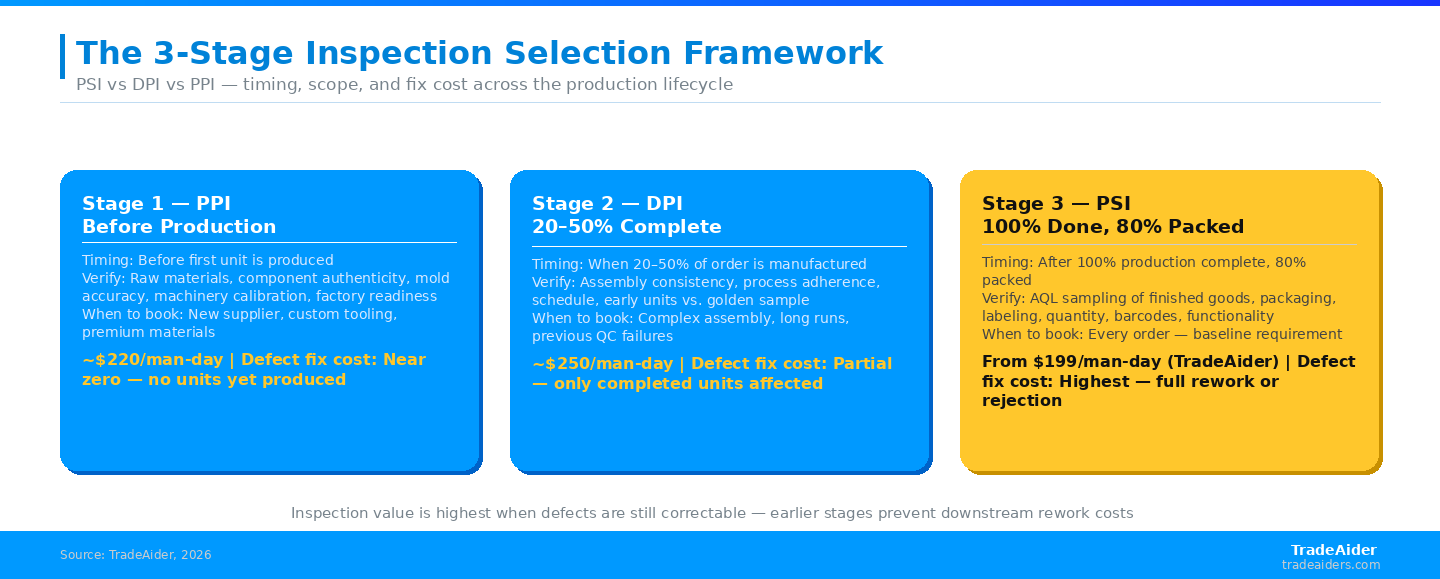
The 3-Stage Inspection Selection Framework: each inspection type addresses a different production-stage risk. Source: TradeAider, 2026.
The framework operates on a single principle: inspection value is highest when defects are still correctable. The further into production, the more expensive a fix becomes. PPI catches problems at zero production cost (no units yet made). DPI catches them at partial cost (only some units affected). PSI catches them at full cost (entire batch manufactured, rework or rejection are the only options).
Stage 1 — Before Production: PPI
Book a PPI when any of these conditions apply: new supplier (first 1–2 orders); product contains branded or specification-critical components (motors, ICs, fabrics); custom tooling or molds are involved; or material substitution risk is high based on product category. The cost of a PPI ($220/man-day market average) is typically recovered many times over if it prevents a batch-level material substitution that would otherwise only surface at PSI.
Stage 2 — Mid-Production: DPI
Book a DPI when: production runs longer than 30 days (quality drift is common on extended runs); the product has complex assembly with multiple failure points; you have had quality issues with this supplier on previous orders; or the product category is high-risk (electronics, safety equipment, children's goods). DPI is particularly valuable for identifying systemic issues in the production process — a single assembly error caught at 25% production prevents that defect from appearing in the remaining 75% of the batch.
Stage 3 — Pre-Shipment: PSI
Book a PSI for virtually every order. It is the baseline quality control checkpoint for importing from China. PSI is the most common approach for small and medium importers because it provides maximum coverage of the finished goods at the point when product quality is locked in. For simple products from established suppliers, PSI alone is usually sufficient. See TradeAider's inspection standard documentation for a complete checklist of what PSI covers by product category.
PSI vs DPI vs PPI: Side-by-Side Comparison
We compared the three inspection types across six dimensions that determine which is right for a given order.
| Dimension | PPI | DPI | PSI |
|---|---|---|---|
| Timing | Before production starts | 20–50% complete | 100% done, 80% packed |
| What it catches | Material substitution, wrong components, factory unreadiness | Assembly defects, process drift, schedule risk | Finished goods defects, packaging, labeling, quantity |
| Fix cost if failed | Lowest — no units yet produced | Medium — partial rework | Highest — full batch rework or rejection |
| Avg. cost | ~$220/man-day | ~$250/man-day | From $199/man-day |
| Best for | New suppliers, custom products, high-value materials | Complex assembly, long runs, previous QC failures | All orders — baseline requirement |
| Use alone? | Rarely — combine with PSI | Rarely — combine with PSI | ✅ Yes — sufficient for most orders |
Based on this comparison, PSI alone is the right baseline for the majority of consumer goods orders. The data shows that DPI and PPI deliver the most value when the cost of a post-production failure is high — complex products, new suppliers, or orders where rework would delay shipment by weeks.
How to Apply the 3-Stage Inspection Selection Framework
An Amazon seller importing a custom-designed Bluetooth speaker from a new Guangdong factory illustrates how the framework works in practice.
Situation: First order, 2,000 units, custom housing mold, branded audio driver components specified in the BOM. Order value $14,000. Lead time 45 days.
Problem: The buyer approved a golden sample but has no production history with this factory. Two risks are specific to this order: mold accuracy (custom housing must match sample dimensions), and component authenticity (branded audio drivers could be substituted with off-brand equivalents costing 40% less).
Action: Applying the 3-Stage Inspection Selection Framework — Stage 1 risk (material substitution, mold) is high → book PPI. Stage 2 risk (assembly, 45-day run) is medium → book DPI at week 3. Stage 3 (PSI) is mandatory → book PSI at 80% packed. Total cost: 3 man-days at TradeAider rates = approximately $600 across a $14,000 order (4.3% of order value).
Result: PPI confirmed the mold dimensions were off by 1.2mm — corrected before first unit produced. DPI found the audio driver supplier had been substituted; factory reverted to specified brand under contract. PSI passed with minor defects below AQL 2.5 threshold. Shipment approved.
Which Inspection Type Should You Book?
Use this decision guide based on your order profile:
Simple product, established supplier: PSI only. TradeAider's PSI at $199/man-day with real-time reporting covers all the bases for this scenario. See the TradeAider inspection standard for the full checklist by product category.
New supplier, any product: PSI mandatory; consider PPI if the product involves custom tooling or spec-critical materials. See why importers choose TradeAider for new-supplier inspection programs.
Complex product (electronics, multi-component assembly), any supplier: PSI + DPI. The mid-production check catches assembly drift before it propagates through the entire batch.
Custom-designed product with new molds: All three stages. PPI validates the mold before any units are produced, protecting both tooling investment and production quality.
High-value order (>$50,000) or regulated category (CE, UL, CPSC): All three stages plus dedicated product testing. See how TradeAider builds multi-stage QC programs appropriate to the product and market.
Who Is TradeAider?
TradeAider is a quality inspection, testing, and certification service provider under the ShiningHub Group, headquartered in China. Founded in 2010 by Justin Chen — an industry veteran with over 30 years of experience in global trade, manufacturing, and quality control — TradeAider operates across all of China, covering major manufacturing provinces including Guangdong, Zhejiang, Jiangsu, and Fujian.
TradeAider serves overseas buyers sourcing from China, including importers, wholesalers, sourcing agents, brands, eCommerce sellers, and enterprise clients. Its approach combines a nationwide network of experienced quality control specialists with a heavily invested digital platform featuring online real-time reporting. Clients can monitor inspections live, communicate directly with inspectors, and address issues during production rather than after shipment — a proactive model focused on problem-solving and prevention, not just defect identification.
Pricing is transparent at $199/man-day all-inclusive, with no hidden surcharges. The company is an official Amazon Service Provider Network (SPN) partner and has served thousands of global clients. Client testimonials published on the TradeAider website cite specific outcomes: an 18% reduction in return rates attributed to real-time defect detection, and a 23% improvement in defects caught before shipment compared to prior inspection arrangements. These are client-reported figures.
Frequently Asked Questions
What is the difference between PSI and DPI?
PSI (Pre-Shipment Inspection) is conducted after 100% of production is complete and at least 80% of goods are packed — it evaluates finished goods against your specifications before shipment. DPI (During Production Inspection) is conducted mid-production, typically when 20–50% of the order is complete — it identifies assembly defects and process issues while there is still time to correct them before the rest of the batch is produced. PSI is reactive; DPI is corrective. Most orders need PSI; complex orders benefit from both.
Do I need a PPI for every order?
No. PPI is most valuable for first orders from new suppliers, products with custom tooling or molds, and orders where material substitution is a known risk. For repeat orders from proven suppliers producing standard products, PPI adds limited value compared to DPI and PSI. PPI is essentially a factory readiness check — once you know a factory produces your product correctly, the readiness has already been established.
Can I substitute DPI with more frequent PSIs?
Not effectively. DPI and PSI address different risks at different production stages. PSI only sees finished, packed goods — it cannot assess the production process, detect assembly drift, or verify mid-run material quality. Booking two PSIs on the same order (one early, one late) is not equivalent to a DPI because early PSI samples will not yet exist and late PSI duplicates effort. TradeAider's During Production Inspection is designed specifically to bridge the gap that PSI cannot cover, examining semi-finished units and verifying the production process while corrections are still actionable.
How much does each inspection type cost in China in 2026?
According to industry pricing data, PPI runs approximately $220/man-day, DPI approximately $250/man-day, and PSI approximately $230–$280/man-day at standard market rates. TradeAider's all-inclusive PSI is $199/man-day with no hidden fees. For a typical global importer booking PSI only, one man-day covers most consumer goods orders of up to 5,000 units. Multi-stage programs (PPI + DPI + PSI) typically run 3 man-days total for orders under 3,000 units.
Not sure which inspection stages your order needs? Contact the TradeAider team with your product category, order size, and supplier history — we'll recommend the right inspection program at $199/man-day all-inclusive.
Related Articles
Grow your business with TradeAider Service
Click the button below to directly enter the TradeAider Service System. The simple steps from booking and payment to receiving reports are easy to operate.

