
A pump or trigger sprayer that works with water in a sample bottle may behave differently with the buyer’s formulation and ordered bottle. Reliable inspection starts with that assembled combination, then checks dose output, startup strokes, locks, leakage, compatibility and packing under the specified conditions. The six checks below show what to measure and how to interpret the results. Priming fills the dispenser’s liquid path until usable discharge begins; dose collection measures the quantity delivered afterward. Including dry startup strokes in the dose calculation can make a correctly dispensing pump appear to fail.
Start with These Six Dispenser Checks
| Check | What to do | How to judge it |
|---|---|---|
| Dose output | Prime first, collect an agreed number of full productive strokes and measure net mass; convert to volume with the tested liquid density where needed. | Each unit meets its dose tolerance; startup strokes are outside the denominator. Check trigger spray pattern separately. |
| Prime cycles | Count strokes from the specified starting condition to the agreed usable-discharge endpoint. | The count meets the limit for that liquid and dispenser; first wetting and steady output are identified separately. |
| Shipping lock | Engage and open the screw-down, clip, twist lock or nozzle setting as instructed; inspect retention and damage. | The ordered mechanism prevents its intended accidental operation and opens normally. An OFF label is not a leakage result. |
| Leakage | Fill, close and condition the assembled bottle as specified; observe each relevant interface in the agreed positions and duration. | No leakage outside the criteria; record the first new wet location before diagnosing the cause. |
| Compatibility | Match the formulation and all liquid-contact materials to the assessment; compare appearance, sealing and dispensing after the agreed exposure. | Matched assessment meets its criteria. A short water test or generic resin table is insufficient for the finished formulation. |
| Cartons | Count models, tubes, caps and clips; inspect actuator protection, then recheck relevant product functions after agreed transport tests. | Correct contents, protected controls and acceptable post-test function; carton appearance alone is insufficient. |
Before testing, agree which liquid to use, what counts as a completed prime, how to perform a full stroke and which limits apply. A startup limit concerns how quickly usable discharge begins; a dose tolerance concerns the quantity delivered afterward. A dispenser can meet either requirement while failing the other, so report both results.
Three Decisions That Prevent Misleading Results
- Keep prime cycles outside the post-prime dose denominator
- Separate lock operation, leakage, and formulation compatibility
- Verify the ordered combination and packed condition before accepting a general passing result
Define the bottle, dispenser, and liquid combination
A dispenser inspection is meaningful only when its tested configuration matches the ordered product. Record the bottle size and neck finish, meaning the thread and sealing geometry at its opening. Identify the closure version, pump or trigger model, gasket and test liquid. Record the length of the dip tube, the tube that draws liquid from the bottle. This guidance concerns manually operated pump bottles and trigger sprayers. Pressurized aerosols and pharmaceutical dosing systems need different product-specific assessment.
Give the inspector the approved sample, component drawing, material specifications, labeling artwork, and test schedule. The schedule should state which liquid to use, filling level, conditioning temperature, priming procedure, actuation method, dose limits, leakage conditions, and compatibility evidence to review. Identify any hazardous formulation and agree safe handling with the testing party before the visit. Do not leave an inspector to improvise a test with an unknown chemical.
When the supplier offers a pump head from one sample and a bottle from another, request a tested assembled combination. A matching thread designation is useful, but it does not establish that the gasket seats correctly or that the tube reaches the intended usable liquid. Use the TradeAider inspection standard to align the product-specific schedule with the reporting and defect-classification process.
Measure dose output after the dispenser is primed
Dose output is the quantity delivered by a defined full actuation after priming. Specify mass or volume, complete actuator travel and the measurement conditions. Count prime cycles separately; exclude dry startup strokes from the dose calculation and do not compare grams directly with a milliliter requirement.
Collect the Discharge and Calculate Mass or Volume per Stroke
For dose output, collect the liquid from the agreed number of full productive strokes after priming. Subtract the empty collection container’s mass from its filled mass to obtain net liquid mass. Divide net mass by the number of productive strokes for grams per stroke. If the specification requires milliliters per stroke, divide by the verified liquid density in g/mL at the relevant test conditions. Density is mass per unit volume. Record the liquid, temperature, masses and stroke count so another inspector can reproduce the calculation.
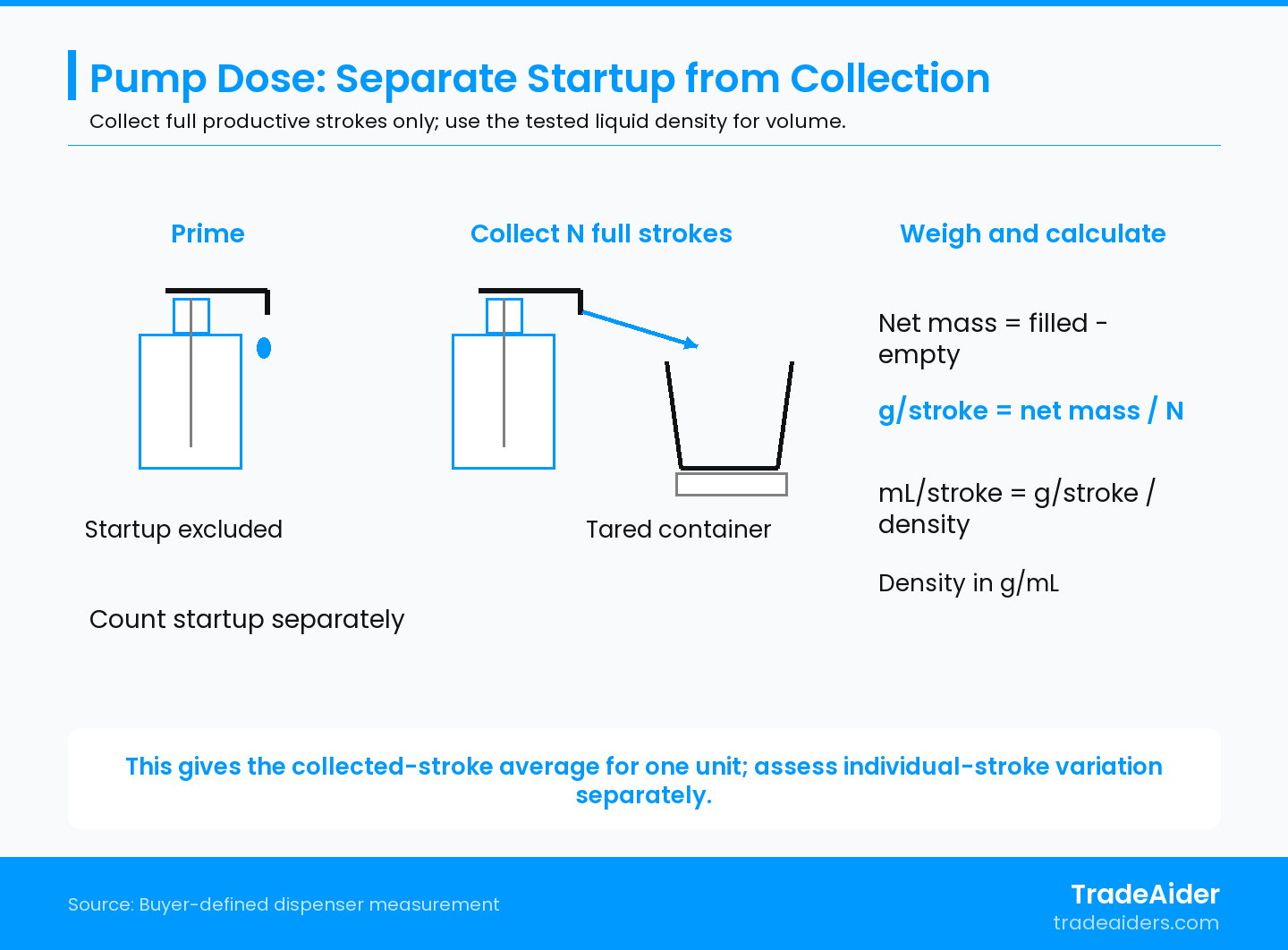
Collect full post-prime strokes and subtract the empty container mass. The calculation gives that unit’s average collected dose; individual-stroke variation needs separate measurement.
ASTM D4336-18(2025) covers the mean quantity dispensed by weight per actuation of mechanical spray or flow pumps with a consumer-type product. That public scope supports a weight-based output assessment; it does not supply this buyer’s stroke count or a density value for conversion.
Do not assume every formulation has the density of water. A supplier's generic liquid description is insufficient for a volume conversion that affects acceptance. Where density is unavailable or the collection method does not capture the complete discharge, record the limitation and agree a suitable measurement method. Foam and liquid retained at the nozzle or lost during transfer can change how much discharge reaches the collector.
Record startup count separately from steady dose. Extra startup strokes can be a priming failure even when later output meets the dose tolerance; rapid priming can still be followed by an unacceptable dose. Keep these results separate when asking the supplier to investigate.
Compare individual output and repeatability, not only the mean
A satisfactory average across several dispensers can conceal low-output and high-output units. Report each tested unit’s result before calculating the group average, with the minimum and maximum where the agreed method supports them. Collecting several strokes together gives an average dose for that unit; it does not show variation between its individual strokes. If that variation is an acceptance requirement, the method needs separate stroke measurements. Keep stroke speed, full travel, collection and bottle position consistent. For trigger sprayers, assess the intended spray pattern separately from dose quantity.
Acceptance quality limit (AQL) is a parameter used in an attribute acceptance-sampling scheme. Use the AQL calculator when preparing an agreed attribute-sampling plan, then separately identify the units allocated to dose and leakage tests. A sampling plan supplies the lot-acceptance structure; it does not create a dose tolerance or guarantee every dispenser in the lot. Record the actual functional-test allocation so the buyer can interpret the evidence.
Record prime cycles and recovery after interruption
For priming checks, count the actuations needed to reach the agreed usable-discharge endpoint from the specified starting condition. Define that endpoint before inspection. The first wet droplet, a partial jet, and a stable full dose are not interchangeable observations. Record the count to the buyer's chosen endpoint, then begin the separate post-prime measurement.
ASTM D3890-18(2025) addresses the number of actuations needed to prime mechanical spray or flow pumps with a consumer-type product. Its public catalog scope does not establish a universal maximum startup count for all formulations and designs.
A new empty pump, a pump left idle with product in its passage, and a nearly empty bottle may behave differently. Test the conditions included in the buying specification and identify them in the report. If the supplier has changed the dip tube, inspect its length, cut, seating, and obstruction without treating those visual checks as a substitute for dispensing the assembled unit.
When a dispenser fails to prime, record the actual symptom before diagnosing the cause. No output may involve an unengaged mechanism, an obstructed tube, a poor connection, or the liquid/test setup. Compare the failing combination with the approved sample under the same conditions. Avoid declaring the pump head defective solely because it was tested with a different bottle or an unapproved substitute fluid.
Check shipping locks and intended opening actions
A shipping lock should prevent the unintended operation the design promises while opening through the instructed action. Identify whether the model uses a screw-down pump, removable clip, twist lock, or trigger nozzle setting. Check the packed position, then open it according to the user instructions. Do not force an actuator that is intentionally locked.
Inspect engagement consistency, excessive play, cracked retaining parts, and parts that detach during normal opening. For a trigger sprayer, verify the labeled nozzle settings and the output expected in each setting. A nozzle marked OFF does not establish that every leakage path is sealed; evaluate leakage separately. Photograph mismatched markings or an ambiguous lock state rather than summarizing them as a general function defect.
Aptar lists 1.2 cc and 2 cc dose options, an uplock design described as sealing when open or closed, and an optional transit e-clip for its GS/GSA K2 pump. Match the ordered option and its stated function; these features do not establish every pump’s construction or finished-package leakage performance.
Locate leakage under the agreed filled-bottle conditions
Leakage inspection should identify where liquid escapes and under which conditions. Agree the filling level, closure-application method, lock position, orientation, temperature, and observation duration before testing. Inspect the closure-to-bottle interface, actuator or nozzle, vent, dip-tube connection, and bottle body as relevant to the construction.
Clean the outside of the assembled bottle before the test so a filling spill is not mistaken for a seal failure. Record the starting condition, then photograph any new wetting and its location. If mass loss is part of the agreed method, define how it will be measured and distinguished from evaporation or liquid transferred during handling. A wet carton establishes concern, but not the leaking component by itself.
An upright bench check does not establish transport performance in every orientation. Use only the agreed sequence and equipment, and keep the tested configuration identifiable. Do not substitute an arbitrary squeeze, shake, vacuum, or drop procedure and report it as compliance with a named method. When a failure is reproduced, isolate the affected interface before proposing a correction.
ASTM D5094/D5094M-24 concerns qualitative gross-leak assessment of threaded or lug-closure rigid and semi-rigid containers up to 4 L. Confirm applicability to the package before commissioning it. The method’s scope is not a quantitative leak-rate specification or a universal trigger-nozzle certification.
Match compatibility evidence to the actual formulation
Compatibility assessment asks whether the product formulation and dispensing materials remain suitable together under the intended storage and use conditions. A short functional test with water addresses a much narrower question. List the materials that contact the liquid, including the bottle, gasket, valve, spring where exposed, and dip tube, and compare them with the approved construction.
Thermo Fisher’s Nalgene chemical-resistance guide gives ratings at 20°C and 50°C, with E and G descriptions tied to 30 days of constant exposure. These are Nalgene-specific reference conditions. They are not ratings for an unidentified dispenser resin or proof for a different concentration, exposure, or mechanical stress.
Ask for evidence that identifies the formulation version, component materials, assembled configuration, exposure conditions, duration, and acceptance criteria. Depending on the product, relevant observations may include swelling, cracking, discoloration, corrosion, seal changes, and changed dispensing behavior. A report for another formulation or an older gasket is a reference, not proof that the current combination was assessed.
ASTM D4333/D4333M-18(2025) addresses compatibility between mechanical pump components and a product. Its public scope does not prescribe a universal aging duration or temperature for all formulations. Agree the relevant exposure and criteria rather than presenting an arbitrary storage test as the standard’s requirement.
Verify assortment, protection, and post-transport function
Carton inspection should confirm the correct dispenser-and-bottle assortment, included accessories, and protection of the assembled product. Check pump or trigger model, tube length, caps or clips, labels, quantity, and the packing list. Mixed variants can look alike while using different closures or dose specifications.
Look for restraints and separators that prevent actuators from being pressed, triggers from snagging, or bottle surfaces from rubbing. Verify that locks and clips remain in their intended packed state. If empty dispensers and bottles ship separately, check their identification and counts so the receiving operation can assemble the correct combinations without guessing.
ASTM D4169 describes shipping-unit performance evaluation using sequential tests on the same unit, which remains unopened until the sequence is complete. Preserve that sequence when it is the agreed protocol. Its public scope does not give a universal drop height or compression load for every dispenser carton.
For an agreed distribution or package-impact test, inspect the packed products afterward as well as the carton. Recheck relevant lock, leakage, and dispensing functions with the specified liquid and configuration. Carton appearance alone cannot establish that an internal seal, actuator, or nozzle survived. State any functions not rechecked rather than assuming an undamaged box means an undamaged dispenser.
ISTA 3A overview describes 3A as a procedure for individually packaged parcel-delivery products transported by air or ground and weighing 150 lb (70 kg) or less. Select a protocol appropriate to the actual shipment. One improvised carton drop should not be labeled completion of that entire protocol.
Investigate Failures and Keep Corrected Measurements Separate
Identify the failing unit, dispenser version, liquid and test conditions before proposing a correction. Retain initial failures and distinguish a product fault from a method error. If the collection procedure or dose denominator was wrong, repeat the agreed measurement and keep both records. An incomplete compatibility or transport check remains pending rather than becoming a pass because another function worked.
Illustrative example: startup strokes create a false low-dose finding
Consider a hypothetical importer order of 2,400 dispensers, split into 1,800 pumps and 600 trigger sprayers, awaiting shipment review. The illustrative pump schedule allows four startup strokes and then measures ten dispensing strokes. The assumed liquid density is 0.95 g/mL and the nominal dose is 1 mL. The inspector instead averages four dry startup strokes and six productive strokes, collecting 5.7 g over ten movements.
Dividing 5.7 g by ten gives 0.57 g per movement, but that denominator includes priming. It does not establish the specified post-prime dose. The buyer asks for the protocol to be corrected and the original observation retained. Mechanical rework is not justified by this calculation alone; the startup result and the dispensing result need separate report entries.
In the illustrative retest, ten full strokes after priming yield 9.5 g: 0.95 g per stroke, equivalent to 1 mL using the assumed density. The buyer reviews the corrected measurements alongside the separately required lock, leakage, compatibility, and carton results. All numbers are hypothetical. This example explains a measurement error, not a TradeAider client case, a universal prime-cycle limit, or a guarantee for every unit.
Send the Assembled Specification and Test Schedule
Send the approved bottle and dispenser drawings, liquid identity, instruction revision, lot quantities and packing plan. Include priming endpoints, stroke conditions, dose tolerance, leakage setup and any required formulation exposure or transport test. Confirm the testing party, specimen identity, equipment, time available and formulation-disclosure arrangements before the factory visit.
Resolve component and instruction questions before mass production when possible. TradeAider's Pre-Production Inspection is a service-stage option for checking agreed materials, components, and initial samples. Explain the assembled dispenser configuration and the unresolved lock or opening issue when discussing scope. Routine sampling should not be presented as a substitute for engineering approval of a new mechanism.
TradeAider’s Pre-Shipment Inspection takes place when the order is 100% complete and at least 80% packed for export, using randomly selected shipment samples. Confirm which dispenser checks can be completed during the visit and which require a separate laboratory assessment or longer observation.
Contact our team with the dispenser specification and test schedule to review the scope and quote. Include any unresolved formulation or shipment-test requirements.
Frequently asked questions
Can water replace the actual product during every inspection test?
Water may be an agreed screening liquid for a limited check, but it should not silently replace the specified formulation in acceptance testing. Record the substitution and the question it can answer. If product viscosity, foaming, density, or material interaction affects the requirement, agree a representative method with the buyer and testing party. A water result alone does not validate the intended filled product.
Can leakage-test samples be returned to saleable stock?
Only when the buyer’s approved sample-disposition rules allow it and the tested unit still meets the intended saleable condition. Keep samples exposed to a substitute liquid, destructive conditions, or opening outside the retail requirements separate until their disposition is agreed. Record which units were used and what they underwent. A passing result does not automatically authorize refilling, repacking, or returning tested units to the shipment.
Can a supplier change the dip tube without repeating relevant checks?
A dip-tube change needs review against the approved assembled configuration and the dispensing behavior the buyer has specified for the bottle. Compare length, cut, material, fit, and the supplier's change record, then identify the affected checks. Repeating relevant priming, dispensing, and compatibility assessment is different from automatically retesting every unrelated feature. Preserve traceability so the buyer knows which stock contains the revised tube.
Should empty pump bottles be accepted using filled-product leakage results?
Evidence from a filled assembled product is relevant only when its bottle, closure, dispenser, and test conditions match the empty components being purchased. Identify the eventual filling and assembly responsibilities before agreeing acceptance. Empty-component inspection can verify identity, workmanship, dimensions, and fit, while the filled-product assessment addresses additional questions. Record which evidence the supplier provides and which checks remain with the buyer or filler.
Related Articles

Grow your business with TradeAider Service
Click the button below to directly enter the TradeAider Service System. The simple steps from booking and payment to receiving reports are easy to operate.