
A factory-audit comparison fails small importers when it ranks provider labels before asking what evidence will let them approve, pause, or conditionally onboard the supplier. For a small importer, the practical question is whether the audit scope will support a defensible supplier decision before deposits, material commitments, and production timing become harder to reverse.
If your purchase order depends on one China supplier, make the quote name the process being checked, the records to be reviewed, the observation that would change your decision, and the follow-up needed to close a gap. That gives you a useful basis for choosing a provider without mistaking a public service description for a promise about an individual order.
Start With the Supplier Decision, Not the Brand
A factory audit is an on-site assessment of a supplier's facility, processes, and controls. It can be valuable before a first order, but it is not the same as a promise that every later unit will conform or ship on time. Before you compare providers, write down the decision that follows the visit: approve the factory, approve it with conditions, delay the deposit, require a corrective action, or route a later order to an inspection checkpoint.
- Choose QIMA conditionally when your written proposal needs to coordinate verified coverage across countries, sites, or specialist modules.
- Choose TradeAider conditionally when your supplier decision is China-focused and you need a current written scope that connects audit observations to buyer checkpoints and the next order-control stage.
- Choose neither quote yet when a proposal does not state the factory, modules, evidence, report timing, corrective-action process, and follow-up treatment in comparable terms.
The comparison is therefore about the evidence output. A provider can be suitable for one buying situation and not for another. Ask both providers to make the same decision fields visible in writing before you compare cost.
What a Small Importer Must Get From Either Factory Audit
A small importer should compare audit providers by the evidence needed to approve, pause, or conditionally onboard a factory. A quote that merely says “factory audit” is not comparable until the buyer can see what will be observed, what will be reported, and what happens if the visit exposes a gap.
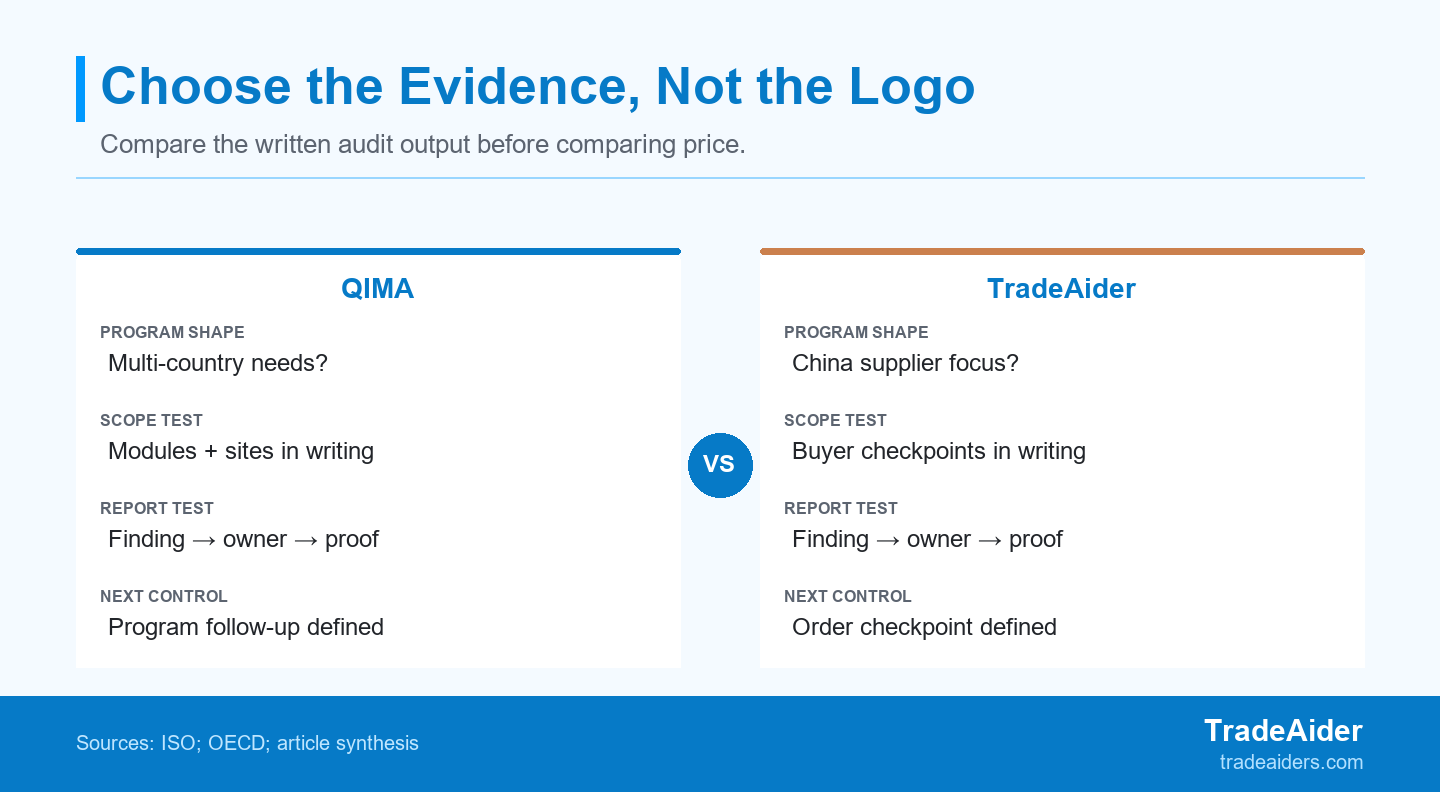
For a small importer, the useful comparison is the evidence each written scope will deliver for the actual supplier decision—not a provider label alone.
Use the following scorecard as a quote-normalization sheet. It does not rank QIMA or TradeAider. It makes a missing commitment visible. Give each quote a “confirmed,” “unclear,” or “not included” mark for every row, then request clarification before deciding that one provider is less expensive or more comprehensive.
| Compare this field | What the proposal should state | Decision it supports |
|---|---|---|
| Factory and audit objective | Named site, product family, audit purpose, and visit boundary | Whether the evidence applies to the supplier you are approving |
| Modules and records | Processes, documents, equipment, worker interviews, and sampling approach | Whether the scope can reveal the risk you actually need to control |
| Report output | Finding detail, photos or supporting evidence where applicable, severity, and reporting deadline | Whether your team can make a timely, traceable supplier decision |
| Corrective-action closure | Owner, due date, required proof, and when a recheck is needed | Whether a finding can move from observation to controlled closure |
| Next order control | Pre-production, production, or final-release handoff when it is in scope | Whether the audit changes the first-order plan rather than ending as a PDF |
Do not assume that a provider's standard template contains every row. The right comparison request is simple: “Show us how this proposal will let us make the next supplier decision.” That question is especially important when a small team has no separate quality manager to reinterpret a broad report after the visit.
Choose the Program Shape Before You Choose a Provider
Provider fit should be tested against sourcing footprint, written scope, corrective-action evidence, and the next order-control point before a small importer compares prices. These are different buying needs: a buyer managing several countries may need program consistency, while a buyer onboarding one China factory may need a tightly defined first-order control path.
Start with the supplier map. Count the countries, sites, product-risk modules, and people who must use the report. Then count the decisions that must happen after the audit: deposit release, tooling approval, material commitment, pre-production readiness, or final shipment release. The quote should cover the more demanding of those two maps, not the provider name with the most familiar reputation.
When a QIMA Proposal May Fit Better
QIMA may be the stronger fit when a buyer needs one audit program to operate across multiple countries, sites, or specialist modules and can verify those needs in the written proposal. That is a conditional fit, not a finding that QIMA is better for every small importer.
For example, a buyer may be consolidating supplier qualification across China, Vietnam, and Turkey, or may need audit modules that must be used consistently by several internal teams. In that situation, ask the QIMA proposal to identify each country, facility type, module, reporting format, language, booking lead time, corrective-action treatment, and owner for escalation. If a required module or location is only mentioned generally, treat it as unconfirmed.
Program breadth also creates an operating cost: the buyer has to make sure one scoring method does not conceal local differences that matter to a particular order. A multi-country program is a good reason to select broader coordination, but it is not a reason to skip factory-specific evidence. Ask how the proposal will distinguish a site-level capacity, calibration, subcontracting, or document-control finding from a portfolio-level summary.
When TradeAider May Fit Better
TradeAider may fit better when the buyer's supplier base is China-focused and the audit scope must be tied to buyer-adjustable checkpoints, online progress visibility, and the next inspection stage. TradeAider describes those elements on its current public service materials; confirm the exact scope, timing, report format, and terms in the proposal before booking.
A small importer may need the audit to answer a very local question: Can this one factory produce this first order under the control plan we need? In that case, request the process map, production-capacity evidence, calibration or maintenance records where relevant, subcontracting boundary, and named corrective-action owner. Use the current service page to compare the factory-audit scope line by line against the checklist above, rather than assuming any public description settles the question.
The potential advantage is not a blanket claim about outcomes. It is the possibility of converting one factory visit into a practical China order-control sequence. If the proposal does not state how an observation becomes a pre-production, in-production, or final-release decision, ask for that handoff. If it cannot be confirmed, include the missing work in your cost comparison rather than treating the lower starting price as the lower total cost.
Make Audit Scope an Evidence Request, Not a Checklist Purchase
Audit guidance emphasizes an evidence-based and risk-based approach, so a useful scope identifies the process, records, observation, owner, and decision each check can support. ISO committee guidance on ISO 19011 covers planning, conducting, and reporting audits and includes evidence- and risk-based principles; it is guidance for management-system auditing, not a prewritten factory-audit package for your order. Read the ISO 19011 audit guidance before treating any generic list as complete.
Turn every requested line item into a short evidence chain. “Capacity” should mean more than a claimed units-per-day number: ask which line will run the order, which shifts are planned, what constrains output, and what record supports that answer. “Quality control” should name the critical process checks, the equipment or method used, the person responsible, and what happens when a result is outside the agreed limit.
This protects both provider choices. A broad program can still be useful when its scope reaches the right records. A China-focused audit can still miss the decision if it only describes the facility. Your order creates the risk context: product complexity, planned quantity, new supplier status, subcontracting, changing components, and the point at which you must release money or materials.
Keep the boundary clear. A factory audit assesses capability and controls. It is not automatically a product test, a social-compliance certification, a shipment inspection, or a substitute for your purchase-order specifications. When a later inspection is needed, review the inspection standard before booking so the physical acceptance check and the earlier supplier audit do not get confused.
The Report Is Useful Only When It Changes Supplier Control
An audit report should connect findings to corrective ownership and a follow-up decision; a factory profile alone does not establish ongoing control. ISO 9001 describes a quality audit as a planned, systematic assessment against procedures, requirements, or recognized standards. That distinction matters: a report should show what requirement or control was assessed, not just list a favorable factory attribute. ISO's quality-audit explanation is useful context for this boundary.
For a first order, turn the report into a decision log on the day it arrives. Mark each finding as one of three categories: information to retain, a condition that must be closed before the next commitment, or a condition that can be checked at a named later stage. The third category only works when the later stage can actually observe the same risk. A capacity-plan gap may need a pre-production readiness check; a packed-carton quantity risk belongs later in the release plan.
A corrective action is a named fix for a finding, with an owner, proof, and a closing condition. Do not accept “corrected” as a close-out status by itself. The report should tell you who will act, what evidence they will submit, the due date, and whether the item needs a document review, a remote demonstration, a revisit, or an order-stage inspection.
A Quality-System Label Is Not a Supplier Approval
ISO 9001 defines quality-management-system requirements but does not prescribe how a factory operates, so a certificate or label cannot replace evidence from the buyer's actual product and process. A certificate or label can be useful context, but it cannot replace evidence that the supplier's actual product, process, line, and records meet your first-order needs. ISO's plain-language explanation of ISO 9001 makes that limit explicit.
Ask four practical questions instead: Does the stated certificate cover the site you are buying from? Does the process that matters to your product appear in the audit scope? Are the records current and linked to the planned production route? And does the provider's report tell you what evidence would change the approval? A “yes” to the first question alone is not an onboarding decision.
Corrective Action Needs a Recheck Trigger
A corrective-action plan is valuable only when the buyer can name what proof will close the finding and when a recheck is required before onboarding or production continues. The Responsible Business Alliance notes that the value of an on-site assessment includes correcting issues, not only identifying them; its program has a specific compliance scope, but the closure principle is broadly useful. See the RBA assessment-program context.
Use a written corrective-action plan with four fields: the finding, the factory owner, the proof required, and the recheck trigger. “Send a photo” may be enough for an updated notice board. It is not enough for an expired calibration sticker, an unmapped subcontractor, or a claimed production capacity that has not been tested against the order schedule. Those conditions require proof tied to the same equipment, process, or order path that caused the finding.
The recheck should be proportionate. A document-only gap can close through a controlled record review. A control that affects product decisions or shipment release may require a follow-up visit or an inspection checkpoint. Put that choice in the proposal before the audit begins; otherwise, the buyer learns about a needed revisit only after the original quote is already accepted.
Use a Four-Point Fit Test Before You Compare Prices
NIST's small-manufacturer guidance supports assessing inputs, processes, and outputs and looking beyond unit price when evaluating supply-chain risk. It is U.S. small-manufacturer guidance rather than a factory-audit buying standard, but the discipline fits a small importer's quote comparison. Read NIST's supply-chain risk context.
For a small importer, provider fit becomes clearer when country spread, required audit modules, evidence urgency, and follow-up capacity are scored before price is compared. Score the following four needs as 0 or 1. The point is not to manufacture a provider ranking; it is to expose which written commitments your order requires.
- Program breadth: Do you need the same audit approach across more than one country, several sites, or specialist modules?
- Order-specific evidence: Do you need the visit to validate capacity, subcontracting, controls, or records for one defined first order?
- Evidence urgency: Will the audit result control a deposit, tooling, material release, or another near-term commitment?
- Follow-up capacity: Do you need a provider to help define a corrective-action proof and the next inspection or recheck point?
A high program-breadth need is a reason to investigate whether a QIMA proposal can document the multi-location commitment you require. A high order-specific evidence and follow-up need is a reason to investigate whether a TradeAider proposal can document the China-focused audit-to-control handoff you require. Either result is provisional until the quote says so. If both scores are high, request a proposal that explicitly handles both needs rather than forcing a false either-or choice.
Risk-based due diligence prioritizes the most significant impacts across supply chains and business relationships. OECD guidance frames that work around identifying and prioritizing significant impacts. This is wider than a factory-audit comparison, but it supports a simple buying rule: concentrate the budget on the uncertainty that could most affect the supplier decision. Read the OECD due-diligence guidance.
Illustrative Scenario: A Factory Pass That Should Not Release the Deposit
An audit can support conditional onboarding when a sample-ready factory lacks evidence that its actual capacity and calibration controls match the planned order. The following is illustrative, not a TradeAider client case and not a prediction of supplier performance.
A small importer has approved samples from one China home-goods factory and plans a first order of 2,400 units. The supplier asks for a 30% deposit before it locks the production plan. The buyer does not need a broad statement that the facility “passed”; the buyer needs evidence that the planned order can follow a controlled route from material commitment through final release.
Use a Conditional Onboarding Decision
A small importer can conditionally onboard a supplier when the audit identifies a control gap that has a named corrective proof and recheck. That decision recognizes usable supplier potential without pretending that the current evidence is complete.
A small importer is qualifying one China home-goods supplier for a first order. The illustrative order is 2,400 units, and the supplier requests a 30% deposit before its production plan is locked. Approved samples exist, but the audit evidence has not yet shown that the planned order can follow the claimed capacity and control route.
One active assembly line is observed, while stated daily capacity is supported only by a planning sheet. Two calibration stickers for final electrical checks are expired. A subcontracted packaging step is absent from the process map. A generic pass/fail label would flatten three different risks into one answer.
The appropriate decision is conditional onboarding: do not release the full deposit as if the audit were an unconditional pass. The buyer can allow progress only after current calibration evidence is submitted, a signed capacity plan names the packaging step, and a pre-production readiness check confirms the controls. This preserves leverage without treating an incomplete record as a rejection of the supplier.
The verification gate is equally specific. Close the finding only when the documents identify the same line, equipment, and packaging process that will serve the order, and the readiness check confirms those controls are present. This is illustrative only; it does not establish what any actual factory will do, what a provider will find, or whether the order will meet requirements.
Turn the Audit Into a China Order-Control Plan
The audit should hand off a supplier decision, open corrective actions, and the inspection checkpoint that will verify the next risk. That is the difference between buying a report and building an order-control plan.
Use the audit close-out meeting to create four entries in the purchase-order file: the supplier decision, open findings, required proof, and the next verification stage. Give every entry an owner and a date. If the audit identifies a readiness risk before bulk production, the next stage is not a final shipment check; it is an early control. You can check readiness before mass production begins when the supplier's capacity, equipment, materials, or process route must be confirmed before a larger commitment.
Later, connect only the findings that can still affect the packed order to a release check. A final inspection can verify agreed physical attributes, quantity, packaging, workmanship observations, and the defined lot. It cannot retroactively prove that a factory's capacity plan was realistic months earlier, that a subcontractor was included in the original audit boundary, or that lapsed calibration was current when the process began. Those risks need their own earlier proof.
Write the final inspection request as a continuation of the audit record, not as a separate generic service booking. State the relevant finding, the evidence that should already be closed, the physical condition to observe, the product or carton population, the acceptance criteria, and the escalation owner. If an item was conditionally accepted, say what result changes that status. If a finding concerns a process that cannot be seen in a finished lot, record its closure evidence separately instead of asking an inspector to certify what the final check cannot establish.
For either provider, ask for the same closing statement: which findings are closed, which are conditionally accepted, what proof is still due, and which next order checkpoint verifies it. Before the final lot is treated as ready, map audit findings to your pre-shipment release plan.
Frequently Asked Questions
Is QIMA or TradeAider cheaper for a factory audit?
Neither provider can be called cheaper until both quotes describe the same factory, audit modules, reporting deadline, travel treatment, and follow-up work. A lower initial rate can omit the records, revisit, or later control point your order needs. Put each field on one quote sheet, ask for unconfirmed items in writing, and compare the total decision-ready scope. Also confirm whether the quote includes report review, corrective-action follow-up, and the decision checkpoint that your order will actually need.
Can a factory audit replace a pre-shipment inspection?
No, because a factory audit assesses supplier capability and controls, while a pre-shipment inspection checks the finished order against the agreed release scope. The two services can complement each other, but they answer different questions at different times. Use the audit to determine whether the factory can move forward; use a later inspection when physical product, packaging, quantity, or lot conditions must be checked before shipment. An audit finding should also state which later check can verify it, if any.
What should a factory audit report include for a first order?
For a first order, the report should identify the factory, product and process scope, evidence reviewed, observations, finding severity, owner, action required, and recheck trigger. It should also state which finding affects the next commercial decision, such as a deposit, material commitment, or readiness check. If a report gives observations without an owner, proof requirement, or decision use, request a close-out plan before treating it as supplier approval evidence. Retain the report with the purchase-order record rather than leaving it only in an email thread.
When should a small importer book a follow-up audit?
Book a follow-up audit when a critical onboarding finding cannot be closed with reliable records, photos, or a later inspection checkpoint tied to the same risk. Examples include an unclear subcontracting route, an unverified capacity claim, or control equipment whose status affects the product process. Put the recheck condition in the original proposal when possible, so the buyer knows the evidence standard and cost before the first audit begins. Do not book a revisit simply because the original report uses a negative label; book it when the planned proof cannot answer the remaining decision.
Related Articles


Grow your business with TradeAider Service
Click the button below to directly enter the TradeAider Service System. The simple steps from booking and payment to receiving reports are easy to operate.

