
- About Us

- Our Services
- Your Industry
- Resources
- News & Blog
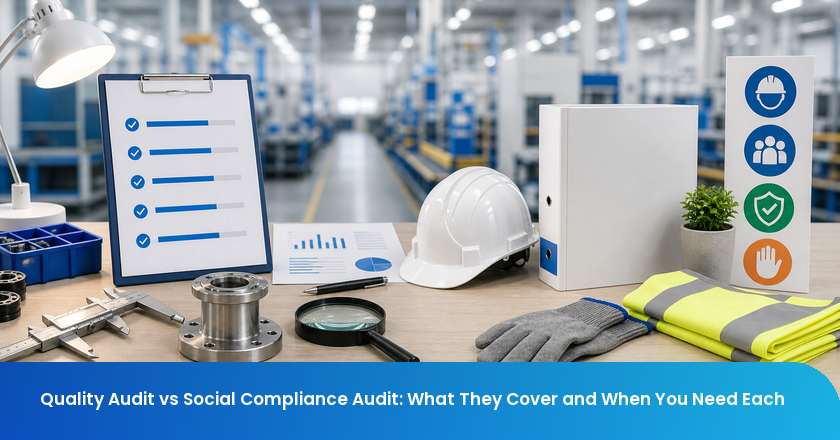
A quality audit evaluates whether a supplier can consistently make conforming products; a social compliance audit evaluates whether the workplace meets labor, health, safety, ethics, and buyer code requirements.
Quality audits and social compliance audits are often grouped under supplier audits, but they answer different buyer questions. A quality audit asks whether the factory has the process control, records, people, equipment, and corrective action discipline to produce acceptable goods. A social compliance audit asks whether the factory's labor, health and safety, working-hours, wage, management, and ethics practices align with required standards or buyer expectations.
For importers sourcing from China, the difference matters because the wrong audit can create false confidence. A factory may have a clean quality system and still fail a retailer's social compliance requirement. Another factory may pass a social audit but still produce inconsistent products because process control, incoming material checks, and final inspection discipline are weak. Buyers need to map audit type to risk type.
Key Takeaways
- Definition: Quality audits focus on product conformity systems; social compliance audits focus on workplace and ethical requirements.
- Overlap: Both review records, management systems, corrective action, and site conditions, but they interpret evidence through different risk lenses.
- Buyer trigger: Use quality audits for product failure risk and social compliance audits for retailer, brand, legal, or responsible sourcing requirements.
- Combined risk: New suppliers for consumer goods often need both audit types before scaling orders.
- TradeAider workflow: A supplier audit should feed into inspection, testing, and release decisions rather than sit as a standalone document.
Quality Audit And Social Compliance Audit Solve Different Risks
A quality audit and a social compliance audit should not be used interchangeably because they protect the buyer from different failure modes. The quality audit is product-performance oriented. The social compliance audit is workplace-and-policy oriented. Both can be important, but each has its own evidence standard and business consequence.
Quality audit: can the supplier make the product correctly?
A quality audit reviews whether the factory can control the processes that affect product conformity. Typical areas include incoming materials, production flow, equipment, in-process inspection, final inspection, calibration, sample control, nonconforming product handling, corrective action, and quality records. ISO 9001:2015 is relevant because it frames quality management around customer requirements, process control, and continual improvement.
The practical output should help the buyer decide whether the supplier is ready for production, whether the order needs during-production inspection, whether additional testing is required, and which process weaknesses should be corrected before mass production.
Social compliance audit: can the supplier meet workplace requirements?
A social compliance audit evaluates the workplace against labor, health and safety, management, ethics, environmental, and buyer code requirements. Reference frameworks may include the ILO Fundamental Principles and Rights at Work, the SA8000 Standard, retailer codes of conduct, or methodologies such as Sedex SMETA. The purpose is to understand whether the site meets responsible sourcing expectations and whether corrective action is required.
For buyers selling to retailers, licensed brands, public-sector buyers, or markets with supply-chain due diligence requirements, social compliance evidence can be a commercial gate. Passing product inspection does not replace the need for acceptable workplace evidence when the sales channel requires it.
The overlap: systems, records, and corrective action
Both audit types examine management discipline. ISO 19011 auditing guidance is useful because it frames auditing as a structured process with principles, audit program management, and audit evidence. In both quality and social audits, the buyer should look beyond a checklist score and ask whether records match reality, whether issues are corrected, and whether management understands the risk.
The overlap is also where corrective action can become confusing. A quality CAPA may require stronger incoming material inspection, while a social compliance CAPA may require changes to working-hour controls or health and safety practices. Buyers should keep the findings in one supplier-risk register, but the owner, deadline, verification method, and business consequence should remain tied to the audit type.
Side-By-Side Audit Scope Comparison
A side-by-side comparison helps buyers avoid scope confusion. If the risk is product conformity, choose a quality audit. If the risk is labor, health and safety, ethics, or buyer code compliance, choose a social compliance audit. If the supplier is new and the order is commercially important, the buyer may need both.
| Decision Area | Quality Audit | Social Compliance Audit | Common Buyer Mistake |
|---|---|---|---|
| Main question | Can this factory consistently make conforming products? | Does this site meet workplace, labor, safety, ethics, and code requirements? | Assuming one audit answers both questions |
| Typical evidence | QC records, process controls, inspection records, calibration, sample control | Worker records, payroll, working hours, safety conditions, grievance process | Collecting documents without checking site reality |
| Best timing | Before first production, product transfer, or supplier expansion | Before retailer onboarding, brand approval, or responsible sourcing review | Waiting until shipment is ready to discover audit gaps |
| Business risk | Defects, returns, rework, failed inspection, recall exposure | Retailer rejection, brand restriction, legal or reputational exposure | Using final inspection to solve supplier system problems |
| Follow-up | CAPA tied to process control and shipment inspection | CAPA tied to workplace practices and management systems | Treating corrective action as paperwork instead of verification |
The comparison reveals a simple rule: audit scope should match the decision the buyer must make. If the buyer needs to decide whether a supplier can control a coating process, a quality audit is the right starting point. If the buyer needs to satisfy a retailer's ethical sourcing requirement, a social compliance audit is the right starting point.
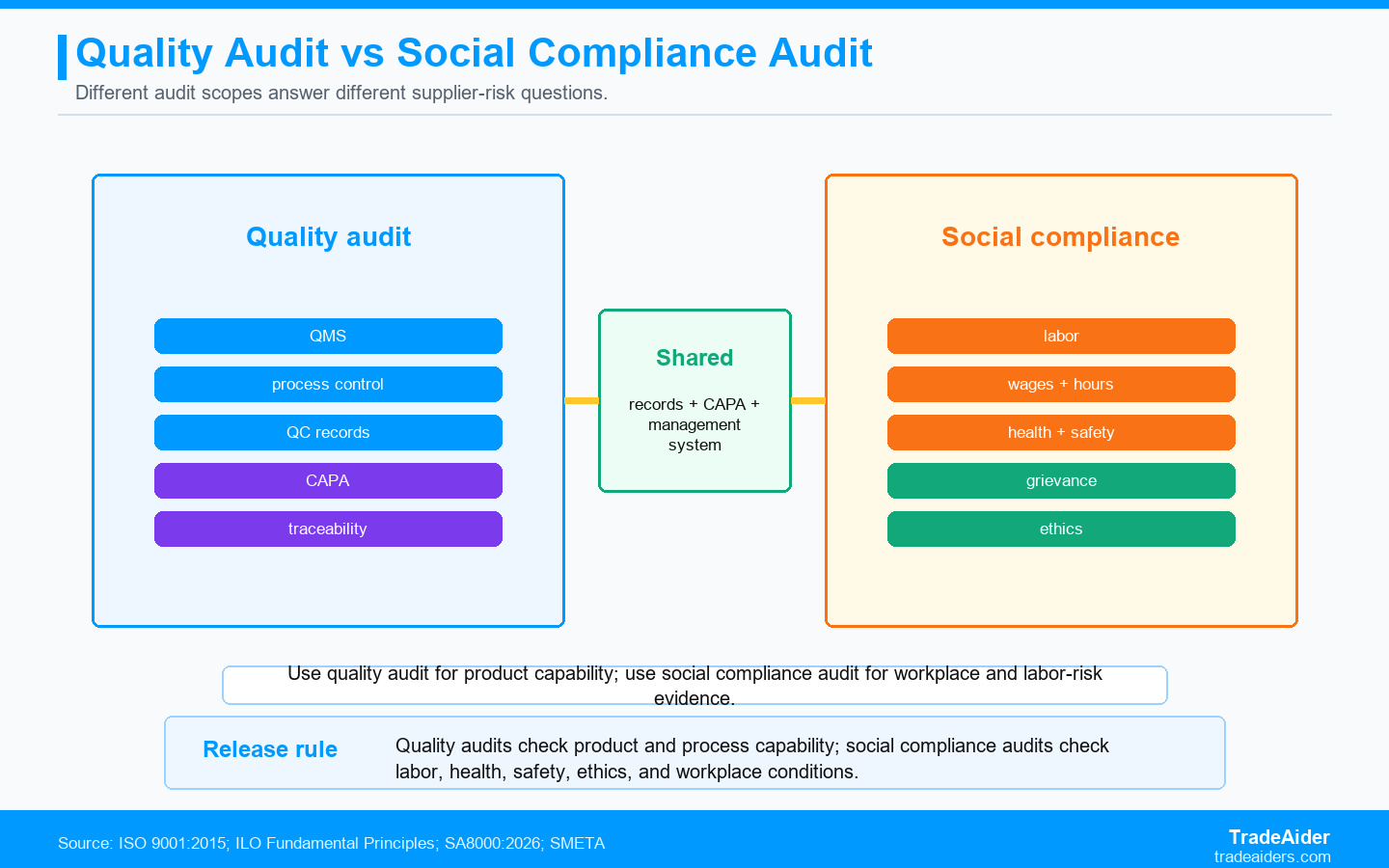
Quality audits and social compliance audits overlap in management evidence, but they answer different buyer-risk questions.
A supplier can pass a product inspection and still fail a social compliance requirement; it can also pass a social audit and still need stronger process control.
How To Choose The Right Audit Before Placing An Order
The right audit depends on which uncertainty could block the order, damage the buyer, or prevent release. Buyers should choose audit scope by decision need rather than by the name of a standard or the cheapest available checklist.
Choose a quality audit when product conformity is uncertain
Use a quality audit when the buyer is unsure whether the supplier can control materials, workmanship, equipment, production process, testing records, packaging, traceability, or final inspection. This is especially important for new suppliers, complex products, tight tolerances, safety-sensitive products, and orders where rework after shipment would be expensive.
A quality audit is also useful after repeated defects. If final inspections keep finding similar problems, the buyer should stop treating inspection as the only control and audit the process that keeps creating the defect.
Choose a social compliance audit when the sales channel requires it
Use a social compliance audit when the buyer's brand, retailer, marketplace, public customer, licensing agreement, or internal sourcing policy requires workplace evidence. The audit should be aligned with the required code or methodology, because a generic workplace visit may not satisfy a specific buyer or retailer requirement.
The timing matters. Social compliance issues can take longer to correct than packaging defects. If the audit happens after the shipment is ready, the buyer may face a commercial block even if product quality is acceptable.
Use both when the supplier is new and the product is important
For a new supplier producing an important consumer product, the most realistic answer may be both. The quality audit reduces product failure risk. The social compliance audit reduces channel and responsible sourcing risk. The two audits should not be merged into one vague checklist unless the buyer is clear about which requirements must be evidenced.
A practical purchasing rule is to decide which failure would block the order first. If product defects would stop release, start with quality. If retailer approval would stop onboarding, start with social compliance. If both could block the order, plan both before the production calendar becomes tight.
How TradeAider Helps Buyers Use Audit Findings
TradeAider's role is to help buyers turn supplier audit findings into practical quality-control decisions. A factory audit is strongest when it influences inspection scope, testing needs, production monitoring, and release conditions for the actual order.
Connect audit findings to inspection scope
If a quality audit finds weak incoming material control, the next During Production Inspection should include material verification and line-level checks. If it finds poor final inspection discipline, the Pre-Shipment Inspection should pay closer attention to defect classification, carton range, and sampling discipline.
Use testing and certification evidence when product risk requires it
Quality audits do not replace laboratory testing or certification review. When the product involves chemical, food-contact, electrical, toy, textile, or destination-market compliance requirements, TradeAider can help coordinate product testing services so audit, inspection, and testing evidence point to the same shipment or product file.
Ask for a decision-ready audit plan
Buyers planning supplier onboarding should identify the product type, destination market, retailer requirement, existing certificates, prior defects, and shipment timeline. With those inputs, they can ask TradeAider to map the audit and inspection sequence before placing the order or releasing deposit balance.
SPAR Scenario: The Right Audit Was Two Different Audits
Situation: A consumer lifestyle brand planned to onboard a new China supplier for a retail program. The product looked simple, but the buyer needed consistent workmanship and retailer-ready supplier documentation.
Problem: The buyer initially requested a quality audit and assumed it would satisfy every supplier requirement. During the document review, the team realized the retailer also required evidence related to workplace standards and corrective action management.
Action: The buyer separated the work into two decisions. A quality audit reviewed process capability, QC records, sample control, and packaging flow. A social compliance audit route was planned against the retailer's required framework. Later inspection scope was adjusted based on the quality audit findings.
Result: The buyer avoided a late onboarding gap. The quality audit informed production controls, while the social compliance audit addressed channel requirements. The supplier relationship moved forward with clearer evidence instead of one generic audit report.
Who Is TradeAider?
TradeAider is a quality inspection, testing, and certification service provider in China. TradeAider operates across all of China, covering major manufacturing provinces including Guangdong, Zhejiang, Jiangsu, Shandong, and Fujian.
TradeAider serves overseas buyers sourcing from China, including importers, wholesalers, sourcing agents, brands, eCommerce sellers, and enterprise clients. Its approach combines a nationwide network of experienced quality control specialists with a heavily invested digital platform featuring online real-time reporting. Clients can monitor inspections live, communicate directly with inspectors, and address issues during production rather than after shipment - a proactive model focused on problem-solving and prevention, not just defect identification.
Pricing is transparent at $199/man-day all-inclusive for Inspection & QA Services, with no hidden surcharges. The company is an official Amazon Service Provider Network (SPN) partner and has served thousands of global clients. Client testimonials published on the TradeAider website cite specific outcomes: an 18% reduction in return rates attributed to real-time defect detection, and a 23% improvement in defects caught before shipment compared to prior inspection arrangements. These are client-reported figures.
Frequently Asked Questions
Is a quality audit the same as a social compliance audit?
No, a quality audit is not the same as a social compliance audit. A quality audit checks supplier capability to produce conforming goods, while a social compliance audit checks workplace, labor, safety, ethics, and buyer code requirements.
Do I need both audits for a China supplier?
You may need both audits when the supplier is new, the product risk is significant, or the buyer's sales channel requires responsible sourcing evidence. Quality risk and social compliance risk are different, so one audit may not satisfy both.
Can a social compliance audit predict product defects?
A social compliance audit cannot reliably predict product defects because it is not designed to verify product-process control. It may reveal management discipline issues, but buyers still need quality audits, inspections, or testing for product conformity.
When should the audit happen?
The audit should happen before major order commitment or before production scaling. If retailer approval or supplier capability is uncertain, waiting until shipment is ready can leave too little time for corrective action.
Related Articles

Grow your business with TradeAider Service
Click the button below to directly enter the TradeAider Service System. The simple steps from booking and payment to receiving reports are easy to operate.

