
- About Us

- Our Services
- Your Industry
- Resources
- News & Blog

Quality control for eBay sellers starts before listing: the product, supplier, photos, description, packaging, safety evidence, and shipment inspection must all match what the buyer will receive. Most seller problems begin when the listing promise is stronger than the goods being shipped.
eBay explains that seller performance is reviewed through seller standards and service metrics. The seller performance standards page ties seller level to metrics such as transaction defects, late shipment, and cases closed without seller resolution.
The eBay selling practices policy tells sellers to provide accurate and consistent item details, specify terms clearly, deliver the item as described, and review listings so inventory status and item condition stay current. Those are quality-control requirements in marketplace language.
For sellers sourcing from China, many defects are invisible when the listing is created. The seller may have clean photos, good copy, and a nice sample, but the factory may ship a later batch with weaker packaging, wrong accessories, color drift, safety risk, or mixed SKUs.
- Biggest mistake: treating listing quality and product quality as separate jobs.
- Highest-risk metric: item-not-as-described returns when product, photos, or description do not match the shipped goods.
- Best prevention: inspect product, packaging, labels, accessories, and carton identity before inventory reaches the warehouse.
- Safety warning: eBay can restrict unsafe, recalled, prohibited, or non-compliant products from the marketplace.
What Quality Control Mistakes Hurt eBay Sellers Most?
The biggest quality control mistakes for eBay sellers are selling unverified supplier goods, using photos that no longer match the shipment, ignoring packaging and accessory checks, missing product safety requirements, failing to inspect before bulk shipment, and not tracking defects that cause item-not-as-described returns.
eBay service metrics include item-not-received and item-not-as-described performance compared with peer sellers. That changes the quality-control goal: reduce the situations where the buyer can honestly say the item was wrong, damaged, unsafe, incomplete, or different from the listing.
Return rules also create pressure. eBay return guidance explains that when an item arrives damaged, faulty, wrong, or does not match the listing description, the seller generally needs to accept the return. A no-returns setting does not protect a seller from a genuine product-quality or description mismatch.
Product safety is another layer. eBay product safety policy restricts recalled, banned, unsafe, or non-compliant products. If a seller imports toys, electronics, cosmetics, baby products, chargers, or other regulated goods, quality control must include product safety evidence rather than only appearance checks.
eBay Quality Control Mistake Map
Use this table to connect each seller mistake to a measurable control before shipment.
| Mistake | What Goes Wrong | eBay Risk | Control Before Shipment |
|---|---|---|---|
| Using sample photos only | Bulk lot differs from listing | Item not as described | Inspect current production photos |
| Ignoring accessories | Missing cable, manual, screws, or gift box | Return and negative feedback | Accessory count and carton check |
| Skipping packaging tests | Damage in transit | Damage claim and refund | Drop-risk review and carton photos |
| Weak supplier approval | Factory changes material or subcontractor | Quality drift | Audit or first-order DPI |
| No safety screen | Restricted or unsafe item | Listing removal or account risk | Test report and label review |
| No defect log | Same failure repeats | Return rate remains high | Track defect type by SKU and batch |
The table shows why eBay quality control is not only about finding defects. It is about protecting the promise in the listing. If the product file changes, the listing must change or the shipment must be corrected.
Small sellers often skip inspection because they think a supplier sample is enough. The sample is useful, but it is not proof that the packed lot matches the listing, especially after a factory changes components, packaging, color, finish, or accessory sourcing.
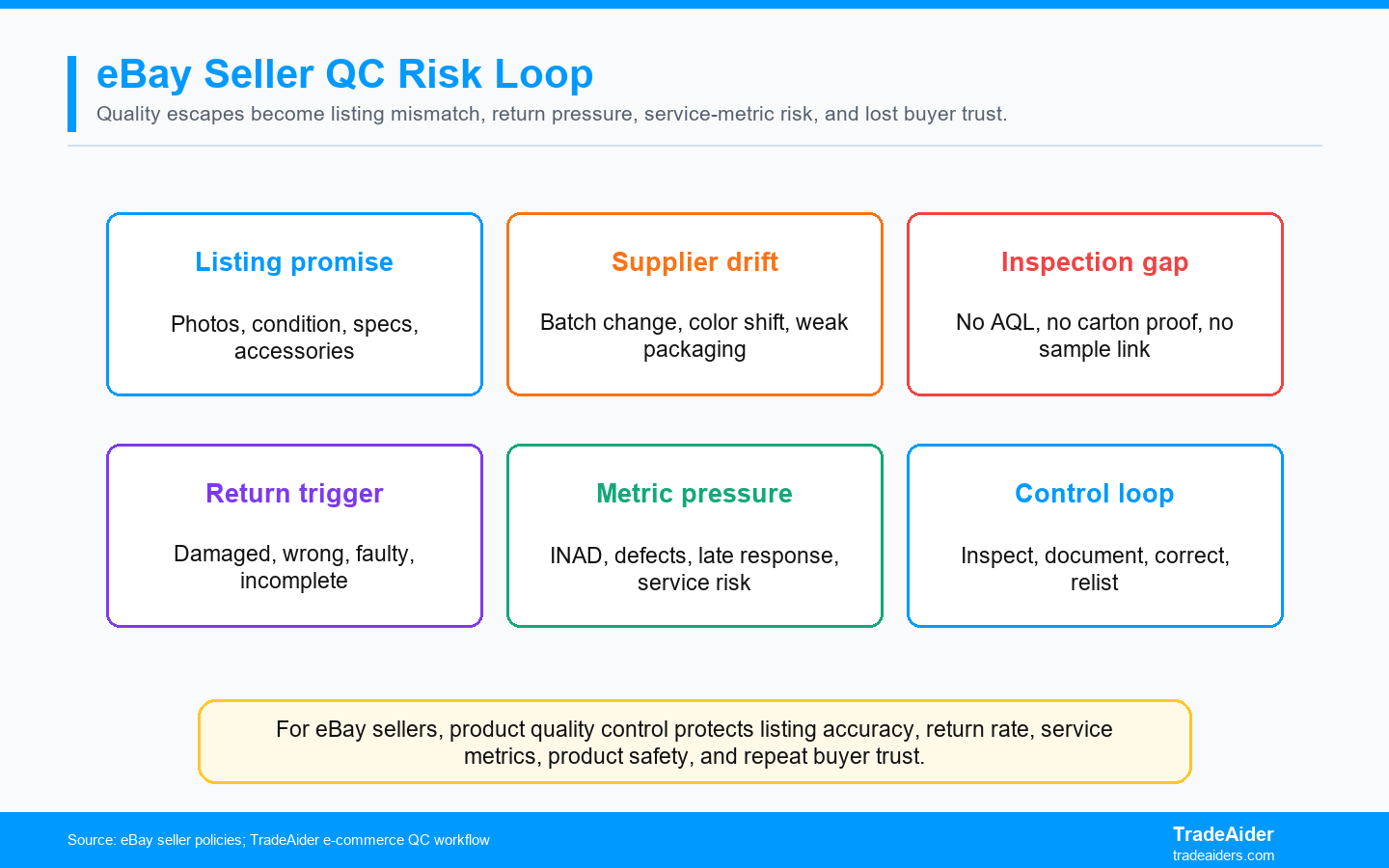
For eBay sellers, product quality control protects listing accuracy, return rate, service metrics, product safety, and repeat buyer trust.
Mistake 1: Listing Before the Shipment File Is Stable
An eBay listing becomes risky when photos, specs, condition claims, and accessories are not tied to the actual production lot.
Photos can become outdated after one production change
A seller may photograph a perfect sample and then receive a shipment with a slightly different color, weaker finish, new barcode sticker, missing pouch, or alternate packaging. The buyer does not care that the first sample looked correct. The buyer judges the product received against the listing.
Before creating or refreshing a listing, the seller should lock the product file: exact SKU, color, dimensions, material, accessory list, packaging type, label, barcode, and any warning or certification claim. If the supplier changes any of these, the seller should update the listing or hold the goods.
Condition claims need inspection evidence
New, open-box, refurbished, used, compatible, original, replacement, and custom claims all carry quality implications. If the supplier uses mixed packaging, reworked goods, or inconsistent accessories, the seller's condition claim can become inaccurate even when the product functions.
A pre-shipment check should photograph the retail box, condition, accessories, label, carton, and random units from the packed lot. The seller then has a record showing whether the goods match the listing promise.
Mistake 2: Treating Returns as Customer Service Instead of Quality Data
Every return reason should become a defect category, supplier question, or listing correction.
Item-not-as-described returns reveal the control gap
When buyers return a product as damaged, wrong, faulty, missing parts, or not matching the listing, the seller should classify the reason by root cause. Was the listing wrong? Did the supplier ship a changed product? Was the packaging too weak? Did the inspection miss a defect? Did the warehouse mix SKUs?
This classification matters because different fixes belong in different places. A bad listing needs copy or photo correction. A weak supplier needs inspection or sourcing action. A fragile package needs a packing test. A safety issue may need testing and listing removal.
A simple return threshold can trigger inspection
For a seller shipping 300 units per month, a 3% quality-related return rate means about nine problem orders monthly. If pre-shipment inspection, packaging correction, or accessory control lowers that to 1%, the seller avoids six problem orders every month and gains cleaner evidence for supplier negotiation.
This scenario is not a guaranteed ROI claim. It is a practical trigger: when repeat returns concentrate around one SKU, the seller should stop treating each return as isolated customer service and start treating the SKU as a quality-control project.
Mistake 3: Ignoring Packaging Until Damage Claims Arrive
A product that passes appearance inspection can still fail eBay buyers if packaging cannot survive the shipping path.
Many eBay sellers focus on the product and forget the package. Thin cartons, weak inner protection, loose accessories, poor sealing, sharp product edges, moisture risk, and crushed retail boxes can create returns even when the product itself is acceptable.
The inspection checklist should include retail box condition, master carton strength, inner pack, edge protection, barcode label, shipping mark, accessory bag, and whether the package can protect the item through the seller's fulfillment route. If the seller uses FBA, 3PL, or cross-border courier delivery, packaging defects can multiply quickly.
A useful rule is to treat packaging as part of product quality whenever the buyer sees it, photographs it, returns it, or uses it to judge whether the product is new. For collectibles, electronics, gift items, shoes, toys, and accessories, packaging can be the difference between a satisfied buyer and an item-not-as-described claim.
Mistake 4: Missing Product Safety and Platform Restrictions
The seller is responsible for marketplace compliance even when the supplier says the product is common.
Some eBay categories carry safety or regulatory risk: toys, children's products, chargers, power banks, cosmetics, helmets, baby goods, medical-style products, chemicals, and branded replacement parts. A supplier's assurance that many sellers buy the item is not enough.
Before purchasing bulk stock, the seller should check whether the product is recalled, restricted, counterfeit-sensitive, or subject to labeling, certification, testing, or battery transport requirements. Inspection can verify labels, packaging, visible safety marks, and the product received, but testing and legal compliance may still be required.
If the product safety file is weak, do not solve the problem by hiding details in the listing. A vague listing may reduce questions before purchase but increase returns, removals, or safety complaints after delivery.
Mistake 5: Not Separating Supplier Defects From Listing Defects
A seller can only fix repeat quality problems when each return is traced to the right owner.
Quality problems often get blurred together after a return arrives. One buyer says the item is smaller than expected. Another says the package was damaged. A third says a cable was missing. If the seller records all three as generic returns, the next purchase order will repeat the same weakness.
A practical seller log should separate listing defects, supplier defects, packing defects, warehouse handling errors, and buyer misunderstanding. Listing defects belong in photos, copy, measurements, condition claims, or compatibility notes. Supplier defects belong in the inspection checklist and supplier corrective action. Packing defects belong in carton, inner protection, and fulfillment tests.
This classification also protects margin. If the issue is a supplier defect, the seller needs photos, counts, batch identity, and inspection evidence to negotiate correction. If the issue is a listing defect, the seller should update the listing before the next order rather than forcing inspection to solve a communication problem.
Where TradeAider Fits for eBay Sellers
TradeAider helps eBay sellers turn supplier promises into product, packaging, label, and report evidence before inventory leaves China.
TradeAider supports e-commerce sellers through e-commerce quality solutions, including product checks, packaging checks, barcode and label review, photo evidence, and order-stage inspection planning for sellers who cannot visit the factory.
For first orders or unstable suppliers, During Production Inspection can catch drift before the whole order is packed. For shipment-ready goods, Pre-Shipment Inspection can verify whether the packed lot matches the listing, sample, accessory list, and order file.
This is not about making every eBay seller run a heavy enterprise QC program. It is about creating enough evidence to prevent avoidable returns, support supplier disputes, and keep the listing promise aligned with what the buyer receives.
SPAR Scenario: The Listing Was Accurate, but the Shipment Was Not
The seller avoided a return wave by checking the shipment version before inventory moved.
Situation: An eBay seller orders 1,200 phone repair kits from a supplier after approving a sample with five tools, a manual, and a retail pouch.
Problem: The supplier changes the pouch and removes one tool from part of the packed lot because a component vendor ran short.
Action: The seller asks TradeAider to inspect accessory count, pouch version, barcode, carton mark, and random packed units before balance payment.
Result: TradeAider finds 310 incomplete kits, so the seller holds those cartons for correction and avoids shipping a partial kit that would trigger item-not-as-described returns.
eBay Seller QC Checklist Before Bulk Shipment
Use this checklist before inventory leaves the supplier or 3PL handoff point.
- Match bulk goods to listing photos and current description.
- Check accessory count, manuals, labels, and barcode.
- Inspect packaging strength and retail box condition.
- Screen safety, recall, and restricted-item risk.
- Track repeat return reasons by SKU and batch.
- Keep inspection photos for supplier disputes and listing updates.
The strongest eBay quality-control habit is to connect listing updates to shipment evidence. If the product changes, either correct the shipment or change the listing before buyers create the quality signal for you.
If your eBay inventory is coming from a supplier in China, send TradeAider your listing, sample photos, accessory list, PO, carton requirements, and shipment date. The next step is to schedule an e-commerce quality inspection before the goods leave the factory.
Frequently Asked Questions
Do eBay sellers need third-party inspection?
They do not need it for every tiny order, but third-party inspection is useful when product mismatch, packaging damage, accessories, safety risk, or supplier drift could create returns or account pressure.
What is an item-not-as-described quality issue?
It is any situation where the buyer receives something materially different from the listing, such as wrong color, missing accessory, damaged item, weaker packaging, faulty function, or inaccurate condition claim.
Can no-returns policies protect eBay sellers from defects?
No. If an item is faulty, damaged, wrong, or does not match the listing, the seller may still need to resolve the return even if the listing says returns are not accepted.
What should eBay sellers inspect before shipment?
Inspect product appearance, function, accessory count, labels, barcode, packaging, carton marks, SKU split, safety labels, and whether the bulk lot matches the listing photos and description.
How does TradeAider help eBay sellers?
TradeAider can inspect products and packaging before shipment, provide photo evidence, identify mismatches, and help sellers decide whether to release, sort, rework, or update the listing.

Related Articles
Grow your business with TradeAider Service
Click the button below to directly enter the TradeAider Service System. The simple steps from booking and payment to receiving reports are easy to operate.

