
- About Us

- Our Services
- Your Industry
- Resources
- News & Blog
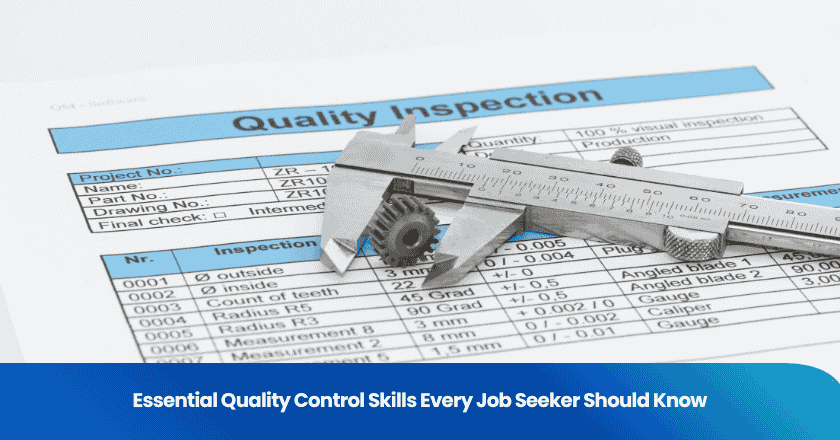
Quality control skills matter to importers when they turn specifications, samples, standards, and factory observations into reliable release evidence. The most useful inspectors and supplier QC teams can read requirements, sample correctly, measure accurately, classify defects, communicate findings, and escalate risk before shipment.
The U.S. Bureau of Labor Statistics describes quality control inspectors as workers who examine products and materials for defects or deviations from specifications. That simple definition is useful because importer-side QC starts with conformance: does the shipment match the requirement?
ASQ's Certified Quality Inspector page says quality inspectors evaluate documentation, perform procedures, inspect products, measure process performance, record data, and prepare formal reports under professional direction. Importers should recognize the same skill pattern in any inspection provider they hire.
The old job-seeker angle is less useful for TradeAider's buyer audience. A better question is: what skills should an importer expect from the person or team whose report may decide whether a shipment is released, reworked, or held?
- Specification reading is the first skill: inspectors need to understand the PO, approved sample, tolerances, and defect rules.
- Sampling discipline matters: the inspector should sample across carton, SKU, color, size, and production groups.
- Defect judgment is a buyer-risk skill: critical, major, and minor classifications should connect to release action.
- Reporting is part of the skill set: a good finding needs photos, counts, lot identity, and an escalation rule.
What Quality Control Skills Should Importers Look For?
Importers should look for quality control skills in specification reading, approved-sample comparison, AQL sampling, measurement, functional checking, defect classification, root-cause thinking, documentation, photo evidence, communication, and escalation when findings affect shipment release.
The inspector does not need to be a product engineer for every category, but the inspector must know how to turn buyer requirements into observable checks. A good inspector asks what to compare, what tolerance applies, how the sample should be spread, and what action follows if the result fails.
O*NET's quality control analyst profile describes testing raw materials, intermediates, and finished products. For importers, that reinforces a broader point: QC skill is not only visual sharpness; it includes data handling, testing awareness, and evidence discipline.
ISO/IEC 17020 ties inspection activity to competence, impartiality, and consistency. Even when a buyer is not requiring formal accreditation, these three words are an excellent skill screen for inspectors and supplier QC teams.
Quality Control Skills Importers Should Screen For
Use this table when choosing an inspector, inspection provider, or supplier QC contact.
| Skill | What It Looks Like | Buyer Evidence | Risk if Missing |
|---|---|---|---|
| Specification reading | Understands PO, sample, tolerances, artwork, and defect classes | Checklist mapped to buyer file | Wrong standard used at inspection |
| Sampling discipline | Samples across cartons, SKUs, colors, sizes, and dates | Sample spread photos and lot notes | Defects hidden in one subgroup |
| Measurement skill | Uses tools correctly and records readings | Photos with tool, value, and tolerance | Dimension disputes after delivery |
| Defect judgment | Classifies critical, major, and minor issues consistently | Defect count and severity logic | Report cannot support release action |
| Communication | Explains findings before leverage is lost | Real-time notes, clear escalation | Late report or unclear remedy |
| Integrity and consistency | Reports facts without supplier pressure | Traceable photos and repeatable method | Buyer cannot trust the evidence |
The table shows why attention to detail is necessary but not enough. An inspector may notice a scratch, but the buyer needs to know whether that scratch is minor, major, repeated, concentrated, acceptable for the sales channel, or serious enough to hold the lot.
The same is true for supplier QC teams. A supplier QC person who can explain process trends, rework actions, and defect concentration is more valuable than a person who only says the goods have been checked.
Importers should also ask how inspectors are trained and calibrated. If two inspectors classify the same defect differently, the buyer's release decision becomes unstable. Calibration can be as simple as shared defect photos, approved sample reviews, and periodic report checks against buyer tolerances.
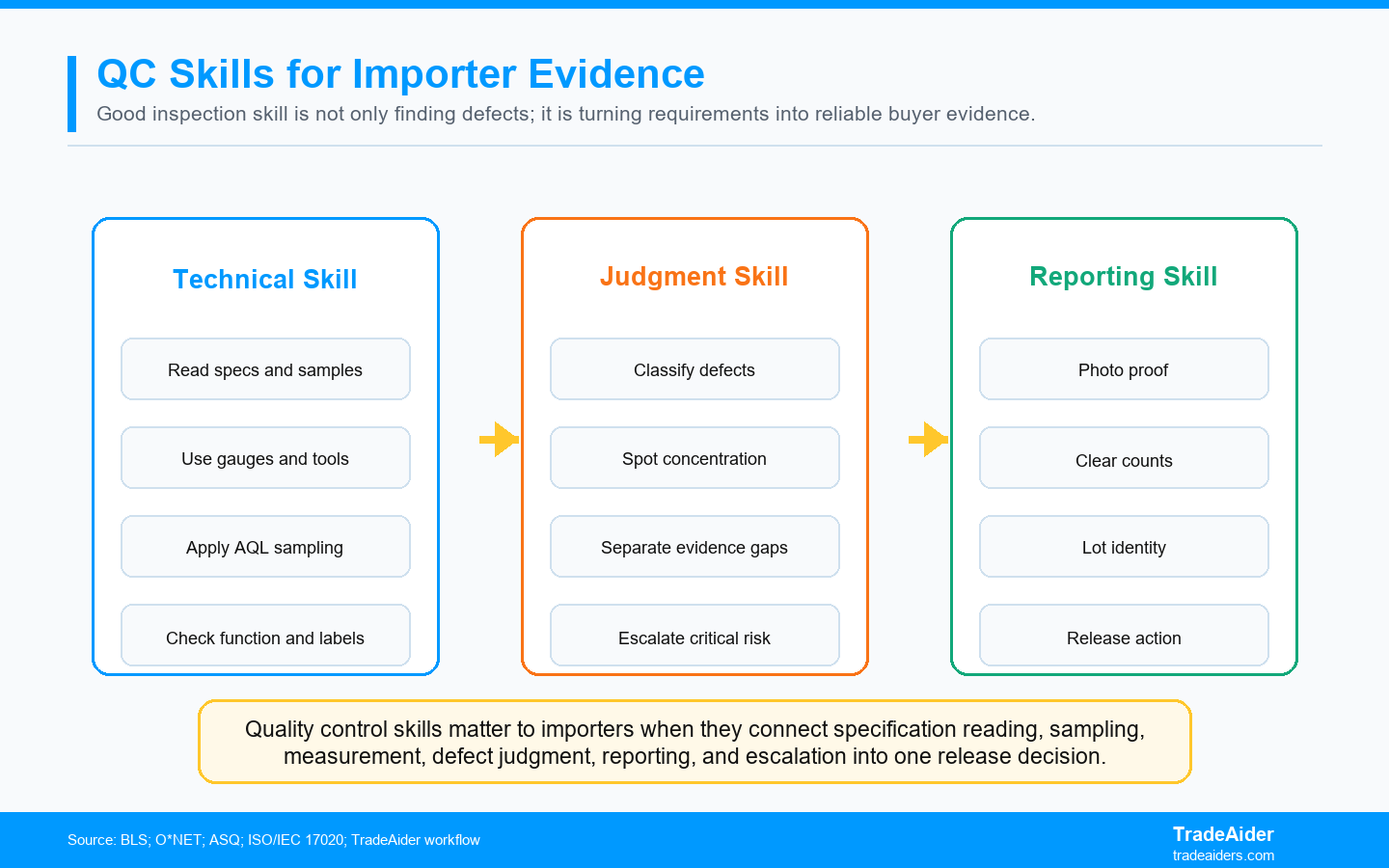
Quality control skills matter to importers when they connect specification reading, sampling, measurement, defect judgment, reporting, and escalation into one release decision.
Quality Control Skills Should Match the Buyer Decision
The best skill set depends on whether the buyer needs prevention, detection, testing awareness, or release evidence.
Specification reading prevents the wrong inspection
Many weak inspections begin with a weak brief. The inspector checks the product, but not the buyer's exact requirement. For importers, specification reading means understanding the PO, approved sample, drawing, tolerance, artwork file, carton mark, destination label, and defect classification before the inspection starts.
If the inspector does not understand the requirement hierarchy, the report may treat a buyer-critical issue as a minor note. For example, a logo color difference may be cosmetic for one product and a brand rejection for another. The inspector needs the buyer context.
Sampling skill protects against hidden subgroup risk
AQL knowledge is more than reading a table. The inspector must understand lot size, inspection level, sample size, defect class, and how to spread samples across the shipment. If samples come from the front of the warehouse only, the result may not represent the lot.
For multi-SKU orders, sampling should include colors, sizes, carton groups, and production dates. A good inspector also records where defects were found so the buyer can decide whether to hold one subgroup or the full shipment.
Sampling skill also includes knowing when to expand a check. If a critical defect appears, or if major defects cluster in one carton group, the inspector should escalate and ask whether the buyer wants additional sampling, sorting, or reinspection instead of finishing the original checklist mechanically.
Good Inspectors Combine Technical Skill With Commercial Judgment
The report should connect facts to buyer risk without exaggerating or hiding limitations.
Measurement and function checks need method discipline
Measurement skill includes tool selection, calibration awareness, reading accuracy, photo evidence, and tolerance comparison. A measurement photo without the accepted tolerance is not enough. The buyer needs to know whether the result matters.
Function checks should also be realistic. A brief power-on check is different from a long-duration reliability test. An assembly check is different from a safety test. Good QC skill includes explaining what was checked and what was outside the inspection scope.
Defect judgment should preserve release options
Defect classification is where technical observation becomes buyer action. A critical defect may require hold or full review. A major defect may fail the lot if the acceptance number is exceeded. A minor defect may be acceptable unless it is repeated, visible to customers, or concentrated in one SKU.
An illustrative calculation shows the skill value. If an inspector identifies that 2.5% of sampled units in one color have a functional defect, a 6,000-unit color group could represent about 150 affected units. That supports a targeted hold instead of a vague complaint.
Reporting and Escalation Are Quality Control Skills Too
A finding that arrives too late or without proof may be useless even when the inspector saw the problem.
A useful report is traceable
Traceability means the buyer can connect each finding to product identity, carton group, SKU, color, size, sample count, and inspection step. This matters during supplier negotiation because the buyer can show exactly where the issue appears.
Photos should include context and close-up evidence. A close-up defect photo proves severity, while a carton, label, barcode, or sample-spread photo proves identity. Without both, the buyer may struggle to isolate the issue.
Escalation skill protects the buyer's leverage
Some findings should not wait for the final report. Critical safety issues, wrong product, wrong barcode, missing labels, severe function failure, or concentrated major defects should be escalated while the factory can still stop packing, sort cartons, or correct the issue.
Real-time communication does not mean informal guessing. It means the inspector sends enough verified evidence for the buyer to decide whether to continue, expand the check, request rework, or hold release until the final report is complete.
A strong inspector also knows what not to claim. If a check was visual only, the report should not imply chemical, electrical, or long-term performance compliance. Honest limitation statements protect the buyer from overreading the report.
Where TradeAider Fits in Inspector Skill and Reporting
TradeAider helps importers turn inspector skill into real-time report evidence that supports release, hold, sort, rework, or reinspection decisions.
TradeAider's Pre-Shipment Inspection service can verify finished goods, packing, labels, quantity, and defect counts before balance payment and shipment release.
When the buyer needs earlier evidence, During Production Inspection can check workmanship and process drift while corrections are still possible. Pre-Production Inspection can help verify sample, material, and readiness before mass production.
TradeAider also gives buyers practical visibility through real-time reports and structured inspection evidence. If the product has hidden compliance risk, product testing services should be coordinated with inspection rather than replaced by visual checks.
SPAR Scenario: The Inspector Found the Defect Pattern, Not Just the Defect
The buyer saved the clean portion of the order because the report showed concentration by carton group.
Situation: A US importer orders 12,000 stainless-steel kitchen tools with two handle colors and mixed cartons.
Problem: The inspector finds loose handles in the black-handle group, but the silver-handle group appears clean.
Action: TradeAider records defect counts by color and carton group, photographs the looseness test, and escalates before payment release.
Result: The buyer holds 3,600 black-handle units for rework, releases the clean silver group, and accepts a two-day delay only on the affected portion.
Quality Control Skills Checklist for Importers
Use this checklist when evaluating inspectors or supplier QC teams.
- Can they read the PO, specification, approved sample, and tolerance?
- Can they apply AQL sampling and spread samples across lot groups?
- Can they measure accurately and photograph evidence with context?
- Can they classify critical, major, and minor defects consistently?
- Can they distinguish inspection findings from testing limitations?
- Can they escalate serious findings before buyer leverage is lost?
Quality control skills are valuable when they change the buyer's decision quality. The best inspector is not only the one who finds defects, but the one who makes the risk clear enough to act on.
When evaluating a provider, ask to see one anonymized report and one defect-classification example. The document will reveal whether the team can translate observations into evidence, or whether it only lists problems without a release path.
Also ask how borderline defects are reviewed. If the provider has no calibration process for repeated judgment calls, the same shipment could pass or fail depending on which inspector is assigned.
For buyer-side teams, the same skills apply internally. A sourcing manager who understands AQL, defect classes, and report limitations can question weak evidence before approving payment.
This shared vocabulary keeps procurement, quality, and logistics aligned when shipment pressure rises.
It also keeps the buyer from accepting a weak supplier explanation when the inspection evidence already shows a pattern that needs rework, sorting, or reinspection.
A practical test is to give the team one failed report and ask what decision they would make next. Strong QC people separate facts, assumptions, supplier promises, and buyer options before recommending release, hold, rework, retest, or reinspection.
For internal training, use real historical defects rather than generic classroom examples. Teams learn faster when they see how a small measurement drift, weak carton, wrong barcode, or unclear photo can change a release decision and supplier negotiation.
If your order depends on accurate sampling, defect judgment, measurement, packaging checks, or fast escalation, send TradeAider the product spec, approved sample, PO, inspection stage, and known risks. The next step is to brief TradeAider on the QC skills your order needs.
Frequently Asked Questions
What are the most important quality control skills?
The most important QC skills are specification reading, sampling discipline, measurement, functional checking, defect classification, reporting, communication, and escalation.
Why do importers need skilled inspectors?
Skilled inspectors turn product requirements into reliable evidence, helping importers decide whether to ship, hold, sort, rework, retest, or reinspect before payment release.
Is attention to detail enough for QC work?
No. Attention to detail is necessary, but inspectors also need sampling knowledge, defect judgment, measurement discipline, report writing, and buyer-risk awareness.
What skills should supplier QC teams have?
Supplier QC teams should control process checks, record defect trends, manage rework, verify materials, communicate changes, and support buyer inspection with accurate evidence.
How can TradeAider support QC skill gaps?
TradeAider can provide structured inspection, real-time reporting, AQL-based sampling, product-specific checklists, and escalation evidence when the buyer needs independent verification.
Related Articles
Grow your business with TradeAider Service
Click the button below to directly enter the TradeAider Service System. The simple steps from booking and payment to receiving reports are easy to operate.

