
- О нас

- Наши услуги
- Ваша отрасль
- Ресурсы
- Новости и блог
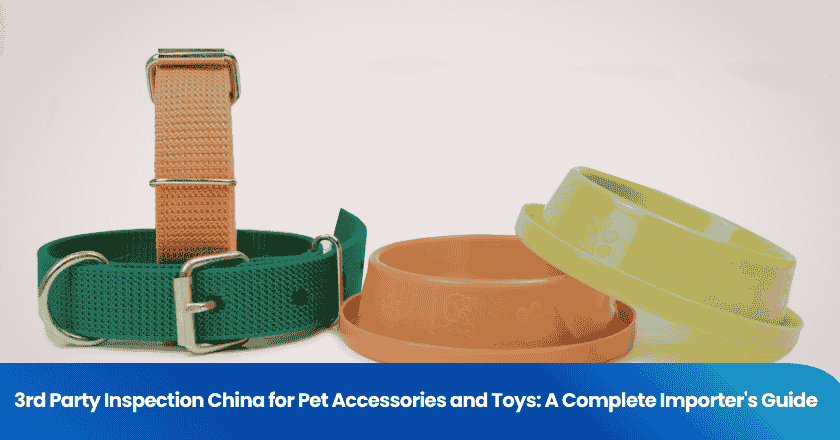
If you're importing pet accessories and toys from China, you already know the stakes. A single batch of defective chew toys can trigger Amazon returns, damage your brand reputation, and expose you to product liability claims. The pet industry is growing fast — the American Pet Products Association (APPA) reports that 94 million U.S. households now own at least one pet, and total industry spending reached $152 billion in 2024. That growth means more competition, more regulatory scrutiny, and less room for quality failures.
Third-party inspection in China is the most practical way to catch defects before they leave the factory. This guide explains exactly what gets inspected, which safety standards apply, and how to structure a quality control process that protects your margins.
Key Takeaways
- ASTM F963 and EN71 compliance is mandatory for pet toys entering the U.S. and EU markets — non-compliant shipments face recalls and import blocks
- A three-stage inspection process (PPI, DPI, PSI) catches defects at the earliest possible point, reducing rework costs by up to 60%
- Third-party inspection in China costs $199 per man-day with transparent pricing — no hidden fees for weekend or holiday inspections
- Real-time reporting lets you see inspection results and photos as they happen, so you can make decisions immediately
Why Pet Product Quality Demands Third-Party Inspection
The Pet Industry Is Booming — and So Are Quality Risks
The U.S. pet market has grown from $45 billion in 2010 to over $152 billion in 2024, driven by millennial and Gen Z pet owners who treat their animals as family members. These consumers don't just expect cute products — they expect safe, durable, and non-toxic items. When a Shopify brand sourcing plush dog toys from Guangdong found a 28% defect rate on arrival (loose eyes, torn seams, and misprinted labels), they lost $35,000 in inventory and three weeks of selling time. A pre-shipment inspection would have caught those defects for roughly $199.
The quality bar is also rising because major marketplaces are getting stricter. Amazon's FBA inbound quality checks now reject shipments with labeling errors, damaged packaging, or products that don't match the listing. Walmart's supplier quality requirements include mandatory third-party testing for children's products, which increasingly applies to pet toys marketed as "for kids and pets."
Common Quality Issues Found in Pet Accessories and Toys
Based on inspection data from pet product factories across Zhejiang, Guangdong, and Jiangsu provinces, the most frequently identified defects include:
| Product Category | Top Defects | Risk Level |
|---|---|---|
| Plush/stuffed toys | Loose eyes/nose, torn seams, stuffing leakage | High (choking hazard) |
| Rubber chew toys | Sharp edges, strong chemical odor, incorrect hardness | High (ingestion risk) |
| Pet collars/harnesses | Weak buckles, frayed stitching, incorrect sizing | Medium (escape risk) |
| Pet apparel | Color bleeding, broken zippers, uneven seams | Low-Medium |
| Feeders/bowls | Lead in coatings, chipped paint, unstable base | High (toxicity) |
Safety Standards You Must Know Before Importing Pet Products
US Market: ASTM F963 and CPSC Requirements
In the United States, the Consumer Product Safety Commission (CPSC) mandates ASTM F963 as the mandatory safety standard for children's toys. While ASTM F963 technically applies to products "designed or intended primarily for children 12 years of age or younger," many pet toys are tested against these same requirements because they share similar construction, materials, and use patterns. Retailers like Amazon and Target often require pet toy suppliers to meet ASTM F963 anyway as a condition of listing.
The latest version, ASTM F963-23, became effective on April 20, 2024. Key requirements relevant to pet toys include:
- Heavy metal limits (lead, cadmium, mercury, and others) in accessible materials
- Small parts testing to prevent choking hazards
- Flammability requirements for textile and plush materials
- Use-and-abuse testing to ensure structural integrity after simulated play
- Sound level limits for squeaker and electronic toys
Manufacturers and importers must have products tested by a CPSC-accepted third-party laboratory and issue a Children's Product Certificate (CPC) when applicable. This is where your inspection partner becomes critical — they can coordinate lab testing alongside physical inspections at the factory.
EU Market: EN71 and CE Marking
For the European market, the Toy Safety Directive 2009/48/EC requires compliance with EN71 standards and CE marking. The European Commission recently adopted the Toy Safety Regulation (EU) 2025/2509, which will replace the Directive and introduce digital product passports for all toys — a significant change for importers managing compliance documentation.
EN71 testing covers three main areas that directly apply to pet toys:
- EN71-1: Mechanical and physical properties (sharp edges, small parts, tensile strength)
- EN71-2: Flammability (how quickly materials catch fire)
- EN71-3: Chemical migration (19 heavy elements including lead, arsenic, and barium)
Additional Regulations for Specific Pet Products
Certain pet product categories carry additional compliance requirements:
- Food-contact items (bowls, feeders, lick mats): Must comply with FDA food-contact material regulations in the U.S. or EU Regulation 1935/2004
- Chemical products (shampoos, sprays): Subject to FDA registration and EU REACH compliance
- Electronic pet products (automatic feeders, heated beds): Require FCC certification (U.S.) or CE electromagnetic compatibility testing (EU)
What a Third-Party Inspection Covers for Pet Products
A comprehensive pet product inspection follows a three-stage process, each designed to catch different types of defects at the point where intervention is most cost-effective.
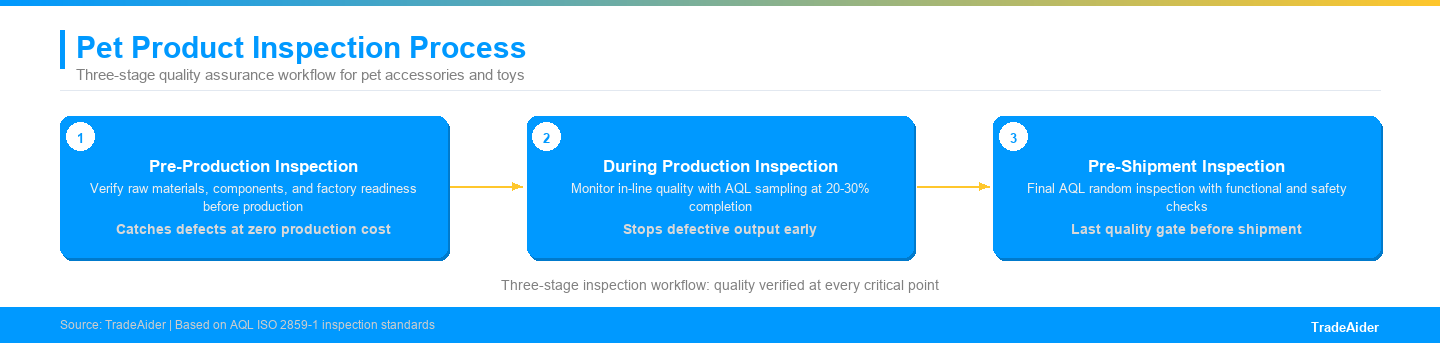
The three-stage inspection workflow ensures quality is verified at every critical point — before, during, and after production
Pre-Production Inspection (PPI): Verify Before You Start
A pre-production inspection happens before mass production begins. The inspector visits the factory to verify:
- Raw materials match your approved specifications (rubber grade, fabric weight, filling type)
- Components like buckles, zippers, and squeakers are the correct model and from approved suppliers
- The factory has your latest product specifications and approved samples on file
- Production equipment is calibrated and in working order
Catching a material substitution at this stage costs almost nothing to fix. Catching it after 10,000 units are produced is expensive. If you're working with a new supplier on pet products, a PPI is the single most valuable investment you can make in quality assurance.
During Production Inspection (DPI): Catch Problems Mid-Production
When 20-30% of your order is produced, a during-production inspection checks the first batch off the line. This is your early warning system. The inspector evaluates:
- Visual appearance against your approved sample (color, stitching, print alignment)
- Dimensional accuracy (sizing of collars, harnesses, and apparel)
- Assembly quality (are all components properly attached?)
- Initial AQL sampling results from the first production batch
If defects are found, you can halt production, correct the process, and avoid producing thousands of defective units. Learn how DPI inspections work and when to schedule them for maximum impact.
Pre-Shipment Inspection (PSI): Your Final Quality Gate
The pre-shipment inspection is the most comprehensive check. It takes place when 100% of production is complete and at least 80% is packed. The inspector performs:
- AQL sampling per your chosen inspection level (typically Level II, the industry standard)
- Visual checks for cosmetic defects, color consistency, and workmanship
- Functional tests — does the squeaker work? Does the buckle hold? Does the zipper open and close smoothly?
- Safety checks — sharp edges, small parts, loose components
- Packaging and labeling — barcode verification, warning labels, country of origin marking
With TradeAider's pre-shipment inspection service, you receive real-time reports with photos and video as the inspection happens — not days later. This means you can approve or reject a shipment within hours, not weeks.
Critical Tests for Pet Accessories and Toys
Beyond visual inspection, pet products require specific physical and chemical tests depending on the product type and target market. Here's a breakdown of the most common tests:
| Test Category | Specific Tests | Applicable Products |
|---|---|---|
| Mechanical Safety | Drop test, tension test, seam strength, compression test | All toys, plush items, collars |
| Chemical Analysis | Heavy metals (8 elements), phthalates, formaldehyde, BPA | Rubber toys, plastic items, coated feeders |
| Flammability | Vertical flame test, horizontal burn rate | Plush toys, fabric apparel, beds |
| Durability | Use-and-abuse testing, bite resistance, wash test | Chew toys, harnesses, apparel |
| Labeling Compliance | Age grading, warning labels, tracking label verification | All products |
Mechanical and Physical Safety Tests
Mechanical tests simulate the physical stress a pet product will experience during normal use. For chew toys, inspectors perform tension tests that pull on attached components (eyes, bells, ropes) with calibrated force to verify they won't detach and become choking hazards. For collars and harnesses, the buckle strength test applies lateral force to ensure the closure mechanism holds under a dog's pulling force. Drop tests from specified heights check whether plastic or rubber toys crack or shatter on impact.
Chemical and Toxicological Tests
Chemical testing is non-negotiable for pet products that go in or near an animal's mouth. Rubber and PVC chew toys are tested for phthalates (plasticizers linked to health issues), lead, cadmium, and other heavy metals. Coated metal feeders are tested for lead content in surface coatings. These tests must be performed by accredited laboratories — your inspection company can coordinate sample extraction at the factory and send them to the appropriate lab.
Durability and Use-and-Abuse Tests
Use-and-abuse testing simulates extended play and wear. Inspectors subject pet toys to repeated impact, flexing, and abrasion cycles. For washable pet apparel, a wash test checks for colorfastness, shrinkage, and seam integrity after laundering. These tests answer the question your customers will ask after three weeks: "Is this product still intact?"
How to Get Started with Pet Product Inspection in China
Setting up a quality inspection process for pet products doesn't need to be complicated. Here's the practical approach most successful importers follow:
- Define your product specifications — Create a detailed product spec sheet including materials, dimensions, colors, performance requirements, and packaging details. This becomes the inspector's reference standard.
- Choose your inspection stages — For new suppliers, schedule all three (PPI, DPI, PSI). For established suppliers with consistent quality, a PSI alone may suffice.
- Set your AQL levels — Most importers use AQL Level II with 2.5% for major defects and 4.0% for minor defects. You can use the AQL calculator to determine exact sample sizes for your order quantity.
- Book your inspection — Schedule at least 5 business days before your expected production completion date. With TradeAider, booking takes minutes through the online platform, and you'll see results in real-time.
Transparent pricing matters. TradeAider charges a flat $199 per man-day with no hidden surcharges for weekend inspections, holiday scheduling, or travel within major manufacturing zones. You know exactly what you're paying before the inspector arrives at the factory.
Get a free quote for your next pet product inspection — most requests receive a response within 2 hours during business hours.
Frequently Asked Questions
Do pet toys require ASTM F963 testing?
Yes, in practice. While ASTM F963 technically covers toys "designed or intended primarily for children," many major retailers require pet toy suppliers to meet the same standard. The CPSC enforces ASTM F963 under 16 C.F.R. part 1250, and products must be tested by a CPSC-accepted laboratory. If your pet toys could reasonably be played with by children — which is most of them — you should plan on full ASTM F963 compliance.
How much does pet product inspection cost in China?
Third-party inspection in China costs $199 per man-day with TradeAider. This covers the inspector's time, travel within standard manufacturing zones, the full AQL inspection, and a detailed report with photos. For orders under 5,000 units, one man-day is typically sufficient. Larger orders may require two man-days for complete coverage.
What is AQL sampling for pet products?
AQL (Acceptable Quality Limit) is the statistical sampling method used to determine how many units to inspect and how many defects are acceptable. At AQL Level II — the most common level — an order of 5,000 units requires inspecting 200 units. If the number of major defects exceeds the acceptance number (typically 10), the entire batch fails inspection. Review the full inspection standard to understand how AQL applies to your products.
How long does a pet product inspection take?
A standard pre-shipment inspection takes one man-day (approximately 8 hours at the factory). This includes AQL sampling, visual inspection, functional testing, photography, and report generation. With TradeAider's real-time reporting, you start seeing results during the inspection itself, and the final report is available within 24 hours.
Can inspection catch all chemical safety issues?
On-site inspection can identify obvious chemical concerns (strong odors, visible residue, wrong materials), but comprehensive chemical testing requires laboratory analysis. Your inspection partner should coordinate sample extraction at the factory and send materials to an accredited lab for heavy metals, phthalates, and other substance testing. This is a separate process from the physical inspection but should be managed together for efficiency.
Похожие статьи
Развивайте свой бизнес с услугами TradeAider
Нажмите кнопку ниже, чтобы войти непосредственно в систему услуг TradeAider. Простые шаги от бронирования и оплаты до получения отчетов легко выполнить.

