
- О нас

- Наши услуги
- Ваша отрасль
- Ресурсы
- Новости и блог
TikTok Shop product quality requirements are the combined platform, legal, and customer-experience conditions a product must satisfy before a seller should list, ship, or replenish inventory. For China sellers, the operational question is not only whether the product can be uploaded to TikTok Shop, but whether the factory lot can prove the listing promise after buyers receive it.
TikTok Shop compresses the distance between content, checkout, and customer feedback. A product can gain demand quickly through short video or livestream traffic, but the same speed also exposes weak specifications, incomplete labels, rushed packaging, or missing compliance evidence faster than a slower marketplace launch. Quality control therefore has to begin before the product page is published and continue through final shipment release.
China sellers often treat platform requirements as a documentation task handled by the operations team. The safer view is that TikTok Shop requirements create a factory checklist. If the listing claims a material, function, accessory set, battery type, size, safety warning, ingredient, or origin statement, the factory must be able to produce physical evidence that the mass-production lot matches that claim.
The practical standard is simple: the product page should describe only what the inspected shipment can prove. That standard protects listing approval, buyer trust, return rates, and the seller's ability to keep a winning SKU live after the first burst of traffic.
Key Takeaways
- Definition: TikTok Shop quality requirements combine platform listing rules, category compliance, product conformity, and customer-experience risk.
- Decision: Build the factory inspection checklist from the exact claims in the TikTok Shop product page, not from a generic product category template.
- Compliance: Regulated products need documents before shipment because platform review, customs, or U.S. regulators may ask for evidence later.
- Timing: A PSI is conducted when 100% of the order quantity is completed and at least 80% is packed for export.
- Boundary: Platform badges, seller history, or supplier photos do not replace final-lot evidence from the factory.
TikTok Shop Quality Starts With the Listing Promise
A TikTok Shop listing is not only a marketing asset. It is the specification buyers, reviewers, and platform teams will compare against the delivered product. The first quality task is to turn every customer-visible promise into a measurable factory checkpoint.
TikTok Shop Seller Center and Seller University resources emphasize accurate product information, category rules, product detail quality, and policy compliance. Those platform requirements matter because a short video can turn a small wording gap into a large fulfillment problem. If a listing says "stainless steel," "BPA free," "fast charging," "for children ages 3+," or "dermatologist tested," each phrase creates a proof obligation that the factory, testing file, and packaging must support.
According to TikTok Shop Seller University, sellers use official learning and policy resources to understand listing, product, and operational requirements. Market rules vary, but the operational pattern is stable: product identity, restricted-category status, claims, price, images, and fulfillment information must be accurate enough for platform review and buyer trust. For China sellers exporting to the United States, that platform layer sits on top of product safety, labeling, and customs obligations.
The hidden risk is that TikTok content often exaggerates the best demonstration of a product. A factory inspection should therefore test the ordinary unit in the carton, not only the perfect sample used for video. In practice, the inspector should compare mass production against the product page, approved sample, purchase order, manual, retail box, barcode label, and any compliance files that support the claims.
Product identity must survive the jump from video to carton
Product identity is the first failure point because TikTok Shop traffic is driven by what shoppers see. The inspected SKU must match the variation name, color, size, material, model number, accessory count, language version, and packaging shown in the listing. A beauty organizer shown with 12 compartments but shipped with 10 creates a visible mismatch. A phone stand shown holding a tablet but shipped with a weaker hinge creates a function mismatch. A charger shown with a USB-C cable but shipped with a micro-USB cable creates an accessory mismatch. These are not cosmetic details; they are return triggers because the buyer can compare the delivered unit against the content in seconds.
Regulated claims need documents before the product moves
Regulated claims should be checked before final packing because documentation is difficult to repair after cartons enter export flow. According to the U.S. Consumer Product Safety Commission, children's products subject to children's product safety rules require a Children's Product Certificate based on testing from a CPSC-accepted laboratory. According to the FCC equipment authorization guidance, radiofrequency devices may require authorization before marketing or import. According to the FDA dietary supplement labeling guide, supplement labels need required nutrition and ingredient information. If a TikTok Shop seller lists toys, battery electronics, wireless devices, cosmetics, supplements, or food-contact goods in 2026, the factory release decision should include document review, not only visual inspection.
Customer-experience checks need to follow the content angle
TikTok Shop quality inspection should follow the content angle because the video promise decides what buyers notice first. A kitchen tool demonstrated as "one-hand use" needs a usability check. A storage product promoted as "fits under narrow sinks" needs measurement verification. A rechargeable device promoted as "travel friendly" needs charging, heat, manual, battery label, and packaging checks. The risk is not only that the product fails a laboratory standard. The risk is that the buyer receives something that does not perform the behavior that persuaded them to buy. On a 5000 unit launch, a 2% mismatch in the feature shown by the creator still creates 100 units that can generate returns, comments, or support tickets during the most visible sales window.
TikTok Shop Requirement vs Factory Evidence
The useful way to manage TikTok Shop quality is to pair each platform-facing requirement with factory-side evidence. If the seller cannot name the evidence before shipment, the requirement is not controlled.
The table below converts common TikTok Shop quality requirements into inspection evidence. It is not a substitute for market-specific TikTok Shop policy review. It is a release tool for China sellers who need to decide whether the current lot is ready to ship.
| Requirement Area | Platform or Buyer Risk | Factory Evidence Before Shipment | Hold Rule |
|---|---|---|---|
| Listing identity | Wrong variation, model, or bundle reaches buyer | SKU label, sample match, accessory count, product photos | Hold if any customer-visible promise is false |
| Category compliance | Restricted product review, document request, removal | Test report, certificate, manual, warning label, claim file | Hold if required evidence is missing or mismatched |
| Barcode and packaging | Receiving error, wrong item shipped, damaged presentation | Barcode scan, carton mark, retail pack, drop-risk photos | Rework if labels or protective packaging fail |
| Function shown in content | Returns from expectation gap after video-driven purchase | Function test, measurement, stress test, use-case video | Sort or rework if the demo behavior is inconsistent |
| Post-purchase support | Complaints from unclear use, missing parts, wrong language | Manual, insert, spare parts count, service contact card | Correct before shipment if buyer setup can fail |
The conclusion from the comparison is that TikTok Shop quality control is not a single "pass inspection" event. It is a chain of proof. The listing, documents, package, and final lot must point to the same product. When one link is missing, the seller should fix that specific evidence gap instead of asking whether the factory is generally reliable.
A Release Sequence for China Sellers
China sellers should move from category classification to claim control, then from claim control to final-lot inspection. The sequence matters because a factory cannot inspect what the seller has not defined.
The release sequence should start before purchase order confirmation. First, classify the product by category, destination market, claims, power source, age grade, material contact, and any restricted-product rule. Second, freeze the listing promise that will be checked during production. Third, send the factory an inspection checklist that reflects the frozen promise. Fourth, inspect the completed lot before export packing is finished beyond recovery. According to U.S. Customs and Border Protection marking guidance, origin marking can affect imported articles, so the release sequence should include label and carton checks when goods are bound for the United States.
A PSI is conducted when 100% of the order quantity is completed and at least 80% is packed for export. That timing is important for TikTok Shop sellers because it gives the inspector enough finished goods to sample while still leaving the factory enough access to rework labels, packaging, accessories, or obvious defects. If inspection is scheduled after the container is sealed, the seller has turned a factory problem into a logistics problem.
According to ASQ's ANSI/ASQ Z1.4 overview, sampling standards are used for inspection by attributes. For a TikTok Shop shipment, the seller should define critical, major, and minor defects around the listing promise. A wrong safety warning may be critical. A missing accessory may be major. A small retail box rub mark may be minor unless the product is gift-oriented and the listing emphasizes premium packaging.
Classify the product before the listing is finalized
Classification should happen before content production because product category changes can alter documents, labels, claims, and shipping decisions. A facial cleansing brush is not only an attractive beauty SKU; it may also be an electrical device with charging, battery, material, and claim risks. A children's craft kit is not only a low-cost impulse product; it may need age grading, small-parts warnings, and certificate evidence. In practice, classification prevents sellers from creating content that the factory cannot legally or consistently support. A 24 hour classification review before filming is cheaper than rewriting claims after 4800 units are already packed with the wrong manual.
Translate the content promise into inspection points
The content promise should become measurable inspection points before the lot is finished. If the video says "no leaking," the checklist needs a leak test. If the title says "304 stainless steel," the checklist needs material evidence. If the bundle image shows five accessories, the inspector must count five accessories in sampled units. According to GS1, barcodes support unique identification and scanning across supply chains. For TikTok Shop sellers, barcode control is part of the same promise-control system: the product in the buyer-facing content, the product identity in the data, and the unit in the carton must all match.
Use final-lot inspection to choose release, rework, or hold
Final-lot inspection should produce a commercial decision. Release is appropriate when product conformity, packaging, labels, and required documents support the listing. Rework is appropriate when the factory can correct a defined defect before export. Sorting is appropriate when the defect is isolated to a portion of the lot. Holding is appropriate when the seller cannot prove category compliance, product identity, or customer-visible performance. The point is to make the decision while the goods, cartons, workers, and supplier leverage are still in one place. On a 3000 unit shipment, even a 1% accessory error creates 30 disappointing deliveries, so a small factory-side sort can protect a much larger marketplace outcome.
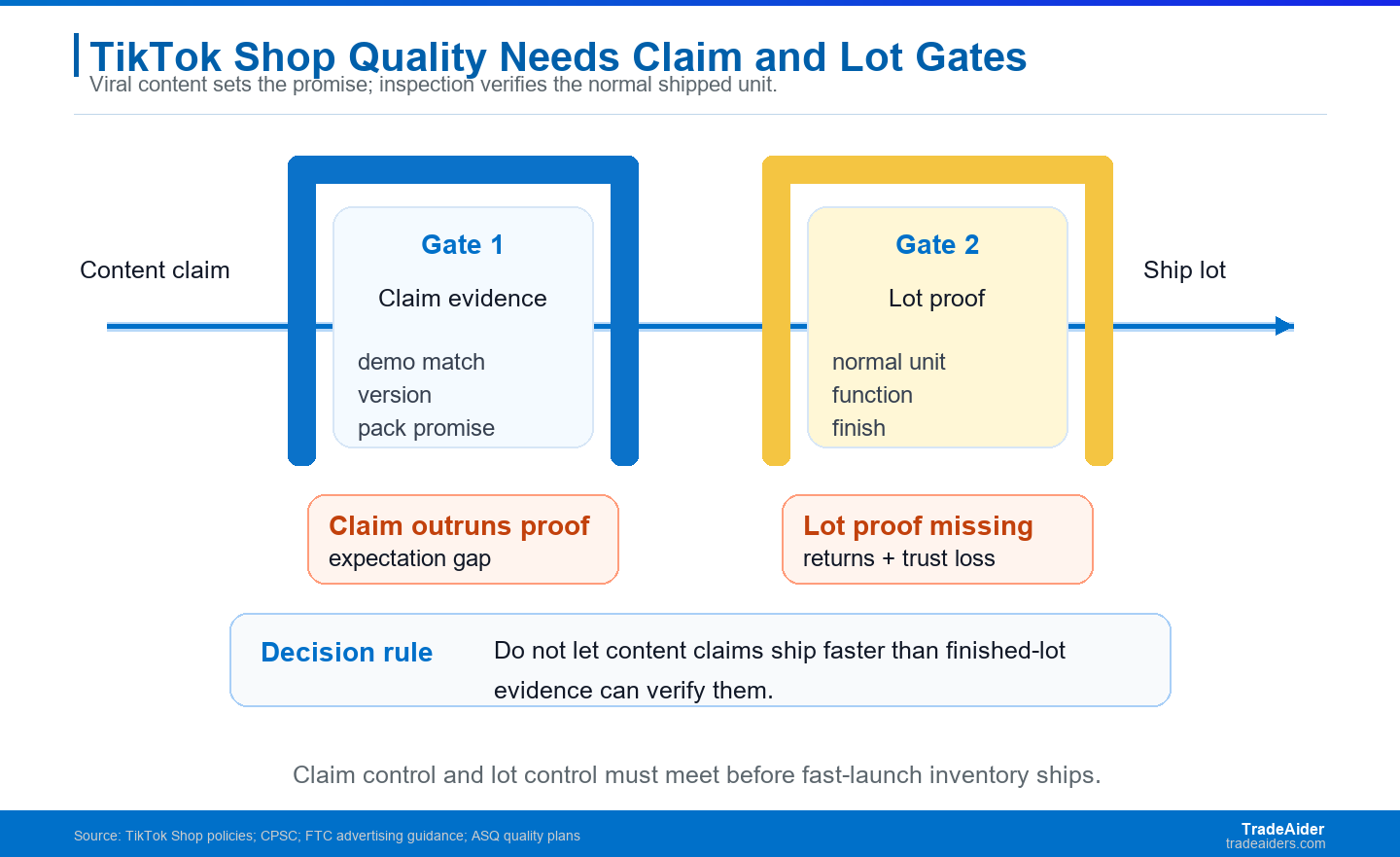
TikTok Shop quality control starts with the listing promise and ends with a shipment release decision.
SPAR Scenario: A Beauty Device Launch Before a Livestream Push
A TikTok Shop launch can fail even when the product looks good on camera. The shipment still has to prove charging safety, label accuracy, accessories, and packaging consistency across the actual lot.
Situation: A Shenzhen seller prepares 4,800 rechargeable facial cleansing brushes for a TikTok Shop campaign. The listing video shows a magnetic charging cable, IPX7 water-resistance language, three brush heads, and a giftable retail box. The factory says production is finished and asks for immediate balance payment because the creator campaign starts in 10 days.
Problem: During PSI, the inspector finds that 11 of 200 sampled units include only two brush heads, 6 units have a charging cable that does not match the manual image, and one carton lot uses an older retail box without the updated water-resistance wording. The product may still function, but the inspected lot no longer matches the buyer-facing content.
Action: The seller holds release for 48 hours, asks the factory to open affected cartons, replace accessory kits, update the manual insert, and segregate old retail boxes. The seller also removes the strongest water-resistance phrase from the first livestream script until document evidence is confirmed. A short reinspection checks accessory count, charging cable match, box version, and carton relabeling.
Result: The shipment misses the earliest consolidation slot but avoids sending a mixed-version lot into a high-visibility launch. The seller keeps the creator campaign, but the first batch now matches the product page closely enough to reduce avoidable returns from accessory gaps, box confusion, and unsupported claims. The trade-off is real: two days of delay protects the first wave of buyer trust.
TikTok Shop Quality Action Card
- Freeze the title, images, variation names, claims, and bundle contents before mass production starts.
- Mark every regulated claim with the document that proves it: certificate, test report, label, manual, or supplier declaration.
- Turn the strongest video demonstration into a physical inspection test on sampled finished units.
- Scan barcodes and compare retail packaging against the exact SKU and variation that will be sold.
- Do not release the shipment if compliance evidence is missing, even when product appearance looks acceptable.
Frequently Asked Questions
Does TikTok Shop inspect every product before sellers list it?
TikTok Shop review processes vary by market and product category. Sellers should not assume platform review replaces factory inspection. Platform review checks the listing and policy compliance; factory inspection checks whether the actual shipment matches the approved product, packaging, and claim evidence.
Which TikTok Shop products need the strictest quality checks?
Strict checks are most important for children's products, battery electronics, wireless devices, cosmetics, supplements, food-contact goods, products with safety claims, and products whose video demonstration creates a strong performance promise.
Can a seller fix TikTok Shop quality issues after shipment?
Some listing text can be edited after shipment, but product, packaging, accessory, and label problems are much more expensive to fix once goods leave the factory. Inspection is valuable because it keeps corrective action close to the source of the defect.
Похожие статьи
Развивайте свой бизнес с услугами TradeAider
Нажмите кнопку ниже, чтобы войти непосредственно в систему услуг TradeAider. Простые шаги от бронирования и оплаты до получения отчетов легко выполнить.

