
- О нас

- Наши услуги
- Ваша отрасль
- Ресурсы
- Новости и блог
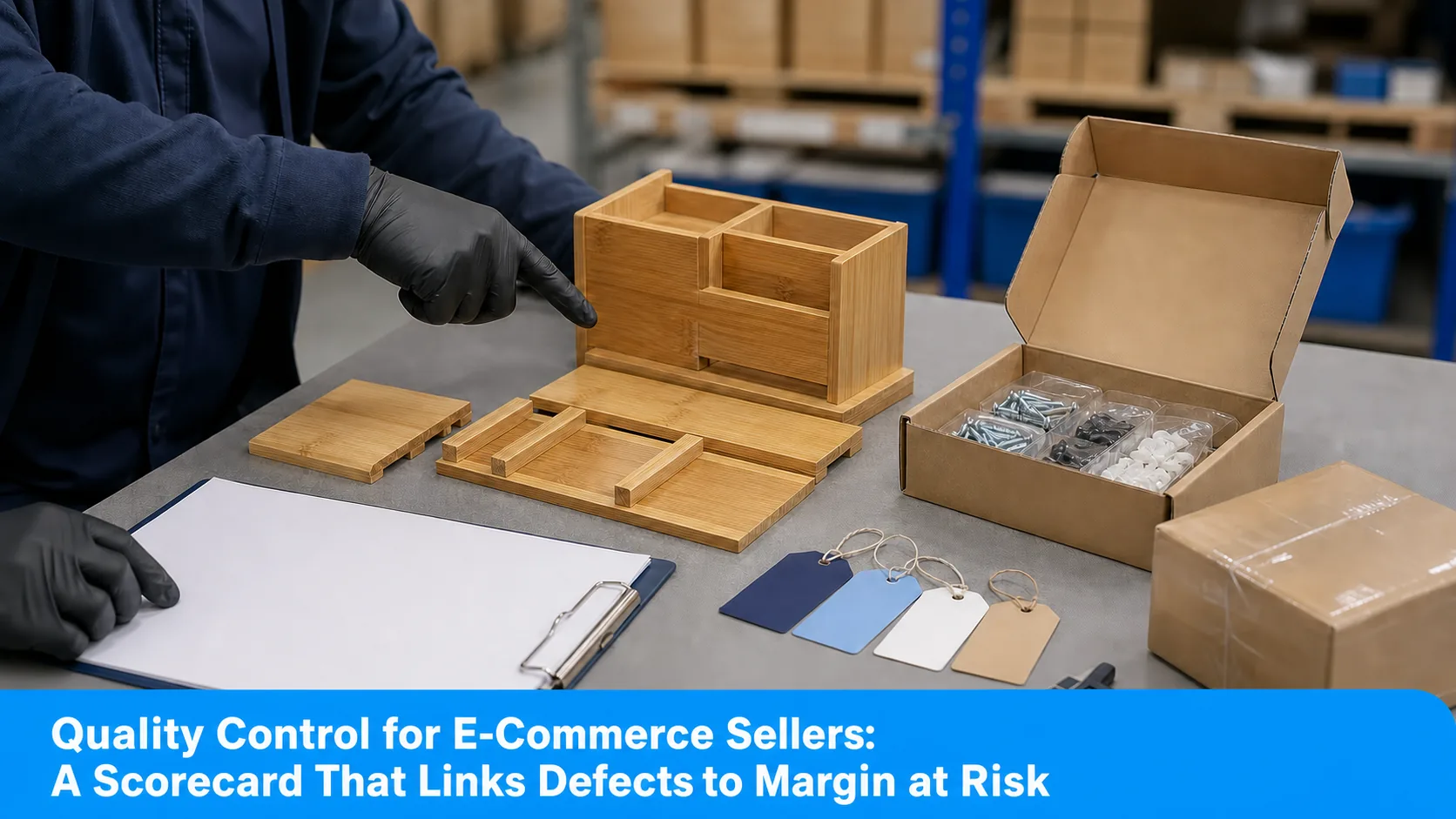
A rising return rate is not a supplier score. It may reflect a factory defect, but it can also reflect a listing mismatch, delivery damage, fit expectation, fulfillment error, or customer misuse. The practical job is to keep those possibilities visible long enough to test them. A useful scorecard therefore starts before the sale, follows a bounded SKU and production cohort through the market, and shows the financial exposure only after the records can be matched. It gives an e-commerce team a disciplined way to decide whether to monitor, contain stock, revise a non-factory cause, or ask the supplier for corrective evidence.
The 12 measures below are organized as six leading factory metrics, four customer-market signals, and two margin measures. They are not universal targets and they do not prove supplier fault. Their value is the link between them: a seller can see whether a specific defect tag appears in the same SKU, version, lot or process window, and sales period before turning a downstream signal into a supplier action.
A Useful Scorecard Keeps the Causal Trail Intact
A useful e-commerce quality scorecard links factory defects to a shared sales cohort, customer outcome, and margin consequence before it changes a supplier decision. That order prevents a familiar mistake: using a marketplace outcome to condemn a whole supplier order without checking the configuration, period, and defect mechanism underneath it. The scorecard should be a decision record, not a leaderboard. TradeAider can help teams define what will be checked before inventory reaches the sales channel; an e-commerce quality-control plan makes the factory-side inputs explicit.
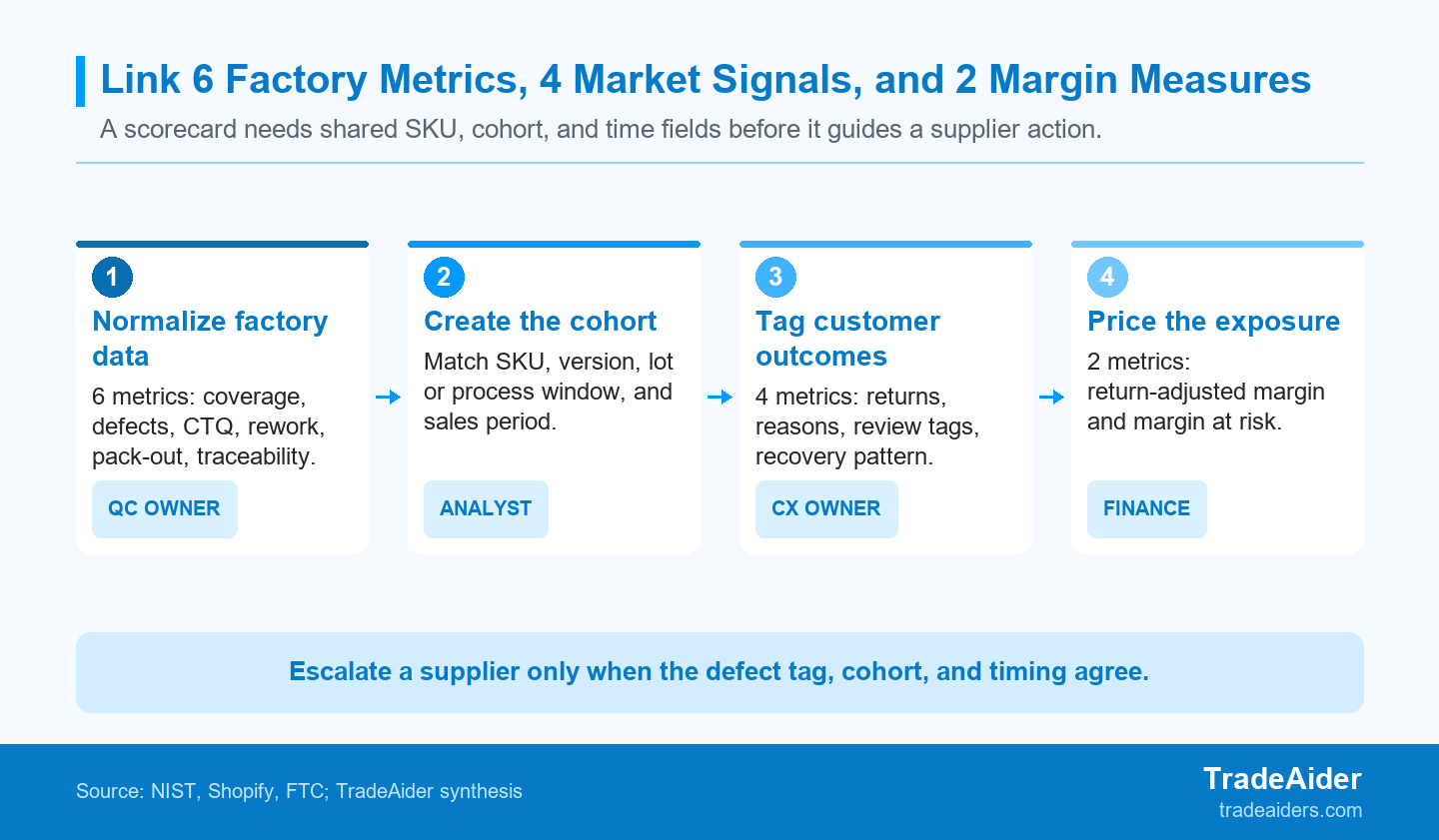
The scorecard turns 12 measures into a decision only after the factory, customer, and finance records share a defined cohort.
- Factory evidence: record what was checked, against which requirement, in which population.
- Cohort match: keep SKU, variant, lot or process window, defect tag, and time window together.
- Market signal: treat returns and review language as investigation inputs, not a verdict.
- Margin consequence: quantify a matched exposure so the next action has commercial priority.
The 6-4-2 split keeps leading and lagging measures in their proper place. The first six help the seller see a production or pack-out issue before it becomes a customer complaint. The next four show the customer-facing pattern after sale. The last two tell the team how much of that pattern is worth containing or investigating first. Use the same fixed reporting period for every metric in a comparison; otherwise an early inspection record and a later return spike can look connected when they merely sit in the same dashboard.
| Group | Metric | Record or calculation | Decision use |
|---|---|---|---|
| Factory | 1. Inspection coverage | Checked units ÷ population | Sets the scope |
| Factory | 2. Critical-defect count | Count by critical class | Tests a hold |
| Factory | 3. Major-defect mix | Count by mechanism | Separates issue types |
| Factory | 4. CTQ conformance | Result for each CTQ feature | Protects promised function |
| Factory | 5. Rework verification | Closed action with recheck | Confirms repair |
| Factory | 6. Pack-out traceability | SKU, carton, lot, pack code | Enables later matching |
| Market | 7. Total return rate | Returns ÷ sold units | Locates pressure |
| Market | 8. Defect-attributed return share | Coded quality returns ÷ all returns | Separates non-quality returns |
| Market | 9. Review defect-tag rate | Repeated tags ÷ reviews | Flags phrases to check |
| Market | 10. Time to signal | Days from delivery to signal | Sets the comparison window |
| Margin | 11. Return-adjusted margin | Contribution less return cost | Compares cohorts |
| Margin | 12. Margin at risk | Matched units × net loss | Prioritizes containment |
Start With Six Leading Factory Metrics
NIST describes statistical quality control as using process monitoring and lot inspection to manage product conformance in a cost-conscious way. See NIST's process-control guidance. Its practical relevance here is limited but important: factory records describe the controlled population and the check that occurred; they do not forecast every customer return. Record the inspection date, population definition, sample or carton scope, requirement revision, and disposition alongside the result. Those fields let a seller compare like with like when a market signal later appears.
Start every row with a cohort key. A cohort is a comparable group of orders that share relevant attributes such as SKU, variant, production window, carton range, and fulfillment receipt date. The exact format can vary, but the same key must be capable of appearing in the inspection record, inventory system, and return or support export. If the information cannot be carried across those records, report the result as an unlinked quality observation rather than a customer-outcome explanation. For a reusable way to set those fields, see this inspection-standard framework.
Measure Defects by Decision Class, Not a Single Pass Rate
NIST describes lot-acceptance sampling as a decision rule for accepting, rejecting, or taking another sample from a lot. See NIST's lot-acceptance sampling guidance. That is why a single pass percentage is too compressed for an e-commerce scorecard. Keep the critical count, major-defect mix, and actual defect tags visible. A small count of a safety, functional, or missing-component defect may deserve a different decision than a higher count of minor finish variation, even when both sit under the same broad "inspection result."
Define the decision classes before inspection begins. A critical-to-quality (CTQ) feature is a product feature that must work or conform for the customer to receive the promised item. For a rechargeable product, that might include battery safety markings and charge function; for a furniture kit, it may include load-bearing hardware and the count of required fasteners. The scorecard should state the agreed requirement and the detection method, then preserve the observed class.
Capture the Fields That Let You Match a Finding Later
NIST explains that process capability compares an in-control process with specification limits and carries stated sample and distribution assumptions. See NIST's process-capability guidance. Do not turn a capability label or a measurement average into a universal claim about all shipped units. Instead, retain the specification revision, measurement method, units, sample count, process or machine window, inspector, and any assumption that affects the comparison. These are the fields that make a dimensional or functional finding interpretable after the shipment has moved.
Pack-out records deserve the same discipline. A missing accessory, wrong insert, or damaged retail box often becomes visible only after fulfillment, so keep the carton code, packaging revision, component count, and any rework identifier with the cohort. If a seller later sees a matching return reason, the record can narrow the check to a defined exposure. If those fields are absent, the correct conclusion is "investigate," not "the supplier caused every return."
Add Four Customer-Market Signals Without Calling Them Root Cause
Shopify identifies refund and return rate as one of its essential e-commerce metrics. See Shopify's e-commerce metrics guide. In a quality scorecard, that makes the measure a useful outcome signal, not a cause label. Segment it by the same SKU, variant, sales channel, fulfillment method, delivery period, and customer-use window where possible. A total return rate can tell the team where pressure is building; only coded reasons and a cohort match can begin to explain what should change upstream.
Keep non-factory reasons visible rather than deleting them to make the quality view look cleaner. Listing accuracy, sizing expectations, transit damage, late delivery, duplicate shipments, and buyer remorse may each require a different owner. This preserves the credibility of the factory-quality portion: the supplier is asked to answer a defined mechanism, while the seller can still correct a listing, packaging, or fulfillment issue that has nothing to do with production.
Split Return Volume From Defect-Attributed Returns
Shopify lists return rate, exchange and refund rate, return-to-resale rate, and top return reasons by SKU, category, and channel as distinct returns measures. See Shopify's returns KPI guidance. Do not flatten them into a single factory number. Start with all returns for the matched sales cohort, then create a narrower subset for reasons that plausibly describe a product, packaging, or quality issue. Preserve the original reason code, any support note, the return date, and the fulfillment or order reference rather than recoding the history to fit a supplier narrative.
Use both counts and rates. Ten defect-attributed returns can be serious for a small, newly released cohort but trivial in a much larger one; the rate gives that count context. Conversely, a rate based on only a few delivered units should remain a watch signal until the period matures. If returned inventory is checked, add its observed condition as a separate field. A customer saying "won't assemble" and a warehouse record showing a missing fastener are related evidence, but they are not identical evidence.
Treat Review Language as a Signal, Not a Rating Target
FTC guidance says businesses should not condition review incentives on positive sentiment or discourage negative reviews. See the FTC's guidance for customer reviews. That boundary supports a better scorecard practice: preserve authentic review language, then tag recurring defect mechanisms such as "missing screws," "lid leaks," or "won't charge." Do not lower a supplier score merely because an average rating moves. A star rating collapses many causes; a repeated, reviewable product phrase may be a useful lead only when it agrees with the SKU, time window, and factory-side record.
Tagging should be narrow enough to be auditable. Keep an "unknown" tag, retain the original text, and separate a product-function phrase from a service or delivery complaint. A related FTC review-rule Q&A also distinguishes review hosting from creating, buying, or disseminating fake or false reviews. The scorecard should use genuine customer language to prioritize a check, never as a mechanism for manufacturing a better review record. When production is still running, test a repeated factory-side mechanism before the remaining stock is packed.
Translate Quality Loss Into Two Margin Measures
Margin at risk is an illustrative operating estimate that should be calculated only from a matched, defect-attributed cohort. It is not a damages figure, a recovery promise, or an accusation. For each included unit, use a transparent net-loss assumption: contribution margin that will not be realized, plus handling and refund or return freight, minus any documented recovery value from resale, salvage, or exchange. Keep every input visible so finance, operations, and the supplier are not debating a black-box score.
The companion measure is return-adjusted margin: sales contribution for a comparable cohort less the matched return cost. Use it to compare two variants, carton codes, or production windows after the same delivery and use period. Avoid mixing a mature cohort with a newly delivered cohort, or a high-recovery item with a non-resalable item. The result helps rank the next check; it does not establish why the loss occurred.
Run a Linking Test Before You Escalate a Supplier
A supplier decision needs a matched SKU, production cohort, defect tag, and time window; otherwise a customer pattern is only a lead for investigation. Treat this as a four-part check. First, is the customer order the same SKU and configuration? Second, can it be tied to the production, carton, or process cohort at issue? Third, does the return reason or review tag describe the same defect mechanism? Fourth, does the timing fit delivery and likely customer use? A "no" or "unknown" on any field limits the action to investigation or data repair.
A complete link does not require false precision. Some sellers cannot map every order to an exact manufacturing lot, especially after commingled fulfillment. In that case, state the best available cohort, the missing field, and the scope of the proposed action. For example, holding a documented carton range while checking pack-out records is a bounded decision. Holding every SKU from every supplier because reviews fell is not. The scorecard is working when it reduces the scope of the question before it raises the severity of the response. A during-production inspection checkpoint can test a repeated factory-side mechanism before the remaining stock is packed.
Worked Scenario: A Desk-Organizer Kit Starts Losing Margin
A return pattern that appears to match one factory finding still needs a cohort-linking test before a seller contains inventory or escalates a supplier. This illustrative case shows why the scorecard should narrow the inventory decision before it broadens the supplier conclusion.
Calculate the Decision, Then Test the Suspected Cause
A DTC home-organization brand sells a four-piece bamboo desk-organizer kit through its store and a marketplace channel. The brand ordered 2,400 kits across two finish options, with assembly hardware packed in a small accessory carton. The first half of the order has sold for five weeks; the second half remains in a domestic fulfilment location.
Inspection records show a rise in missing fastener packs in one production window for the natural finish. Twenty-six return records are tagged to incomplete hardware, while review text for the natural finish mentions loose dividers and missing fasteners. The scorecard has SKU, finish, and sales-window data but does not yet connect every customer order to the accessory-carton code.
In this illustrative scenario, 26 return records tagged to incomplete hardware do not prove an order-wide supplier failure until the accessory-carton code is checked. The scorecard separates all returns from the 26 returns tagged to incomplete hardware, then checks whether those customer orders map to the natural-finish SKU and the same accessory-carton code before treating the pattern as supplier-linked. Contain the unsold natural-finish cohort, request carton-code reconciliation, and do not hold the painted-finish cohort until the shared-accessory exposure is verified. This is a staged response: it protects the most plausible cohort without treating a partial link as a complete root-cause finding.
The next release can use a pre-shipment inspection before channel release focused on accessory count, carton identification, and documented rework verification. For a transparent priority estimate, assume the matched return loss is $18 of lost contribution margin plus $6 of handling and refund freight, less $4 of recovery value. The illustrative margin at risk is 26 × ($18 + $6 − $4) = $520. That number is only a prioritization estimate; it should change if the reason code, recovery value, or cohort match changes.
Ask the supplier to reconcile accessory count records, segregate the affected carton code, and provide a rework count before the next release. Release only the documented unaffected cohort or the reworked cohort after an accessory-count check confirms the agreed pack-out condition. This is an illustrative composite, not a TradeAider client case or a claim that missing hardware caused every return.
Turn the Scorecard Into the Next Inspection Brief
The next inspection brief should name the SKU, variant, evidence tag, process or lot window, and decision that the scorecard needs to resolve. Add the relevant CTQ check, carton or component count, packaging revision, sample or coverage rule, photo requirement, and release boundary. A brief framed this way tells an inspector what evidence the seller needs, while keeping the work separate from a conclusion the data has not yet earned.
Set the action boundary before the report arrives. Examples include: hold the named carton range when a critical defect is found; request rework evidence when the same major defect repeats; or continue monitoring when the market signal cannot be matched to a factory cohort. Record the exact verification method, evidence recipient, and release owner so the next report answers an operational question instead of creating a new one. If your team needs help translating the fields into a checkable request, ask TradeAider to map your scorecard to an inspection brief.
Who Is TradeAider?
TradeAider provides quality-control context for China-sourced e-commerce goods without promising a return outcome or a supplier score. Its role in this type of workflow is to help turn a product risk into an observable inspection scope: a defined SKU and variant, the relevant function or pack-out condition, the population that can be checked, and the evidence the seller needs for a release or corrective-action conversation.
A useful external inspection record does not replace the merchant's return, review, inventory, or margin data. It gives those teams a bounded factory-side record to compare with their own cohort evidence. That distinction matters when one product has several versions, suppliers, packaging revisions, or fulfillment paths.
Before arranging a check, state which customer-facing signal is being investigated, which product configuration can be observed, and which inventory decision will change if the evidence agrees. This keeps the inspection purpose narrow enough to verify and helps the merchant preserve ownership of commercial decisions. The service does not set a universal acceptance threshold, decide a platform refund, or transform a partial signal into a supplier-fault determination. It supports a factual conversation about the defined goods and the evidence that is still missing. The buyer still owns the final release, listing, fulfillment, and customer-remedy decisions, while the inspection scope remains a defined evidence request. Learn more about TradeAider's China quality-control background.
Frequently Asked Questions
Which returns belong in a supplier quality scorecard?
Only returns with a coded product, packaging, or quality issue should enter the supplier-quality view; keep sizing, listing, delivery, and abuse cases separately visible. Retain the original return reason and any support note, then add a normalized defect tag only when the wording supports it. The supplier-facing subset should remain narrower than total returns, because the scorecard is trying to test a product mechanism rather than explain every customer decision.
Should a low star rating lower a supplier score?
No. A low rating should trigger review-language tagging and cohort checking, because the rating alone does not identify a manufacturing cause or supplier responsibility. Check whether specific product phrases recur, whether the same SKU and time window are affected, and whether the factory or pack-out record contains a related mechanism. If not, the action may belong to the listing, service, delivery, or product-design owner rather than the supplier.
How long should sellers wait before comparing defects with returns?
Wait for a pre-defined sales and return window that fits the product's delivery and use cycle, then compare like-for-like SKU and version cohorts. The window should allow time for delivery and ordinary use without mixing a mature cohort with newly delivered inventory. Record the start and end dates in the scorecard; otherwise a late seasonal spike or fulfillment delay can be mistaken for a production trend.
Can every SKU use the same defect threshold?
No. Defect thresholds should reflect the SKU's critical features, selling price, use conditions, packaging risk, and the cost of a customer-facing failure. A missing component may be release-blocking for a kit, while a minor surface variation might call for a different response. Define the class, coverage, and action boundary in the product's inspection brief rather than applying a broad scorecard number to unrelated goods.
What conditions should trigger a new inspection?
Trigger a new inspection when a linked cohort shows a repeated defect tag, rising defect-attributed returns, or margin exposure that exceeds the agreed action boundary. The request should name the exact mechanism to test and the inventory or production scope to check. If the cohort link is incomplete, start with a targeted verification or data-reconciliation step rather than assuming a full order failure.
Похожие статьи



Развивайте свой бизнес с услугами TradeAider
Нажмите кнопку ниже, чтобы войти непосредственно в систему услуг TradeAider. Простые шаги от бронирования и оплаты до получения отчетов легко выполнить.

