
- О нас

- Наши услуги
- Ваша отрасль
- Ресурсы
- Новости и блог
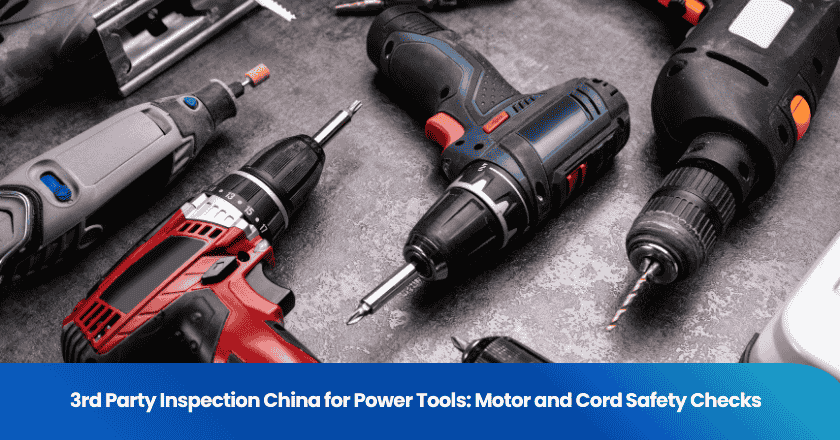
A corded drill with a frayed power cable. A circular saw whose motor overheats after two minutes of use. A grinder with inadequate grounding that delivers an electric shock the first time it's plugged in. These aren't hypothetical scenarios—they're the types of dangerous defects that third-party inspectors find regularly in Chinese power tool factories.
Power tools sit at the intersection of electrical safety and mechanical reliability. A defect that would be merely cosmetic on a hand tool becomes a genuine safety hazard on a powered one. That's why motor and cord safety checks are among the most critical elements of any pre-shipment inspection for electric power tools manufactured in China.
This article breaks down exactly what professional inspectors check when evaluating power tool motors and power cords—and why these checks matter for every importer selling into the US, EU, UK, or Australian market.
Key Takeaways
- Motor safety checks verify thermal protection, insulation resistance, and grounding continuity—three areas where factory-side defects most commonly appear
- Cord and plug inspection covers wire gauge, strain relief, insulation integrity, and connector security—defects here are among the leading causes of CPSC recalls
- IEC 62841 (successor to IEC 60745) is the current global standard for hand-held motor-operated electric tool safety
- Third-party inspection catches defects before they become recall liabilities—a single recalled product can cost an importer tens of thousands in retrieval and disposal costs
- Real-time inspection reporting allows importers to verify corrective actions on the factory floor before shipment
Why Motor and Cord Safety Checks Are Non-Negotiable
The Safety Stakes for Power Tool Importers
Power tools are classified as electrical products with inherent safety risks. The U.S. Consumer Product Safety Commission (CPSC) Hazard Screening Report for Power Tools and Workshop Equipment documents thousands of injuries annually attributed to defective power tools, with electrical failures including cord damage, motor overheating, and inadequate grounding among the top hazard patterns.
For importers, the risk extends beyond customer injury. A product recall triggered by an electrical safety defect can result in:
- Mandatory product retrieval and disposal at the importer's expense
- Legal liability for injuries caused by the defective product
- Marketplace listing suspensions on Amazon, Walmart, and other platforms
- Brand reputation damage that can take years to recover from
The CPSC estimates that electrical extension cords and power cords cause approximately 4,000 injuries and 3,300 residential fires annually in the United States, according to a Federal Register substantial product hazard listing. While this data covers all cord types, it underscores the safety stakes of inadequate cord inspection.
Key Safety Standards for Power Tools
The primary international standard governing hand-held motor-operated electric tools is IEC 62841, which replaced the earlier IEC 60745 series. In the US market, this standard is adopted as UL 62841. The standard covers requirements for:
- Electrical insulation and protection against electric shock
- Motor thermal protection and overload safeguards
- Grounding continuity and earth bonding
- Cord anchoring, strain relief, and wire gauge specifications
- Mechanical safety guards and locking mechanisms
Understanding which version of the standard applies to your product is essential. Inspectors reference these standards when evaluating whether a product meets the safety specifications defined in your purchase order and product specification sheet.
What Inspectors Check on Power Tool Motors
Motor Thermal Protection Verification
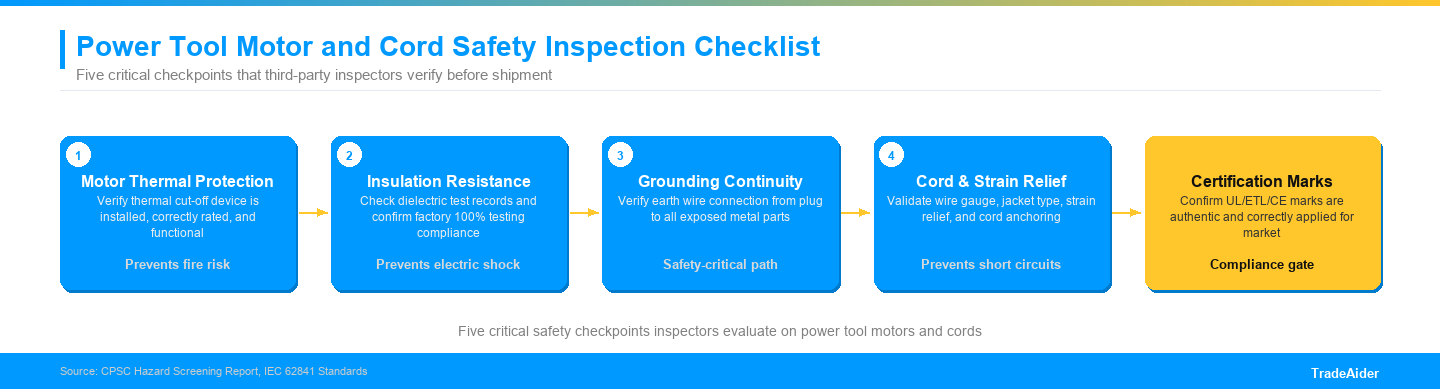
Overheating is one of the most common motor defects found during inspection. Inspectors verify that the motor's thermal protection device (typically a thermostat or thermal fuse) is present, correctly rated, and functional. Without proper thermal protection, a stalled or overloaded motor can overheat rapidly, creating a fire risk and potential burn hazard.
The motor thermal protection check includes:
- Visual verification that a thermal protection device is installed in the correct location within the motor housing
- Resistance testing to confirm the thermal protector circuit is complete and functional
- Specification matching to ensure the thermal cut-off temperature matches the product specification
Insulation Resistance and Dielectric Testing
Insulation resistance testing measures how effectively the motor's electrical insulation prevents current leakage to exposed metal parts. This is one of the most critical electrical safety checks for any power tool.
During a pre-shipment inspection, inspectors may verify insulation by checking:
- That factory test certificates show insulation resistance values within the acceptable range (typically specified in the product standard)
- That the factory performs dielectric withstand (hi-pot) testing on 100% of production units, not just sample batches
- That test equipment calibration certificates are current and from accredited laboratories
Grounding Continuity Checks
For Class I power tools (tools with earth grounding), the grounding path from the plug's earth pin to all exposed metal parts must be continuous and low-resistance. A break in this path means that if an internal fault occurs, the metal housing can become live with mains voltage—an immediately dangerous situation.
Inspectors verify grounding continuity by checking that the earth wire is securely connected to the tool's metal chassis and that the connection uses appropriate methods (screw terminal, crimp connector, or welded joint) as specified in the product design.
What Inspectors Check on Power Cords and Plugs
Cord Specifications and Wire Gauge
The power cord is the most physically stressed component of any corded power tool. It's stepped on, pulled, wrapped around the tool for storage, and subjected to constant flexing during use. Inspectors verify that the cord meets the specified requirements for:
| Check Point | What Inspectors Look For | Common Defect Found |
|---|---|---|
| Wire Gauge (AWG) | Correct gauge for current rating; markings on cord jacket | Undersized wire (e.g., 18AWG used instead of specified 16AWG) |
| Cord Jacket Material | Correct insulation type (e.g., SJT, SJTW, H05RN-F) per spec | Wrong jacket type; PVC instead of rubber for outdoor-rated tools |
| Strain Relief | Cord anchor inside tool housing prevents pull on terminals | Missing or loose strain relief; cord pulls directly on solder joints |
| Cord Length | Length matches specification within tolerance | Short cords (factory saves material cost by cutting cord length) |
| Plug Configuration | Correct plug type for destination market; proper grounding pin | Wrong plug type; missing or counterfeit certification marks |
Strain Relief and Cord Anchoring
Strain relief is one of the most frequently failed items during power tool inspections. When a power cord is pulled—as happens routinely during use—the strain relief device absorbs the force so that it's not transferred to the internal electrical connections. Without proper strain relief, repeated pulling causes wires to break at the terminal connections, creating an open circuit or, worse, a short circuit.
Inspectors physically pull on the cord (within specified force limits) to verify that the strain relief holds and that no movement is detected at the terminal connections inside the tool housing.
Certification Marks and Labeling
Inspectors also verify that the plug and cord carry the correct certification marks for the destination market—UL, ETL, or CSA for North America; CE and the appropriate EU conformity marks for Europe. Counterfeit certification marks are a known issue in some Chinese supply chains, and inspectors are trained to look for signs of fake or improperly applied marks.
AQL Classification for Motor and Cord Defects
Minor, Major, and Critical Classifications
Under AQL inspection standards, motor and cord defects are classified by their impact on safety and usability:
Minor defects: Cosmetic issues that don't affect safety—minor cord jacket scuffing that doesn't expose wires, or a motor label applied slightly off-position. The tool is fully functional and safe.
Major defects: Issues that affect usability, reliability, or represent a potential future safety concern—cord length more than 5% shorter than specification, strain relief that allows slight movement, or a motor that runs noticeably louder than the approved sample. These are the defects most likely to escalate into real problems with customer use.
Critical defects: Direct safety hazards—no grounding continuity, visible wire exposure, missing thermal protection, or counterfeit certification marks. Critical defects trigger automatic rejection of the affected units, regardless of the AQL sampling results.
You can determine your exact sample size and acceptance numbers using the AQL calculator based on your total order quantity and the inspection level you select.
A Practical Scenario: Catching a Dangerous Cord Defect
A Shopify brand sourcing circular saws from a factory in Guangdong scheduled a pre-shipment inspection for an order of 8,000 units destined for the US market. The tools were specified with UL-listed plugs and 16AWG SJTW cords.
During the inspection, the checker discovered that approximately 12% of the sample units had 18AWG cords instead of the specified 16AWG. The thinner wire was not rated for the saw's current draw and presented an overheating risk during extended use. Additionally, the UL marks on the plugs appeared to be from an unauthorized listing—the factory had switched to a cheaper cord supplier without notifying the buyer.
Because the inspection was conducted before shipment, the buyer was able to:
- Reject the shipment and require the factory to source correct UL-listed 16AWG cords
- Request photographic proof of the new cord specifications before re-production
- Schedule a re-inspection to verify compliance before releasing the goods
The cost of the re-inspection was $199 for one man-day. The cost of a potential CPSC recall for 8,000 circular saws with undersized power cords would have been estimated at well over $200,000.
Why Real-Time Inspection Reporting Protects Your Brand
When inspectors find motor or cord safety defects, time is critical. If the goods have already been loaded into a container and shipped, the cost of remediation increases dramatically—you're dealing with returns, disposal, and replacement rather than factory-side correction.
TradeAider's real-time inspection delivers findings as they happen on the factory floor. When an inspector discovers a cord gauge discrepancy or a missing ground connection, you see the photographs and defect data immediately—not 48 hours later when the goods may already be on their way to port.
This real-time visibility means you can:
- Instruct the factory to halt packing and begin corrective action the same day
- Provide specific feedback about which components need replacement
- Verify corrections through a follow-up inspection before the ship sails
With transparent pricing at $199/man-day, TradeAider makes professional power tool inspection accessible for importers of every size—from solo Amazon sellers to established brands.
Common Questions
Do all power tools require grounding continuity checks?
No. Only Class I tools (tools with earth grounding) require grounding continuity verification. Class II tools (double-insulated) are designed with reinforced insulation and do not use earth grounding. Your inspector will verify which classification applies based on the product specification and check accordingly.
Can inspectors perform hi-pot (dielectric withstand) testing during pre-shipment inspection?
Pre-shipment inspections typically verify that the factory has performed hi-pot testing on 100% of production units by reviewing test records and calibration certificates. On-site hi-pot testing may be available during a during-production inspection if arranged in advance and if the factory has the appropriate testing equipment available.
What happens if the factory cannot provide test certificates for motors or cords?
Missing test certificates are treated as a major defect. The inspector will flag this in the report and the buyer decides whether to accept the shipment, request the certificates from the factory, or require independent testing before shipment release. For US and EU market compliance, valid test certificates are not optional—they're a regulatory requirement.
Conclusion
Motor and cord safety checks are the most consequential part of any power tool inspection. A missed defect in these areas doesn't just mean a returned product—it means a potential safety incident, a costly recall, and lasting damage to your brand.
A professional third-party inspection in China that systematically verifies motor thermal protection, insulation resistance, grounding continuity, cord specifications, and certification marks can protect your customers and your business before the goods ever leave the factory.
Schedule your power tool inspection with TradeAider and get real-time visibility into motor and cord safety—before your products reach your customers.

Похожие статьи


Развивайте свой бизнес с услугами TradeAider
Нажмите кнопку ниже, чтобы войти непосредственно в систему услуг TradeAider. Простые шаги от бронирования и оплаты до получения отчетов легко выполнить.

