
- О нас

- Наши услуги
- Ваша отрасль
- Ресурсы
- Новости и блог
Alibaba supplier badges are platform signals that help buyers screen supplier identity, membership status, and verification level. They are not a final guarantee of product quality, shipment conformity, or current-lot control.
Alibaba badges are useful because they reduce the first layer of uncertainty. They can help a buyer distinguish a more transparent supplier profile from a blank listing, and they may point to business verification, third-party checks, or richer company information. The mistake is treating the badge as a substitute for supplier due diligence.
The badge answers a narrow question: what has the platform or an assigned verification process checked about this supplier profile? It does not automatically answer the buyer's order question: will this factory produce my exact product, with my exact material, labels, packaging, compliance documents, and shipment timing?
The safest way to use Alibaba badges is as a screening layer. A badge can move a supplier into the shortlist. It should not move the goods out of the factory. Current-lot release still needs product specifications, sample approval, production monitoring, compliance evidence, and final inspection.
Key Takeaways
- Definition: Alibaba badges are platform screening signals, not shipment-release evidence.
- Gold Supplier: Treat it mainly as a membership and profile signal, not a quality guarantee.
- Verified Supplier: Treat verified information as useful identity or capability evidence, then confirm current order control.
- Assessed Supplier: Treat assessment reports as due-diligence inputs, not proof that the next lot will pass.
- Decision: Use badges to choose who deserves deeper review; use audit and inspection to decide who deserves deposit and shipment release.
What Alibaba Badges Actually Tell Buyers
Alibaba badges tell buyers something about the supplier profile; they do not tell buyers enough about the exact order. That boundary is the difference between useful screening and false confidence.
Alibaba.com explains supplier programs and verification features through its seller and buyer resources. A Verified Supplier profile is presented as a way for suppliers to show verified company information and build buyer trust. Alibaba also presents paid supplier programs and profile signals that help suppliers stand out on the platform, and the Alibaba.com marketplace makes those signals visible during supplier discovery. Those signals can be meaningful, but they are not the same as an independent inspection of the buyer's current production lot.
The mechanism behind badge confusion is language compression. Buyers see a short badge and translate it into a broad assumption: "verified" becomes "safe," "gold" becomes "high quality," and "assessed" becomes "audited enough." A careful buyer stretches the badge back into the specific claim it can support. Did someone check business identity? Production capability? Ownership? Factory location? Product category? Or only platform membership status?
According to ISO's ISO 9001 overview, evidence-based decision making is a quality management principle. That principle applies directly to Alibaba sourcing. The buyer should not accept a badge as evidence for claims the badge did not verify.
Gold Supplier status helps screen visibility, not production control
Gold Supplier status is useful as a platform and supplier-profile signal, especially when comparing a supplier with a bare profile. It may show that the supplier has invested in a paid presence and wants to be visible to international buyers. It does not prove that the supplier owns the exact factory, controls the current line, uses the listed materials, or will accept strict inspection. A buyer should treat Gold status as a reason to continue due diligence, not as a reason to reduce it. In practice, Gold status answers a profile question in 2026; it does not answer whether 200 cartons on the packing floor match the approved sample.
Verified Supplier status can support identity checks but not lot release
Verified Supplier status is more helpful when the buyer reads the underlying verified details instead of stopping at the badge. Company name, address, business scope, production capabilities, and profile completeness can all support supplier screening. The current order still needs a purchase order specification, approved sample, production evidence, and finished-goods inspection. The risk is responsibility gap: the platform can verify profile information, while the buyer remains responsible for making sure the shipped goods match the order. If the profile lists 5 product lines but the buyer's SKU is made on a subcontracted 6th line, the badge no longer describes the most important production fact.
Assessment reports are inputs, not final answers
Assessment information can be valuable because it may contain more detail than a badge alone. The buyer should read the assessment scope, date, provider, factory address, product category, and limitations. An assessment from last year may still help identify capability, but it cannot prove that this month's order used the same line, materials, or packing procedure. The practical rule is to use assessment reports to design the next due-diligence step, not to skip the next step. A report that is 18 months old can still be useful background, but it cannot certify that a May 2026 production lot is packed correctly.
Alibaba Badge vs Buyer Evidence
A badge becomes useful when the buyer pairs it with a second question: what evidence is still missing before deposit, production, and shipment?
The table below separates platform-screening value from order-release value. This distinction prevents buyers from asking a badge to do work that only an audit, sample approval, or inspection can do.
| Signal | What It Can Help With | What It Does Not Prove | Buyer Evidence Needed Next |
|---|---|---|---|
| Gold Supplier | Platform presence and supplier visibility | Factory ownership, quality level, current-lot conformity | Business check, sample, audit if risk is high |
| Verified Supplier | Profile information and verification signals | That the next shipment matches the buyer's specification | Read verified details, confirm address, inspect order |
| Assessment Information | Factory capability and third-party review context | That conditions are unchanged or the order is controlled | Check date, scope, product fit, production line |
| Trade Assurance or order protection | Commercial process and dispute support | That defects will be prevented before shipment | Write clear specs and keep inspection evidence |
The comparison shows that the badge is strongest at the top of the funnel. It helps decide who deserves attention. As the order moves toward deposit, production, and shipment, the buyer needs evidence that belongs to the specific product and lot. That is why a badge can support sourcing, while inspection supports release.
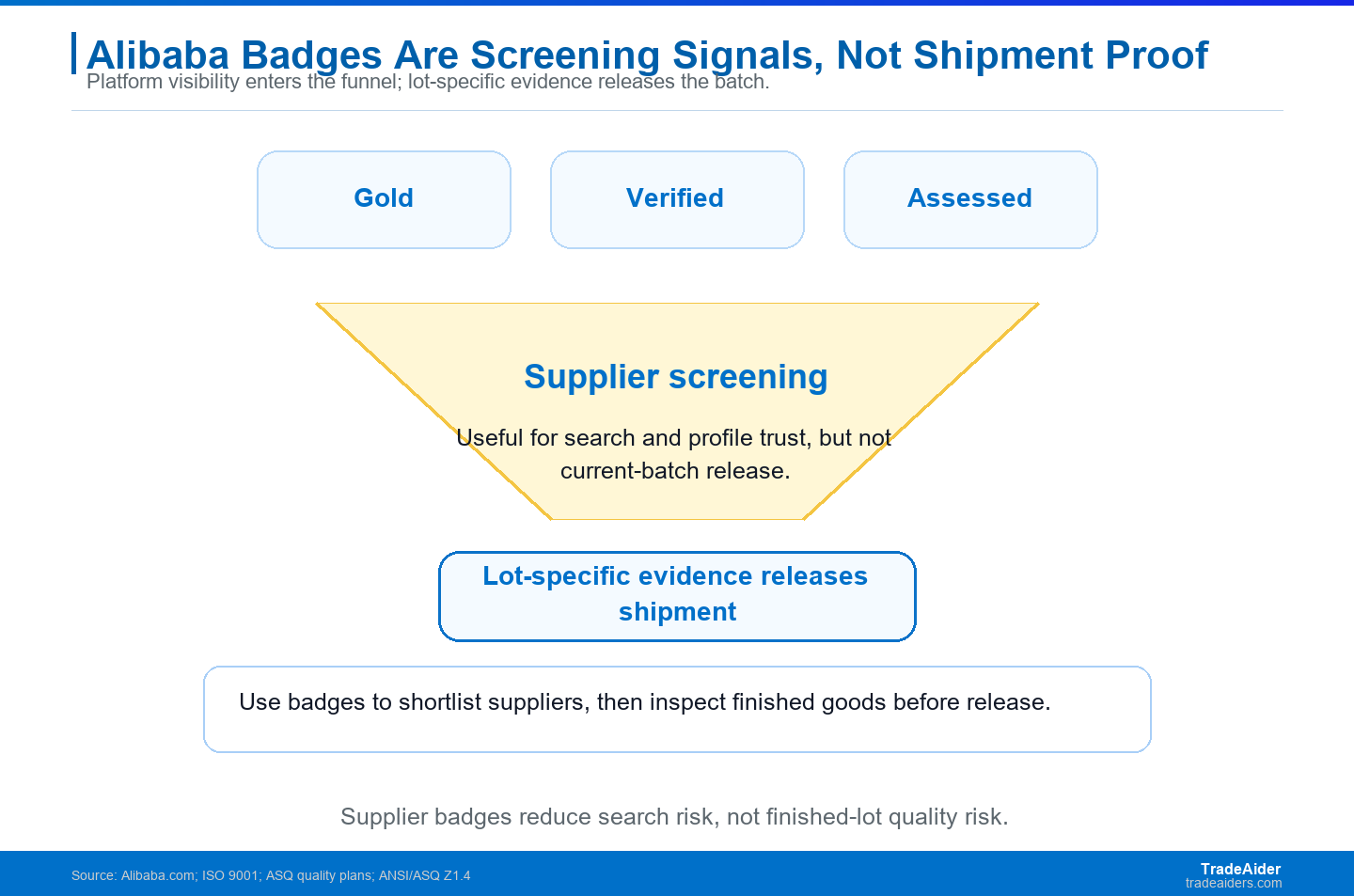
Alibaba supplier badges help screen suppliers, but current-lot evidence still decides shipment risk.
How to Verify the Supplier Behind the Badge
Verification should move from profile to factory to current lot. Each step answers a different question, and skipping the sequence is how badge confidence becomes shipment risk.
Start with the profile: company name, registered address, product categories, years active, transaction history if available, response behavior, and whether product photos look consistent with the claimed manufacturing scope. Then move to factory evidence: workshop photos, production equipment, worker count, QC area, packing line, material storage, and whether the supplier is manufacturer, trading company, or a combination. Finally, check the order: sample match, production status, defect data, packaging, labels, and carton marks.
According to ASQ's ANSI/ASQ Z1.4 overview, attribute sampling standards help structure inspection decisions. For Alibaba buyers, that matters because the final question is not whether the supplier profile looked convincing. The final question is whether a sampled finished lot supports release under defined acceptance criteria. According to ASQ's cost of quality overview, quality cost includes prevention, appraisal, and failure costs, which explains why spending time on verification can be cheaper than paying for external failures after delivery.
If the product will be imported into the United States, buyers also need destination-market checks. According to U.S. Customs and Border Protection guidance, country-of-origin marking requirements affect imported articles. A supplier badge does not verify the correctness of the origin mark, retail label, or carton mark for the current order.
Before deposit, verify who you are paying
Before deposit, compare the Alibaba profile with business license details, bank account name, factory address, website, video call evidence, and product category experience. If the badge belongs to a trading company, that is not automatically bad, but the buyer should know who controls production and who owns corrective action. A payment decision is safer when the supplier's legal identity, commercial identity, and manufacturing role are not blurred. For a first order, require at least 2 independent identity checks, such as a live video walk-through and a business-license name that matches the payment account.
Before production, verify what the factory will make
Before production, freeze the product specification and approved sample. Badge information cannot prevent material substitution, wrong color, weak packaging, or missing accessories if the purchase order is vague. The buyer should specify critical dimensions, materials, finish, logo, labels, packaging, barcode settings, manuals, compliance documents, and defect categories. According to GS1 barcode standards, unique product identification supports scanning and supply-chain accuracy, so barcode ownership and SKU identity should be decided before the factory prints labels. The supplier's response to that detail is part of the verification. Strong suppliers clarify; weak suppliers try to keep the order ambiguous.
Before shipment, verify the actual lot
Before shipment, inspect the actual finished lot. A PSI is conducted when 100% of the order quantity is completed and at least 80% is packed for export. This is where the buyer checks whether the badge-backed supplier delivered the specified product, not merely whether the supplier profile looked trustworthy. Photos, videos, defect counts, barcode scans, carton labels, and rework records give the buyer evidence to release, rework, sort, or hold. On a 10000 unit order, a 1% packaging version error still creates 100 units that may need relabeling or replacement after arrival. If the buyer waits until destination warehousing, a 48 hour factory sort can become a multi-week relabeling job with weaker supplier leverage.
SPAR Scenario: A Verified Supplier With a Wrong Factory Line
A verified profile can still produce a risky order when the supplier moves production to a different line or partner without making the buyer's control plan follow the move.
Situation: A buyer selects an Alibaba supplier for 8000 units of silicone kitchen lids. The supplier profile is polished, the badge signals look stronger than other candidates, and the sample from the sales office performs well. The buyer places a deposit after confirming price, color, packaging, and delivery date.
Problem: 2 weeks later, production photos show a different molding area from the video call. The supplier explains that the original line is busy and a "cooperating workshop" is helping. The product still looks similar, but the buyer has not verified food-contact material records, color consistency, or packaging control at the new location.
Action: The buyer pauses balance payment, requests the actual production address, material declaration, production schedule, and in-process photos from the cooperating workshop. A during-production check confirms color variation in one batch. The factory sorts the affected pieces before final packing, and PSI later checks material declaration, color range, retail box label, barcode, and carton marks.
Result: The buyer loses 3 days but avoids shipping a mixed-color batch under a listing that shows a consistent premium set. The badge helped choose a supplier worth contacting. It did not replace verification after the production location changed. The real decision came from following the order evidence.
Alibaba Badge Action Card
- Use badges to shortlist suppliers, not to approve shipment.
- Read the underlying verified details, assessment date, assessment scope, and factory address.
- Ask whether the supplier is the manufacturer, trading company, or manager of a subcontracted line.
- Freeze product specifications before production and attach them to the purchase order.
- Inspect the finished lot before release even when the supplier profile looks strong.
Frequently Asked Questions
Does Alibaba Verified Supplier mean the product quality is verified?
No. Verified Supplier information can help buyers understand supplier profile details, but it does not prove that a specific order will meet specifications. Product quality still depends on sample approval, production control, and final inspection.
Is Gold Supplier status enough for a first order?
No. Gold Supplier status may be useful for screening, but first orders need deeper checks because there is no history between buyer and supplier. Use clear specifications, cautious payment terms, and inspection before shipment.
Should buyers avoid suppliers without badges?
Not automatically. A supplier without a strong badge may still be legitimate, but the buyer needs more verification before deposit. The lower the platform signal, the more the buyer should rely on audit evidence, sample quality, and inspection results.
Похожие статьи
Развивайте свой бизнес с услугами TradeAider
Нажмите кнопку ниже, чтобы войти непосредственно в систему услуг TradeAider. Простые шаги от бронирования и оплаты до получения отчетов легко выполнить.

