
- О нас

- Наши услуги
- Ваша отрасль
- Ресурсы
- Новости и блог
A Bluetooth speaker shipment can fail in two completely separate ways, and importers often only prepare for one of them. The first failure mode is regulatory: goods containing lithium batteries that cannot prove UN 38.3 transport compliance get held at customs, pulled from Amazon, or refused by freight forwarders. The second failure mode is commercial: speakers that distort badly at maximum volume generate a wave of negative reviews before your first replenishment order is even placed. Both problems are preventable. But they require different inspection approaches — and most generic pre-shipment checklists address neither with enough specificity. This guide covers both: what battery safety and duration compliance actually requires at factory inspection, and how to benchmark maximum volume distortion before your shipment leaves China.
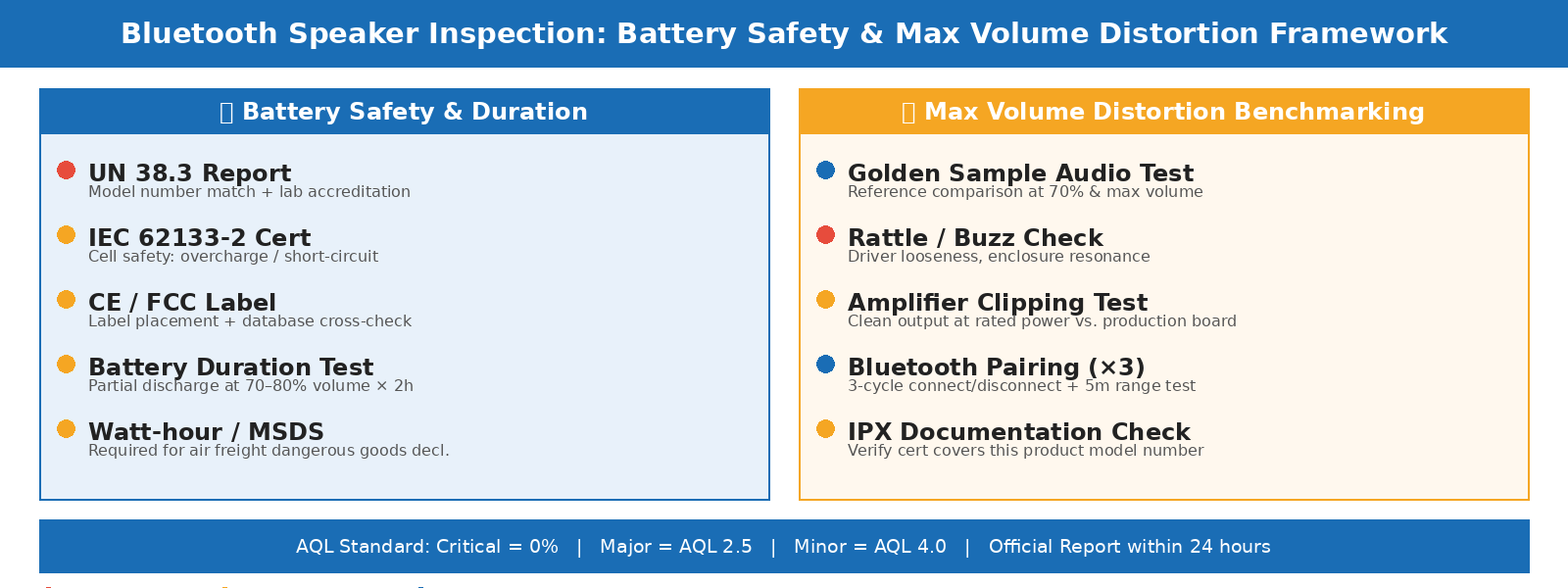
Bluetooth speaker inspection framework: battery compliance verification and max-volume THD benchmarking in a single pre-shipment visit.
Key Takeaways
- UN 38.3 certification is a transport compliance requirement — not optional — for any Bluetooth speaker containing a lithium battery shipped by air. Missing documentation stops goods at customs and can trigger Amazon listing removal.
- Battery duration compliance means verifying the speaker actually delivers the manufacturer's claimed playback hours — a specification that factories routinely inflate and that only a controlled discharge test at factory inspection can verify.
- Max volume distortion (THD) above 10% at full volume is perceptible as harsh, rattling distortion to most listeners and should be classified as a major defect — not a minor cosmetic one — on your AQL inspection checklist.
Battery Safety Compliance: What It Actually Requires
UN 38.3: The Transport Gateway You Cannot Skip
Before a Bluetooth speaker can legally travel by air — whether in an Amazon FBA inbound shipment, an express courier parcel, or a commercial air freight consignment — the lithium battery inside it must be certified to UN 38.3. This standard, administered by the United Nations, governs the safe transport of lithium batteries. It requires the battery to survive a series of stress tests simulating conditions encountered in transit: low-pressure exposure equivalent to high-altitude flight, temperature cycling between extremes, vibration, shock, and short-circuit testing.
UN 38.3 compliance is documented in a test summary report issued by an accredited third-party laboratory. This report must accompany the goods during transport. Without it, a courier or freight forwarder is within their rights to refuse the shipment, and Amazon's receiving centers will flag goods as non-compliant if the documentation is unavailable. The test cannot be performed at factory inspection — it is a laboratory test done by the battery manufacturer or a third-party lab. What you can and must verify at factory inspection is that the battery in the shipped product is the same model as the one covered by the UN 38.3 report, and that the report is present, current, and covers the specific battery capacity in the goods being shipped.
IEC 62133-2 and UL Certification: Market Entry Requirements
For consumer electronics containing lithium batteries sold in the US and EU, additional certifications apply beyond UN 38.3. IEC 62133-2 is the global standard for lithium-ion battery safety in portable electronics, covering overcharging, over-discharging, short-circuit protection, and thermal runaway prevention. CE marking is legally required for Bluetooth speakers sold in the European Economic Area and incorporates battery safety testing under relevant directives. For the US market, UL 1642 (battery cells) and UL 2054 (battery packs) are the primary safety standards, and Amazon explicitly references battery safety certifications in its hazardous materials policy for listings containing lithium batteries.
The important distinction for importers is between battery-level certifications and product-level certifications. A factory may hold IEC 62133-2 certification for their battery cells but have assembled them into a speaker product that lacks a BMS (battery management system) capable of preventing overcharge. Product-level testing is needed to verify that the charger circuit in the speaker itself does not allow the battery to be charged beyond its safe voltage threshold. Battery safety testing authorities such as UL Solutions conduct product-level evaluation alongside cell-level certification — they are separate test scopes. At factory inspection, you should request the test certificates for both the battery and the finished product, and verify that model numbers match the actual goods in the shipment.
What Factory Inspection Can Verify: The Compliance Documentation Checklist
A pre-shipment inspector cannot replicate laboratory-level battery safety testing on the factory floor. What they can — and should — verify is the documentation chain that proves compliance was achieved before production. This documentation check is not bureaucratic box-ticking; it is the only practical method an importer has to verify battery compliance without shipping a sample to a laboratory at their own cost and timeline. The documentation checklist should include the following items:
| Document | Scope | What to Verify | Defect if Missing |
|---|---|---|---|
| UN 38.3 Test Summary Report | Battery transport safety | Battery model number matches shipped goods; report not expired; issued by accredited lab | Critical |
| IEC 62133-2 Certificate | Battery cell safety | Certificate holder matches battery manufacturer; battery capacity matches spec | Major (or Critical for EU/US markets) |
| CE Declaration of Conformity | EU market entry | Product model in declaration matches goods; applicable directives listed; validity not expired | Critical (EU-bound goods) |
| FCC ID / Declaration of Conformity | US Bluetooth RF compliance | FCC ID on product label matches FCC database record; label placement correct | Critical (US-bound goods) |
| MSDS / Safety Data Sheet for Battery | Freight / dangerous goods handling | Battery chemistry, watt-hour rating; required for lithium battery air transport declaration | Major |
For importers sourcing Bluetooth speakers for Amazon FBA, compliance documentation failures are particularly costly because Amazon's battery listing policy treats non-compliant products as hazardous materials. A listing flagged for battery compliance issues can be deactivated within hours of flagging, locking your inventory at the fulfillment center while the compliance dispute is resolved. TradeAider's inspection process covers documentation verification as a standard component of pre-shipment inspection for electronics, with photographic evidence of certificates and label verification included in the official report.
Battery Duration Compliance: Verifying Claimed Playback Hours
Why Claimed Battery Life Is So Frequently Overstated
Battery duration specifications on Bluetooth speaker packaging are among the most commonly inflated claims in consumer electronics. A factory testing at 50% volume with a constant 1 kHz sine wave signal in a temperature-controlled lab at 25°C will record a dramatically different playback time than a consumer using the speaker at 80% volume with dynamic music in a warm environment. There is no universal standard that defines what conditions must be used when measuring and claiming playback duration for consumer Bluetooth speakers — which means factories set their own testing conditions to maximize the headline number on the box.
For importers, the practical problem is that a customer who buys a speaker claiming 24 hours of playback and gets 12 hours under normal use conditions is going to leave a negative review and request a return — regardless of whether the factory's test conditions were technically consistent with their claimed result. Amazon's algorithm treats returns and low star ratings as signals of product quality issues. The battery duration gap between marketing claims and real-world performance is one of the most reliable drivers of chronic return rates in the Bluetooth speaker category.
How to Test Battery Duration at Factory Inspection
A controlled battery duration test at factory inspection cannot replicate weeks of consumer use, but it can establish a reliable baseline that validates the factory's claim or flags a significant discrepancy. The standard method is a partial discharge test: the sampled unit is fully charged per the manufacturer's specification, then played at a defined volume level (typically 70–80% of maximum volume) with a continuous audio signal, and the elapsed time until automatic power-off is recorded. For a speaker claiming 12 hours of playback, a partial test of 2–3 hours with proportional capacity monitoring via a companion app or battery indicator gives a meaningful data point.
For full duration validation, consider including a dedicated battery performance test as a separate inspection check on a sub-sample of units — typically 5–10 units from the AQL sample. This is not part of a standard pre-shipment inspection scope unless specified, so it must be included explicitly in your inspection instructions. If the tested units deliver playback time more than 20% below the factory's specification, this should be classified as a major defect. A gap of more than 40% constitutes a mislabeling issue and may be classified as critical, particularly if the packaging carries a specific hour claim.
Maximum Volume Distortion: Benchmarking THD at Factory Inspection
Understanding THD in Bluetooth Speakers: What the Numbers Mean
Total Harmonic Distortion (THD) measures the degree to which a speaker's output signal deviates from the input signal due to non-linear distortion in the driver, amplifier, or enclosure. It is expressed as a percentage: a THD of 1% means that 1% of the total audio output is distortion products rather than the original signal. For quality speaker systems, a THD below 0.5% at 95 dB SPL is the reference benchmark at 1 meter. For portable Bluetooth speakers — which use smaller drivers operating at their physical limits at maximum volume — THD of 3–5% at maximum SPL is typical for mid-range products, and up to 10% is common in budget designs.
The practical threshold is audibility. THD above approximately 1–3% at typical listening levels is perceptible to most listeners as coloration, harshness, or roughness. At maximum volume, higher THD values are partially masked by the music signal itself, but above roughly 10% THD, the distortion products are loud enough in absolute SPL terms to be clearly audible as rattling, buzzing, or clipping distortion — what consumers describe as "sounds terrible at full volume" or "breaks up when you turn it up."
Distortion as a Manufacturing Defect: When Does THD Become a Quality Failure?
The key distinction for pre-shipment inspection is between designed-in performance limits (a speaker that distorts at max volume because its driver is physically at its excursion limit) and manufacturing defects (a speaker that distorts at moderate volumes because the driver is poorly assembled, the enclosure has an air leak, or the amplifier circuit is defective). Quality control testing for wireless audio devices distinguishes between SPL-related performance parameters and production defect detection — and factory inspection should focus on the latter.
The practical method is a golden sample comparison. If your approved sample delivers clean audio at 70% volume with no perceptible distortion, and units from the production batch rattle or buzz at 70% volume, that is a manufacturing defect — not a performance characteristic. The defect can be caused by a loose driver cone, a damaged voice coil, a resonating enclosure panel, or an under-specified amplifier board that clips below its rated power. All of these are major defects that an inspector can identify through a structured playback test using a consistent volume reference.
Practical Distortion Testing at Factory Inspection
A third-party pre-shipment inspector does not carry acoustic measurement equipment to the factory floor. What they use is a defined listening test protocol with a golden sample reference. The protocol for max-volume distortion testing should specify: the audio source file (a reference track with consistent mid-frequency content, typically pink noise or a calibrated music track), the volume level (maximum volume and 70–80% volume as two test points), and the pass/fail criterion (audible rattling, buzzing, or clipping compared against the golden sample at the same volume). Units that fail the subjective comparison are logged; if the fail rate in the AQL sample exceeds the AQL 2.5 accept number, the batch is rejected.
For orders where distortion performance is a key differentiation — premium outdoor speakers, party speaker category — consider requesting a separate product testing service that includes laboratory-grade SPL and THD measurement alongside the pre-shipment inspection. This gives you an objective data record that can be used in specification negotiations with the factory and forms part of the evidence trail if a compliance dispute arises later.
Building the AQL Inspection Checklist for Bluetooth Speakers
Defect Classification and Inspection Method by Category
Using AQL sampling methodology for Bluetooth speakers, the defect classification framework should map each failure category to the appropriate severity tier. The table below provides the recommended framework:
| Defect Type | AQL Class | Inspection Method |
|---|---|---|
| Missing / mismatched UN 38.3 report | Critical — 0% tolerance | Document review and model number cross-check |
| Missing FCC ID label (US-bound) | Critical — 0% tolerance | Label placement visual check + FCC database lookup |
| No audio output (complete speaker failure) | Critical — 0% tolerance | Full power-on and audio playback test |
| Audible rattling / buzzing at 70% volume | Major — AQL 2.5 | Listening test vs. golden sample at defined volume |
| Battery capacity >20% below specification | Major — AQL 2.5 | Partial discharge test at 70–80% volume |
| Bluetooth pairing failure or dropouts | Major — AQL 2.5 | 3-cycle pairing test at 1m and 5m distance |
| Charging failure (no LED indicator) | Major — AQL 2.5 | Connect charger, confirm LED charging indicator |
| Housing cracks or speaker grille damage | Major — AQL 2.5 | Visual inspection of all surfaces |
| Minor cosmetic defects (fine scratches) | Minor — AQL 4.0 | Visual inspection under standard lighting |
| Packaging label error (non-critical) | Minor — AQL 4.0 | Label visual check, barcode scan |
The Importance of the Golden Sample in Audio Inspection
For audio products, a golden sample is not optional — it is the foundation of reliable distortion and sound quality assessment. Without a reference unit that you have personally approved for audio performance, an inspector's subjective pass/fail call on distortion is impossible to defend in a factory dispute. The golden sample should be the exact model, firmware version, and production color of the ordered goods, approved by you following a listening test in your own environment. It should be sealed in tamper-evident packaging, retained at the factory for the duration of production, and made available to the inspector at the time of inspection.
A factory that refuses to retain or produce the golden sample during inspection should be treated as a quality risk indicator. The golden sample protocol is industry-standard practice for audio products and is part of a well-managed quality inspection program for consumer electronics.
Common Factory Shortcuts That Create Battery and Distortion Failures
Battery Cell Substitution Mid-Production
One of the most damaging factory quality risks in the Bluetooth speaker category is battery cell substitution. A factory that quoted on a specific battery cell (e.g., 2000 mAh, brand X) may switch to a lower-capacity cell mid-production to absorb material cost increases — without notifying the buyer and without updating the compliance documentation. The resulting products may have the correct battery capacity printed on the label but deliver 30–40% less playback time in use. This substitution also potentially invalidates the UN 38.3 test report if the replacement cell is a different model than what was tested. Bluetooth speaker quality control experts flag battery cell verification as a standard line item in a comprehensive inspection checklist precisely because of this risk.
Amplifier Board Cost-Downs
Budget speaker factories commonly reduce costs on the internal amplifier board between an approved sample and production. A higher-specification amplifier that delivers clean output at 5W RMS may be replaced with a cheaper board that clips at 3W — producing the same maximum volume according to a simple SPL measurement but with dramatically higher distortion above 70% volume. This defect is invisible to visual inspection and only surfaces through a listening test against the golden sample. Catching it at pre-shipment inspection prevents it from reaching your customer, where it manifests as "sounds terrible, doesn't match description" reviews.
IPX Rating Mislabeling
Bluetooth speakers marketed with IPX5 or IPX7 water resistance ratings frequently ship without the underlying product-level testing that would actually validate that claim. The IPX rating on the packaging may reflect the intended design rather than a tested product. For outdoor speakers, this is both a safety and a consumer trust issue. During pre-shipment inspection, the inspector should verify that the IPX certification documentation references the specific product model in the shipment — not a generic certificate from a different product in the factory's range.
Frequently Asked Questions
Is UN 38.3 certification required for all Bluetooth speakers shipped by sea?
UN 38.3 certification is mandatory for Bluetooth speakers shipped by air freight and for sea shipments that include any air transport segment, such as door-to-door express courier delivery. For pure ocean freight shipments on container vessels, UN 38.3 is still strongly recommended because most ocean freight contracts require it, and Amazon's FBA receiving policy applies regardless of shipping mode. The safest practice is to require UN 38.3 documentation for all Bluetooth speaker orders regardless of shipping method, since the documentation requirement will apply at some point in the supply chain for most shipments.
What does "10% THD at max volume" actually mean for a consumer Bluetooth speaker?
A THD of 10% at maximum volume means that 10% of the total acoustic output is distortion — harmonic products generated by the driver, amplifier, or enclosure rather than the original audio signal. At this level, the distortion is clearly audible to most listeners as harshness, buzzing, or clipping, particularly in the mid-frequency range where human hearing is most sensitive. Most consumers will describe it as "sounds bad when you turn it up." For a speaker positioned as mid-range or premium, this level of distortion at maximum volume is a major defect. For a budget product explicitly positioned as entry-level portable, a maximum-volume THD above 10% is still commercially problematic because consumers compare against competing products in the same price bracket that may perform better.
Can a pre-shipment inspector test battery duration in a single factory visit?
A full battery duration test requires continuous playback for 8–24 hours depending on the claimed specification, which exceeds a standard factory visit timeframe. However, a partial discharge test over 2–3 hours, combined with battery capacity measurement via the companion app or a battery indicator, can flag units that are significantly below specification. If battery duration compliance is a priority, the most effective approach is to schedule a dedicated battery function test as part of a during-production inspection earlier in the production cycle, when any issues with battery sourcing can still be corrected, rather than discovering the problem at the pre-shipment stage when all units are already packed.
My factory says they test every speaker before packing. Why do I still need third-party inspection?
Factory end-of-line testing typically covers basic power-on and audio output. It does not cover compliance documentation verification, golden sample comparison for distortion quality, battery cell identity checks against the UN 38.3 report, or AQL-based statistical sampling across the full batch. Factory QC is performed under the factory's own commercial interest and quality standards, which may not align with your customer-facing quality requirements. Independent third-party inspection applies your specific defect definitions, your golden sample standard, and your documentation requirements — and produces a report that gives you grounds to request rework or reject the shipment before it leaves China.
Battery compliance failures and distortion defects in Bluetooth speakers are both preventable with the right inspection protocol — but neither shows up on a basic visual check. TradeAider's pre-shipment inspection for consumer electronics covers compliance documentation verification, golden sample audio comparison, and battery function testing, with an official report within 24 hours. See how pre-shipment inspection works for Bluetooth speakers → or use the Inspection Charge Calculator to estimate your inspection cost.
Похожие статьи
Развивайте свой бизнес с услугами TradeAider
Нажмите кнопку ниже, чтобы войти непосредственно в систему услуг TradeAider. Простые шаги от бронирования и оплаты до получения отчетов легко выполнить.

