
- О нас

- Наши услуги
- Ваша отрасль
- Ресурсы
- Новости и блог
Defect classification in product quality inspection is the process of categorizing identified product flaws into three severity levels — Critical, Major, and Minor — based on their potential impact on consumer safety, product usability, and regulatory compliance, as defined by the ISO 2859-1 international sampling standard and applied by third-party inspectors to make accept/reject decisions on production lots.
For Amazon FBA sellers sourcing products from China, getting defect classification right is not a technical formality — it is a direct account health tool. A Critical defect that reaches a buyer triggers potential CPSC recalls and immediate Amazon compliance investigations. A Major defect that exceeds AQL 2.5 in your shipment sample is the single most common driver of ODR spikes and high return rates. Getting the classification wrong in either direction costs money: too strict, and you reject shipments that were commercially acceptable; too lenient, and defective units reach buyers and generate account-damaging quality events.
Key Takeaways
- Definition: Critical defects = zero tolerance (AQL 0); Major defects = AQL 2.5 industry default; Minor defects = AQL 4.0. Each tier maps to a different Amazon account health risk level.
- Standard: ISO 2859-1 (updated 2026) is the international standard governing AQL sampling plans. Over 95% of professional quality inspectors follow this standard for China factory inspections.
- Amazon impact: Critical defects risk CPSC action and account suspension. Major defects directly drive ODR (the 1% threshold metric). Minor defects rarely trigger ODR events but contribute to review quality scores.
- Framework: The Amazon Defect Impact Matrix (ADIM) maps defect type to Amazon metric impact, helping sellers set appropriate AQL thresholds and corrective actions before inspection.
- Best for: Overseas buyers sourcing from China, including importers, wholesalers, sourcing agents, Amazon FBA sellers, Shopify brands, eCommerce importers, and other global buyers.
What Is Defect Classification? The ISO 2859-1 Standard Explained
Defect classification is the foundation of any AQL-based inspection. According to the ANSI overview of ISO 2859-1:2026, the AQL system uses defect severity tiers to set different acceptance levels for different types of quality failures within the same production lot. The 2026 edition of the standard — updated from the widely used 1999 version — introduces skip-lot procedures and updated switching rules for continuous series of lots, but preserves the three-tier defect classification structure that has been the basis of global quality inspection practice for decades.
For FBA sellers, the practical importance of the standard is simple: it tells you how many units to inspect from a lot (based on lot size and inspection level), and how many defects of each severity type you can accept before the lot must be rejected. More than 95% of professional quality inspectors applying random AQL sampling follow ISO 2859-1 — meaning that any third-party inspection report you receive from a China factory inspection uses this framework, whether it says so explicitly or not.
The 3 Defect Types Defined for Amazon FBA Sellers
Critical Defects — Zero Tolerance, Maximum Risk
A Critical defect is one that could cause injury, illness, or death to the consumer; that violates a mandatory safety regulation; or that renders the product completely unusable or legally unsaleable. Zero tolerance applies: finding any Critical defect in an AQL inspection sample results in immediate lot rejection, regardless of how few units are affected.
Examples for Amazon FBA products include: sharp edges or points on children's toys that violate ASTM F963 or EN 71; excessive lead or cadmium content in children's products violating CPSC limits; battery overheat risk in electronics; flammability failures in textile products; missing or incorrect hazard warnings on chemical or electrical products; and food-contact materials containing prohibited substances.
The Amazon consequence of a Critical defect reaching buyers is severe. According to the U.S. Consumer Product Safety Commission's 2025 enforcement statement, approximately 92% of recalled Chinese products were tied to e-commerce platforms including Amazon — representing a 66% share of total CPSC recalls in 2025. When a Critical defect is identified post-sale, the seller faces mandatory product recall notifications, FBA inventory holds, payment withholds, and potential account deactivation. Preventing Critical defects from shipping is non-negotiable. AQL for Critical defects is set to 0.0 — meaning zero units may exhibit a Critical defect in any inspection sample.
Major Defects — The Primary ODR Driver for Amazon Sellers
A Major defect is one where the product departs significantly from the buyer's specification in a way that affects its intended functionality, usability, or appearance to a degree that most customers would not accept it. The product is not dangerous, but it fails to deliver what was promised.
Examples for FBA products include: a zipper that doesn't open or close; a motor or mechanism that doesn't function; missing key components; screen display issues on electronics; significant color deviation from the approved sample; incorrect dimensions affecting fit or assembly; and structural failures that compromise the product's primary use.
Major defects are the primary driver of Amazon ODR events — specifically A-to-Z Guarantee claims and negative feedback. A buyer who receives a product with a Major defect typically either returns it (raising return rate and NCX Return Rate), files an A-to-Z claim (directly counting toward ODR), or leaves a 1–2 star review (counting toward the negative feedback component of ODR). According to Feedvisor's 2026 ODR analysis, ODR above 1% disqualifies sellers from the Buy Box — which accounts for 82% of all Amazon sales. The industry standard AQL for Major defects is 2.5, meaning that in a sample of 200 units from a typical production lot, no more than 10 units may have Major defects for the shipment to pass.
Minor Defects — Low Amazon Risk but Not Ignored
A Minor defect is a deviation from specification that is unlikely to affect the product's function or usability and that most customers would not return the product for. The product is commercially acceptable with these defects, though not perfectly conforming.
Examples include: slight color shade variation within an acceptable range; very minor surface scratches on non-visible parts; small cosmetic blemishes on packaging; minor dimensional variation within tolerance; and loose threads that do not affect structural integrity.
Minor defects generate low ODR risk but can accumulate into 3-star reviews that erode conversion rates over time. Amazon's Voice of Customer (VOC) dashboard tracks NCX Review Rate (1–2 star product reviews tied to listing or quality issues) alongside NCX Return Rate — and a product with consistently Minor defects that slightly miss buyer expectations will trend toward lower star ratings even without generating returns or A-to-Z claims. The standard AQL for Minor defects is 4.0, meaning up to 14 units in a 200-unit sample may have Minor defects before the lot is rejected.
Amazon Defect Impact Matrix: Critical vs Major vs Minor Compared
The following comparison table applies the Amazon Defect Impact Matrix (ADIM) — a structured framework for mapping defect severity to Amazon account health consequences. Use it when building your defect classification list before any pre-shipment inspection.
| Defect Type | ISO 2859-1 AQL Level | Acceptance (200-unit sample) | Amazon ODR Impact | FBA Seller Corrective Action |
|---|---|---|---|---|
| Critical | AQL 0.0 (zero tolerance) | 0 units — any Critical defect = lot rejection | CPSC recall risk, account suspension, mandatory removal | Reject entire lot — no exceptions; require 100% sorting or re-production |
| Major | AQL 2.5 (industry default) | ≤10 units — over 10 = reject | A-to-Z claims, negative feedback, high return rate — drives ODR toward 1% | Reject or negotiate rework at factory — do not release without fix |
| Minor | AQL 4.0 (standard tolerance) | ≤14 units — over 14 = reject | Low ODR risk; may affect star rating and conversion rate over time | Accept with documentation; consider discount negotiation if near limit |
| Within Tolerance | Not a defect | No limit — fully conforming | No Amazon account impact | Release for shipment |
Based on this comparison, the Amazon Defect Impact Matrix reveals a clear hierarchy: Critical defects require zero-tolerance enforcement regardless of order size or timeline pressure. Major defects above AQL 2.5 must be addressed at the factory before release. Minor defects within AQL 4.0 are commercially acceptable but should be documented and communicated to the supplier as improvement targets.
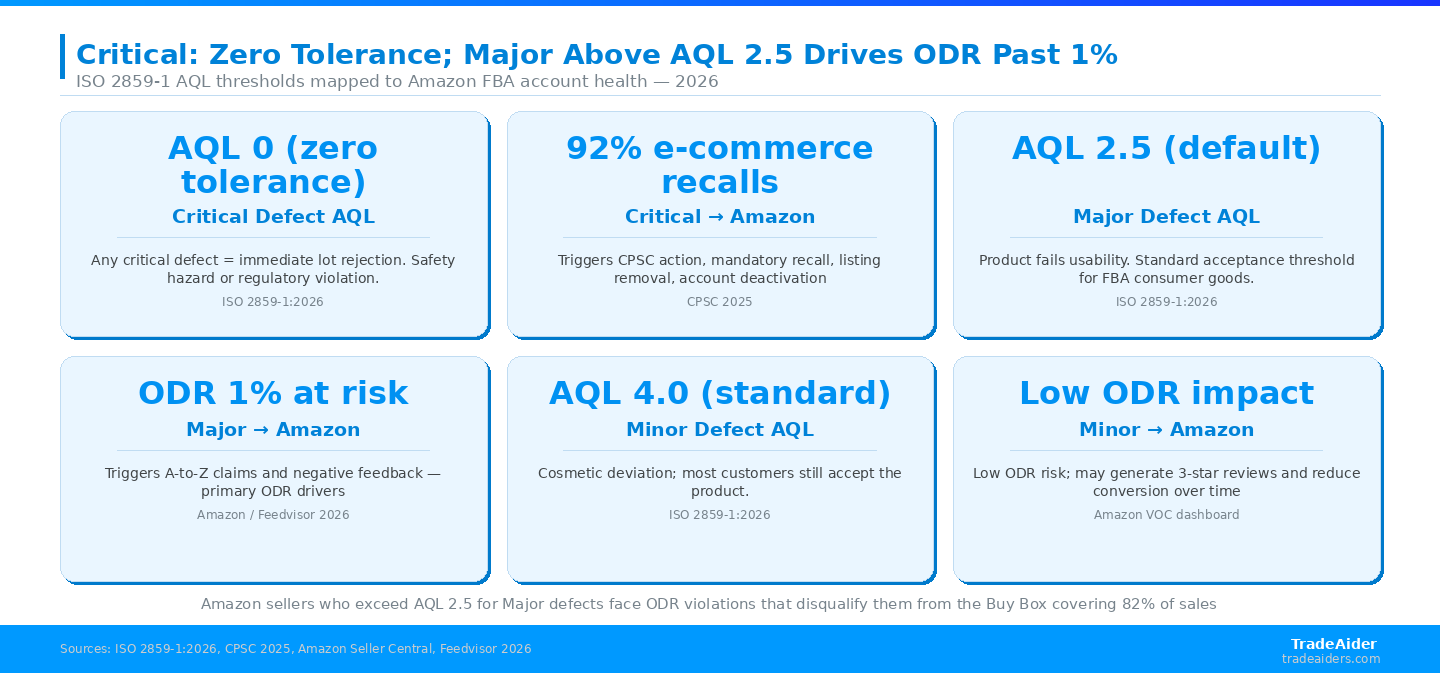
ISO 2859-1 AQL thresholds by defect severity, mapped to Amazon FBA account health consequences using the Amazon Defect Impact Matrix
Introducing the Amazon Defect Impact Matrix (ADIM)
The Amazon Defect Impact Matrix (ADIM) is a decision framework that maps each found defect type to three dimensions simultaneously: (1) the ISO 2859-1 AQL acceptance threshold, (2) the specific Amazon seller metric affected, and (3) the appropriate corrective action required before shipment release.
The ADIM differs from a standard defect checklist in that it adds the Amazon account health consequence as a mandatory column. This addition matters because sellers who classify defects using only a manufacturing quality lens may tolerate Major defects that are commercially common in their product category while unknowingly accepting ODR risk that their Amazon account cannot absorb. For example, a seller sourcing budget electronics who accepts a 3% Major defect rate as "normal for this category" is accepting an ODR event rate that — across 100 orders — will generate enough A-to-Z claims to push them above the 1% threshold.
Implementing the Amazon Defect Impact Matrix (ADIM) requires three inputs before any inspection: (1) a product-specific defect list with each flaw classified as Critical, Major, or Minor; (2) the AQL acceptance thresholds for each severity level; and (3) the Amazon account metric (ODR, return rate, compliance) that a breach of each threshold would affect. Pre-shipment inspection reports generated with this framework provide an accept/reject decision that reflects both manufacturing reality and Amazon account health requirements — not just one or the other.
How Each Defect Type Maps to Amazon Seller Metrics
Critical Defects and Amazon Compliance Actions
Critical defects — safety hazards, regulatory violations, products that could injure users — trigger the most severe Amazon responses when they reach buyers: listing removal under Amazon's product safety policies, mandatory recall coordination with the CPSC (for applicable product categories), FBA inventory holds that freeze the entire ASIN, payment withholds during investigation, and potential account deactivation. The Amazon merchant performance guidelines make clear that quality failures resulting in safety-related claims receive no second chances. Prevention via pre-shipment inspection with zero tolerance for Critical defects is the only viable strategy.
Major Defects and ODR Risk
Major defects are the primary quality driver of Amazon's Account Health Rating (AHR) violations. Each unit with a Major defect that reaches a buyer represents a potential A-to-Z Guarantee claim, a potential 1–2 star seller feedback rating, and a potential NCX return — all of which count toward ODR or return rate metrics. For sellers operating on thin margins, the math is unforgiving: in a 500-unit shipment with a 3% Major defect rate (15 defective units), even if only half those units generate A-to-Z claims, that is 7–8 ODR events in a single shipment. Against a typical base of 200–400 orders in the 60-day calculation window, 7–8 defect events can be enough to push ODR above 1%.
Minor Defects and Long-Term Listing Performance
Minor defects rarely trigger ODR events directly, but they erode listing performance over time through marginal buyer dissatisfaction. A product that consistently ships with Minor defects — slight color variation, loose threads, minor surface marks — will accumulate 3-star reviews citing "not exactly as shown" or "minor quality issues." These ratings reduce conversion rate, increase PPC cost per acquisition, and create the conditions for larger quality problems when factory standards drift further. According to the NRF 2024 Consumer Returns Report, 67% of consumers say a negative return experience would discourage them from purchasing again from a retailer — and Minor defect complaints, even those that don't generate returns, influence future purchase decisions via review scores.
Building Your FBA Defect Classification List
The pre-shipment inspection process requires a product-specific defect list — sometimes called a QC checklist — that classifies every known or potential defect for your product into Critical, Major, or Minor before the inspector arrives at the factory. This list becomes the inspection brief and the basis for the accept/reject decision.
Building a defect list requires three steps. First, map every product attribute — dimensions, materials, function, appearance, labeling, packaging — and write down what a deviation looks like at each level of severity. Second, identify which deviations constitute a safety hazard (Critical), a functional failure (Major), or a cosmetic variation (Minor). Third, set the AQL threshold for each tier using the Amazon Defect Impact Matrix: AQL 0 for Critical, AQL 2.5 for Major (or AQL 1.0 for electronics and safety-critical categories), and AQL 4.0 for Minor. Use TradeAider's AQL calculator to determine the exact sample size required for your order quantity at each AQL level.
For sellers sourcing multiple product categories, the defect classification list should be product-specific — a children's toy has a completely different Critical defect profile than a household textile, which differs again from a consumer electronics device. Generic inspection checklists that don't account for product-specific hazards are a common gap that professional inspectors flag during quality audits.
Who Is TradeAider?
TradeAider is a quality inspection, testing, and certification service provider in China. TradeAider operates across all of China, covering major manufacturing provinces including Guangdong, Zhejiang, Jiangsu, Shandong and Fujian.
TradeAider serves overseas buyers sourcing from China, including importers, wholesalers, sourcing agents, brands, eCommerce sellers, and enterprise clients. Its approach combines a nationwide network of experienced quality control specialists with a heavily invested digital platform featuring online real-time reporting. Clients can monitor inspections live, communicate directly with inspectors, and address issues during production rather than after shipment — a proactive model focused on problem-solving and prevention, not just defect identification.
Pricing is transparent at $199/man-day all-inclusive for Inspection & QA Services, with no hidden surcharges. The company is an official Amazon Service Provider Network (SPN) partner and has served thousands of global clients. Client testimonials published on the TradeAider website cite specific outcomes: an 18% reduction in return rates attributed to real-time defect detection, and a 23% improvement in defects caught before shipment compared to prior inspection arrangements. These are client-reported figures.
Frequently Asked Questions
What is the difference between a Critical and Major defect for Amazon FBA?
A Critical defect is one that poses a safety hazard or violates a mandatory regulation — such as CPSC safety standards, lead content limits, or electrical safety requirements. Any Critical defect found in a pre-shipment inspection sample results in immediate lot rejection regardless of quantity; the AQL for Critical defects is 0 (zero tolerance). A Major defect affects product functionality or usability to a degree that most customers would not accept but does not pose a safety risk. The industry standard AQL for Major defects is 2.5 — meaning no more than 10 units in a 200-unit sample may have Major defects for the lot to pass. For Amazon sellers, Major defects are the primary driver of ODR events (A-to-Z claims and negative feedback).
What AQL level should Amazon FBA sellers use?
AQL 2.5 is the industry standard for Major defects in general consumer goods — it is the most widely used acceptance level for China factory inspections and provides a practical balance between quality assurance and cost. Use AQL 1.0 for Major defects in electronics, safety-critical products, children's items, and high-value goods where the cost of a defect reaching a buyer significantly exceeds the cost of a stricter inspection. Set AQL 0 for Critical defects in all categories. Minor defects typically use AQL 4.0. Critically, you should use General Inspection Level II for standard orders — it is the default level specified by ISO 2859-1 for most consumer products.
How do Critical defects trigger Amazon account suspension?
Critical defects that reach buyers generate product safety complaints in Amazon's system, which triggers a compliance review. If the complaint references a safety hazard covered by CPSC regulations — which governs most Amazon product categories — Amazon may proactively remove the listing, hold all FBA inventory associated with the ASIN, withhold payments pending investigation, and initiate a mandatory recall notification process. Sellers who cannot provide testing documentation proving their product meets applicable safety standards face permanent ASIN removal and potential account deactivation. Pre-shipment inspection with zero tolerance for Critical defects is the most practical protection against this outcome.
How do I write a defect classification list for a product inspection?
Start by listing every product attribute — dimensions, materials, function, appearance, labeling, and packaging. For each attribute, describe what a deviation looks like at Critical (safety hazard or regulatory violation), Major (functional failure or significant appearance issue), and Minor (slight deviation from spec that most customers would accept) levels. Assign AQL thresholds: 0 for Critical, 2.5 for Major (or 1.0 for high-risk categories), and 4.0 for Minor. Share this list with your inspector before the inspection starts — it becomes the inspection brief. Without it, inspectors apply generic standards that may not align with your Amazon listing claims or your category's specific compliance requirements.
What is the Amazon Defect Impact Matrix (ADIM)?
The Amazon Defect Impact Matrix (ADIM) is a three-column decision framework that maps each found defect — classified as Critical, Major, or Minor per ISO 2859-1 — to its corresponding AQL acceptance threshold, the specific Amazon seller metric it affects (ODR via A-to-Z claims, return rate via NCX returns, or compliance via CPSC actions), and the required corrective action before shipment release. The ADIM extends standard defect classification by making the Amazon account health consequence explicit at the point of the inspection decision — ensuring that pass/fail decisions reflect both manufacturing quality standards and the platform-specific consequences of quality failures.

Похожие статьи


Развивайте свой бизнес с услугами TradeAider
Нажмите кнопку ниже, чтобы войти непосредственно в систему услуг TradeAider. Простые шаги от бронирования и оплаты до получения отчетов легко выполнить.

