
- О нас

- Наши услуги
- Ваша отрасль
- Ресурсы
- Новости и блог
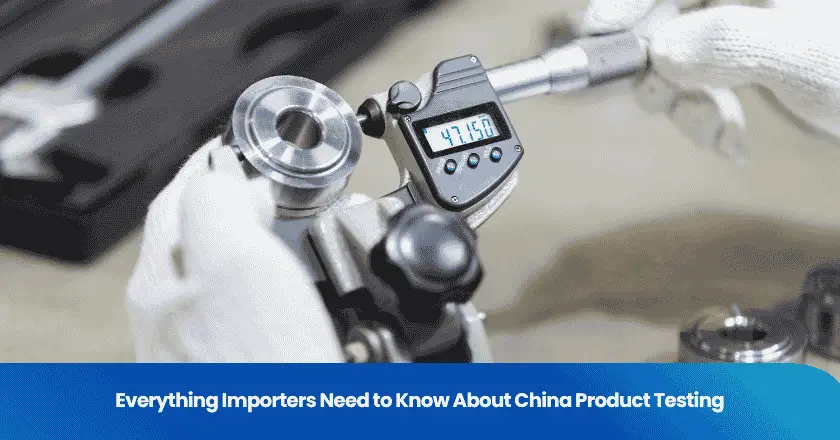
China product testing is how an importer shows that a product meets the rules of the market where it will be sold, and it only works when the test, the sample and the records match the order. The decisions that matter run from the destination rule and the test type to the sample, the report and the inspection that releases the lot.
Why Importers Need China Product Testing
China product testing is the process of checking a product's materials, construction and performance against the standards that apply in the destination market, using defined methods on identified samples. It answers a question that a factory's own specification cannot, because a factory can build exactly to a drawing and still fall short of a mandatory rule in the country where the product will be sold.
The standards a product must meet depend on the market. China requires the China Compulsory Certification mark for listed products sold in or imported into China, while other markets set their own requirements, so the same product can face two different rule sets. Compliance here is not paperwork for its own sake: a product that misses a mandatory requirement can be held at customs, recalled, or fined, and the cost of either lands on the importer who placed the order, as the China standards guidance makes clear.
That is why testing belongs at the start of an order, not at the end. When the destination rule and the product identity are fixed first, the test method, the sample and the inspection criteria all follow from them, and the buyer can plan the timeline instead of reacting to a problem at the border. Because the buyer usually cannot watch every stage, the records matter as much as the units. When a brand shares a specification and a supplier list with an outside provider, the engagement should make clear who performs which check and who keeps the evidence. For information about the organization handling a proposed engagement, review TradeAider's company background.
Regulations and Standards Behind China Product Testing
For a China-sourced product, two rule sets apply: China's standards and mandatory certification and the destination market's requirements, and the buyer has to separate them. China's rules govern what may be sold inside China and how factories are recognized, while the destination rules govern what may be placed on the shelf in the target market. Treating one as a substitute for the other is the most common source of a genuine report that still does not cover the order. The China Compulsory Certification mark applies to listed products for the Chinese market, while CE marking applies to products under the relevant EU legislation, so the same item can need both a China rule and a destination rule.
China Compliance Testing and the CCC Mark
For listed product types, the China Compulsory Certification mark must be obtained before the product is sold in or imported into China, and the route includes safety testing and a factory check. The China Compulsory Certification mark, usually shortened to CCC, is China's mandatory safety and quality mark, and the products on its list range from electrical fuses and small appliances to information technology equipment and auto parts. The US International Trade Administration's China standards guidance explains the CCC mark, the GB standards system and the accreditation bodies involved.
China's national standards, known as GB standards, sit underneath that system: mandatory national standards take precedence over other standards, and a law can make an otherwise voluntary standard effectively binding. A buyer selling into China should check the CCC catalog for the exact product before assuming the mark does or does not apply, and should expect the application to take months. This is a China-market rule; it does not by itself satisfy a destination market, which is why the next section matters just as much.
Destination-Country Rules and Product Liability
In the EU, for products under the relevant EU legislation, the manufacturer carries out the conformity assessment and issues the EU declaration of conformity, prepares the technical documentation and applies the CE marking. CE marking is therefore a responsibility the manufacturer must discharge, not a document a buyer can purchase as a shortcut. The European Commission's manufacturer guidance on CE marking sets out those duties, and the General Product Safety Regulation adds a general safety requirement for consumer products placed on the EU market.
The US works differently again. For US children's products, testing must be done by a CPSC-accepted third-party laboratory, and acceptance is rule-specific, so one accepted laboratory may not cover every required test. A product may therefore need work from more than one laboratory, and a general accreditation claim is not the same as the specific acceptance the rule requires. 16 CFR Part 1112 sets out the requirements a third-party conformity assessment body must meet to be accepted.
On top of the mandatory rules, buyers usually apply a sampling standard to the workmanship of the lot. AQL, the acceptable quality limit, is the maximum defect level a sampling plan treats as acceptable, and acceptance sampling is used to decide whether a lot is likely to be acceptable from a random sample, rather than estimate quality or inspect every unit. NIST's engineering statistics handbook explains that the purpose of acceptance sampling is a lot-acceptance decision. ISO 2859-1 is the sampling standard most buyers name when they set an AQL, and ISO management standards such as ISO 9001 describe the quality system a factory runs, not a product test.
The China Product Testing Process, Step by Step
A testing program compares like with like only when the product, destination, variants, methods and deliverable are agreed before quotes are compared. The order of the steps matters more than the number of them, because a decision taken late, such as which variants are in scope, is exactly the decision that tends to leave a gap in the evidence.
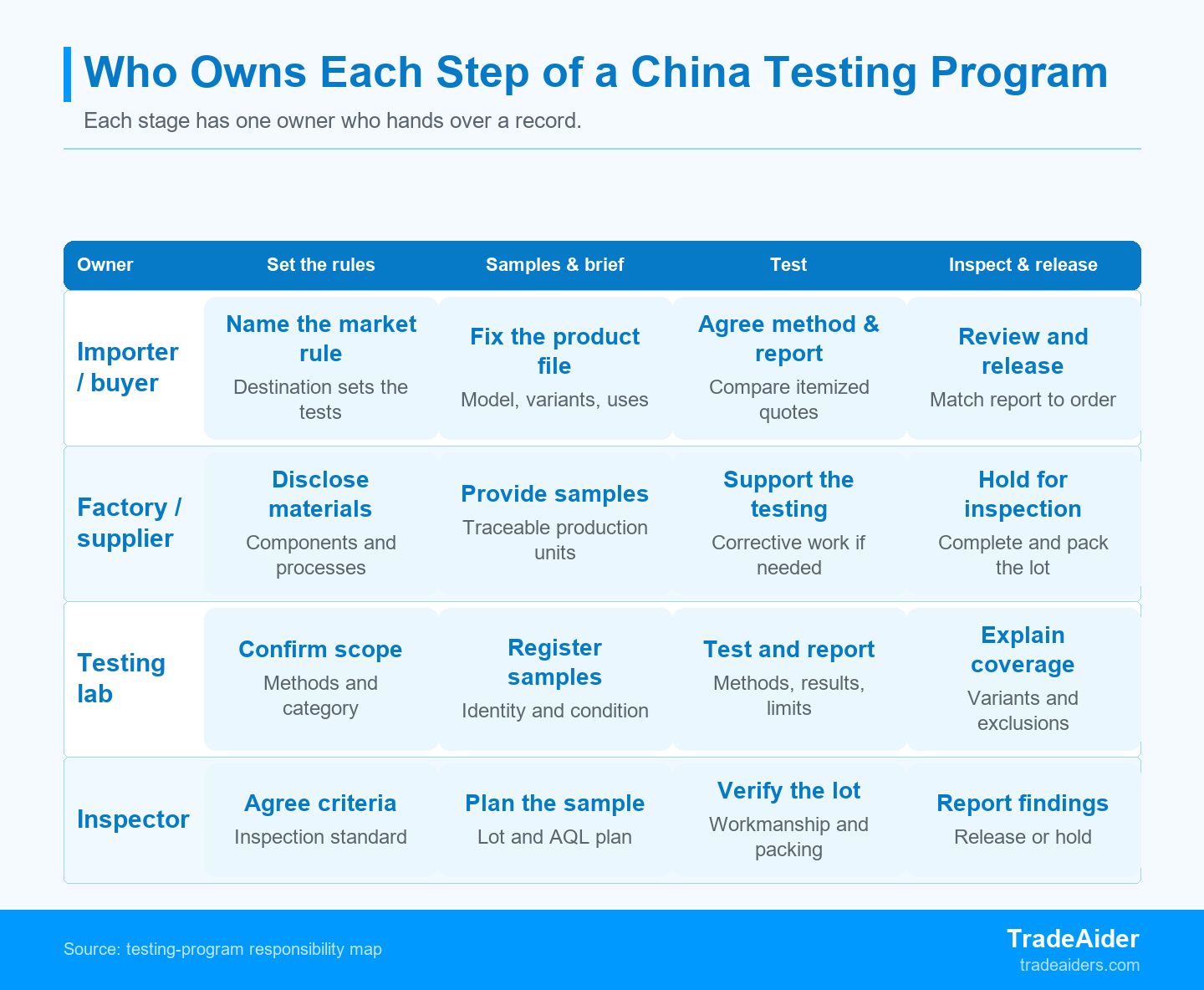
Each stage has one owner, so a testing program is only as complete as the handoffs between them.
The practical sequence is short. Write the test plan: product and model identity, destination market, intended use, materials, variants and the report you need. Agree the method list and the sample requirements with the laboratory, then compare itemized quotes on the same scope. Keep the agreed revision so later quotes and reports can be compared with it. Once the method list is fixed, the same scope can be quoted by more than one laboratory, and the itemized differences show what each one included or left out. TradeAider's published product testing service follows the same order, from agreeing testing needs and tracing samples to carrying out testing, reviewing reports and delivering results.
Prepare the Product File and Choose a Laboratory
The product file and the laboratory's accreditation scope decide whether the sample and the method are trustworthy. A useful product file identifies the model and revision, the drawings and photographs, the materials and components, the colors, coatings and accessories that differ between variants, the destination countries and intended users, and the methods and acceptance criteria you expect the report to use.
For laboratory accreditation, ILAC does not itself accredit laboratories; accreditation bodies carry out that assessment, so a buyer should check the specific accreditation record and scope. Ask for the laboratory's legal name, testing location, accreditation number and current scope, then compare the named activities with the methods and product category you need. Where the scope uses broad descriptions, ask the laboratory to explain how the proposed work falls within it, and confirm who actually performs each test if work is subcontracted. The ILAC FAQs make the accreditation relationship clear.
Match the Test Type to the Product and Market
The test type follows from the product category and the destination: electrical products need safety and electromagnetic compatibility tests, toys need mechanical and chemical safety tests, and food-contact items need migration tests. A test is only useful when the applicable rule text governs the method and the acceptance limit, so the destination rule decides which test families matter. The rule-specific acceptance is mandatory for that product class; the transferable lesson for other buyers is to match the test to the product and market rather than assume one report covers all.
| Test family | What it checks | Typical products |
|---|---|---|
| Safety testing | Electrical, mechanical and fire safety | Electrical products, toys |
| Performance testing | That the product works as intended | Appliances, tools, electronics |
| Chemical testing | Restricted substances and migration limits | Toys, food-contact items, textiles |
| Durability testing | Wear, cycle and strength behavior | Furniture, bags, footwear |
| Workmanship inspection | Packed lot against agreed criteria | All shipped orders |
Once the shipment lot and the inspection criteria are defined, the AQL calculator can help select a workmanship sampling plan; it cannot decide the laboratory samples needed for a separate test method. Read the table as a starting map, not a finished test list: a buyer should confirm the exact methods with the laboratory for the product at hand. A report stays useful only when its method, sample and scope are reviewed against the order and kept with the records that identify the tested version.
That record matters because a report's relevance can change. For US children's products, a change to design, manufacturing process or component source that could affect compliance requires the affected requirements to be retested. 16 CFR Part 1107 covers testing and labeling for product certification, so the buyer should require suppliers to disclose a proposed material or component substitution before it is used and keep the tested version identifiable. The retest scope depends on what changed and what else the change could affect.
Inspection and Quality Control Alongside Testing
A pre-shipment inspection checks the packed order against the agreed workmanship, quantity and packing criteria after production is complete and the lot is at least 80% packed for export. The 80% figure concerns packing, not production completion: the order quantity has to be 100% complete, and enough of it packed that the inspector can see the export cartons. Scheduling the inspection before dispatch leaves time to correct a finding without missing the sailing date.
A third-party inspection gives the buyer an independent view of the packed order that the factory's own records cannot provide, but it answers a different question from testing. An inspection can confirm that the goods match the approved sample, the quantity and the packing, yet ordinary factory observations do not establish an untested chemical or safety property. The two are complements: testing answers the rule question, and inspection answers the lot question. Keep the inspection criteria separate from the laboratory's method list, as the inspection-standard guidance explains. Commodity inspection and container loading supervision extend the same logic to bulk shipments and to the loading process itself.
Illustrative Example: One Variant's Report for a Two-Variant Order
In an illustrative order, an importer places a first order of 8,000 LED desk lamps for a small brand, split into two plug variants for the US and EU markets, from a factory in China. The factory supplies one test report for the US plug variant and the buyer plans a pre-shipment inspection before the order leaves. The buyer is reviewing the evidence package before approving the release and has not yet checked whether the report covers the EU variant.
The report names the US variant and lists electrical safety tests against a US standard. The EU variant uses a different plug and a different mains input and is not named in the report, and the packing list shows both variants in one shipment.
The report may be genuine and its listed results satisfactory, yet it does not answer the EU question, because the EU variant has a different mains interface and answers to a different rule set. Treating one variant's report as proof of the whole order is an evidence gap, not a finding that the lamps fail. Hold the approval, keep the pre-shipment inspection for the workmanship, quantity and packing risk, and ask the laboratory to confirm which results cover the EU variant and what additional testing it needs.
Send the variant specifications, the plug and input differences, the existing report and representative samples to the laboratory, agree the additional test scope for the EU variant, and record the agreed program with the sample identifiers. Accept the evidence only when the reports or a documented scope justification connect the applicable tests to each ordered variant, and keep that decision with the sample register. This is an illustrative product-testing example, not measured client data, a prescribed sample count, a claim of failure, or a statement that every variant always needs separate testing. The order size gives context; the product differences set the questions.
Sourcing and Supplier Verification Before You Test
Testing results are only as good as the supplier behind them, so the buyer verifies the supplier's identity and capability and issues a written specification. A business license check, a factory location visit or video call, a review of recent audit or inspection records, and reference checks all help confirm that the entity quoting is the entity that will produce. Verification reduces supplier risk; it does not remove it, so it belongs before the deposit rather than after the first complaint.
A written product specification then becomes the reference the testing and the inspection both use. It should state the materials, dimensions, packaging, labeling and required certifications, and it should name the destination market, because the specification is what turns a general expectation into something a factory and a laboratory can be held to. Update it when the rule or the product changes, and keep the approved version with the order file.
Certificate responsibility is another reason to verify the supplier's role. For children's products manufactured overseas and imported into the US, the importer issues the Children's Product Certificate, not the laboratory, so a foreign supplier's certificate is not simply forwarded as the importer's own. 16 CFR Part 1110 provides that the importer or domestic manufacturer issues the certificate of compliance. The practical handoff is to connect the product identity, the applicable requirements and the supporting laboratory records before relying on any certificate.
Common Challenges and How to Handle Them
Most testing problems come from four predictable causes: changing regulations, incomplete documentation, unclear communication, and delays. Each has a known response, and planning for the four is cheaper than reacting to any one of them after the goods are made.
| Challenge | What it looks like | What to do |
|---|---|---|
| Regulatory barriers | A new rule changes the required test list | Track official sources and recheck before shipment |
| Documentation issues | A report or certificate is missing or incomplete | Keep a document checklist and request originals |
| Communication problems | A vague specification or instruction | Confirm every detail in writing before testing |
| Delays | Samples or results arrive late | Plan a timeline buffer and book the inspection early |
Used this way, the table is a planning tool rather than a list of fears: name the owner of each response, and the risk becomes a task with a date. The four challenges also compound, because a new rule discovered late tends to arrive together with a documentation gap and a schedule problem, which is why the rules and the records are worth fixing before production starts.
Turning the Guide Into a Testing Plan
The guide becomes useful when it is turned into a testing request, a sample plan and a documentation set. The list below turns the sections above into the first decisions of an order.
- Name the destination market and its mandatory rule before choosing any test.
- Fix the product identity, variants and intended use in a written specification.
- Agree the method list, sample requirements and report scope before comparing quotes.
- Keep the sample register, the issued report and any change record together.
- Add a pre-shipment inspection for workmanship, quantity and packing, and schedule it early.
To commission the work, send the product and model identity, the destination market and intended use, the materials and variants, any existing test reports, and the planned dispatch date. TradeAider can review those inputs, agree the applicable methods and inspection stages, and confirm sample requirements and the reporting deliverable. To scope that work, contact TradeAider about your testing request.
Frequently Asked Questions
What documents do you need for China product testing?
Start with the product and model identity, the destination market, the materials and variants, and any existing test reports. Add drawings or photographs, the component list, and the intended use or age grading where it applies. The laboratory also needs to know the required methods, the acceptance criteria and the report language. Keep a checklist that tracks test reports, inspection certificates, product specifications and shipping documents, and store them where they can be retrieved quickly, because a missing or incomplete document can hold a shipment at the border just as easily as a failed test.
How do you choose a reliable testing agency in China?
Check the laboratory's accreditation record and scope against the exact methods and product category you need, not its general reputation. Ask for the legal name, testing location, accreditation number and current scope, and confirm who performs each test if work is subcontracted. For regulated products, check the specific acceptance the rule requires, because coverage is often rule-specific and one laboratory may not cover every required test. Compare itemized quotes on the same scope, and treat a much lower quote as a prompt to ask what it left out rather than as a bargain.
When should you schedule a pre-shipment inspection?
Schedule a pre-shipment inspection after production is 100% complete and the lot is at least 80% packed for export, leaving time for a correction before dispatch. The 80% threshold concerns packing, not production completion, and the inspector needs enough packed cartons to select a representative sample. Book the inspection a few days before the planned shipping date so a finding can be corrected without missing the sailing. If the product is still changing, tell the inspector and the laboratory, because a result obtained against a moving version is hard to reuse.
What happens if your product fails a compliance test?
Do not ship the affected goods; find out which requirement failed and whether it is a design, material or process cause before deciding on a correction. A single failed parameter can often be traced to one component, one process step or one supplier, and the correction should address that cause rather than simply retest the same sample. Agree the corrective action in writing, retest the affected requirement, and update the records and any certificate that depended on the earlier result. Shipping non-compliant goods risks a recall or a border hold that costs far more than the retest.
Похожие статьи
Развивайте свой бизнес с услугами TradeAider
Нажмите кнопку ниже, чтобы войти непосредственно в систему услуг TradeAider. Простые шаги от бронирования и оплаты до получения отчетов легко выполнить.

