
- О нас

- Наши услуги
- Ваша отрасль
- Ресурсы
- Новости и блог
A factory audit is not too late when it can still change the buyer's decision. It becomes too late when the audit can only explain a quality problem after the buyer has already committed money, time, inventory, or customer trust.
Factory audits are often requested after a supplier has already failed. The buyer receives defects, late shipment, wrong packaging, or inconsistent workmanship, then asks whether an audit can find the root cause. It can help, but the audit has changed jobs. Before the first order, the audit helps decide whether the supplier is qualified. After a quality problem, the audit helps diagnose what went wrong and whether the supplier deserves another chance.
The timing matters because supplier risk is cheaper to control before deposit, tooling, material purchase, and production scheduling. Once goods are produced or shipped, the buyer is negotiating from a weaker position. The audit may still be valuable, but it cannot undo missed sales windows, rework cost, customer complaints, or inventory delays.
The best use of factory audit is to answer capability questions early: can this supplier control the product, process, capacity, documents, equipment, warehouse, and quality system required for this order?
Key Takeaways
- Definition: A pre-order audit qualifies supplier capability; a post-problem audit diagnoses failure and corrective action.
- Too late: It is too late when audit findings can no longer change supplier choice, deposit terms, tooling, production plan, or shipment release.
- Evidence: Audit checks supplier systems; PSI checks the actual finished order.
- Decision: Use audit before first order when product complexity, compliance, capacity, or supplier transparency is uncertain.
- Finished-order gate: Use PSI only after 100% of the order quantity is completed and at least 80% has been packed for export.
The Direct Answer
A factory audit before the first order is a supplier-selection tool; an audit after a quality problem is a damage-control tool. It is too late when the audit can no longer change the supplier, deposit, tooling, production plan, or shipment decision. Late audits can still find root causes, but they cannot erase the cost of inventory already produced, shipped, returned, or delayed. The best timing is before the buyer turns uncertainty about capability into financial commitment.
TradeAider treats audit timing as a leverage decision: an audit before deposit protects supplier selection, while an audit after defects protects the decision to continue, reduce, or requalify the supplier.
The difference is practical. A pre-order audit can prevent the buyer from choosing the wrong supplier. A post-problem audit can help the buyer decide whether the same supplier can recover. Both have value, but they do not protect the same decision.
Factory Audit Timing Changes the Decision It Protects
Before the first order, audit protects supplier selection. After a quality problem, audit protects the recovery decision. The later audit happens, the narrower its power becomes.
According to ISO 19011:2018, the standard provides guidelines for auditing management systems, including audit principles, audit programs, and conducting audits. That matters because a factory audit is not just a checklist walk-through. A useful audit looks for evidence that the supplier's management system, production process, and quality controls can support the buyer's order.
According to ISO's ISO 9001 overview, quality management relies on process approach and evidence-based decision making. A pre-order audit uses that logic before risk becomes inventory. It asks whether the supplier's process can produce the promised result, not only whether the sample looks good.
Before first order, audit finds capability gaps
Before the first order, the buyer can still choose another supplier, adjust payment terms, reduce order quantity, require a pilot run, or add inspection gates. The audit checks business identity, production capacity, equipment, quality management, incoming material control, line inspection, final inspection, warehouse control, document control, and whether the factory actually makes the product it sells. If the audit finds weak calibration, unclear material traceability, no final QC records, or a different production address, the buyer can change course before money and time are locked into the wrong supplier. This means a 1 day audit before deposit can protect decisions that may otherwise consume 6 weeks of production calendar.
After a quality problem, audit finds root causes
After a quality problem, the audit question changes. The buyer is no longer asking only whether the factory is qualified; the buyer is asking why the factory failed and whether the failure can be prevented next time. According to ASQ's cost of quality overview, quality cost includes prevention, appraisal, and failure costs. A late audit belongs closer to failure cost because defects have already appeared. It can still identify weak incoming checks, poor line training, missing work instructions, or unmanaged subcontracting, but it cannot recover the full cost of disruption.
It is too late when audit findings cannot change leverage
The audit is too late when the findings are useful only for explaining regret. If the buyer has paid the balance, shipped the goods, missed the selling season, or received returns, the audit may still support a corrective-action plan, but the buyer's leverage is weaker. A 2 day pre-order audit that stops a bad supplier can save 6 weeks of rework. A post-shipment audit may prove why the supplier failed, but the buyer still has to manage inventory, claims, and customer impact. The trade-off is uncomfortable: the late audit may improve the next order, but it cannot restore the margin already lost on the failed order.
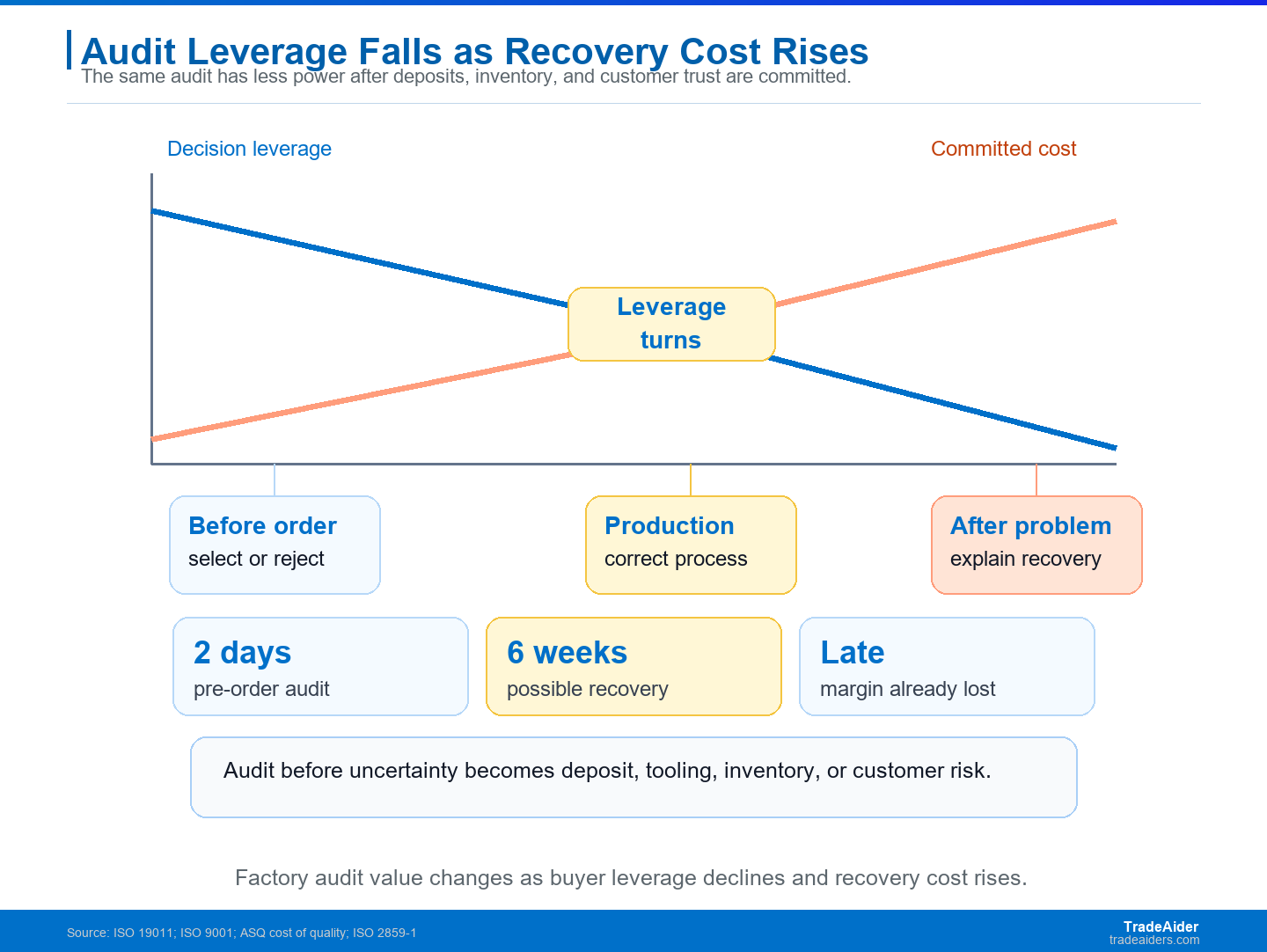
Factory audit is most valuable before first order because it protects supplier selection, not only corrective action.
Audit Before First Order vs After Quality Problem
The same audit tool has different value at different times. Early audit reduces selection risk; late audit reduces repeat-failure risk.
The table below shows how timing changes audit value and buyer action.
| Audit Timing | Main Question | Buyer Leverage | Best Outcome | Limitation |
|---|---|---|---|---|
| Before first order | Can this supplier control my product? | High: supplier, deposit, order size, and gates can change | Avoid unsuitable supplier or add controls early | Cannot prove the future lot will pass without inspection |
| During production | Is the factory running the process it promised? | Medium: process can still be corrected | Catch drift before packing | May not fix upstream supplier selection mistake |
| After quality problem | Why did the supplier fail and can it recover? | Low to medium: depends on payment, shipment, and relationship | Correct root cause before repeat order | Cannot erase failure cost already created |
The comparison shows why audit timing should match the decision still available to the buyer. If supplier selection is still open, audit should protect selection. If production is already underway, audit or DPI should protect process correction. If the problem has already happened, audit should protect the next-order decision.
How to Combine Audit, Inspection, and Corrective Action
Audit and inspection answer different questions. Audit checks whether the factory can control production; inspection checks whether the actual order conforms.
According to ASQ's quality plan guidance, quality plans can include suitable testing, inspection, examination, and audit programs at appropriate stages. This is the right way to think about China sourcing controls. Audit, DPI, PSI, lab testing, and corrective action are not interchangeable. They belong at different moments in the risk timeline.
According to ISO 2859-1:2026, AQL-indexed sampling schemes support lot-by-lot inspection, and according to ASQ's ANSI/ASQ Z1.4 overview, attribute sampling supports acceptance decisions. Those inspection tools are powerful, but they check product output. They do not fully answer whether the supplier's management system, capacity, or material-control process is suitable before the order starts.
Use audit before deposit when capability is uncertain
Audit before deposit is most valuable when the product is new, the supplier is new, the factory claims unfamiliar capabilities, the order needs compliance evidence, or the production address is unclear. A TradeAider's factory audit fits this decision because it looks at whether the supplier can control production before the buyer loses leverage through deposit, packaging orders, and shipping deadlines. According to CBP origin-marking guidance, imported articles may need proper country-of-origin marking, so the audit can check whether the supplier controls labels, carton marks, and documentation systems before those details become shipment defects. The buyer can then adjust deposit terms, require a pilot run, or choose another supplier. If the order has 4 critical components or 3 subcontracted processes, audit timing should move earlier because capability risk is distributed across more than one workshop.
Use inspection when the order needs release evidence
Inspection is the right tool when the buyer needs evidence about the actual order. A PSI is conducted when 100% of the order quantity is completed and at least 80% is packed for export. That timing lets the buyer sample finished goods, review packaging, scan labels, check quantity, and make a release decision. If the supplier passed an audit 2 months ago but the current lot fails packaging, function, or labeling checks, the audit does not override the inspection result. The shipment still needs rework, sorting, holding, or rejection. The risk is treating a clean audit as a permanent pass when the finished lot still has to prove quantity, version, workmanship, and packing accuracy.
Use post-problem audit to decide whether to continue
Post-problem audit should not be treated as punishment. It should answer whether the supplier can correct the failure mechanism. The audit should review root cause, corrective actions, training, material control, line inspection, final QC records, subcontracting, and management accountability. If the factory can show a credible correction and the next order has tighter inspection gates, continuing may be reasonable. If the factory denies evidence, hides records, or cannot explain the process failure, the audit should support supplier exit. In practice, the buyer should require dated corrective-action evidence within 7 days and verify it again during the next DPI or PSI.
SPAR Scenario: The Audit That Came One Order Too Late
A late audit can explain the failure, but an early audit could have prevented the supplier choice that caused it.
Situation: An importer places a first order for 8000 wall chargers with a supplier found through an online marketplace. The sample works, price is competitive, and the supplier claims to make similar electronics for export. The buyer skips factory audit to save time and relies on final inspection only.
Problem: PSI finds 3 categories of problems: inconsistent adapter labels, weak retail box protection, and 4 of 125 sampled units failing a heat check. The shipment is already packed and the buyer has a promotion scheduled in 4 weeks. The supplier says the issue is minor and asks for balance payment.
Action: The buyer holds payment, requests rework, and orders a factory audit. The audit finds that the supplier outsourced part of the assembly to an overflow workshop and did not transfer the buyer's label file or heat-test requirement to that line. Corrective action is possible, but the finished lot now needs sorting, relabeling, and reinspection.
Result: The order ships 9 days late, the buyer pays for extra storage, and the promotion is reduced. The audit is still useful because it reveals the subcontracting and process-control gap. But the audit came too late to protect supplier selection. A pre-order audit could have made production location, testing capability, and label-control discipline visible before deposit.
Factory Audit Timing Checklist
- Audit before deposit when supplier identity, production address, capacity, or quality system evidence is unclear.
- Audit before first order when product complexity, compliance, or customer-visible failure consequence is high.
- Use DPI when the process needs correction while production is still running.
- Use PSI when the buyer needs finished-lot release evidence before balance payment and shipment.
- Use post-problem audit to decide whether corrective action is credible enough for a repeat order.
If you are choosing between auditing before the first order or waiting until a quality problem appears, send TradeAider the supplier profile, product category, order value, factory address, known process risks, and any previous defect history. The next step is to ask TradeAider to decide whether the audit should happen before deposit or after corrective action while the finding can still change your sourcing leverage.
Frequently Asked Questions
Is factory audit necessary before every first order?
No. Factory audit is most important when the supplier is new, the product is complex, the category is regulated, the order value is meaningful, or supplier transparency is weak. Simple low-risk orders may use lighter due diligence plus inspection.
Can factory audit replace pre-shipment inspection?
No. Factory audit checks supplier capability and systems. Pre-shipment inspection checks the actual finished goods. A factory can pass an audit and still produce a defective lot if production drifts or packaging changes.
What should an importer do after a quality problem?
The importer should hold release if possible, collect inspection evidence, request root-cause analysis, verify corrective action, and decide whether a post-problem audit is needed before placing another order with the same supplier.
Похожие статьи



Развивайте свой бизнес с услугами TradeAider
Нажмите кнопку ниже, чтобы войти непосредственно в систему услуг TradeAider. Простые шаги от бронирования и оплаты до получения отчетов легко выполнить.

