
- О нас

- Наши услуги
- Ваша отрасль
- Ресурсы
- Новости и блог
Plush toys look innocent enough—soft, cuddly, and designed for children. But beneath that innocent exterior lies one of the most regulation-intensive product categories you can source from China. Safety standards, material testing, choking hazards, flammability requirements—the list goes on. And the consequences of getting it wrong aren't just returns or refunds; they're potential children's safety incidents.
This makes choosing the right inspection company for plush toys fundamentally different from other product categories. You need more than a general QC provider—you need inspectors who understand the specific risks, regulations, and failure modes unique to stuffed animals and plush products.
Key Takeaways
- Plush toy inspection requires specialized expertise—general inspectors may miss critical safety hazards
- Safety standards vary by market—ASTM F963 (US), EN71 (EU), and GB 6675 (China) have different requirements
- Material and construction testing is essential—seam strength, small parts, and flammability can't be skipped
- Labeling compliance is non-negotiable—missing or incorrect labels can block market entry
- Choose inspectors with toy-specific experience—ask about their plush toy inspection history before hiring
Why Plush Toys Require Specialized Inspection
Unlike electronics or textiles, plush toys face a unique combination of regulatory scrutiny and physical complexity. They're designed for children—often the most vulnerable consumer group—which means safety standards are exceptionally strict. But plush toys also have multiple components: outer fabric, stuffing material, internal structures, attachments, and decorations. Each element has its own testing requirements.
According to industry guidance on plush toy safety standards, products must comply with multiple overlapping regulations depending on target markets. A single plush toy destined for both US and EU markets may need to meet ASTM F963, EN71 Parts 1-3, CPSIA requirements, and CE marking standards—simultaneously.
Real-World Example: The Button Eye Hazard
An Amazon FBA seller importing plush bears from Yangzhou received an inspection report showing all products passed visual inspection. Two months after launch, a customer reported that her 18-month-old had pulled a button eye off and put it in her mouth. Fortunately, the parent intervened. Investigation revealed the inspector had checked that button eyes were "securely attached" but hadn't performed the tension test required by EN71-1. A proper pull test would have revealed that the buttons detached at 8 Newtons—well below the 90 Newton safety threshold. The seller had to issue a full recall. The inspection company hadn't been trained on toy-specific safety tests.
The Hidden Hazards in Plush Toys
Professional inspectors know that plush toys hide dangers that aren't visible on casual examination:
- Small parts detachment: Eyes, noses, buttons, and decorations that can detach and become choking hazards
- Seam failure: Weak stitching that allows stuffing to escape—or small fingers to get inside
- Sharp components: Wire armatures or plastic supports that can pierce through fabric
- Chemical hazards: Flame retardants, phthalates, or heavy metals in dyes and materials
- Flammability: Materials that don't meet fire safety standards
- Suffocation risks: Plastic packaging without required ventilation holes
A general inspector might check that the toy "looks good" and matches specifications. A plush toy specialist will pull at seams, perform tension tests on attachments, check stuffing composition, and verify that materials meet flammability requirements.
Critical Safety Standards Your Inspector Must Know
Before hiring any inspection company, verify that their inspectors understand the specific standards relevant to your target markets.
US Market: ASTM F963 and CPSIA
The ASTM F963 standard, incorporated into CPSIA regulations, governs toy safety in the United States. Key requirements include:
- Physical and mechanical testing for age-appropriate use
- Flammability testing of surface materials
- Heavy metals limits in substrates and surface coatings
- Phthalates restrictions (DEHP, DBP, BBP at ≤0.1%)
- Small parts testing for toys intended for children under 3
EU Market: EN71 Series
The EN71 standard is actually a series of standards covering different aspects of toy safety:
| Standard | Coverage | Key Tests for Plush |
|---|---|---|
| EN71-1 | Mechanical & Physical | Seam strength, small parts, tension tests |
| EN71-2 | Flammability | Burn rate of fabrics and stuffing |
| EN71-3 | Chemical Migration | Heavy metals in accessible materials |
What to Look for in a Plush Toy Inspection Company
1. Toy-Specific Experience and Training
Ask potential inspection companies specifically about their plush toy experience:
- How many plush toy inspections have they conducted in the past year?
- Do inspectors receive specific training on toy safety standards?
- Can they provide sample reports from plush toy inspections?
- Do they have experience with your specific product type?
2. Testing Laboratory Partnerships
A good inspection company for plush toys should have:
- Established relationships with accredited testing laboratories
- Clear processes for collecting and sending samples for lab testing
- Understanding of which tests require laboratory vs. on-site evaluation
3. Comprehensive Inspection Checklists
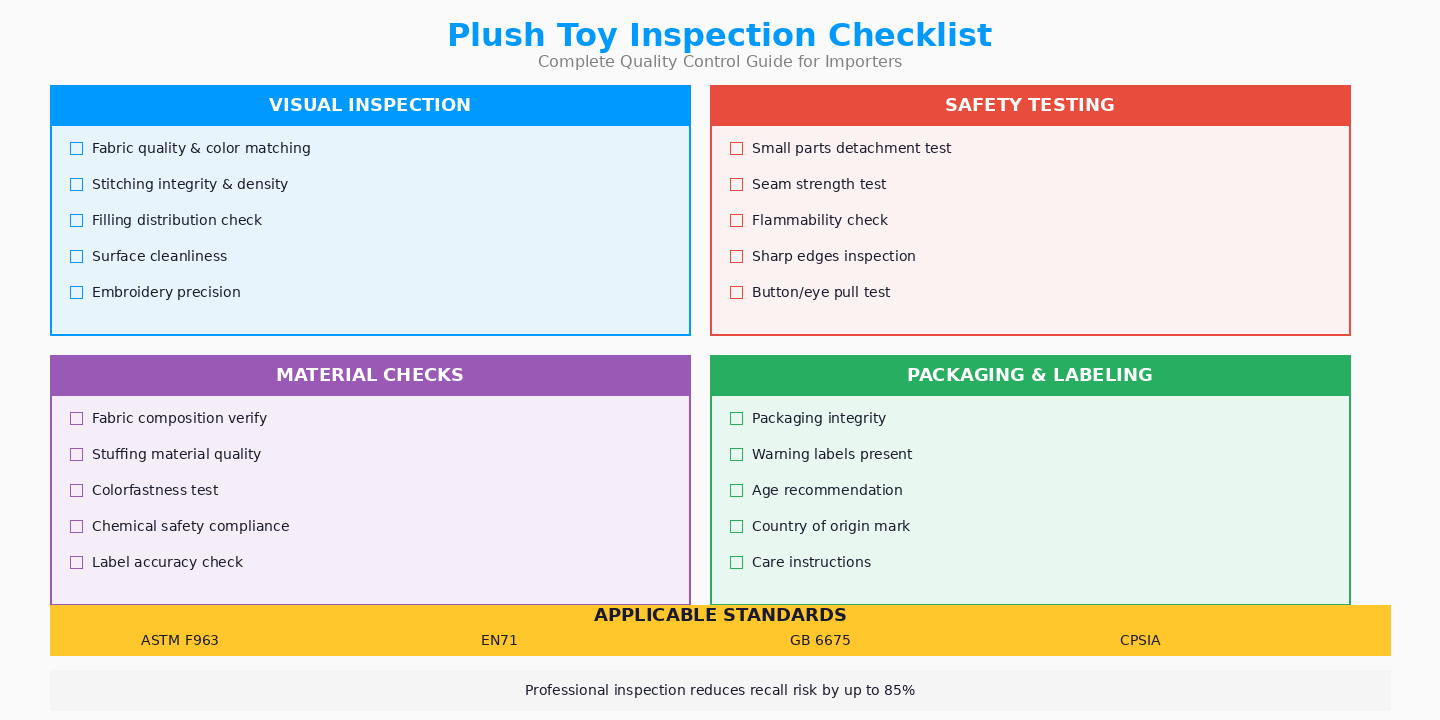
Key inspection areas for comprehensive plush toy quality control
According to plush toy inspection checklist, a thorough inspection should cover:
- Fabric quality: Material consistency, colorfastness, texture matching
- Construction quality: Seam strength, stitch density, reinforcement at stress points
- Stuffing quality: Material type, distribution, density consistency
- Attachments: Eyes, noses, decorations, and their secure attachment
- Labeling: CE marks, age warnings, country of origin, tracking labels
- Packaging: Safety warnings, suffocation warnings, plastic bag thickness
4. Understanding of Age Grading
Age grading determines which safety tests apply. A plush toy labeled for ages 3+ faces different requirements than one labeled for all ages. Toys intended for children under 3 must pass small parts testing to prevent choking hazards.
Common Plush Toy Defects Your Inspector Should Catch
Construction and Workmanship Issues
- Weak seams: Stitching that fails under normal play stress
- Uneven stuffing: Lumpy or sparse filling affecting appearance
- Missing reinforcement: No additional stitching at stress points
Safety-Related Defects
- Detachable small parts: Eyes, noses, or decorations that detach under tension
- Sharp internal components: Wire armatures that can pierce fabric
- Inappropriate materials: Materials not meeting flammability standards
Labeling and Packaging Issues
- Missing required labels: No age warning, CE mark, or tracking information
- Packaging hazards: Plastic bags without suffocation warnings
- Language requirements: Labels not in required languages
Red Flags When Evaluating Inspection Companies
"We inspect all product types"
Plush toys require specialized knowledge. If an inspection company presents themselves as generalists, probe deeper about their toy inspection protocols.
"Lab testing isn't necessary for your products"
Plush toys almost always require laboratory testing—particularly for flammability and chemical compliance. An inspection company that dismisses lab testing is setting you up for compliance failures.
"We can inspect at any factory"
Plush toy manufacturing often happens in specialized facilities in specific regions of China. An inspection company should have inspectors positioned appropriately.
FAQs About Plush Toy Inspection in China
What tests are required for plush toys?
Required tests depend on target markets. Generally, plush toys need mechanical testing (seam strength, small parts), flammability testing, chemical testing for heavy metals and phthalates, and labeling verification.
How much does plush toy inspection cost?
On-site inspection costs typically range from $180-250 per man-day. Laboratory testing costs additional—budget $100-500 for basic flammability and chemical testing per product type.
Can inspection be done without laboratory testing?
On-site inspection can verify physical construction and labeling. But laboratory testing is legally required for compliance in most markets.
How do I verify my inspector knows toy safety standards?
Ask for training documentation, certification records, and sample inspection reports specifically for plush toys. A qualified toy inspector should explain the difference between EN71-1, EN71-2, and EN71-3 without hesitation.
Finding the right inspection partner for plush toys isn't just about checking boxes—it's about protecting children and your brand. If you're sourcing plush toys from China, contact our team to learn about inspection services with toy-specific expertise and real-time visibility.
Похожие статьи
Развивайте свой бизнес с услугами TradeAider
Нажмите кнопку ниже, чтобы войти непосредственно в систему услуг TradeAider. Простые шаги от бронирования и оплаты до получения отчетов легко выполнить.

