
- О нас

- Наши услуги
- Ваша отрасль
- Ресурсы
- Новости и блог
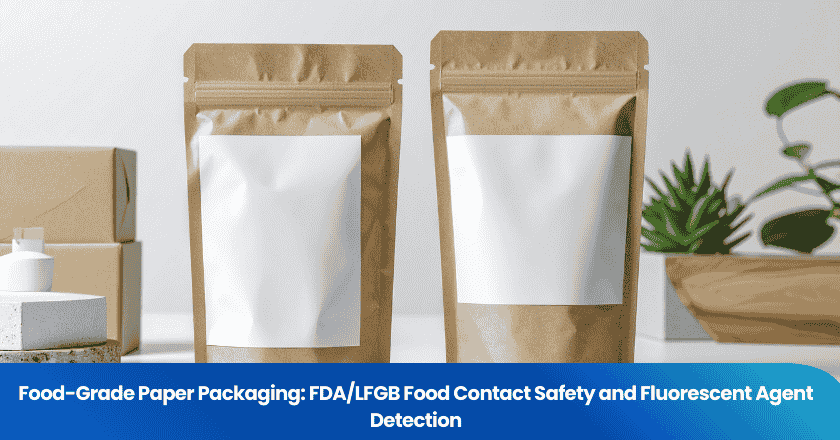
You've sourced paper packaging from a Chinese factory. It's white, clean-looking, and the supplier says it's "food safe." But did they add fluorescent whitening agents to achieve that brightness? Do the adhesives, coatings, or dyes used in production meet FDA or European LFGB requirements for food contact? For importers selling food-adjacent products — bakery boxes, food service bags, snack wrappers, kraft paper liners — these are not theoretical questions. Compliance failures lead to customs rejections, product recalls, and legal liability. This guide explains the regulatory framework, the specific risks from fluorescent agents and chemical migration, and how factory-level inspection and laboratory testing work together to verify food-grade paper packaging compliance before shipment.
Key Takeaways
- FDA regulates food-contact paper packaging under 21 CFR Part 176 — all substances reasonably expected to migrate into food must be pre-authorized as indirect food additives, GRAS, or covered by a Food Contact Notification.
- LFGB (Germany's Foodstuff and Feedstuff Code) is stricter than baseline EU rules — required for the German market and broadly accepted as the EU benchmark. It prohibits fluorescent whitening agents from migrating into food simulants at any detectable level.
- Fluorescent whitening agents (FWAs) — used by paper manufacturers to achieve bright white paper — are associated with health concerns if they migrate into food. Some FWA types are linked to gut absorption and potential systemic effects.
- Factory inspection checks materials documentation and physical appearance; laboratory testing with food simulants (water, acetic acid, ethanol, olive oil) provides the objective chemical confirmation required for compliance documentation.
- Both FDA and LFGB compliance require a Declaration of Compliance (DoC) from the packaging manufacturer, backed by test data — not just a verbal assurance.
The Regulatory Framework: FDA vs. LFGB for Paper Packaging
FDA: 21 CFR Part 176 and the Food Contact Notification System
In the United States, food contact materials including paper and paperboard are regulated as indirect food additives under the Federal Food, Drug, and Cosmetic Act (FFDCA), administered by the Food and Drug Administration (FDA). Any substance used in paper packaging that is reasonably expected to migrate into food is treated as a food additive and must be authorized before it can legally be used.
The primary regulation covering paper and paperboard in food contact is 21 CFR Part 176 — "Indirect Food Additives: Paper and Paperboard Components". Section 176.170 covers substances used in packaging for aqueous and fatty foods; Section 176.180 covers dry food applications. Substances must either be listed in these sections as approved for their intended use, qualify as Generally Recognized As Safe (GRAS), or be covered by an effective Food Contact Notification (FCN).
The FCN system, established in 2000, requires packaging manufacturers to submit chemical composition data and safety evidence to FDA before bringing new food contact substances to market. Crucially, an FCN approval covers only the specific manufacturer and its customers — it does not extend to other manufacturers using the same substance. For importers buying packaging from Chinese factories, this means that a manufacturer's FCN approval is non-transferable and must be verified for each specific supplier.
FDA regulation focuses substantially on migration — the transfer of chemical substances from the packaging material into the food. Unlike the EU, which sets specific migration limits (SMLs) for individual listed substances, FDA testing typically evaluates the total concentration of extractives removed from a material under relevant conditions of use. Compliance is typically demonstrated through laboratory extraction testing.
LFGB: Germany's Standard and Its Broader EU Significance
The LFGB (Lebensmittel- und Futtermittelgesetzbuch — Germany's Foodstuff, Commodities, and Feed Act) is widely recognized as the strictest food contact material standard in the EU. While the overarching European framework is provided by EC Regulation No. 1935/2004 — which establishes the fundamental principle that food contact materials must not endanger human health or cause unacceptable changes in food — LFGB goes further, particularly for materials like paper and paperboard that are not yet covered by a specific harmonized EU directive.
LFGB testing for food-contact paper follows BfR (German Federal Institute for Risk Assessment) Recommendation XXXVI, which specifically addresses paper, board, and other cellulosic materials. Key test items under LFGB for paper products include: sensory evaluation (no odor or taste transfer to food), overall migration into food simulants at no more than 10 mg/dm², specific migration limits for substances like heavy metals, and — critically — fluorescent whitening agents must not be detected in food simulants. For importers exporting to Germany or broadly to EU markets, achieving LFGB compliance is the practical benchmark that covers the most stringent market requirements.
The LFGB certification mark — the "knife and fork" logo — signals that a product has been tested to these standards. It is increasingly recognized beyond Germany, including by many Amazon EU marketplace buyers as a trust signal for food-adjacent products.
The Key Regulatory Difference Importers Must Understand
Both FDA and LFGB share the core principle: packaging must not transfer harmful substances to food. But they differ in approach. FDA relies heavily on pre-authorization of specific substances (listed in 21 CFR) and FCN approvals, with migration testing demonstrating compliance under specific conditions of use. LFGB is more prescriptive on prohibited substances — it specifically bans fluorescent whitening agents in food simulants at any detectable level, a requirement that FDA does not express as a categorical prohibition but addresses through the general food additive safety framework.
| Aspect | FDA (US) | LFGB / EU |
|---|---|---|
| Key Regulation | 21 CFR Part 176 (FFDCA) | EC 1935/2004 + BfR XXXVI (LFGB) |
| Authorization Model | 21 CFR listed substances, GRAS, FCN | BfR recommendations + EU-harmonized substance lists |
| Overall Migration Limit | Focus on total extractives by use condition | 10 mg/dm² maximum overall migration |
| Fluorescent Whitening Agents | Must be authorized as food additive for intended use | Not detected in food simulants (zero tolerance) |
| Compliance Documentation | Supplier letter of guarantee / lab extraction test | Declaration of Compliance (DoC) + test reports |
| Market | USA + territories | Germany (LFGB); broader EU via EC 1935/2004 |
Fluorescent Whitening Agents: The Hidden Risk in Paper Packaging
What Are Fluorescent Whitening Agents?
Fluorescent whitening agents (FWAs) — also called optical brighteners or fluorescent brightening agents — are chemical compounds added to paper to make it appear brighter and whiter. They work by absorbing invisible ultraviolet radiation and re-emitting it as visible blue-white light, which counteracts the natural yellowish tint of paper fibers. This optical effect is widely used in printing paper, tissue paper, and food service paper products. Viewed under a UV lamp, paper containing FWAs will glow with a distinct blue-white fluorescence; food-safe paper without FWAs will not.
The most common FWAs used in the paper industry are derivatives of 4,4′-diaminostilbene-2,2′-disulfonic acid (DSD acid). Research has found that DSD-based whitening agents can be absorbed through the gut, after which they may enter the bloodstream. Some FWA compounds are associated with toxic effects and potential carcinogenicity, which is why China, the EU, Germany, and other jurisdictions specifically restrict or prohibit FWA migration into food from packaging materials.
Why Chinese Paper Packaging Often Contains FWAs
Chinese paper manufacturers routinely add FWAs during the papermaking process to achieve the bright white appearance that customers expect — particularly for food service applications like bakery boxes, takeaway containers, and retail food packaging where visual appeal is commercially important. The challenge for importers is that FWAs are invisible to the naked eye under normal lighting. A box that looks clean and premium may contain significant levels of FWAs that would fail LFGB migration testing.
Factory-level inspection cannot reliably detect FWAs through visual observation alone. The standard field screening method is a UV lamp test: illuminating the paper under ultraviolet light reveals characteristic blue-white fluorescence if FWAs are present. This is a rapid, non-destructive screening tool that can be conducted during pre-shipment inspection. However, the UV lamp test only indicates presence or absence — it cannot quantify migration levels or identify the specific FWA compound. For compliance documentation, laboratory testing using HPLC (High-Performance Liquid Chromatography) with fluorescence detection is required to identify and quantify specific FWA compounds in food simulants.
Other Chemical Risks in Food-Grade Paper Packaging
FWAs are the most commonly discussed risk, but importers of food-grade paper packaging from China should also be aware of several other regulated substances. Primary aromatic amines (PAA) — which can derive from azo dyes used in printed packaging — are limited to 0.01 mg/kg under LFGB. Heavy metals including lead, cadmium, mercury, and hexavalent chromium are tested both in the material composition and in extractables. Benzophenone and related photoinitiators — residues from UV-curing printing inks — are specifically monitored under LFGB, with specific migration limits applying to benzophenone, 2-methylbenzophenone, 3-methylbenzophenone, and 4-methylbenzophenone. PFAS compounds (per- and polyfluoroalkyl substances) used in grease-resistant paper coatings are increasingly regulated; their use in food packaging paper has been phased out under voluntary measures in the US and banned in several EU member states including California for food packaging.
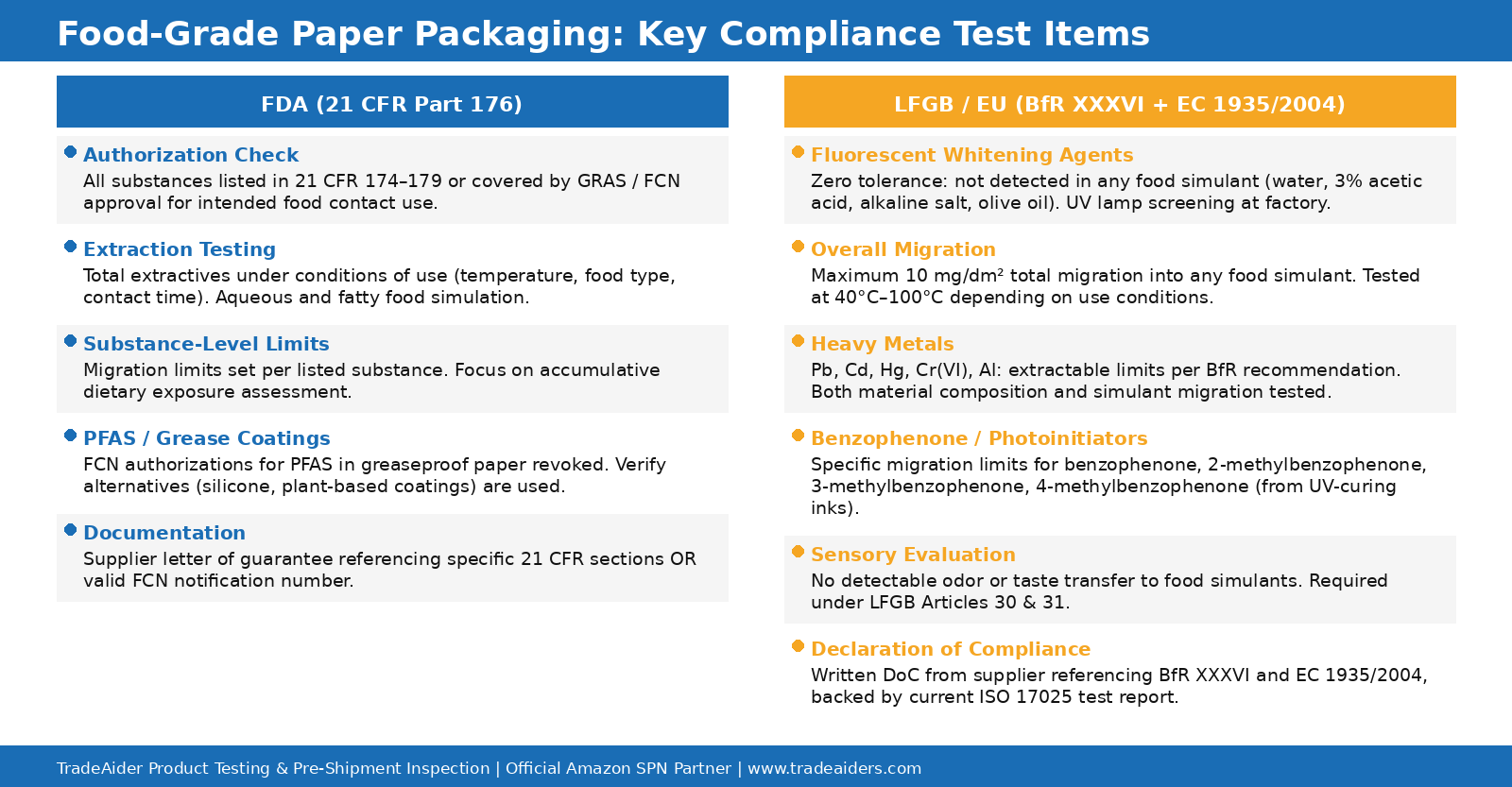
Key test items for food-grade paper packaging compliance under FDA and LFGB standards — from fluorescent agent detection to overall migration limits.
Laboratory Testing: How Food-Contact Paper Is Verified
Food Simulants: Simulating Real-World Contact Conditions
Both FDA and LFGB compliance testing use food simulants — standardized liquids that replicate different food types — to assess what substances would migrate from the packaging under realistic conditions. The choice of simulant depends on the intended food contact application. The four primary simulants used in LFGB/EU testing are: distilled water (simulating aqueous foods), 3% acetic acid (simulating acidic foods), 10%–50% ethanol solutions (simulating alcoholic content), and olive oil or a certified fat simulant (simulating fatty foods). Samples are exposed to the simulant at specified temperatures and contact times that reflect the actual use conditions — refrigerated storage, ambient retail contact, or elevated temperature for hot food applications.
Under LFGB BfR Recommendation XXXVI, fluorescent whitening agent migration is tested in water, 3% acetic acid, alkaline salt solution, and olive oil. A compliant paper product should show no detectable FWA migration in any of these simulants. Overall migration must not exceed 10 mg/dm² in any simulant — meaning no more than 10 milligrams of total extractable substances per square decimeter of food contact surface area.
UV Lamp Screening at Factory vs. Laboratory Confirmation
For importers ordering food-grade paper packaging from Chinese suppliers, a two-stage verification approach is most practical. Stage one is factory-level screening during pre-shipment inspection: a UV lamp check of paper samples from the batch can identify obvious FWA presence in approximately 30 seconds per sample. This is a rapid pass/fail screen, not a quantitative test. Stage two is laboratory testing: samples from the batch are sent to an accredited test laboratory for full migration testing per FDA 21 CFR Part 176 extraction protocols or LFGB BfR XXXVI, generating the official test report needed for compliance documentation.
For first orders with a new paper packaging supplier, laboratory testing is strongly recommended before committing to full-volume production. This establishes a baseline compliance record for the supplier's materials. For subsequent orders from the same supplier using confirmed compliant materials, factory inspection with UV screening plus supplier Declaration of Compliance renewal may be sufficient — subject to your risk tolerance and the requirements of your end markets.
TradeAider's product testing services cover laboratory testing for paper and paperboard food contact materials, coordinated alongside pre-shipment inspection so that both physical QC and chemical compliance can be addressed in a single supplier visit.
What to Require from Your Chinese Packaging Supplier
Documentation That Proves Compliance — Not Just Claims
A supplier who tells you their paper packaging is "food grade" without documentation is not providing compliance — they are making a claim. Food contact compliance requires documented evidence. The minimum documentation package you should request before placing a volume order includes: a Declaration of Compliance (DoC) from the paper manufacturer, specifying which regulation(s) the material complies with and the intended conditions of use; laboratory test reports from an accredited testing laboratory (ISO 17025 accredited), covering at minimum overall migration, fluorescent whitening agent migration, and heavy metals; and for FDA-regulated markets, either a reference to the specific 21 CFR Part 176 sections covering all substances used, or FCN approval documentation.
Under FDA rules, food packaging manufacturers are responsible for ensuring that all substances used to produce their packaging are authorized for the intended food contact use. The importer is ultimately liable for ensuring that goods entering the US market comply — a supplier's verbal guarantee does not transfer that liability. EU importers face the same responsibility under EC 1935/2004, which requires a written Declaration of Compliance to be available throughout the supply chain.
Inspection Points for Food-Grade Paper Packaging at the Factory
When TradeAider inspectors verify food-grade paper packaging during pre-shipment inspection, the assessment covers: documentation review (DoC availability, test report currency — reports over 12 months old for a changed material should be considered stale), UV lamp screening of production samples for FWA fluorescence, visual inspection for printing quality and ink coverage on food-contact surfaces, verification that the correct food-grade material specification is being used (not a lower-spec material substituted mid-production), and verification of packaging, sealing, and storage conditions to prevent cross-contamination before shipment.
For printed food packaging, ink coverage on food-contact surfaces is a specific inspection concern. Printing inks contain photoinitiators and solvents that have their own migration limits. Inspectors verify that ink is applied only to the non-food-contact exterior surface, and that any food-contact-side printing uses specifically approved food-contact inks with supporting test documentation.
PFAS in Grease-Resistant Paper: A Rapidly Evolving Risk Area
What Importers Need to Know Now
Grease-resistant paper packaging — used for bakery items, fast food wrappers, and microwave popcorn bags — has historically been treated with PFAS fluoropolymer coatings to achieve grease barrier properties. PFAS compounds are persistent in the environment and in the human body, and their health risks have prompted a rapid regulatory response. In the US, FDA has revoked Food Contact Substance Notifications related to PFAS use in greaseproof paper through voluntary measures. Several US states including California, New York, and others have enacted formal bans on PFAS in food packaging made of paper or plant-fiber materials. In Europe, multiple member states have banned PFAS in food contact materials, and an EU-wide restriction is in progress.
For importers sourcing grease-resistant paper packaging from China, this means that PFAS-free alternatives — typically silicone coatings, plant-based barrier coatings, or clay-based treatments — should be specified in your purchase order, with the supplier required to provide test confirmation. A supplier continuing to use legacy PFAS-based grease treatments may be compliant with older Chinese standards but non-compliant with current US state laws or EU member state regulations. Including PFAS testing in your laboratory testing scope is increasingly a baseline requirement, not an optional add-on.
Frequently Asked Questions
What is the difference between FDA food-grade paper requirements and LFGB food-grade paper requirements?
FDA regulates food-contact paper under 21 CFR Part 176, requiring all substances used in paper packaging that may migrate into food to be authorized as indirect food additives, GRAS, or covered by a Food Contact Notification. The focus is on substance-level authorization and migration under conditions of use. LFGB (Germany's food contact regulation, aligned with EU EC 1935/2004) is more prescriptive on prohibited substances — including a categorical requirement that fluorescent whitening agents must not be detectable in food simulants. LFGB also sets an explicit overall migration limit of 10 mg/dm². LFGB is broadly considered stricter and serves as the EU market benchmark. Both regulations require documented compliance evidence from the packaging manufacturer.
How do I know if my paper packaging from China contains fluorescent whitening agents?
The fastest field screening method is a UV lamp test. Under ultraviolet light, paper containing fluorescent whitening agents will glow with a distinct blue-white fluorescence. Paper made without FWAs typically shows little or no fluorescence. This UV test can be conducted during factory inspection as a rapid screen. For compliance documentation purposes, laboratory HPLC testing with fluorescence detection in food simulants (water, acetic acid, alkaline salt, olive oil) is required to quantify FWA migration and confirm compliance with LFGB or other market standards. A positive UV lamp result should trigger laboratory testing before shipment is released.
What documentation should I require from my Chinese paper packaging supplier to prove food-grade compliance?
At minimum, you should require: a Declaration of Compliance (DoC) specifying which regulation the material complies with and the intended use conditions; laboratory test reports from an ISO 17025 accredited laboratory covering overall migration, FWA migration, heavy metals, and any other substances relevant to your end-market regulation; and for FDA markets, documentation of which 21 CFR Part 176 sections authorize each substance used in production. Test reports should reflect the current material composition — reports based on a different formulation or more than 12 months old for a material with known production variability should be treated as insufficient. Annual re-testing is a reasonable minimum for ongoing supplier relationships.
Does LFGB compliance automatically cover FDA compliance for food-grade paper?
Not automatically. LFGB and FDA operate under different regulatory frameworks. A material that passes LFGB migration testing under BfR XXXVI demonstrates compliance with German and EU food contact requirements. For the US market, the substance-level authorization approach of 21 CFR Part 176 requires verification that each substance used is specifically listed or authorized. In practice, if a material passes LFGB testing, it is generally a strong indicator of food safety — but the formal compliance documentation required by FDA (21 CFR listing or FCN coverage for each substance) is a separate requirement. When sourcing for multi-market distribution (US and EU), request documentation addressing both frameworks from your supplier.
Verify Food-Contact Compliance Before Shipment
Food-grade paper packaging compliance failures are discovered at customs, at retail partner audits, or — worst case — after consumer complaints. All three scenarios are costly and damaging to your brand.
TradeAider's product testing services cover food contact material testing including FWA migration, overall migration, heavy metals, and PFAS screening for paper and paperboard packaging — coordinated alongside pre-shipment inspection for a single-visit supplier verification. As an official Amazon SPN partner, TradeAider supports e-commerce sellers across food-adjacent packaging categories with real-time inspection reports delivered within 24 hours.
See TradeAider's product testing scope → or contact the team to discuss food contact material testing requirements for your supplier.

Похожие статьи
Развивайте свой бизнес с услугами TradeAider
Нажмите кнопку ниже, чтобы войти непосредственно в систему услуг TradeAider. Простые шаги от бронирования и оплаты до получения отчетов легко выполнить.

