
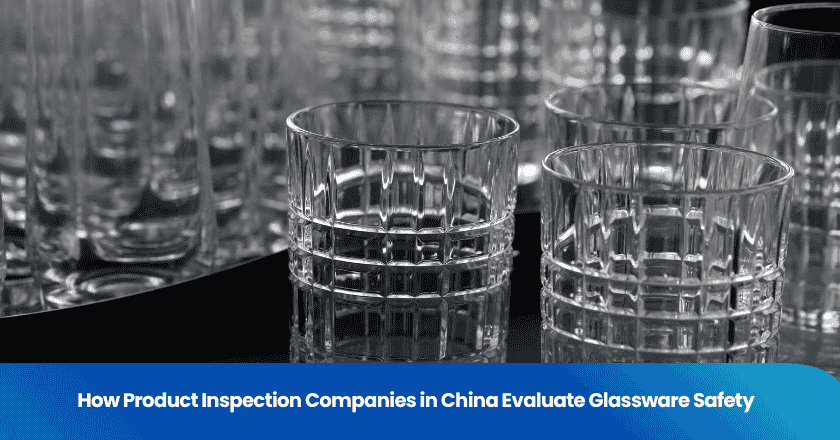
Glassware is one of the most import-sensitive product categories you can source from China. A drinking glass that shatters from thermal shock, a decorative bowl that leaches lead into food, or a bottle with invisible stress fractures can create serious safety hazards and legal liability. Product inspection companies in China play a critical role in verifying that glassware meets international safety standards before it leaves the factory, and understanding how they evaluate glassware safety helps you specify the right inspection protocols for your orders.
Key Takeaways
- Heavy metal migration testing for lead and cadmium is the most critical safety check for food-contact glassware, governed by FDA, EU, and Chinese national standards.
- Thermal shock resistance testing verifies that glassware can withstand temperature changes without cracking or shattering.
- Mechanical safety checks include impact resistance, rim strength, and stability tests that simulate real-world use conditions.
- On-site inspection combined with laboratory testing provides the most comprehensive safety verification for glassware imports.
Why Glassware Safety Inspection Is Non-Negotiable
Glassware used for food and beverage contact must meet strict regulatory requirements across every major market. In the United States, the FDA regulates lead and cadmium leaching from glass and ceramic food-contact articles under 21 CFR. The European Union applies even tighter limits under its framework regulation on food contact materials (EC 1935/2004). China's own GB 4806 series of national food safety standards sets limits for heavy metal migration from glass, ceramic, and metal food-contact products.
According to the U.S. Department of Agriculture's Foreign Agricultural Service report on China's food contact material standards, the GB 4806 series establishes specific migration limits for lead, cadmium, arsenic, and other heavy metals in glass and ceramic products. Compliance with these standards is not just a regulatory requirement; it is a baseline for consumer safety.
The risks of skipping proper glassware safety inspection are severe. A study published in Science of the Total Environment found that some imported ceramic dinnerware released lead at levels exceeding FDA limits, highlighting the importance of independent third-party verification rather than relying solely on factory self-certification.
Core Glassware Safety Tests Performed During Inspection
Product inspection companies in China typically evaluate glassware safety across five major categories. Each category addresses a different risk vector, and together they form a comprehensive safety assessment.
1. Heavy Metal Migration Testing (Lead and Cadmium)
This is the single most important safety test for food-contact glassware. Lead and cadmium can leach from decorative glazes, painted designs, or the glass matrix itself into food and beverages, posing serious health risks particularly for children.
Testing involves filling the glassware with a simulated food solution (typically 4% acetic acid) and holding it at a specified temperature for a set period (usually 24 hours at 22°C for cold-fill products, or shorter periods at elevated temperatures for hot-fill applications). The solution is then analyzed using atomic absorption spectroscopy or inductively coupled plasma mass spectrometry (ICP-MS) to determine the concentration of migrated metals.
| Standard | Lead (Pb) Limit | Cadmium (Cd) Limit | Scope |
|---|---|---|---|
| FDA 21 CFR | Varies by type | Varies by type | U.S. market |
| EU 84/500/EEC | 0.8 mg/L ( Category 1) | 0.07 mg/L | European market |
| GB 4806 series | 0.5 mg/L (flatware) | 0.25 mg/L | China domestic |
| LFGB (Germany) | Stricter than EU | Stricter than EU | German market |
While on-site inspectors cannot perform spectroscopy analysis in the factory, they verify that products are accompanied by valid laboratory test reports and can pull samples for independent lab submission. For a thorough approach, combining a pre-shipment inspection with product testing services ensures both physical quality and chemical safety are verified.
2. Thermal Shock Resistance Testing
Thermal shock occurs when glass experiences a rapid temperature change, causing uneven expansion or contraction that can lead to cracking or catastrophic failure. This is particularly dangerous for drinking glasses, teapots, and bakeware.
Inspectors test thermal shock resistance by heating glassware to a specified high temperature (typically 100-180°C depending on the product type and standard) and then rapidly immersing it in cold water (typically 20°C or lower). The glassware is then examined for cracks, chips, or complete breakage. Standards such as ISO 7459 and ASTM C149 provide detailed test procedures for different glassware categories.
For tempered (toughened) glass products, the thermal shock differential is expected to be much higher than for annealed glass. Inspectors verify that the product meets the thermal shock rating claimed by the manufacturer, which is critical for products marketed as "heat-resistant" or "oven-safe."
3. Mechanical Safety and Impact Resistance
Mechanical safety testing evaluates whether glassware can withstand the bumps, drops, and handling stresses of normal use without creating hazardous sharp edges or fragments. Key tests include:
- Rim impact test: A steel ball of specified weight is dropped onto the rim from a set height to simulate impact during use and washing.
- Base stability test: The glass is placed on a tilted surface to verify it doesn't tip over under normal conditions.
- Edge smoothness check: Inspectors run a cloth or gloved finger along all edges to detect chips, burrs, or rough spots that could cut users.
- Wall thickness uniformity: Using calipers, inspectors measure wall thickness at multiple points to ensure the glass was properly blown or pressed, with no dangerously thin areas.
4. Visual and Dimensional Quality Checks
Beyond safety-specific tests, inspectors perform comprehensive visual and dimensional checks that also affect safety. These include:
- Stone and seed inclusions: Foreign particles embedded in the glass that can create stress concentration points and weaken the structure.
- Cord and striae: Visible lines or streaks in the glass indicating uneven composition, which can affect strength.
- Bubble assessment: While small bubbles are often acceptable in hand-blown glassware, large bubbles near stress points (rim, base junction) can compromise structural integrity.
- Dimensional accuracy: Capacity, height, rim diameter, and base diameter are measured against specifications to ensure consistent quality.
5. Labeling and Compliance Verification
Inspectors also verify that glassware products carry the correct safety markings and labeling required for the target market. This includes food-contact safety symbols, microwave-safe icons (if applicable), manufacturer identification, and country of origin markings. Non-compliant labeling can result in customs holds or market withdrawal, even if the product itself is safe.
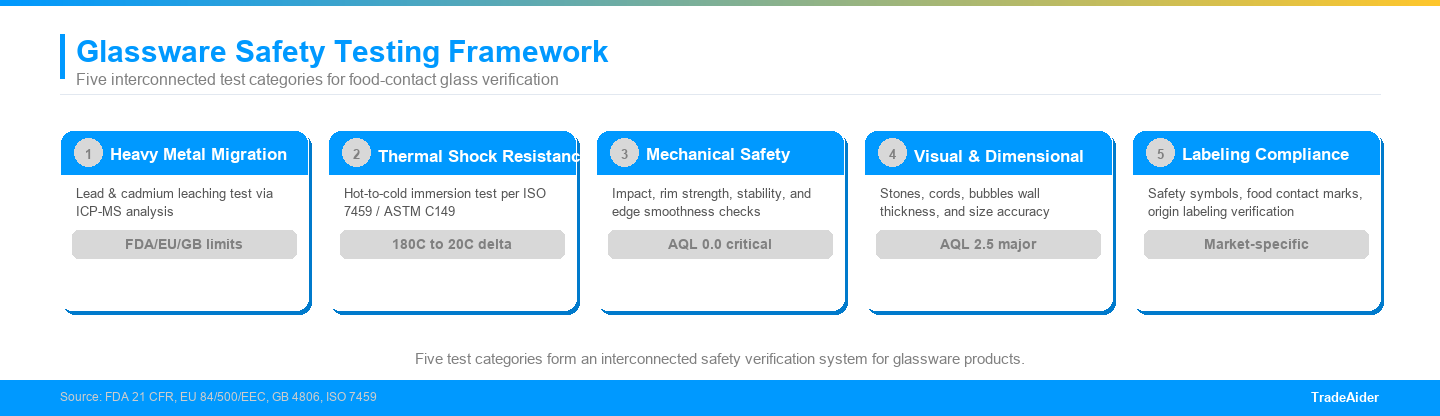
Glassware safety evaluation framework: five interconnected test categories that together form a comprehensive safety verification system for food-contact glass products.
On-Site Inspection vs. Laboratory Testing: What You Need
Understanding the distinction between what can be verified on-site at the factory versus what requires laboratory testing is essential for planning your quality assurance budget effectively.
| Test Category | On-Site (Inspection) | Laboratory (Testing) |
|---|---|---|
| Lead/Cadmium Migration | Verify lab reports | ICP-MS analysis |
| Thermal Shock | Basic hot/cold test | Full ISO 7459 protocol |
| Mechanical Safety | Impact, edge, stability | Instrumented testing |
| Visual/Dimensional | Full AQL check | N/A |
| Labeling Compliance | Full verification | N/A |
The most effective approach is a combined strategy: use an on-site pre-shipment inspection to verify physical quality, dimensions, visual defects, and mechanical safety, and supplement it with laboratory testing for heavy metal migration when selling into regulated markets. TradeAider offers both services, and real-time inspection reports let you make immediate decisions while coordinating lab testing in parallel.
Real-World Scenario: An Amazon FBA Seller's Glassware Quality Catch
An Amazon FBA seller sourcing borosilicate glass storage containers from a factory in Zhejiang scheduled a pre-shipment inspection for a 20,000-unit order. The factory had provided lab reports showing compliance with FDA lead and cadmium limits. During the on-site inspection, the inspector noticed visible cord patterns in approximately 15% of the sampled units, indicating uneven glass composition that could affect thermal shock resistance.
The inspector performed a basic thermal shock test by filling samples with boiling water and then plunging them into cold water. Three of the cord-affected glasses cracked immediately, while glasses without visible cord patterns passed. Because this was caught during inspection, the buyer required the factory to re-sort the batch, removing cord-affected units, and submitted retained samples for independent laboratory heavy metal testing to validate the factory's certificates.
Frequently Asked Questions
Do all glassware products need heavy metal migration testing?
Any glassware that will contact food or beverages should be tested for lead and cadmium migration, especially if it has decorative finishes, painted designs, or colored components. Clear, unadorned soda-lime or borosilicate glass generally poses lower risk, but regulatory requirements still apply regardless of decoration.
Can on-site inspectors test for lead in glassware?
On-site inspectors can use XRF (X-ray fluorescence) analyzers for rapid lead screening, but definitive migration testing requires laboratory analysis using standardized extraction methods and ICP-MS instrumentation. Inspectors primarily verify lab report validity, check labeling compliance, and flag visual indicators of potential contamination risks.
What is the difference between annealed and tempered glass in safety testing?
Annealed glass cools slowly to relieve internal stress, while tempered glass is rapidly cooled to create surface compression that makes it significantly stronger and safer when it breaks (it shatters into small, relatively harmless pieces rather than large sharp shards). Tempered glass undergoes different safety testing criteria and is required for certain product categories in some markets.
How much does glassware safety testing cost?
On-site pre-shipment inspection for glassware starts at $199/man-day with TradeAider. Laboratory testing for heavy metal migration typically costs $50-150 per sample depending on the number of analytes and the required standard. A combined inspection and testing approach provides the best value for importers serious about product safety.
How do I know which safety standards apply to my glassware?
The applicable standards depend on your target market (U.S., EU, UK, etc.), the product type (drinking glass, storage container, bakeware, decorative), and whether the product makes food-contact safety claims. When you contact our team, we can help you identify the exact standards and testing requirements for your specific product and market.
Похожие статьи
Развивайте свой бизнес с услугами TradeAider
Нажмите кнопку ниже, чтобы войти непосредственно в систему услуг TradeAider. Простые шаги от бронирования и оплаты до получения отчетов легко выполнить.

