
To use an AQL sampling chart, identify the lot size and agreed inspection level, find the code letter, then open the correct sampling-plan table. Read the sample size and the acceptance/rejection numbers for your chosen AQL. Inspect randomly selected units and compare the count with those limits. The worked example below follows a 2,000-unit lot at General Level II through every lookup.
What an AQL sampling chart can tell you
AQL means acceptance quality limit: an index used to select an acceptance sampling scheme. It is not the maximum number of failed items allowed in your sample. The chart translates agreed inspection conditions into a sample and a decision rule.
Acceptance sampling helps decide whether to accept or reject a lot; it does not establish its exact defect rate. NIST’s explanation of acceptance sampling makes this distinction explicit. A useful report therefore states which plan was used and what was found, rather than treating “AQL passed” as a measurement of every item shipped.
Sampling is useful when inspecting every item would consume too much time, money or product, particularly for destructive checks. Its limits still matter: a cosmetic sample, a functional check and a safety test may need different methods. Decide what the inspection covers before asking the chart how many units to examine.
The table does not choose your product specification, defect classifications or business tolerance. Those are inputs supplied by the buyer and the responsible quality team.
Set the inspection inputs before opening the chart
Write down the standard and edition, lot definition, inspection level, inspection severity, sampling type and AQL for each defect class. Two people can obtain different answers from an apparently similar chart if these inputs differ.
ISO 2859-1:2026, Edition 3, was published in January 2026. Confirm the edition specified in your purchase order or inspection agreement; do not silently replace it with a chart screenshot from another edition. The numerical example here uses the legacy ANSI/ASQ-labelled tables displayed on TradeAider’s resource page, not a reproduction of the 2026 ISO tables.
Inspection level and inspection severity are separate choices. General inspection levels I, II, and III determine the code-letter lookup for a given lot. Normal, tightened and reduced inspection identify different plans within a scheme. Level I does not mean reduced inspection, and Level III does not mean tightened inspection. ASQ’s Z1.4 overview describes the severity plans and switching rules.
A lot is the defined group submitted for an acceptance decision. Reconcile its quantity with the packing list and the goods available. Do not combine unrelated products merely because they share a shipment. If products differ materially, ask the quality lead how lots and sampling coverage should be separated.
Agree what makes a defect critical, major or minor using product-specific descriptions and reference samples. Select the AQL for each applicable class before inspecting. AQL 2.5 for major defects is an example, not a universal requirement. Serious hazards may need separate controls and a zero-acceptance rule; a small positive AQL does not express “nothing unacceptable can be present.”
Use TradeAider’s inspection standards as a starting point for discussing inspection coverage, then document your own product requirements and agreed exceptions.
How to read an AQL sampling chart
Read the chart in two stages: find the code letter, then use the correct plan table. Keep the input record beside the chart so you can check each selection without relying on memory.
Find the code letter from lot size and inspection level
Use the lot size and the agreed inspection level to find the sample-size code letter. This letter is a lookup key, not the number of items to inspect. NIST’s historical guide to table-based plans describes this sequence; use your contracted standard for the actual tables and rules.
- Find the lot-size interval containing the full submitted quantity. Check the endpoints carefully.
- Move across that row to the agreed general or special inspection-level column.
- Record the code letter at the intersection, together with the table identifier.
For the same lot, a different general level can produce a different code and sample. General II is commonly used for ordinary inspection, but the booking should state it explicitly. Do not select a smaller sample simply because the inspector has limited time.
Special levels S-1 to S-4 provide smaller samples for checks where larger samples may be impractical and the associated sampling risk is acceptable. They are not automatically the right choice for small lots or safety-critical features. For example, a destructive test can have a separately agreed special-level plan while visual inspection uses a general level. Record the scope of each rather than implying that both checks covered the same units.
Read the correct sample size and Ac/Re pair
Open the table for the agreed sampling type and severity, such as single sampling under normal inspection. Find the code-letter row and read its sample size. Then move to the agreed AQL column for the defect class being assessed.
Ac is the acceptance number, the largest observed count allowed for acceptance under that plan. Re is the rejection number, the count that triggers rejection. Read both values from the table rather than calculating a percentage of the sample.
For a single sampling plan, compare the observed count with the plan’s acceptance and rejection numbers. NIST’s sampling-plan definitions distinguish this decision from double or multiple sampling, where a prescribed additional sample can be part of the original plan.
Follow arrows and footnotes. A chart cell containing an arrow directs you to another plan; it is not a blank or permission to use zero. Follow the direction specified by that table, then record the resulting sample size and limits. If its instructions require full inspection when the sample equals or exceeds the lot, apply that instruction.
Repeat the AQL-column lookup for each agreed defect class. Keep the class, counting basis, sample size and Ac/Re together. Never carry a major-defect acceptance number into the minor-defect column, or retain a normal-plan sample while borrowing a tightened-plan threshold. A screenshot is only useful when its title, row labels and notes remain visible.
Worked example: inspect a lot of 2,000 units
Illustrative example, not a client case: a buyer submits one lot of 2,000 identical metal brackets for a visual inspection. The agreed conditions are General Level II, normal inspection, single sampling and AQL 2.5 for major nonconforming units. Other tests and defect classes retain their own agreed requirements.
In the displayed normal single-sampling chart, 2,000 units at General Level II give code K and sample size 125; AQL 2.5 gives Ac 7 and Re 8. These values can be checked in TradeAider’s AQL calculator and displayed charts. The displayed code-letter chart is labelled ANSI/ASQ Z1.4-2008; confirm your contracted edition before operational use.
| Lookup | Result for this illustration |
|---|---|
| Lot-size interval / inspection level | 1,201–3,200 / General II |
| Code letter / sample size | K / 125 units |
| Normal single plan / AQL 2.5 | Ac 7 / Re 8 |
| Observed major nonconforming units | 6: within limit; 8: rejects under this plan |
After inspecting the complete random sample, six major nonconforming units are within the acceptance limit. Eight reach the rejection number. Seven are still within the stated limit. This conclusion concerns the major-defect sampling result; shipment approval also depends on the other agreed checks.
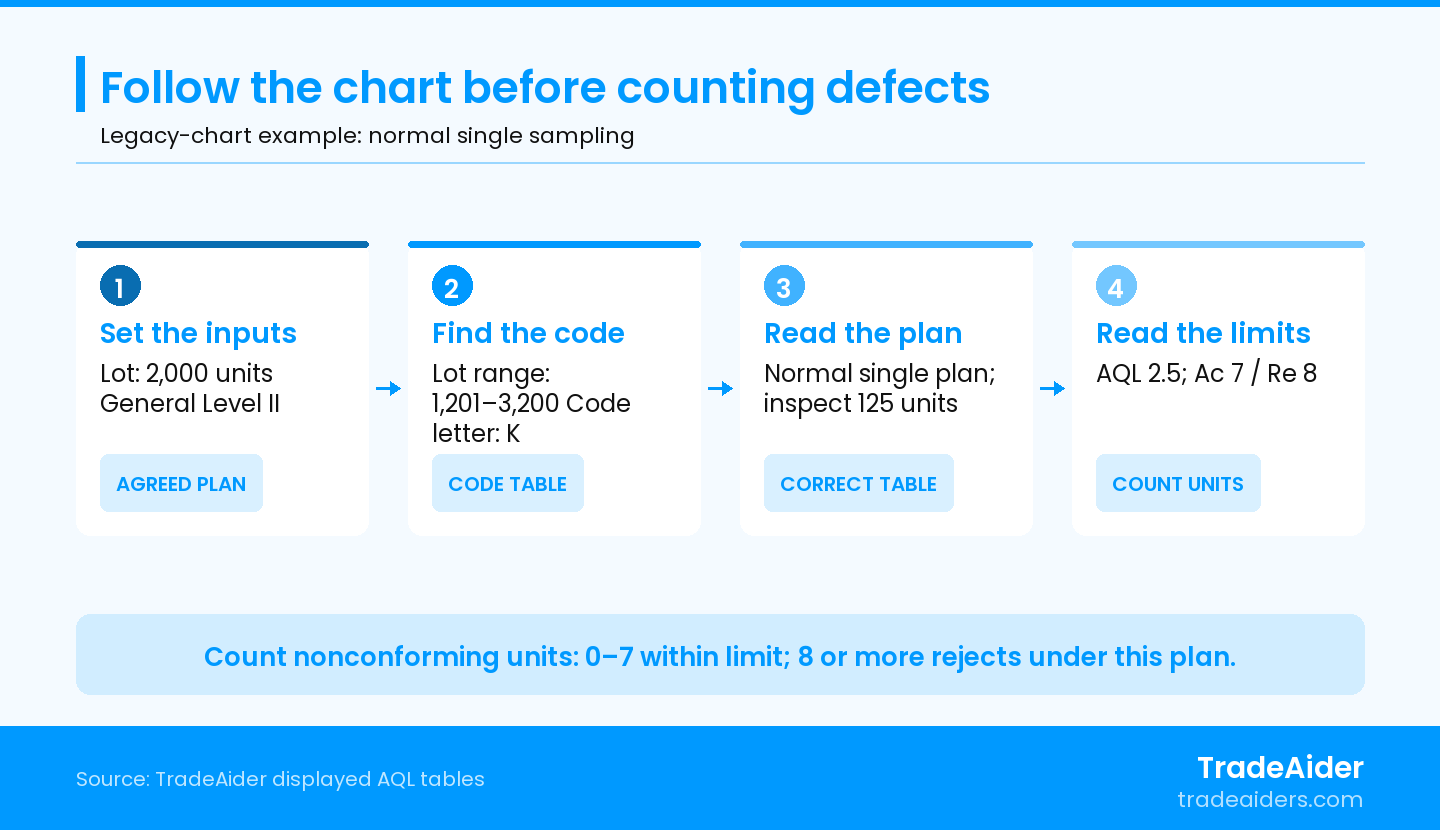
Illustrative normal single-sampling lookup using the displayed legacy chart. Confirm the contracted edition and counting basis before inspection.
Multiplying 125 by 2.5% gives 3.125. Rounding that result to three would replace the chart’s rule with a different one. AQL is an index for selecting a plan, while Ac/Re are its decision numbers.
If the submitted quantity changes, return to the code-letter table. If severity, sampling type or AQL changes, recheck the relevant plan. Do not preserve this example’s result after changing its conditions.
Inspect the sample and record the decision
A correct table lookup only helps when the inspected sample matches the plan. Select units randomly from the defined lot, with access to its cartons and locations. Supplier-selected “good examples” cannot stand in for the random sample. Record any inaccessible goods or incomplete quantities before treating the inspection as complete.
Nonconforming units and individual nonconformities are different counting bases. One bracket with two major faults can be one major nonconforming unit, but two major nonconformities. ASQ’s expert discussion of Z1.4 counting explains why these measures should not be mixed. Agree the basis and classification rules before comparing totals with the limits.
Photograph and identify failures clearly enough for the supplier to find the affected feature. Record actual dimensions or test results where applicable, along with the approved specification. An image labelled “bad quality” is weaker evidence than a stated requirement and the observed deviation.
For TradeAider pre-shipment inspection, the order quantity is 100% complete and at least 80% packed for export. When booking the pre-shipment inspection service, provide the lot details, approved checklist, defect classifications and proposed sampling conditions. The packing threshold does not mean production can be only 80% complete.
Copy this record into the inspection brief and complete the results after inspection:
| Sampling record | Enter the agreed value or result |
|---|---|
| Standard, edition and table | ________ |
| Lot ID, product and submitted quantity | ________ |
| Inspection level / severity / sampling type | ________ / ________ / ________ |
| Code letter / final sample size | ________ / ________ |
| Defect class / AQL / counting basis | ________ / ________ / ________ |
| Ac / Re / observed count / result | ________ / ________ / ________ / ________ |
| Other failed checks / disposition owner | ________ / ________ |
Repeat the defect-class row for every applicable class. If a count reaches Re, report the lot as rejected under that plan and refer its disposition to the authorized buyer or quality lead. Sorting, rework and resubmission need an agreed procedure and identifiable goods; drawing another sample until one passes does not explain or correct the first failure.
For example, if the factory sorts the failed lot, ask it to identify the original lot, the sorting instruction, the defects removed and the quantity resubmitted. Keep the first inspection report with that record. The next inspection should refer to the agreed resubmission procedure and the goods actually presented, rather than being described as a fresh attempt at the same sample. If a supplier disputes a classification, compare the failure with the approved defect description before changing the count. This separates a genuine classification correction from an attempt to alter the acceptance rule after seeing the result.
Fix common chart-reading mistakes
A passing sample does not guarantee a defect-free shipment. NIST’s discussion of operating-characteristic curves shows that acceptance probability varies with incoming quality. Sampling involves the possibility of accepting poorer lots and rejecting better ones.
Check who is responsible for the report. Identify the inspection provider and the person authorized to decide disposition. If you are evaluating TradeAider, TradeAider’s company information provides background on the organization. For an actual order, the booking scope and recorded method explain what the inspection result covers.
If two charts disagree, compare their conditions first. Match the standard edition, lot range, inspection level, severity, sampling type and AQL column. Then check for arrows and whether the chart is cropped. Do not resolve the disagreement by choosing whichever result allows shipment. Ask the responsible quality lead to identify the governing table.
If quality deteriorates, review the scheme’s switching rules. Changing from normal to tightened inspection is different from moving from General II to III or choosing a lower AQL. Keep the lot history required by the selected scheme. A favorable run does not, by itself, authorize smaller samples or less frequent inspection.
If a hazard is found, escalate it separately. A cosmetic sampling pass does not override a critical defect, failed mandatory test or contractual prohibition. Define those stop conditions in the product checklist so the inspector does not need to infer them from a generic chart.
If the sample is incomplete, disclose it. Inspecting fewer units than planned changes the evidence available. Record the achieved sample and the reason, then obtain a decision about completing or rescheduling the inspection. Avoid presenting the original plan’s conclusion as though its full sample had been examined.
Before the next booking, keep the approved chart reference and completed record with the product specification. This makes a disagreement easier to diagnose: the buyer can see whether the issue arose from the selected plan, defect classification, sample access or observed results.
Keep the chart lookup reproducible
- Record the lot, level, severity, sampling type and edition before selecting a code letter.
- Read the resulting sample size and Ac/Re from the correct plan, including arrows and notes.
- Report observed counts on the agreed basis, retain failed results, and separate the sampling decision from other shipment checks.
Ready to confirm an inspection scope? Send your lot size, product checklist and proposed sampling plan so the booking can specify the inspection stage and agreed checks. Contact our team.
AQL sampling chart FAQ
Can I calculate the sample size as a percentage of the order?
No. Use the sample size produced by the specified tables and their instructions, rather than applying a fixed percentage to the order. Lot-size intervals, inspection levels and plan conditions determine the lookup. Increasing the order quantity does not necessarily increase the sample in direct proportion. Recheck the table when a lot crosses an interval boundary or the agreed inspection conditions change.
Is an Ac of zero the same as a defect-free shipment?
No. An Ac of zero means none of the counted nonconformities or nonconforming units is accepted in the inspected sample under that plan. Uninspected units remain unobserved. Where consequences are serious, determine whether additional testing, process controls or full inspection are appropriate. Record the table edition, lot, inspection level, severity, sample size, counting basis and Ac/Re values before inspecting.
Can I use this sampling chart for a one-off purchase?
Do not assume a one-off purchase can use every feature of a sampling scheme designed for a continuing series of lots. ASQ describes Z1.4 as a system for a continuing stream of lots with switching rules. Without the relevant lot history, ask the quality lead which plan and protection are appropriate. Record that choice rather than claiming that a single purchase has established eligibility for reduced inspection.
Похожие статьи


Развивайте свой бизнес с услугами TradeAider
Нажмите кнопку ниже, чтобы войти непосредственно в систему услуг TradeAider. Простые шаги от бронирования и оплаты до получения отчетов легко выполнить.