
- О нас

- Наши услуги
- Ваша отрасль
- Ресурсы
- Новости и блог
You ordered 5,000 units of a 20,000mAh power bank from a Chinese supplier. The samples passed. The price was right. But when the first batch reaches your Amazon warehouse, customers start reporting that the banks die after one phone charge — and your return rate climbs toward 30%. What went wrong? In most cases, the answer is capacity fraud: a factory inflated the mAh rating, and no one tested the actual output before the goods shipped. This guide explains exactly how to catch inflated capacity claims during factory inspection, and how to verify that the UN38.3 transport certification accompanying your shipment is genuine — not a forged document your supplier printed last Tuesday.
Key Takeaways
- A "10,000mAh" power bank can realistically only deliver around 6,600–7,400mAh to a device at 5V — if it is genuine. If real output is below 50% of the stated rating, the cells are fraudulent.
- UN38.3 is mandatory for all international shipments of lithium batteries. The report must name the specific battery model, applicant, and lab. A generic or undated document is a red flag.
- Three on-site tests — weight check, USB meter discharge, and Wh cross-calculation — can expose capacity fraud during a standard pre-shipment inspection without lab equipment.
Why Capacity Fraud Is Rampant in Power Banks
The Economics of Deception
Power bank capacity is determined by the number and quality of internal lithium-ion cells. A genuine Samsung or LG 18650 cell rated at 3,000mAh costs significantly more than a recycled or B-grade cell rated at 1,500mAh. When a Chinese factory substitutes inferior cells but keeps the "20,000mAh" label, the profit margin on each unit can double. The buyer has no visual way to detect the swap from the outside.
The problem is compounded by how mAh is marketed. Most consumers — and even experienced buyers — do not realize that a 10,000mAh power bank cannot deliver 10,000mAh to a phone. Because the battery cell operates at 3.7V internally but the USB output port delivers 5V, voltage conversion alone creates an unavoidable energy loss. A legitimate 10,000mAh (3.7V) power bank theoretically outputs a maximum of 7,400mAh at 5V, and with realistic conversion efficiency of 80–90%, actual delivered capacity typically falls between 6,600–7,400mAh. This conversion math is the starting point for any serious capacity audit.
What Factories Do to Inflate Numbers
Capacity fraud takes several forms, ranging from obvious to sophisticated. The simplest version involves recycled cells: manufacturers pull used cells from old devices, recharge them, and assemble them into new-looking units. A more sophisticated approach involves firmware manipulation — reflashing the indicator circuit so the LED display shows a full charge even when the underlying cells are depleted. In documented cases, buyers using a USB power meter found that a power bank claiming 20,000mAh delivered under 6,000mAh of usable output before shutting off. A third method involves mixing genuine and counterfeit cells in the same pack, which passes a partial test but fails under full discharge.
Three On-Site Tests That Catch Capacity Fraud
Test 1: Weight-to-Capacity Cross-Check
Lithium-ion cells are dense. A 10,000mAh power bank assembled with genuine cells will weigh approximately 200–230 grams; a 20,000mAh unit with real cells should weigh between 420–500 grams. If a unit claiming 20,000mAh weighs under 250 grams, the cells inside cannot physically hold the stated energy. This test requires nothing more than a postal scale and a reference weight chart — it can be done on a sample of 10–20 units within minutes at the factory floor.
Test 2: USB Power Meter Discharge Test
A USB power meter — a small inline device that measures voltage, current, and cumulative mAh — is the most direct field tool for capacity verification. The procedure is straightforward: fully charge the power bank, connect it to the meter with a constant resistive load set at 2A, and let it run until it shuts off. The meter displays total delivered capacity in mAh. For a claimed 10,000mAh unit, a pass result is anything above 6,600mAh. Anything below 5,000mAh indicates fraud; below 3,000mAh is near-certain cell substitution. This test typically takes four to six hours per unit, so inspectors should start it at the beginning of the inspection day and read results at the end.
Test 3: Wh Label Cross-Calculation
Legitimate power banks must display both the mAh rating and the watt-hour (Wh) figure, particularly for export to markets that require it for customs and air transport declarations. The formula is: Wh = (mAh × nominal voltage) / 1000. For a 10,000mAh bank with 3.7V cells, the correct Wh value is 37Wh. If the label shows "10,000mAh" but prints only "10Wh," the stated mAh is three times the actual energy — a mathematical impossibility. Inspectors should cross-check every unit's label against this formula. Discrepancies are frequently caught at this step alone, without requiring a discharge test.
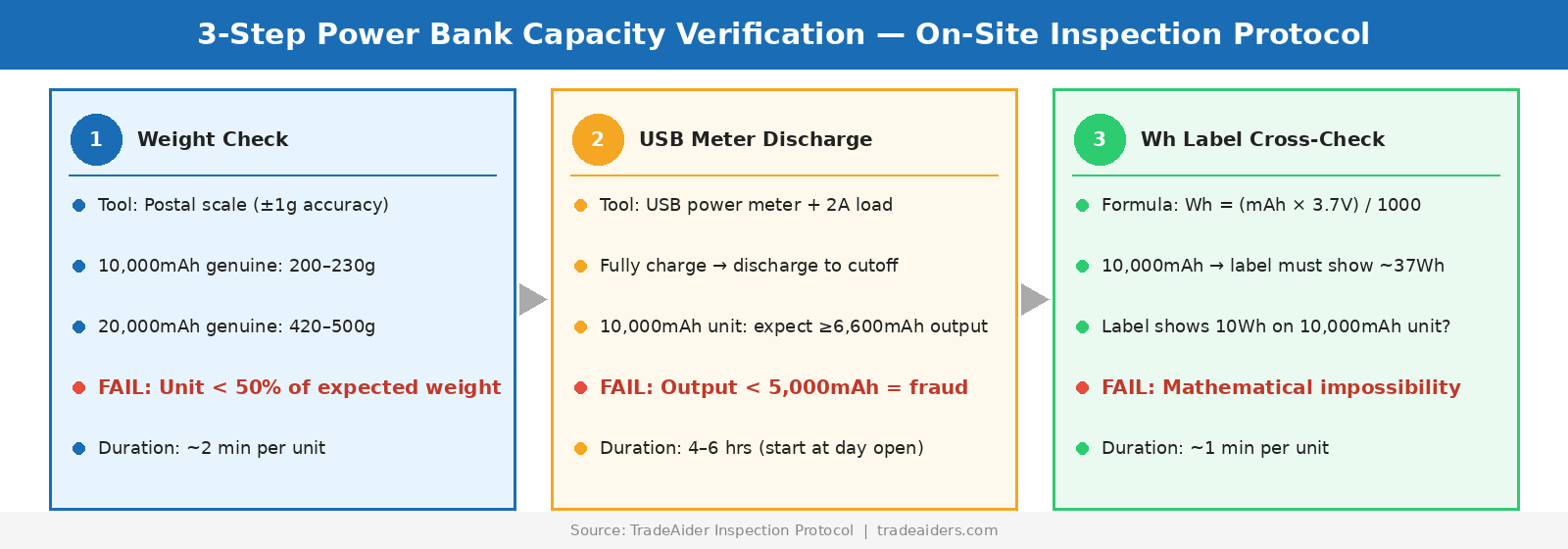
Three-step on-site capacity verification process used during power bank pre-shipment inspection.
Understanding UN38.3: What It Is and What the Report Should Contain
Why UN38.3 Matters for Every Lithium Battery Shipment
The United Nations has classified lithium batteries as Class 9 dangerous goods due to their potential for thermal runaway — a chain reaction in which a battery cell reaches temperatures exceeding its melting point, leading to fire or explosion. To control transport risk, all lithium-ion batteries shipped internationally by air, sea, road, or rail — whether standalone or installed inside a device — must pass UN38.3 testing before export. This testing certifies that batteries are safe and will not pose a safety risk during shipping over air, water, rail, or road transportation methods. Power banks, classified under UN3480 when shipped without a device, require their own UN38.3 certification — a certificate obtained by one supplier does not transfer to another, even if the battery design is identical.
The Eight Tests That Make Up UN38.3 (T1–T8)
UN38.3 certification requires a battery to pass eight distinct tests, typically run by an accredited third-party laboratory. Understanding what each test covers helps buyers spot gaps in fraudulent or outdated reports. The test sequence runs as follows: T1 (altitude simulation) — batteries are subjected to low-pressure conditions equivalent to aircraft cargo holds; T2 (thermal test) — extreme temperature cycling from -40°C to +75°C; T3 (vibration) — road and sea transport vibration simulation; T4 (mechanical shock) — sudden impact stress; T5 (external short circuit) — battery exposed to a short at 57°C for one hour; T6 (impact/crush) — physical compression; T7 (overcharge) — charged at twice the manufacturer's maximum; and T8 (forced discharge) — each cell forced discharged in series. To pass these tests, batteries must not leak, vent, disassemble, rupture, or ignite, and the open circuit voltage must remain above 90% of the pre-test measurement.
What a Genuine UN38.3 Report Must Include
A legitimate UN38.3 test report typically runs 10 or more pages and is issued by an accredited independent laboratory. When you receive a UN38.3 document from a supplier, check for these specific fields before accepting it as valid: the exact battery model designation and rated capacity; the nominal voltage; the applicant company's name and address; the battery manufacturer's name and address; the number of samples submitted for testing; the test commencement and completion dates; individual results for each T1–T8 test with pass/fail notation; and the laboratory's accreditation number. The accompanying one-page test summary should reference the same model and dates. Critically, UN38.3 certification cannot be transferred between suppliers — if your factory switches its cell supplier, the batteries must be retested under the new manufacturer's name.
Red Flags in Fraudulent UN38.3 Documents
Forged UN38.3 reports are a documented problem in Chinese electronics manufacturing. Common indicators of a fraudulent or manipulated document include: a generic laboratory name that does not appear in official accreditation databases; missing or mismatched battery model numbers between the report and the physical unit; a test completion date that predates the factory's production run for your order; a one-page "certificate" with no accompanying detailed test data; and a report that names the same model but a different cell supplier than the one currently used in production. Importers can verify the authenticity of a UN38.3 report by checking the issuing laboratory against the ILAC (International Laboratory Accreditation Cooperation) database or, for Chinese labs, the CNAS accreditation list maintained by the China National Accreditation Service.
| UN38.3 Test | What It Simulates | Pass Criterion |
|---|---|---|
| T1 — Altitude Simulation | Aircraft cargo hold pressure (11.6 kPa) | No leakage, rupture, or fire |
| T2 — Thermal Test | -40°C to +75°C cycling | No loss of mass, leakage, or venting |
| T3 — Vibration | Road/sea transport vibration | No quality loss or function change |
| T4 — Shock | Sudden mechanical impact | No leakage, rupture, or fire |
| T5 — External Short Circuit | Short circuit at 57°C for 1 hour | External temp ≤ 170°C; no fire |
| T6 — Impact/Crush | Physical compression of cells | No fire or explosion |
| T7 — Overcharge | Charged at 2× maximum voltage | No fire or explosion within 7 days |
| T8 — Forced Discharge | Series discharge beyond cutoff | No fire or explosion within 7 days |
China's CCC Requirement: An Additional Layer Since August 2024
What Changed and Why It Affects Your Export Orders
Buyers sourcing power banks from China now need to track a second mandatory certification alongside UN38.3. Starting from August 1, 2024, power banks without China Compulsory Certification (CCC) are prohibited from being manufactured, sold, or imported within China. While CCC is primarily a domestic China market requirement, it directly affects export orders in two ways: first, it restricts which power banks can be carried onto domestic Chinese flights, which matters for buyers traveling to inspect their goods; second, factories that lack CCC certification may be cutting corners on the same safety standards that underpin compliant export products. When auditing a factory's compliance posture, confirming CCC status on power bank production lines is now a meaningful indicator of overall quality management.
TradeAider's pre-shipment inspection service for electronics includes document verification checks alongside on-site functional testing — inspectors confirm that the UN38.3 report on file matches the specific battery model in production, not just the product category. This distinction matters because factories frequently update cell suppliers between certification cycles without obtaining new test reports.
How to Build a Power Bank Inspection Checklist
What Should Be on Every Electronics PSI for Power Banks
A robust inspection checklist for power banks combines visual checks, physical measurements, functional tests, and document reviews. The visual checks cover label accuracy (mAh and Wh both present and mathematically consistent), packaging condition, certification marks (UN38.3 label, CCC mark if applicable, FCC/CE for target markets), and barcode scanability. Physical tests include a weight cross-check against a capacity reference table. Functional tests run the USB meter discharge protocol on a statistically valid AQL sample — for a 5,000-unit order, this means testing at least 20–32 units depending on the AQL level applied. Document review covers the UN38.3 report (lab accreditation, model match, test date currency) and any additional country-specific certifications.
Understanding how quality inspection fits into manufacturing oversight helps buyers set the right checkpoints — not just for finished goods, but for the incoming cell components that determine capacity before assembly even begins. A pre-production inspection that verifies cell supplier certification is the upstream intervention that most capacity fraud cases never receive.
What Happens When an Inspection Fails
When on-site discharge tests show delivered capacity below acceptable tolerance — typically defined as ≥80% of the stated mAh after accounting for conversion losses — the buyer has several options. If fewer than 20% of the sampled units fail, a 100% sort-and-rework of the batch may recover the shipment. If the failure rate is widespread, the entire production run should be quarantined pending re-testing with new cells. In either case, the supplier bears the cost of rework or remanufacture; establishing this contractually in the purchase order is essential before production begins. The downstream cost of quality defects — returns, account suspensions, customer harm — consistently exceeds the upfront cost of an inspection by multiples.
Frequently Asked Questions
Can a power bank pass visual inspection but still have inflated capacity?
Yes — this is the most common form of capacity fraud. Units can look identical to genuine products, carry the correct label, and even show a full charge indicator while containing inferior or recycled cells that deliver a fraction of the stated output. Only a discharge test using a USB power meter reveals actual delivered capacity. Visual inspection alone will not catch mAh fraud.
How do I know if a UN38.3 report was issued for the exact cells in my order?
Request the full UN38.3 test report — not just the summary certificate — and compare the battery model designation and cell manufacturer name on the report against the actual cells used in current production. Ask your inspector to photograph the cell labeling inside a disassembled sample unit. If the cell brand or model number differs from what appears on the UN38.3 report, the certification does not legally cover your shipment.
What is the difference between UN38.3 and CCC for power banks?
UN38.3 is an international transport safety standard required for any lithium battery shipped across borders — it certifies that the battery is safe to transport by air, sea, or road. CCC (China Compulsory Certification) is a Chinese domestic market standard that certifies the complete power bank product meets national safety requirements for consumer use. Both are now required for power banks produced and sold within China, but UN38.3 is the primary document required by international freight carriers for export shipments.
How many units should be discharge-tested during a pre-shipment inspection?
The sample size depends on the order quantity and the AQL level specified. For a 5,000-unit order at AQL 2.5 (the standard for major defects in consumer electronics), the inspection sample is typically 200 units, of which 10–15% should undergo the full discharge test — roughly 20–30 units. Because the discharge test takes several hours per unit, inspectors should start discharge cycles early in the inspection day and check results before the inspection closes.
Catching capacity fraud after your goods arrive is expensive, disruptive, and damaging to your brand. TradeAider's pre-shipment inspection for electronics includes on-site discharge testing, document verification, and a real-time report you can access mid-inspection — so if the discharge results are coming in low at noon, you can redirect the inspector to test a larger sample before the day ends. Use the Inspection Charge Calculator to estimate the cost for your order volume.

Похожие статьи



Развивайте свой бизнес с услугами TradeAider
Нажмите кнопку ниже, чтобы войти непосредственно в систему услуг TradeAider. Простые шаги от бронирования и оплаты до получения отчетов легко выполнить.

