
- О нас

- Наши услуги
- Ваша отрасль
- Ресурсы
- Новости и блог
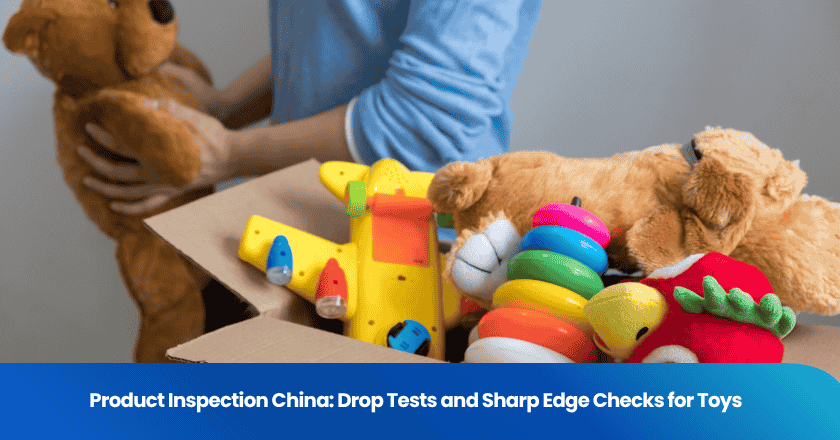
When a child drops their favorite toy down the stairs, throws it across the room, or inevitably uses it in ways the designer never intended, what happens? Does a sharp edge emerge from a cracked casing? Does a small part break free and become a choking hazard? Those questions determine whether your product passes regulatory scrutiny—or becomes a safety incident waiting to happen.
Drop tests and sharp edge checks are two of the most critical safety inspections for children's toys. They're not optional add-ons; they're mandatory requirements under ASTM F963 (US), EN71 (EU), and GB 6675 (China). Understanding how these tests work—and ensuring your inspection partner conducts them correctly—is essential for any toy importer sourcing from China.
Key Takeaways
- Drop tests simulate real-world use and abuse—toys must survive without creating hazards
- Sharp edge testing uses standardized equipment—UL 1439 sharp edge testers are the industry standard
- Test parameters vary by age grading—younger children's toys face more rigorous requirements
- Both tests are mandatory for regulatory compliance—ASTM F963 and EN71 require them
- On-site inspection can include basic testing—but laboratory certification requires accredited facilities
Why Drop Tests Matter: Simulating Real-World Abuse
Drop tests aren't about checking if a toy survives perfectly intact. They're about ensuring that even when damaged, the toy doesn't create new hazards. A plastic toy car that cracks open after being dropped might expose sharp edges or release small parts—both serious safety concerns for children's products.
The drop test simulates the inevitable falls, throws, and impacts that toys experience during normal play. According to toy safety testing guidance, these mechanical tests assess whether toys "remain safe even after experiencing reasonable foreseeable abuse."
Real-World Example: The Battery Compartment Failure
A US-based importer of electronic learning toys received a "PASS" inspection report from their Chinese supplier's chosen inspection company. The toys looked perfect, functioned correctly, and met all dimensional specifications. Six months after retail launch, the CPSC issued a recall. Multiple parents reported that the battery compartment doors had cracked open after their children dropped the toys, exposing AA batteries that toddlers could access. The inspection company had performed visual checks and functional tests—but never conducted drop tests. The recall cost the importer $2.3 million in direct costs and permanently damaged their retail relationships. A proper drop test would have revealed the weak battery door design in minutes.
How Drop Tests Work
The basic drop test procedure is straightforward: the toy is dropped from a specified height onto a hard surface a specified number of times. After each drop, the toy is examined for:
- Structural damage: Cracks, breaks, or separation of components
- Sharp edge creation: New edges that could cut skin
- Small parts release: Components small enough to be swallowed or inhaled
- Exposed mechanisms: Internal parts that shouldn't be accessible
What varies significantly is the test severity, which depends on the toy's intended age range.
Drop Test Parameters by Age Group
According to the summary of drop test parameters, different standards specify different drop heights and number of drops based on the child's age:
| Age Group | Drop Height | Drops | Rationale |
|---|---|---|---|
| 0-18 months | 138 cm (4.5 ft) | 4 | Infants can't control drops; toys fall from adult height |
| 18-36 months | 93 cm (3 ft) | 4 | Toddlers drop from waist height while standing |
| 36-96 months | 93 cm (3 ft) | 4 | Older children's toys tested from similar height |
| 96+ months | Not required | N/A | Older children's toys have different requirements |
The drop surface is standardized: a steel plate at least 3mm thick, mounted on a concrete base. This ensures consistent impact severity across all testing facilities.
Sharp Edge Testing: Detecting Hidden Dangers
Sharp edges can exist in toys right out of the factory—or they can emerge after a drop, impact, or during normal use. Sharp edge testing uses specialized equipment to determine whether an edge is dangerous enough to cause injury.
The Sharp Edge Tester: How It Works
The industry-standard sharp edge tester (UL 1439 compliant) works by wrapping a specialized tape around a rotating mandrel that contacts the edge being tested. After the test, the tape is examined for cuts. The principle is straightforward: if the edge cuts the tape under standardized pressure and rotation, it's considered hazardous.
Toy safety testing equipment suppliers describe the sharp edge tester as designed to "evaluate whether accessible edges on toys or other products are likely to cause injury." The test is both objective and reproducible—critical qualities for regulatory compliance.
What Gets Tested
Inspectors should check all accessible edges on a toy, including:
- Plastic casing edges: Molded parts, battery compartments, access panels
- Metal components: Hardware, brackets, armatures, wire supports
- Broken or damaged areas: After drop testing, new edges must be evaluated
- Assembly joints: Where different materials meet
- Decoration attachments: Metal appliques, rivets, fasteners
The key word is "accessible." Edges that cannot be touched during normal play or reasonably foreseeable abuse don't require testing. But inspectors must think carefully about what "accessible" means—a determined child can reach surprisingly many places.
The Critical Connection: Drop Tests and Sharp Edge Checks
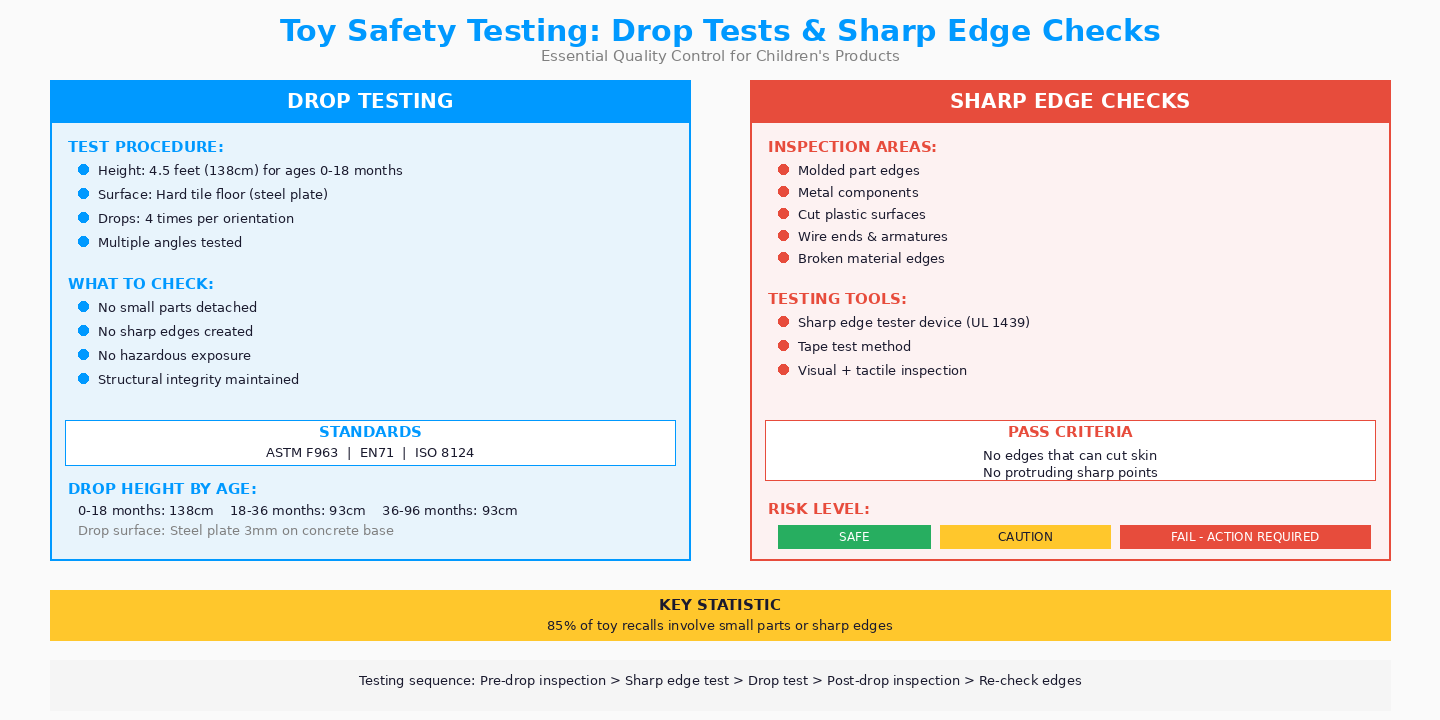
How drop tests and sharp edge checks work together in toy safety inspection
These two tests are often performed sequentially, and for good reason. Drop tests can create sharp edges that didn't exist in the original product. A plastic housing that passes sharp edge testing before the drop test might fail afterward—cracks can create razor-sharp edges.
The Correct Testing Sequence
- Pre-drop inspection: Examine toy for existing sharp edges and other hazards
- Pre-drop sharp edge test: Test all accessible edges on the intact product
- Drop test: Conduct the appropriate number of drops per age grading
- Post-drop inspection: Examine for damage, small parts, and exposed internal components
- Post-drop sharp edge test: Test any new edges created by the impact
This sequence ensures that both the "as manufactured" and "after abuse" conditions are evaluated. A toy that passes all pre-drop tests but creates hazards after dropping fails the overall safety evaluation.
On-Site vs. Laboratory Testing: What Your Inspection Company Can Do
Not all testing requires a laboratory. Understanding the difference helps you plan your inspection and testing strategy effectively.
On-Site Inspection Capabilities
Professional inspection companies can perform basic drop tests and sharp edge checks at the factory:
- Drop tests: Using a measured height and standard surface, inspectors can conduct drop tests and document results with photos
- Sharp edge testing: Portable sharp edge testers allow on-site evaluation of accessible edges
- Visual inspection: Before and after testing, inspectors document the toy's condition
On-site testing is valuable for production monitoring and identifying obvious problems before products ship. It provides immediate feedback and can catch issues early in the manufacturing process.
Laboratory Testing Requirements
For regulatory compliance and certification, laboratory testing is often required. Compliance Gate's EN71 testing guide emphasizes that accredited laboratories provide documentation needed for CE marking and CPSIA compliance.
Laboratory testing offers:
- Accredited results: Official test reports accepted by regulators
- Standardized conditions: Temperature, humidity, and equipment calibration
- Comprehensive documentation: Detailed test reports for compliance files
- Additional testing: Chemical, flammability, and other tests requiring specialized equipment
For product testing services that coordinate with on-site inspection, look for inspection companies that have established laboratory partnerships.
Common Failure Modes: What Goes Wrong
Drop Test Failures
- Battery compartment rupture: Batteries become accessible or fall out
- Plastic casing cracks: Creating sharp edges or exposing internal mechanisms
- Fastener failure: Screws or rivets that shear off or become loose
- Small part detachment: Buttons, decorations, or components that break free
- Joint separation: Where different materials or components meet
Sharp Edge Test Failures
- Flash or burrs: Manufacturing defects on molded plastic edges
- Metal stamping edges: Unfinished edges on stamped metal parts
- Battery compartment edges: Thin plastic edges around battery access
- Wire armature tips: Exposed wire ends in plush toys with internal supports
- Post-damage edges: Sharp edges created after impact or stress
What to Look for in Inspection Reports
When reviewing inspection reports that include drop tests and sharp edge checks, verify that the following information is included:
- Age grading confirmation: The age group the toy is labeled for
- Drop test parameters: Height used, number of drops, drop surface
- Drop test photos: Before and after images showing any damage
- Sharp edge test results: Which edges were tested, pass/fail for each
- Post-test inspection findings: Any new hazards created by testing
- Equipment used: Identification of sharp edge tester model and calibration
If your inspection company provides real-time inspection reporting, you can review test results as they're conducted, allowing you to make faster decisions about production approval.
FAQs About Drop Tests and Sharp Edge Checks
Are drop tests mandatory for all toys?
Drop tests are required for toys intended for children under 8 years old under both ASTM F963 (US) and EN71-1 (EU). Toys for older children (8+) are not typically subject to drop testing, but may have other mechanical testing requirements. The specific requirements also depend on the toy type—some toys may have alternative tests based on their design and intended use.
Can drop tests be performed during production?
Yes, drop tests can and should be performed during production as part of quality control. While formal compliance testing typically happens in accredited laboratories, on-site production testing helps identify problems before full production runs are completed. This saves time and money by catching issues early.
What if a toy fails the drop test?
A drop test failure means the toy created a safety hazard during testing—typically sharp edges, small parts, or exposed mechanisms. The product cannot be shipped to most markets without remediation. Options include redesigning the product to be more robust, changing materials, or modifying the construction. The toy must pass re-testing before market approval.
How accurate are on-site sharp edge tests compared to laboratory tests?
On-site sharp edge tests using properly calibrated equipment are generally accurate for identifying obvious hazards. However, laboratory tests provide more controlled conditions, better documentation, and official results accepted by regulators. For production monitoring and supplier feedback, on-site testing is valuable. For regulatory submission, laboratory testing is usually required.
Do plush toys need drop tests and sharp edge checks?
Yes, plush toys are subject to these tests, though the focus may differ from hard toys. Drop tests on plush toys check for seam failure, stuffing release, and detachment of decorations or features. Sharp edge testing focuses on internal components like wire armatures, plastic pellets, or other rigid elements that might become exposed. Soft toys without rigid components may have limited sharp edge concerns but still require mechanical testing.
Drop tests and sharp edge checks aren't just regulatory checkboxes—they're essential safeguards that protect children from preventable injuries. If you're sourcing toys from China and need inspection partners who understand these critical safety tests, schedule your inspection to learn about comprehensive toy inspection services with real-time visibility.
Похожие статьи
Развивайте свой бизнес с услугами TradeAider
Нажмите кнопку ниже, чтобы войти непосредственно в систему услуг TradeAider. Простые шаги от бронирования и оплаты до получения отчетов легко выполнить.

