
- О нас

- Наши услуги
- Ваша отрасль
- Ресурсы
- Новости и блог
When an umbrella inverts in a gust of wind or a rain jacket starts leaking after two weeks, your customer doesn't blame the factory — they blame your brand. Umbrellas and rainwear are products where durability directly determines whether a customer buys from you again. The challenge is that these items face a uniquely harsh combination of stressors: water pressure, wind force, UV exposure, repeated mechanical action, and temperature extremes. Catching durability failures before shipment requires specific, standardized testing performed at the factory in China.
This guide covers the durability tests that matter most for umbrellas and rainwear, the standards that define acceptable performance, and how to build an inspection process that prevents defective products from reaching your customers.
Key Takeaways
- Water resistance is just one of six critical durability categories — wind, UV, tensile strength, colorfastness, and mechanical cycling all affect product lifespan
- AATCC TM22 and ASTM standards define the minimum performance thresholds for waterproof fabrics used in umbrellas and rainwear
- On-site inspection combined with lab testing catches 40-60% more defects than lab testing alone
- A pre-shipment durability inspection in China costs $199 per man-day with real-time reporting
Why Durability Testing Matters for Umbrellas and Rainwear
The Real Cost of Product Failure
An Amazon FBA seller sourcing 5,000 folding umbrellas from Fujian province received a shipment where 18% of units had frames that bent or broke during the first use. The result: 900 returns in the first month, a surge of negative reviews, and a 34% drop in organic ranking. The cost of that quality failure — returns processing, lost sales, and advertising spend to recover ranking — exceeded $45,000. A pre-shipment durability inspection that included frame flex testing and open-close cycling would have cost $199.
Rainwear carries similar risks. A Shopify brand importing 3,000 rain jackets discovered that the seam sealing tape was detaching after five wash cycles. By the time the issue was identified through customer complaints, 400 units had already been sold. Product recalls for apparel are rare, but the damage to brand trust and the cost of refunds are real and immediate.
Common Defects Found in Umbrellas and Rainwear
| Product | Defect Type | Root Cause |
|---|---|---|
| Folding umbrellas | Frame bending/breaking | Low-grade steel or fiberglass ribs |
| Stick umbrellas | Canopy water leakage at seams | Inadequate seam sealing |
| Rain jackets | Tape peeling at seams | Incorrect heat-bond temperature |
| Rain pants | Color fading after wash | Poor dye fixation process |
| Ponchos | Tear at stress points | Thin fabric below spec weight |
| Golf umbrellas | Auto-open mechanism failure | Spring tension mis-calibrated |
Key Testing Standards for Umbrellas and Rainwear
Durability testing for rain protection products draws on standards from multiple organizations. Understanding which standards apply to your products helps you set clear expectations with your factory and inspection partner.
Water Resistance and Waterproofing Tests
Water resistance is the most fundamental test for any rain protection product. The AATCC TM22 water repellency spray test is the industry's primary screening method for umbrella and rainwear fabrics. The test sprays 250 ml of water onto a taut fabric sample from a fixed height, then compares the wetted pattern against photographic standards rated from 0 (complete wetting) to 100 (no wetting). For umbrellas, a minimum rating of 80 is generally expected; for waterproof rainwear, 90 or higher is the standard.
For hydrostatic pressure testing — which measures the water column height a fabric can resist before leaking — the AATCC TM127 (Hydrostatic Pressure Test) is commonly used. Waterproof rainwear jackets typically need to withstand a minimum of 5,000 mm water column, while high-performance mountaineering gear targets 10,000-20,000 mm. Umbrella fabrics are generally tested to lower thresholds (1,500-3,000 mm) since the canopy doesn't face standing water.
The ANSI blog notes that umbrella performance specifications historically referenced ASTM D4112-02 for woven umbrella fabrics, which covered water resistance, yarn slippage (no greater than 6 mm between threads), breaking force, and flammability. While that specific standard has been withdrawn, its test criteria remain the basis for most factory-level umbrella inspections in China today.
Wind Resistance and Frame Strength Tests
Wind resistance testing simulates the aerodynamic loads an umbrella experiences during use. The test typically involves mounting the open umbrella in a wind tunnel or using a mechanical fan to apply consistent airflow. Performance criteria include:
- No frame deformation at wind speeds up to 30 km/h for standard umbrellas
- Golf and large umbrellas must withstand 40 km/h without permanent rib bending
- Windproof models are tested to 60 km/h with canopy inversion recovery (the frame should return to shape without damage)
Frame strength is also tested mechanically. Inspectors apply lateral force to individual ribs to measure flex resistance and check for metal fatigue. Fiberglass ribs are tested for splinter resistance under repeated flexing. The runner (the sliding mechanism that opens and closes the umbrella) is cycled 300-500 times to verify mechanical durability.
Fabric Tensile and Tear Strength
Rainwear fabrics must resist tearing at stress points — seams, zipper areas, and pocket corners. The key tests include:
- ASTM D5034 (Grab Test): Measures the breaking force and elongation of textile fabrics. Rainwear shell fabrics typically need to exceed 200 N breaking force in both warp and weft directions.
- ASTM D5587 (Trapezoid Tear Test): Measures tear resistance. For lightweight rainwear, minimum trapezoid tear strength of 15 N is common.
- Seam strength testing: Measures the force required to separate a sewn seam. A properly constructed rainwear seam should withstand at least 120 N before seam slippage.
UV Degradation and Colorfastness
Umbrellas and rainwear are frequently exposed to sunlight. UV degradation weakens fabric fibers over time and causes color fading that customers notice immediately. Key tests include:
- AATCC TM16 (Colorfastness to Light): Exposes fabric samples to xenon arc light that simulates sunlight. Fabrics are rated on a 1-5 scale; minimum Grade 4 is expected for products marketed as UV-protective.
- AATCC TM61 (Colorfastness to Washing): Tests whether dyes bleed or fade after repeated laundering. Rainwear should achieve Grade 4 or higher after 5 wash cycles.
- ASTM G154 (UV Accelerated Weathering): Used for umbrellas marketed with UV protection claims, this test measures fabric strength retention after prolonged UV exposure.
What a Durability Inspection Covers
On-Site Testing at the Factory
A pre-shipment durability inspection combines visual checks with physical tests performed at the factory. For umbrellas, the on-site inspector performs:
- Open-close cycling: 50 consecutive open-close cycles to test runner and spring mechanism durability
- Water spray test: Spraying the open canopy with water to identify leakage at seams, panel joins, and the center cap
- Frame flex test: Manually flexing each rib to check for bending, cracking, or rivet looseness
- Auto-open/close function: Verifying smooth deployment and retraction with consistent spring tension
- Tip and ferrule security: Pulling tips and ferrule to verify they're properly attached
For rainwear, on-site testing includes:
- Seam tape adhesion: Attempting to peel seam tape at stress points to verify bonding strength
- Zipper function: 20 full open-close cycles on all zippers
- Snag and pill check: Visual inspection for fabric pilling and surface defects
- Water beading test: Spraying water on the fabric surface to verify DWR (Durable Water Repellent) coating performance
- Elastic and drawcord function: Testing elastic recovery and cord lock mechanisms
With TradeAider's pre-shipment inspection, all on-site test results and photos are reported in real-time through the online platform, so you can make ship-or-hold decisions within hours.
Lab Testing Coordination
Some durability tests require laboratory equipment that isn't available at the factory. Your inspection partner can extract samples during the PSI and send them to an accredited lab for:
- Hydrostatic pressure testing (AATCC TM127)
- UV accelerated weathering (ASTM G154)
- Colorfastness to washing and light (AATCC TM16, TM61)
- Formaldehyde and pH testing for fabric safety
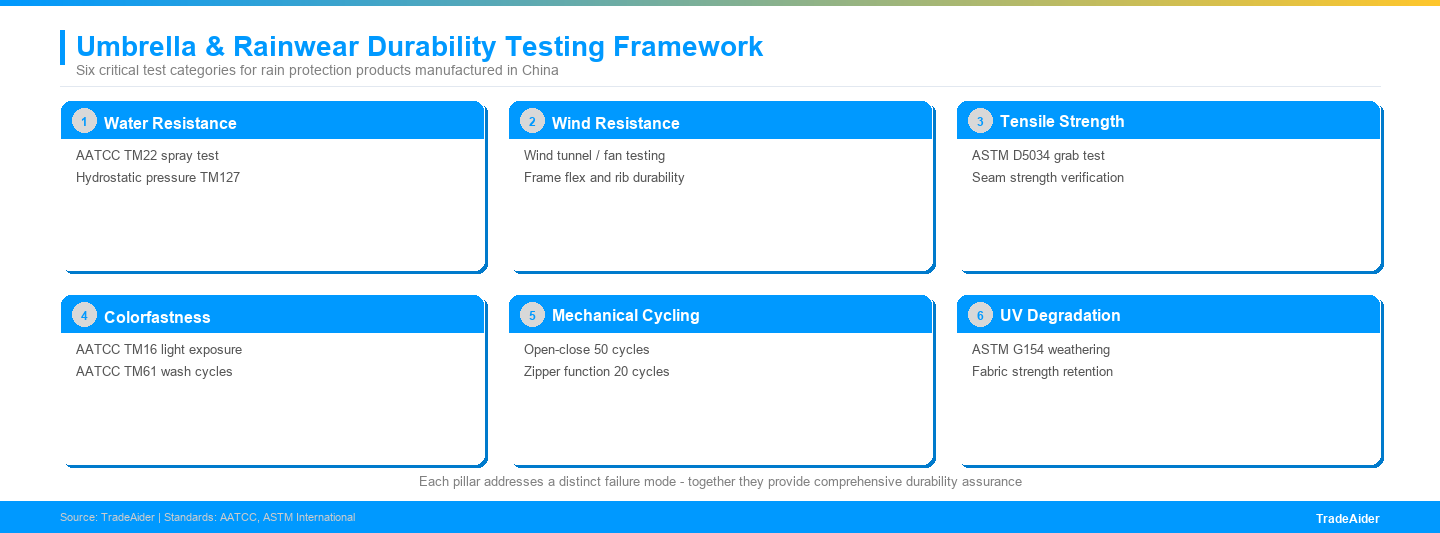
Six-pillar durability framework: each category addresses a distinct failure mode common to rain protection products
The Umbrella and Rainwear Durability Test Checklist
| Test Category | Test Method | Product | Typical Pass Criteria |
|---|---|---|---|
| Water repellency | AATCC TM22 Spray Test | Both | Rating 80+ (umbrella), 90+ (rainwear) |
| Hydrostatic pressure | AATCC TM127 | Rainwear | 5,000 mm minimum |
| Wind resistance | Fan/wind tunnel test | Umbrellas | No frame deformation at 30 km/h |
| Tensile strength | ASTM D5034 Grab Test | Rainwear | 200 N minimum (warp and weft) |
| Open-close cycling | 50-cycle mechanical test | Umbrellas | No mechanical failure |
| Colorfastness to light | AATCC TM16 | Both | Grade 4 minimum |
How to Schedule Your Durability Inspection
Timing matters for durability testing. Here's the recommended approach:
- During product development: Send a sample to a lab for full durability testing before you commit to mass production. This is your cheapest insurance — finding a fabric issue at the sample stage costs pennies compared to a full production run.
- Pre-production inspection (PPI): Verify that the factory is using the correct fabric grade, rib material, and components you approved in the sample. Material substitution is the #1 cause of durability failure in umbrellas and rainwear. Schedule a PPI before production begins.
- Pre-shipment inspection (PSI): The comprehensive on-site durability check. Book when production is 100% complete and at least 80% packed. The inspector performs all on-site tests described above plus AQL sampling for visual and dimensional checks.
TradeAider charges a flat $199 per man-day for on-site inspections in China, including durability testing, with no hidden fees for travel, weekends, or holidays in standard manufacturing zones. Real-time reporting means you see every test result as it happens.
Get a free quote for your umbrella or rainwear inspection — most requests receive a detailed response within 2 hours during business hours.
Frequently Asked Questions
What is the most common durability failure in umbrellas from China?
Frame bending and breakage is the most frequently identified defect, typically caused by factories substituting lower-grade steel or fiberglass for the rib material specified in your product requirements. This is why the pre-production inspection — where the inspector verifies the actual raw materials — is so important. On-site open-close cycling tests at the PSI catch mechanical failures that material specs alone cannot predict.
How is waterproofing tested on rainwear?
Waterproofing is tested through two complementary methods. First, the AATCC TM22 spray test evaluates surface water repellency by spraying water onto the fabric and rating the beading pattern from 0-100. Second, the AATCC TM127 hydrostatic pressure test measures the water column height the fabric can resist before penetration occurs. For fully waterproof rainwear, both tests are necessary — surface repellency alone doesn't confirm waterproofness.
Can durability testing be done at the factory or only in a lab?
Many durability tests can be performed on-site at the factory during a pre-shipment inspection: water spray testing, open-close cycling, frame flex testing, zipper cycling, and visual seam checks. Tests requiring specialized equipment — hydrostatic pressure, UV weathering, colorfastness, and tensile strength — need to be conducted in an accredited laboratory. Your inspection partner should coordinate sample extraction at the factory and manage the lab submission process.
How much does durability inspection cost for umbrellas and rainwear?
On-site inspection costs $199 per man-day with TradeAider. For orders under 5,000 units, one man-day is typically sufficient for the full range of on-site durability tests plus AQL sampling. Lab testing fees are separate and depend on the specific tests required — a basic water resistance and colorfastness panel typically runs $150-300 per test group.
What AQL level should I use for umbrellas and rainwear?
Most importers use AQL Level II with 2.5% for major defects (functional failures like frame bending, water leakage, zipper malfunction) and 4.0% for minor defects (cosmetic issues like color variation, minor stitching irregularities). For high-end products or brands with strict quality expectations, tightening to AQL 1.5/2.5 provides an extra safety margin. Use the AQL calculator to determine sample sizes for your order quantity.
Похожие статьи
Развивайте свой бизнес с услугами TradeAider
Нажмите кнопку ниже, чтобы войти непосредственно в систему услуг TradeAider. Простые шаги от бронирования и оплаты до получения отчетов легко выполнить.

