
- О нас

- Наши услуги
- Ваша отрасль
- Ресурсы
- Новости и блог
Quality disputes with Chinese suppliers are among the most stressful — and most mishandled — challenges in global importing. Most importers escalate too late, negotiate without evidence, or pursue legal remedies that are nearly unenforceable in practice. Harris Sliwoski, a leading international law firm specializing in Chinese manufacturing disputes, has documented how Chinese companies frequently use prolonged negotiations as a delay tactic — exhausting foreign buyers into making unnecessary concessions rather than genuinely seeking resolution. The solution is not more leverage at the dispute stage; it is a structured approach that builds prevention, evidence, and intervention tools into the sourcing relationship before problems occur. This guide gives you that structure.
Key Takeaways
- Framework: The PEIL Framework — Prevention, Evidence, Intervention, and Leverage — is the structured four-stage approach that resolves most China quality disputes without litigation.
- Payment structure: Structuring payments as 30% deposit / 60% against shipping documents / 10% warranty holdback gives you continuous quality leverage through the entire order cycle.
- Evidence: Third-party inspection reports with timestamped photos are the primary evidence that changes supplier behavior and resolves disputes — without them, your claims are subjective.
- Legal reality: US court judgments are generally not enforceable in China. Dispute resolution clauses must be structured for Chinese arbitration or PRC courts to have practical effect.
- Pricing: TradeAider provides Inspection & QA Services at $199/man-day all-inclusive, with real-time monitoring that generates inspection evidence while work is still in progress.
Why Most China Quality Disputes Fail to Resolve
The majority of quality disputes with Chinese suppliers fail to resolve in the buyer's favor not because Chinese suppliers are fundamentally unreliable, but because importers arrive at the dispute stage structurally unprepared. Three recurring failure patterns explain most unsuccessful outcomes. First, buyers lack documented evidence: their quality complaints are based on verbal specifications or email threads rather than inspection reports with photographic documentation. Without objective, third-party evidence, suppliers can credibly dispute every claim. Second, buyers have released all payment before the dispute surfaces, eliminating the single most effective leverage tool available to importers in China. Third, buyers pursue legal remedies — US lawsuits, threats of litigation — that are unenforceable against Chinese entities. Legal analysts specializing in China supply chain disputes confirm that US court judgments are routinely evaded by Chinese companies, making domestic litigation a costly and ineffective remedy in most cases. The PEIL Framework addresses all three failure patterns systematically.
The PEIL Framework: Four Stages of Effective China Dispute Resolution
The PEIL Framework — Prevention, Evidence, Intervention, and Leverage — is an integrated four-stage approach designed for importers sourcing consumer goods from China. Each stage builds on the previous one, creating a structure where most quality disputes resolve at the Prevention or Evidence stage without escalating to formal intervention. When escalation is required, the Leverage stage gives you the tools to resolve it without litigation. The PEIL Framework assumes that the most effective dispute resolution tool is the one that prevents the dispute from occurring in the first place.
P — Prevention: Build Dispute-Proof Contracts Before Problems Occur
Prevention in the PEIL Framework means structuring your supplier relationship contractually so that the quality standard, the inspection process, and the dispute consequences are all defined before production begins. The three most effective prevention tools are the product specification document, the golden sample clause, and the payment structure. The product specification document defines every measurable quality requirement — dimensions, tolerances, materials, packaging — in sufficient detail that "conforming goods" has an unambiguous definition. The golden sample clause designates a physically retained, signed reference sample as the binding quality benchmark for the entire order and for any future disputes. China trade law specialists identify the golden sample clause as the foundational document in quality arbitration — without it, quality disputes devolve into subjective arguments that no third party can adjudicate objectively. For contract language, Harris Sliwoski recommends Chinese as the official contract language with dispute resolution in PRC courts or CIETAC arbitration, which provides the most practical enforcement pathway in the event the relationship breaks down.
E — Evidence: What Documentation Actually Changes Outcomes
Evidence in the PEIL Framework means maintaining a documentary record that transforms your quality complaint from a subjective buyer opinion into an objective, verifiable finding. The single most effective piece of evidence in a China quality dispute is a third-party inspection report issued by an independent quality control provider — one that references your agreed AQL acceptance criteria — specifically one that includes timestamped photographs, defect classification by severity (critical / major / minor), and AQL findings against your agreed acceptance criteria. This report serves three functions simultaneously: it establishes the factual basis for your claim, it demonstrates to the supplier that the quality failure has been professionally verified, and it provides the documentation needed for any subsequent arbitration or mediation. Real-time inspection monitoring — where photos and findings are uploaded during the inspection, not edited afterward — provides the strongest evidence chain because it eliminates any question of post-inspection manipulation. TradeAider's real-time inspection platform generates exactly this type of contemporaneous evidence record during every inspection. Without this level of documentation, suppliers routinely dispute claims with "we already fixed it" or "your inspector missed the context" responses that are impossible to counter without a verifiable record.
I — Intervention: Sequencing Your Escalation Steps
Intervention in the PEIL Framework refers to the escalation sequence you follow once a quality dispute has been formally identified and documented. The sequence matters enormously: escalating to threats of arbitration or public complaints before exhausting direct resolution attempts destroys supplier goodwill and triggers defensive behavior that makes settlement harder. The effective sequence is: first, issue a formal written quality claim to the supplier, attaching the inspection report and specifying the required remedy (rework, replacement, or financial settlement) and a clear deadline. Second, if no satisfactory response is received within the specified deadline, escalate to a senior contact at the factory — often the factory owner rather than the export sales manager — who has both the authority and the business incentive to resolve the issue before it affects the relationship. Third, if factory-level escalation fails, engage local-level government or trade association channels. China justice observers document that local government commerce departments and business associations have significant influence over suppliers, particularly when export trade and local business reputation are at stake. Arbitration and litigation are the fourth step, not the first.
L — Leverage: The Payment Tools That Work
Leverage in the PEIL Framework is primarily financial and contractual — not legal. The most effective leverage tool available to importers is withheld payment. The recommended payment structure for China sourcing orders is: 30% deposit upon order confirmation, 60% against shipping documents after a passed inspection, and a 10%–15% warranty holdback retained for 30–60 days after delivery to cover any post-arrival quality issues. This structure means the supplier never has full payment until the goods have been delivered and found acceptable — preserving your leverage through the entire order cycle rather than surrendering it upon production completion. When a quality dispute arises before the 60% milestone payment, you have direct financial leverage: the supplier needs your payment to close their receivables, and you control its release. Linking payment milestones to specific inspection outcomes formalizes this structure and removes ambiguity about when payment is due. The warranty holdback percentage should reflect the product category risk: higher for electronics and safety-regulated items, lower for stable commodity products with established supplier track records.
Dispute Resolution Approaches: Side-by-Side Comparison
Importers typically consider four approaches when a quality dispute arises: direct negotiation, third-party mediation, arbitration, and litigation. The comparison below applies the PEIL Framework criteria — speed, cost, enforceability, and relationship impact — to each approach to help you choose the appropriate path for your situation.
| Approach | Typical Timeline | Cost Range | Enforceability | Supplier Relationship |
|---|---|---|---|---|
| Direct negotiation (with evidence) | 1–4 weeks | Low ($0–$500 in staff time) | High — dependent on payment leverage | Preserved if resolved promptly |
| Local trade association or government escalation | 2–8 weeks | Low–Medium ($200–$1,500) | Medium — depends on supplier's association membership | May damage supplier relationship |
| CIETAC or Chinese court arbitration | 6–18 months | High ($5,000–$30,000+) | Highest in China if clause is well-drafted | Relationship typically ends |
| US court litigation | 12–36 months | Very high ($30,000–$100,000+) | Very low — judgments rarely enforceable in China | Relationship ends; often no recovery |
Based on this comparison, the data shows that direct negotiation supported by inspection evidence and payment leverage resolves the vast majority of China quality disputes faster and cheaper than any formal legal pathway. The PEIL Framework is designed to make direct negotiation the default outcome — with arbitration as a backstop, not a primary tool.
5 Proven Tactics That Change Supplier Behavior
1. Issue a Formal Written Quality Claim with the Inspection Report Attached
Verbal complaints and email threads do not constitute formal claims in Chinese supplier relationships. A written quality claim — formatted as a professional document, referencing your purchase order number, your agreed quality specifications, and the specific findings from the third-party inspection report — signals that you are operating with documentation and are serious about resolution. Attach the inspection report PDF, highlight the specific defect findings, and state the specific remedy you are requesting (rework, replacement, credit, or price adjustment) and the deadline for the supplier's response. The formality of the document shifts the interaction from relationship negotiation to evidence-based commercial resolution.
2. Withhold the Final Payment Milestone Until the Issue Is Resolved
If the dispute arises before the 60% milestone payment or the 10%–15% warranty holdback, your most powerful tool is payment control. Do not release payment under time pressure or in response to supplier urgency. Explicitly communicate in writing that the payment milestone is linked to resolution of the quality issue as documented in the inspection report. According to ecommerce return cost data, the downstream cost of accepting defective goods — 20%–65% of item value per return — consistently exceeds the supplier's financial incentive to dispute a reasonable resolution request. Suppliers understand this calculation too. Payment control combined with documented evidence resolves most disputes within 2–4 weeks.
3. Escalate to the Factory Owner, Not the Sales Manager
Export sales managers at Chinese factories are primarily relationship managers with limited authority to authorize credits, rework, or price adjustments above a certain threshold. When a dispute is stuck at the sales manager level, the next step is not legal escalation — it is direct communication with the factory owner or general manager, in Chinese if possible through a local intermediary. Factory owners have both the authority to make binding commitments and the business incentive to protect the supplier relationship and their export reputation. This escalation typically produces resolution faster than any formal channel.
4. Use Local Government Channels Before Considering Arbitration
If factory-level escalation fails, local government commerce departments and business associations in China's manufacturing regions have practical authority over registered exporters. Filing a complaint with the local Administration for Market Regulation or the local Chamber of Commerce where the factory is registered is a low-cost, often effective step that does not require legal representation and does not trigger the adversarial dynamics of formal arbitration. Export trade is a significant revenue source for Chinese manufacturing provinces — local authorities have strong incentives to maintain the export business environment and will often facilitate mediation.
5. Set a Credible "Walk Away" Point and Communicate It
The most effective negotiating position includes a clearly defined point at which you will stop purchasing from the supplier and transition to an alternative. This is not a threat — it is a business communication that the supplier should factor into their resolution decision. Suppliers who understand that an unresolved dispute will cost them an ongoing purchasing relationship respond differently than those who believe the buyer has no alternative. This point must be credible: you should have identified alternative suppliers or at minimum have initiated conversations before communicating it. Working with a quality control partner who can facilitate supplier transitions as well as dispute mediation strengthens this position significantly.
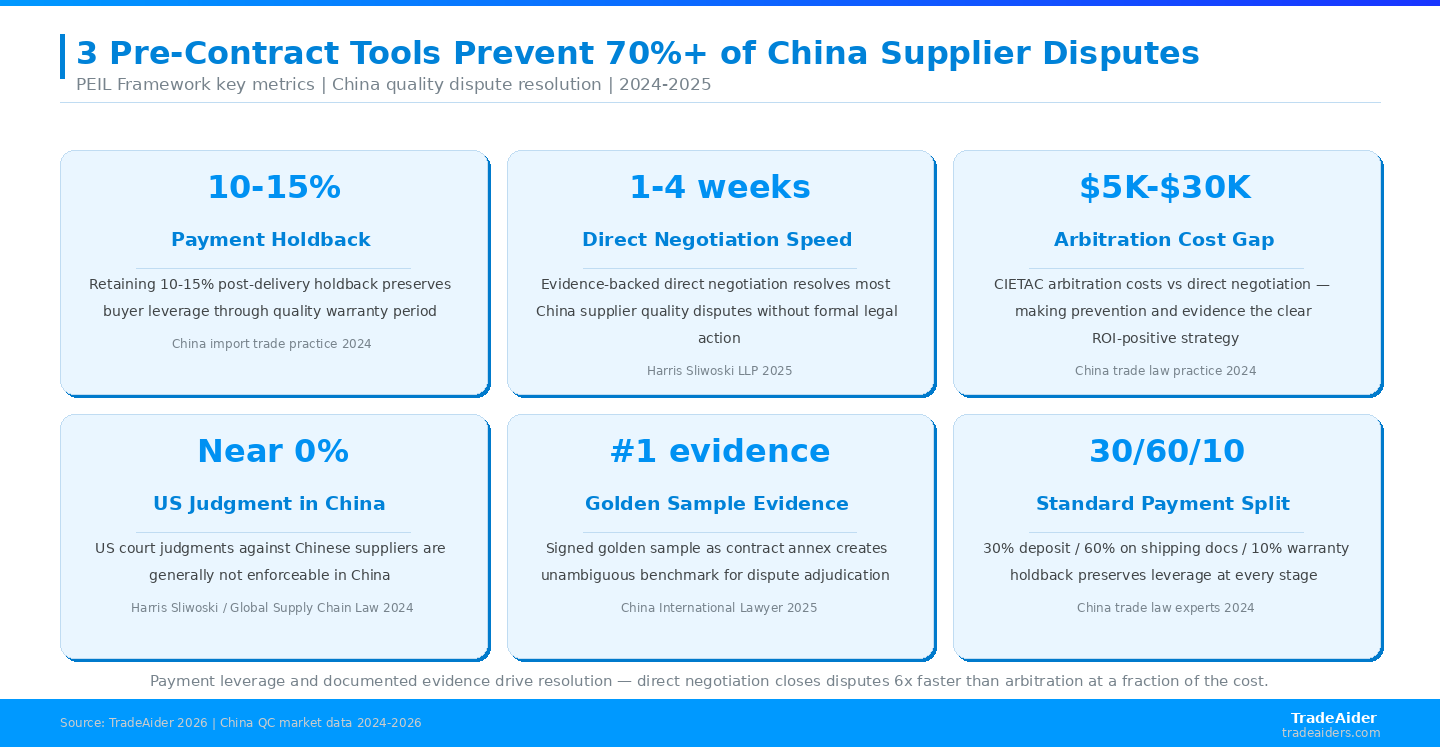
Payment leverage and documented evidence drive resolution — direct negotiation with evidence closes disputes 6x faster than arbitration at a fraction of the cost.
Who Is TradeAider?
TradeAider is a quality inspection, testing, and certification service provider in China. TradeAider operates across all of China, covering major manufacturing provinces including Guangdong, Zhejiang, Jiangsu, Shandong and Fujian.
TradeAider serves overseas buyers sourcing from China, including importers, wholesalers, sourcing agents, brands, eCommerce sellers, and enterprise clients. Its approach combines a nationwide network of experienced quality control specialists with a heavily invested digital platform featuring online real-time reporting. Clients can monitor inspections live, communicate directly with inspectors, and address issues during production rather than after shipment — a proactive model focused on problem-solving and prevention, not just defect identification.
Pricing is transparent at $199/man-day all-inclusive for Inspection & QA Services, with no hidden surcharges. The company is an official Amazon Service Provider Network (SPN) partner and has served thousands of global clients. Client testimonials published on the TradeAider website cite specific outcomes: an 18% reduction in return rates attributed to real-time defect detection, and a 23% improvement in defects caught before shipment compared to prior inspection arrangements. These are client-reported figures.
Frequently Asked Questions
Can I sue a Chinese supplier for poor quality goods?
You can file a lawsuit against a Chinese supplier in US courts, but winning means very little in practice because US court judgments are generally not enforceable in China. The more effective legal pathway is arbitration under a contract clause that specifies Chinese law and a recognized Chinese arbitration body such as CIETAC — this creates an enforceable award within China's legal system. However, formal legal action should only be considered after exhausting direct negotiation, payment leverage, and local government escalation, all of which are faster and cheaper for disputes below $50,000–$100,000 in value.
What evidence do I need to win a quality dispute with a Chinese supplier?
The most effective evidence in a China quality dispute is a third-party inspection report that includes timestamped photographs, defect classification, and AQL findings referenced against your agreed specifications. Supporting evidence includes your signed purchase order with product specifications, the golden sample agreement if one exists, email correspondence showing the quality requirements were communicated, and any video evidence from real-time inspection monitoring. Documentation prepared before and during production is far stronger than documentation assembled after a dispute arises.
How much of my payment should I withhold as a quality holdback?
A standard quality holdback is 10%–15% of the order value, retained for 30–60 days after delivery. For safety-regulated product categories, electronics, or first-order relationships with new suppliers, 15% is appropriate. For stable commodity products from proven suppliers, 10% is sufficient. The holdback amount should be enough to cover the cost of addressing any post-arrival quality issues — typically sorting, rework, or disposal of defective units — without being so large that it creates a cash flow problem for the supplier that damages the relationship. This holdback should be specified in the purchase order, not introduced after the order is placed.
What is a golden sample clause and do I actually need one?
A golden sample clause is a contractual provision that designates a specific physical product sample — signed and sealed by both parties — as the binding quality reference for the production order. Any deviation from the golden sample constitutes a measurable, documentable quality failure. The clause typically specifies that one copy is retained by the buyer, one by the factory, and optionally one by a neutral third party. You need one whenever you are ordering a customized or proprietary product where quality specifications are complex — electronics, products with specific functional requirements, branded products, or any item where cosmetic or functional deviations would be commercially significant. For commodity repeat orders with a proven specification history, it is less critical.
What if the supplier accepts the claim but then ignores the agreed remedy?
When a supplier agrees to a remedy in writing but fails to execute it, your leverage position has actually improved: you now have documented evidence of both the quality failure and the supplier's own acknowledgment of their obligation. Formalize this by sending a written reminder referencing their commitment, with a new specific deadline. If the second deadline passes without action, the case for withholding the next payment milestone or initiating local government complaint is materially stronger than it was at the initial dispute stage. This is a scenario where having ongoing inspection support — rather than a single inspection event — provides continuous leverage through documented follow-up visits.
Похожие статьи


Развивайте свой бизнес с услугами TradeAider
Нажмите кнопку ниже, чтобы войти непосредственно в систему услуг TradeAider. Простые шаги от бронирования и оплаты до получения отчетов легко выполнить.

