
- О нас

- Наши услуги
- Ваша отрасль
- Ресурсы
- Новости и блог
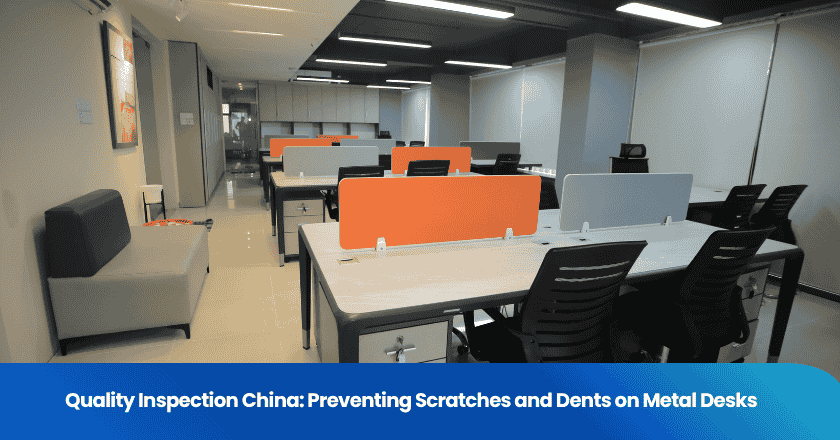
China shipped over 419,000 tons of metal office furniture in 2024 — a 20% increase over the previous year — and the United States alone absorbed roughly a third of that volume. For importers sourcing metal desks at scale, that growth is good news. But it also means more production pressure on Chinese factories, and production pressure is exactly when surface defects like scratches and dents become a systemic problem rather than an isolated one. A single container of desks with widespread coating damage or dented panels can trigger chargebacks, one-star reviews, and Amazon FBA removal requests before you've had a chance to react.
This guide walks through how professional quality inspection catches surface defects on metal desks before they leave the factory — and what you can do at each stage of production to prevent them from happening in the first place.
Key Takeaways
- Scratches and dents on metal desks originate at four distinct stages — raw material intake, fabrication, powder coating, and packaging — and each stage requires a different inspection approach.
- AQL 2.5 for major defects and 4.0 for minor defects is the industry-standard tolerance setting for furniture pre-shipment inspections under ISO 2859-1.
- A During Production Inspection (DPI) is often more cost-effective than a pre-shipment inspection alone, because surface defects caught mid-production can still be corrected before the batch is complete.
- Real-time inspection reporting lets you make accept/reject decisions and communicate rework instructions to the factory on the same day the inspection is conducted.
Why Metal Desks Are Particularly Vulnerable to Surface Defects
Unlike wood or laminate furniture, metal desk surfaces are unforgiving. Cold-rolled steel panels — the most common substrate for office desks manufactured in China — show every contact mark, handling scratch, and impact dent with high visibility. The problem is compounded by the production environment: metal components move between cutting, welding, forming, and coating stations using forklifts, conveyors, and manual lifting, each transition creating an opportunity for surface contact damage.
The Four Defect Origination Points
Understanding where defects begin is the first step to preventing them. Steel processing specialists identify three primary surface defect types in metal products: scratches from contact with tools or equipment during handling, scale from oxidation during hot rolling or moisture exposure, and dents from impact during storage and transport. For metal desks specifically, these map to four factory-stage origination points:
| Stage | Common Defect | Root Cause |
|---|---|---|
| Raw Material Intake | Surface rust, scale, pre-existing dents | Poor coil storage, moisture exposure |
| Fabrication (cutting, bending, welding) | Tool marks, weld spatter, sharp edges | Inadequate tooling maintenance, manual handling without padding |
| Powder Coating | Orange peel, pinholes, adhesion failure, post-coat scratches | Poor pre-treatment, under-curing, inadequate film thickness |
| Packaging & Loading | Transit dents, carton puncture damage | Insufficient inner padding, stacking without corner protectors |
What a Metal Desk Inspection Checklist Covers
A professional pre-shipment inspection (PSI) for metal desks goes well beyond a quick visual walk-around. Inspectors follow a structured checklist that systematically evaluates each risk category. If you're sourcing through a third-party inspection company, request a checklist preview before booking — this confirms they have category-specific experience with metal furniture rather than generic hardgoods protocols.
Surface and Coating Inspection
The surface check is the most labor-intensive portion of a metal desk inspection. Inspectors examine all exposed faces — desktop surface, frame panels, drawer fronts, and leg exteriors — under controlled lighting at multiple angles. Sheet metal fabrication specialists in China confirm that the most common powder coating defects include pinholes (small holes exposing bare metal to corrosion), orange peel texture (uneven coating caused by incorrect spray distance or viscosity), adhesion failure, and discoloration. Each of these is assessed during a systematic visual inspection.
Coating thickness is measured with a magnetic induction gauge. Industry guidelines for powder coating QC specify that coating below 2 mils risks incomplete coverage and poor corrosion protection, while exceeding 5–7 mils in a single coat can cause "orange peel" or runs. For metal desks, inspectors typically verify thickness across a minimum of five measurement points per panel.
Adhesion is checked via the cross-cut test: a grid of cuts is made in the coating, adhesive tape is applied and pulled off, and the amount of coating removed determines the adhesion rating under ISO 2409. Any large-area touch-up with liquid paint — rather than re-coating — should be flagged as a critical non-conformance, as it produces a visually inconsistent finish that customers will notice.
Structural and Dimensional Checks
Surface defects don't exist in isolation. Inspectors also verify that frame welds are complete, that desk surfaces are flat (checked with a straightedge or feeler gauge across the length), that drawers glide smoothly without binding, and that load-bearing components pass a static load test. For an adjustable-height metal desk, the height adjustment mechanism is cycled through its full range. All dimensions — desktop length, width, height, and frame-to-frame measurements — are compared against the approved technical drawing or signed golden sample.
Packaging Integrity
The packaging inspection confirms that each desk is sufficiently protected for ocean freight. Inspectors check that foam corner protectors are in place at all impact-vulnerable edges, that the carton wall strength (expressed in ECT or Mullen Burst) matches the specification, and that there is no movement of the desk within the carton when tilted. Shipping marks, barcodes, and labels are verified against the purchase order. A desk that passes surface inspection but arrives with transit damage due to under-spec packaging is still a failed delivery.
Setting the Right AQL for Metal Desk Inspections
AQL — Acceptance Quality Limit — is the statistical framework that determines how many units to inspect from a production lot and how many defects are acceptable before the batch is rejected. For metal desks, importers typically apply the ISO 2859-1 standard, which defines AQL levels as follows: 0 for critical defects (safety hazards), 2.5 for major defects (functional or severe cosmetic failures), and 4.0 for minor defects (small cosmetic issues that most customers would accept).
Scratches and dents on metal desks are typically classified based on severity. A deep gouge that exposes bare metal and creates a corrosion risk is a major defect. A hairline surface scratch in a non-visible area may be classified as minor. Your inspection company should help you build a defect classification list before the first inspection so there's no ambiguity at the factory.
To apply AQL in practice, the ANSI Z1.4 table maps your lot size to a sample size code letter. For a production run of 1,200 metal desks under General Inspection Level II, the code letter is K — requiring a sample of 125 units. At AQL 2.5, the lot passes if inspectors find 7 or fewer major defects and fails if they find 8 or more. You can also use TradeAider's AQL calculator to quickly generate sample sizes for your specific order quantity.
When to Inspect: Timing Your Quality Checks
 Catching defects earlier at each stage reduces rework cost — a mid-production DPI costs the same man-day rate as a PSI but prevents batch-wide failures
Pre-shipment inspection (PSI) is the most common intervention point — inspectors visit the factory when at least 80% of the order is finished and packed. But for metal desks, relying solely on PSI creates a catch-22: if defects are widespread, you've already paid for the production run and face a difficult negotiation over rework costs. A more robust strategy for larger orders uses multiple inspection stages.
Pre-Production Inspection (PPI)
A Pre-Production Inspection verifies that raw materials — particularly the steel coil grade and thickness, and the powder coating materials — match the approved specification before production begins. At this stage, you can catch a factory that has substituted a lower-grade cold-rolled sheet or a different powder coating class without your approval. Catching this on Day 1 costs nothing to correct. Catching it after production costs everything.
During Production Inspection (DPI)
A During Production Inspection (DPI) — also called a DUPRO — visits the factory while the line is still running, typically when 20–40% of the order is complete. This is the most powerful tool for preventing widespread surface defects because corrections can still be made across the remaining production volume. If an inspector finds that the powder coating pre-treatment line is being rushed and leaving residual oil on the panels, that problem can be addressed before it affects 600 units instead of 60. Learn more about how DPI inspections work and what they cover for metal furniture orders.
Pre-Shipment Inspection (PSI)
The PSI remains the industry standard for most importers, particularly for orders under 500 units where PPI and DPI may not be cost-justified. At this stage, inspectors conduct the full checklist — surface, structure, dimensions, packaging — against the AQL thresholds you've set. With a real-time inspection platform, your report is available the same day, allowing you to approve shipment, request rework, or place a hold before the factory loads the container.
How Factories Typically Fail Metal Desk Surface Inspections
After reviewing inspection data across metal furniture categories, several failure patterns repeat. The most common is a rushed powder coating pre-treatment process. A thorough pre-treatment process for sheet metal parts can involve anywhere from 8 to 12 steps, including chemical cleaning, phosphating, rinsing, and drying — each step critical to ensuring the powder adheres properly. When factory timelines compress, pre-treatment is the first step that gets shortened, and the result is powder that peels or blisters within weeks of delivery.
A second recurring failure is inadequate inter-operation protection. Metal components that travel between the fabrication and coating stations without protective blankets or foam separators arrive at the coating line with handling scratches already present. Coating over a pre-existing scratch doesn't heal it — it just makes it temporarily less visible until the coating flexes and the scratch reappears.
A third pattern is inadequate packaging for the export journey. Foam inserts that are sized for road freight rather than ocean freight compress and fail over a 30-day transit. Inspectors who review the packaging specification during a PSI — not just the product condition — add significant value by flagging this before containers are sealed.
Practical Tips for Importers
Before your first order, request a golden sample — a physically signed, approved unit that the factory retains on the production floor. Inspectors compare production units to this sample during every subsequent inspection, creating an objective benchmark that removes ambiguity about what "acceptable surface quality" means. This one step alone reduces negotiation friction over defect classification by removing the subjective element from the conversation.
Define defect severity in writing in your purchase order. Specify that any scratch longer than 5mm on a primary surface (desktop top, drawer front) is a major defect, any scratch on a secondary surface (interior drawer side, underside of frame) is minor, and any scratch that exposes bare metal is a critical defect. These thresholds give your inspector unambiguous criteria and give the factory a clear production standard to maintain.
Finally, consider requesting a factory audit before placing a first-time order with a new metal desk supplier. A factory audit reviews the manufacturer's QC infrastructure — whether they have an in-house quality team, a documented inspection protocol, calibrated measuring instruments, and a non-conformance procedure. A factory with a robust internal QC system produces fewer defects and responds more professionally to third-party inspection findings.
Frequently Asked Questions
What AQL level should I set for scratches on metal desks?
For scratches that are visible on primary surfaces (desktop top, front drawer face), treat these as major defects and set AQL 2.5. For minor cosmetic marks on secondary surfaces that don't affect functionality or appearance from a normal viewing distance, AQL 4.0 is appropriate. The ANSI/ASQ Z1.4 standard provides the framework for applying these thresholds systematically across your production lot.
Can inspection detect dents that happen during shipping after the factory?
No — a pre-shipment inspection can only verify the condition of products at the time of inspection. What it can do is assess whether the packaging is adequate to protect against transit dents. If an inspector identifies that the carton lacks proper corner protection or that the inner foam is under-specified for the product weight, this finding gives you the opportunity to require packaging improvements before the container is sealed.
How does real-time inspection reporting help with metal desk orders?
Same-day digital reports let you respond to inspection findings while the factory still has flexibility to act. If an inspection finds widespread orange peel on the coating, a report delivered within 24 hours lets you instruct the factory to re-coat the affected units before your shipment window closes — rather than discovering the problem after the container arrives at your warehouse. Learn more about PSI services that include real-time reporting.
Is it worth doing a DPI for a small order of metal desks?
For orders under 200 units, a PSI alone is usually sufficient. For orders of 500 units and above, a DPI becomes cost-effective because catching a systemic surface defect mid-production prevents you from facing a full-batch rework negotiation after all units are finished. The man-day cost of a DPI is typically the same as a PSI — it's the timing, not the cost, that's different.
What should I do if my metal desk inspection fails?
Request a written rework plan from the factory before authorizing any rework. The plan should specify which units are affected, what the corrective action is (re-coating, re-polishing, or replacement), who is responsible for quality-verifying the reworked units, and the revised shipment date. A follow-up inspection after rework confirms that the corrective action was effective. Contact our team to discuss how we manage rework verification for metal furniture orders.

Похожие статьи



Развивайте свой бизнес с услугами TradeAider
Нажмите кнопку ниже, чтобы войти непосредственно в систему услуг TradeAider. Простые шаги от бронирования и оплаты до получения отчетов легко выполнить.

