
- О нас

- Наши услуги
- Ваша отрасль
- Ресурсы
- Новости и блог
A factory audit red flag is any finding in a third-party audit report that indicates a supplier's inability — or unwillingness — to reliably meet quality, compliance, or ethical standards. Red flags range from immediate disqualifiers (falsified documents, child labor) to serious concerns (missing CAPA records, restricted access) that require corrective action before placing production orders.
The global factory audit service market is valued at approximately $15 billion in 2025 and growing at a 7% CAGR through 2033 — a figure that reflects how seriously importers now take supplier verification. Yet audit reports remain one of the most misread documents in global sourcing. Many buyers scan the summary score and move on, missing the specific findings that carry the most risk. Here are the 12 red flags that demand your full attention, ranked by severity.
Key Takeaways
- Severity matters: Factory audit findings fall into immediate disqualifiers (walk away), major non-conformities (CAPA required), and minor issues (monitor and follow up). Knowing the difference protects your investment.
- Documents first: Falsified or expired certifications are the single most common indicator of a factory that cannot be trusted — verify every document against official registries before committing to an order.
- Access is everything: A factory that restricts auditor access to any production area has something to hide. No legitimate supplier should limit your auditor's scope.
- CAPA records signal maturity: A factory with no corrective action history is not a factory that has zero problems — it is a factory that does not track problems. That is a structural quality risk.
- Risk is cumulative: Three minor red flags together often signal the same risk as one major non-conformity. Always assess the pattern, not just individual findings.
Understanding Non-Conformity Severity Before You Read the Report
Factory audit reports classify findings as major non-conformities, minor non-conformities, or observations. According to U.S. International Trade Administration due diligence guidance, supplier evaluation should be systematic and evidence-based — not based on a factory's self-reported claims. Understanding the scoring framework your auditor uses is the first step to reading the report correctly.
A major non-conformity represents an absence of a required system or evidence of a significant deviation from standards. A minor non-conformity indicates incomplete procedures or isolated implementation gaps. Observations flag opportunities for improvement. The 12 red flags below span all three categories, but they are ranked here by the actual business risk they create — not necessarily by how your auditor labeled them.
The 12 Red Flags: Ranked by Severity
#1 — Falsified Documents or Expired Certifications
Falsified documents are an unconditional disqualifier. If your audit report identifies a business license that does not match official registration records, an ISO certificate that belongs to a different entity, or safety certifications linked to a "sister company" rather than the specific manufacturing address, you are not dealing with a trustworthy supplier. As NIST confirms, ISO 9001 certification represents a commitment to quality systems — a supplier that cannot produce valid, current documentation has not made that commitment. Walk away immediately.
#2 Evidence of Labor Violations or Unsafe Working Conditions
Child labor, unpaid wages, excessive working hours, or blocked emergency exits are immediate disqualifiers under the laws of every major import market. European importers face direct liability under the EU Corporate Sustainability Due Diligence Directive (CSDDD) and Germany's Supply Chain Due Diligence Act (LkSG). U.S. Customs and Border Protection enforces the Uyghur Forced Labor Prevention Act (UFLPA) with a rebuttable presumption standard — meaning the burden of proof falls on the importer. An audit report flagging any labor violation requires immediate disqualification, not remediation.
#3 — No Formal Quality Management System
A factory operating without documented quality procedures, process controls, or incoming material inspection protocols is not a factory that has "low overhead" — it is a factory that has no systematic mechanism for preventing defects. Research published in PMC (National Library of Medicine) on supplier risk assessment confirms that organizations with ISO 9001-aligned quality management systems present fundamentally lower process risk than those without structured QMS documentation. An audit report noting "no formal QC system" or "verbal-only inspection procedures" is a structural failure, not a minor gap.
#4 — Restricted Access During the Audit
Auditors blocked from raw material storage, waste treatment areas, dormitories, or specific production lines during your factory audit are not encountering a scheduling inconvenience — they are encountering deliberate concealment. A legitimate manufacturing partner has nothing to hide and should welcome comprehensive access. Any audit report notation of "access restricted by factory management" in areas relevant to your product's production is a major red flag that warrants immediate follow-up questioning and, in most cases, disqualification.
#5 — Undisclosed Subcontracting
Some factories outsource portions of production without disclosing it to buyers — a practice that introduces quality risk, compliance gaps, and complete loss of traceability. When an audit reveals that key production stages are handled off-site by third-party facilities that were not included in the audit scope, your entire quality control framework becomes invalid. The audit report's production capacity and QMS findings only apply to the facility actually inspected. Subcontracting without disclosure is a contract breach in most buyer agreements and a significant supply chain integrity risk.
#6 — Outdated, Absent, or Unused Testing Equipment
A standard audit finding that importers consistently underweight: the factory's in-house testing lab. An audit report noting that equipment is visibly dusty, unplugged, out of calibration, or simply absent tells you that the factory's stated QC process does not match its actual practice. UL Solutions' supplier quality audit framework specifically evaluates whether facilities maintain calibrated testing equipment and documented measurement processes — because equipment that is not used is not protecting your product quality.
#7 — No Corrective Action or CAPA Records
Every manufacturing facility encounters defects, equipment failures, and process deviations. A factory with no Corrective Action and Preventive Action (CAPA) records is not a perfect factory — it is a factory that does not document problems or track whether fixes actually work. Audit reports flagging the absence of CAPA records, non-conformance logs, or trend analysis should be treated as a major quality system non-conformity. Case data cited in industry auditing guidance shows that factories implementing structured corrective action programs achieve defect rate reductions of up to 30% — the benchmark that separates mature suppliers from those operating on institutional memory alone.
#8 — High Staff Turnover and Unstable Headcount
An audit report that reveals headcount volatility of 25% or more over the prior six months signals that the factory is struggling with either labor market conditions, working environment issues, or rapid expansion beyond its management capacity. Skilled production workers carry institutional quality knowledge. High turnover means that knowledge walks out the door regularly, increasing the risk of process drift, inconsistent product quality, and missed delivery windows during peak production periods. Request and review the factory's actual headcount records for the past 12 months — not just the figure stated during the audit tour.
#9 — Production Capacity Misrepresentation
A factory claiming 15 years of production experience but registered two years ago, or quoting capacity of 50,000 units per month with equipment that physically cannot produce that volume, is misrepresenting its operational reality. Audit reports that identify discrepancies between claimed capacity, registered production area, actual equipment count, and historical output data require explanation. Capacity misrepresentation often indicates a trading company presenting itself as a manufacturer — a fundamental sourcing risk that affects quality control, compliance responsibility, and supplier relationship management.
#10 — Inconsistent Employee Responses
Professional auditors conduct private interviews with production workers alongside management walkthroughs. When audit reports note that employee responses about working hours, wage payment schedules, safety training, or quality procedures contradict management statements, this inconsistency is not a communication gap — it is evidence of a coached audit. Factories that train workers to give scripted answers to auditors are factories that are managing audit outcomes rather than managing actual quality and compliance. This pattern requires thorough investigation before any order placement.
#11 — Poor Floor Organization and Equipment Maintenance
Physical factory conditions are a leading indicator of process discipline. Audit reports noting disorganized production layouts, machinery that has not been maintained on a documented schedule, raw materials stored without labeling or separation from finished goods, and general housekeeping deficiencies are not cosmetic observations — they predict output consistency. A factory that cannot organize its physical environment reliably is unlikely to maintain the process discipline required to produce consistent quality across large production runs. As Bloomberg Law's 2024 supply chain analysis notes, supply chain risk is not always dramatic — it accumulates through operational degradation that only becomes visible under audit scrutiny.
#12 — Missing or Inconsistent Material Traceability Records
For importers selling into regulated markets — consumer electronics, children's products, apparel, food contact materials — material traceability is not optional. Audit reports flagging the absence of incoming material inspection records, lot tracking systems, or supplier qualification documentation for raw materials mean that your factory cannot prove what went into your product. This finding represents both a product safety risk and a compliance risk: if a product recall occurs, the absence of traceability records significantly complicates both remediation and regulatory defense.
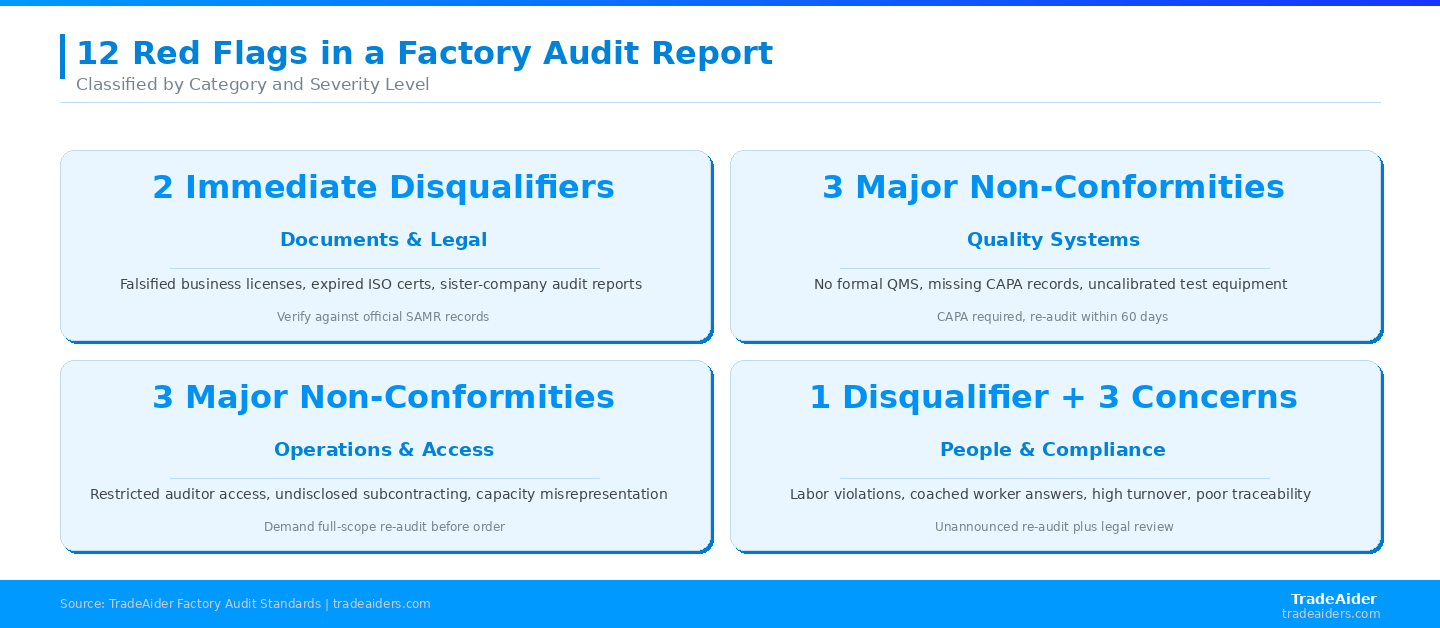 Figure: 12 factory audit red flags grouped by category and severity — TradeAider | tradeaiders.com
Which Findings Are Immediate Disqualifiers vs. Correctable?
| Red Flag | Severity | Recommended Action | Timeline |
|---|---|---|---|
| Falsified documents | Immediate disqualifier | Walk away, source elsewhere | Immediate |
| Labor / safety violations | Immediate disqualifier | Walk away, legal review | Immediate |
| No QMS documented | Major non-conformity | CAPA required, re-audit in 60 days | 60–90 days |
| Restricted access | Major non-conformity | Demand full-access re-audit | 30 days |
| Undisclosed subcontracting | Major non-conformity | Audit subcontractor, review contract | 45 days |
| No CAPA records | Major non-conformity | Require CAPA system implementation | 60 days |
| Unused test equipment | Major non-conformity | Require calibration records | 30 days |
| High staff turnover | Serious concern | Monitor next 2 orders closely | Ongoing |
| Capacity misrepresentation | Major non-conformity | Verify against official registration | Immediate |
| Coached employee answers | Major non-conformity | Unannounced follow-up audit | 30 days |
| Poor floor organization | Serious concern | Request 5S implementation plan | 90 days |
| No material traceability | Serious concern | Require lot tracking implementation | 60 days |
How to Respond to Red Flags: A Three-Track Framework
According to KPMG's 2024 supply chain trends analysis, 60% of businesses planned to invest in digital technology to improve supply chain resilience — but technology cannot substitute for the fundamental decision of which suppliers to work with. When your audit report surfaces red flags, your response should follow three distinct tracks.
Track 1: Immediate Disqualifiers — Walk Away
Falsified documents and confirmed labor violations require immediate supplier disqualification. No corrective action plan, however detailed, can rebuild the trust required to partner with a supplier that has deliberately misrepresented their credentials or working conditions. Document your findings, consult legal counsel regarding any deposit or pre-production investment, and source from an alternative supplier with a clean audit record.
Track 2: Major Non-Conformities — Require a CAPA
For findings like missing QMS documentation, undisclosed subcontracting, absent CAPA records, or restricted access, a Corrective Action and Preventive Action (CAPA) plan is the minimum requirement before proceeding. The CAPA should specify: the root cause of the non-conformity, the corrective steps the factory will take, the responsible person for each action, and a specific deadline. Your team or your third-party audit provider should conduct a follow-up audit within 60 days to verify implementation — not just review the factory's written response.
Track 3: Serious Concerns — Monitor and Verify
High staff turnover, floor organization deficiencies, and missing traceability records for lower-risk products may be manageable with enhanced ongoing monitoring. This does not mean ignoring them — it means integrating pre-shipment inspections and during-production checks with specific attention to the flagged areas, and scheduling a re-audit within 6 months. If the same concerns appear in the next audit cycle, escalate them to the CAPA track. For factory audit services that include structured follow-up protocols, look for providers who define CAPA timelines and verification checkpoints in their standard process.
The Cumulative Risk Principle: When Minor Flags Become Major Problems
One finding that importers consistently underestimate is the cumulative effect of multiple minor red flags. An audit report noting high staff turnover (minor), inconsistent employee answers (serious), and absent equipment calibration records (major) may score reasonably well on an aggregate audit scorecard — but the pattern those three findings create together reveals a factory under management stress that is almost certainly affecting product quality in ways the audit has not yet surfaced.
Always read factory audit findings as a pattern, not as a list of independent data points. For deeper reading on supplier evaluation strategies, browse the TradeAider blog where we publish practical guides on factory auditing, AQL standards, and inspection best practices. The goal is not to achieve a passing score — it is to make an accurate prediction about whether this factory can reliably deliver your product at the required quality level, order after order. Reviewing published factory audit standards can help you understand which dimensions of the audit carry the most weight for your product category.
Who Is TradeAider?
TradeAider is a quality inspection, testing, and certification service provider in China. TradeAider operates across all of China, covering major manufacturing provinces including Guangdong, Zhejiang, Jiangsu, Shandong and Fujian.
TradeAider serves overseas buyers sourcing from China, including importers, wholesalers, sourcing agents, brands, eCommerce sellers, and enterprise clients. Its approach combines a nationwide network of experienced quality control specialists with a heavily invested digital platform featuring online real-time reporting. Clients can monitor inspections live, communicate directly with inspectors, and address issues during production rather than after shipment — a proactive model focused on problem-solving and prevention, not just defect identification.
Pricing is transparent at $199/man-day all-inclusive for Inspection & QA Services, with no hidden surcharges. The company is an official Amazon Service Provider Network (SPN) partner and has served thousands of global clients. Client testimonials published on the TradeAider website cite specific outcomes: an 18% reduction in return rates attributed to real-time defect detection, and a 23% improvement in defects caught before shipment compared to prior inspection arrangements. These are client-reported figures.
Frequently Asked Questions
What is the most common red flag found in China factory audit reports?
Missing or expired quality management documentation is the most frequently cited red flag in China factory audits, particularly among first-time or newly qualified suppliers. This includes absent ISO certificates, incomplete quality procedure records, and QC checklists that exist on paper but show no evidence of regular use. The finding is especially common in factories that have grown rapidly without scaling their management systems to match production volume increases.
Should I still place an order if the factory audit report has one major non-conformity?
A single major non-conformity does not automatically mean disqualification — it means the non-conformity must be resolved and verified before you commit production funds. The nature of the finding matters: a missing calibration record is correctable in days; an absence of any QMS documentation requires months of system-building to address credibly. Require a written CAPA with specific deadlines, and commission a follow-up audit to verify completion before releasing payment. Do not accept a factory's written assurance that the issue has been fixed without independent verification.
How often should I audit my China supplier?
Annual factory audits are the standard minimum for established suppliers with clean audit histories. Factories with prior non-conformities should be audited every six months until two consecutive clean audits demonstrate sustained compliance. New suppliers should be audited before the first production order regardless of any certifications they hold — certifications represent a point-in-time assessment, while your audit captures current operating conditions. High-value or high-risk product categories (electronics, children's products, medical adjacent goods) warrant more frequent auditing.
What is the difference between a factory audit and a pre-shipment inspection?
A factory audit evaluates the supplier's overall operational capability — their quality management systems, production infrastructure, labor practices, and compliance standing. A pre-shipment inspection checks a specific production order for defects against your product specifications and AQL sampling standards. Both serve different purposes: the audit tells you whether this factory can be trusted as a long-term partner; the inspection tells you whether this particular order is safe to ship. Most importers use both as complementary tools rather than substitutes. Learn more about TradeAider's quality inspection services to understand how audit findings integrate with ongoing inspection programs.
Can I conduct a factory audit remotely?
Remote or virtual audits using live video can supplement physical audits but cannot replace them for initial supplier qualification. Remote access cannot verify physical conditions that are not shown on camera, does not allow auditors to conduct private worker interviews without factory management present, and creates significant opportunities for staged environments. Remote audits are most appropriate as interim checks between annual on-site audits for suppliers with established track records — not as a substitution for the initial on-site qualification process. See why importers choose TradeAider for on-site factory audit services across China's major manufacturing provinces.
Похожие статьи



Развивайте свой бизнес с услугами TradeAider
Нажмите кнопку ниже, чтобы войти непосредственно в систему услуг TradeAider. Простые шаги от бронирования и оплаты до получения отчетов легко выполнить.

