
RoHS, REACH, and WEEE are not three names for the same EU environmental check; RoHS restricts substances, REACH manages chemical obligations, and WEEE controls waste-electrical responsibility. An importer can pass one rule and still fail another because the evidence sits in different parts of the product file.
The safest workflow is to map every SKU to material declarations, chemical inquiries, producer responsibility, labels, and shipment inspection before inventory leaves China. Three regulations multiplied by four evidence owners creates twelve handoff points where a missing declaration can become an EU launch delay.
For importers sourcing from China, the hard part is not remembering the acronyms. The hard part is assigning the evidence owner. RoHS evidence may sit with component suppliers, REACH evidence may require chemical or SVHC inquiry, and WEEE obligations may involve the EU producer or importer registration path.
- RoHS: Focuses on restricted hazardous substances in electrical and electronic equipment.
- REACH: Focuses on chemical obligations that can apply to substances, mixtures, and articles.
- WEEE: Focuses on waste electrical and electronic equipment responsibilities.
- Inspection gate: Verify labels, model, packaging, and shipment version against the EU evidence file before release.
The Direct Answer
RoHS is a restricted-substance gate, REACH is a chemical-obligation gate, and WEEE is an end-of-life responsibility gate.
TradeAider treats RoHS, REACH, and WEEE as separate evidence lanes because the inspector, testing coordinator, and buyer need to know which physical shipment detail each lane can actually verify before release.
The buyer should not accept one report as proof for all three rules. A RoHS test report may help with restricted substances, but it does not answer every REACH inquiry or WEEE responsibility question. A REACH declaration may address substances of concern, but it does not prove WEEE registration or marking. WEEE evidence may support producer responsibility, but it does not prove restricted-substance compliance.
According to the European Commission RoHS Directive page, RoHS restricts hazardous substances in electrical and electronic equipment. According to ECHA's REACH overview, REACH is the EU regulation for chemicals. According to the European Commission WEEE page, WEEE concerns waste electrical and electronic equipment. The so what is operational: the evidence files belong to different owners and different moments in the sourcing process.
RoHS vs REACH vs WEEE Compared
The comparison is about what each rule controls, what evidence proves it, and where importers usually lose control.
| Rule | Main Control | Typical Evidence | Importer Risk |
|---|---|---|---|
| RoHS | Restricted hazardous substances in electrical and electronic equipment | Material declaration, component file, test report | Supplier changes a component after testing |
| REACH | Chemical obligations for substances, mixtures, and articles | SVHC inquiry, supplier declaration, chemical file | Article contains a substance the importer did not ask about |
| WEEE | Waste electrical and electronic equipment responsibility | Registration path, marking, EU producer responsibility records | Product ships before the EU responsibility path is ready |
| CE route | Applicable EU conformity evidence when required | Declaration, technical file, label, manual | CE label is used without matching evidence |
| Factory release | Physical shipment matches evidence file | Label, model, barcode, carton mark, manual, inspection result | Correct documents but wrong packed version |
The comparison reveals why EU environmental compliance should be managed as a product-file workflow. RoHS, REACH, and WEEE share environmental purpose, but they do not check the same thing. The importer has to connect supplier declarations, test evidence, EU obligations, and physical shipment identity before the goods move.
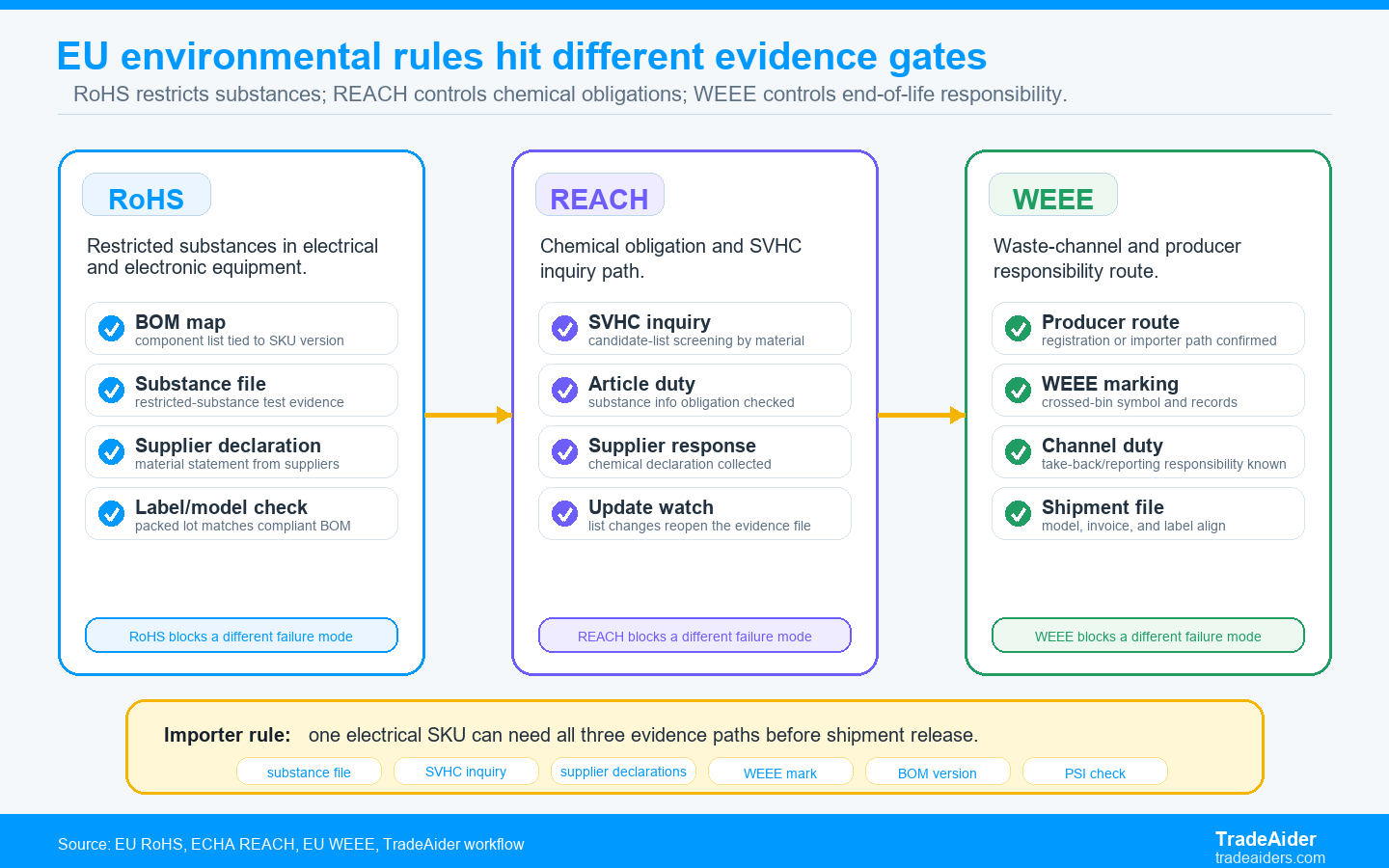
RoHS, REACH, and WEEE stop different EU environmental failure modes.
Where Each Regulation Usually Fails in China Sourcing
Compliance gaps usually appear where the buyer assumes one supplier document travels across every component, claim, and EU obligation.
According to ISO 9001 quality management guidance, quality management depends on controlled processes and evidence-based decisions. That principle applies directly to EU environmental evidence. The buyer needs a controlled file that links component sourcing, finished product model, label, manual, packaging, and EU importer role. A factory can be cooperative and still provide the wrong file if the buyer has not defined which rule the file supports.
RoHS fails when the bill of materials changes after evidence is collected
RoHS risk is usually a component-control risk. A supplier may provide an RoHS report for a PCB, cable, adapter, casing, solder, or coating that was used in a sample, then substitute a component during mass production. The buyer should therefore connect RoHS evidence to the bill of materials and approved production version. If a power adapter changes after the report was collected, the evidence pack should be reviewed again. For a 6,000-unit electronics order, even one undocumented component change can create a lot-wide evidence gap, not just a component-level paperwork issue.
REACH fails when the buyer asks only about the finished product
REACH risk is often hidden in materials, coatings, plastics, adhesives, packaging, and accessories. If the buyer asks, "Is the finished product REACH compliant?" the supplier may answer broadly without checking article-level substance duties. The better request is to ask which materials, components, coatings, and packaging are covered by declarations or inquiries. The decision rule is to connect REACH evidence to the material list, not only to the finished product photo. When the supplier cannot explain the material path, the importer does not have a reliable chemical-obligation file. This is especially important for soft-touch coatings, rubber cables, printed packaging, strap materials, adhesive pads, and accessory bags, because those parts can change quietly while the finished product photo still looks identical.
WEEE fails when responsibility is left until after shipment
WEEE risk is different because it is not only a factory evidence problem. It can involve EU producer responsibility, registration, marking, and the business path for placing electrical or electronic equipment on the EU market. According to the European Commission CE marking page, products may need to meet applicable EU legislation before CE marking is used. According to EU conformity assessment guidance, applicable requirements should be identified before placing products on the market. For WEEE, the importer should decide responsibility before packaging and labeling are finalized. A factory can print a crossed-out wheeled bin symbol on a label, but that does not prove the EU producer-responsibility path, registration plan, or take-back responsibility is ready.
How to Build the Evidence File Before Shipment
The EU environmental file should connect the component, the finished SKU, the label, the importer role, and the packed shipment.
The importer should separate the evidence file into four owners. Component suppliers provide material declarations and test reports. The assembly factory controls BOM, model, labels, and production version. The EU importer or producer handles market responsibility. The listing or packaging team controls customer-facing claims, symbols, and instructions. The original estimate is practical: 3 regulations x 4 evidence owners equals 12 handoff points. The limitation is that every product category has its own details, but the handoff map prevents hidden gaps.
Freeze component evidence before mass production
RoHS and REACH evidence should be collected before the factory buys or substitutes production components. The buyer should lock the BOM, ask which materials are covered by declarations, and require approval for substitutions. If a supplier changes cable, coating, adhesive, plastic resin, or PCB supplier, the evidence file may need review. This is where factory discipline matters. A TradeAider's factory audit can check whether the factory controls suppliers, incoming materials, traceability, and document versions before the order becomes a finished-lot problem. The buyer should treat every approved supplier list change as a possible evidence-file change, not merely as a purchasing update, because one cheaper material can reopen both RoHS and REACH questions.
Verify packaging and marks before release
The physical shipment should match the EU evidence file. According to GS1 barcode standards, barcodes support supply chain identification, so the SKU identity in the EU file should align with the barcode and carton. Pre-Shipment Inspection can verify model, label, carton mark, manual, barcode, warning text, and visible symbols before shipment. PSI cannot certify RoHS, REACH, or WEEE, but it can catch a common practical failure: correct documents attached to the wrong model, wrong label, or outdated carton version. If two carton versions are found in the same lot, the buyer should require a count by version before deciding release, rework, relabeling, or shipment hold.
Keep EU responsibility separate from factory promises
The factory can help collect reports and declarations, but the EU importer cannot delegate every obligation to a supplier email. WEEE especially requires the buyer to understand the EU market path. If the factory says "we have WEEE," the buyer should ask what exactly that means: symbol on product, registration support, documentation, or simply a prior customer's label. The risk is that a factory promise sounds complete but does not match the importer role, product category, or member-state obligation. Treat WEEE as a market-access responsibility, not only a production document.
SPAR Scenario: One Adapter Changed, Three EU Files Reopened
EU environmental compliance can break when a small component change travels faster than the evidence file.
Situation: A UK and EU importer orders 8,000 LED desk lamps from a factory in Shenzhen. The supplier provides RoHS reports, a general REACH declaration, and packaging with WEEE symbol artwork. The buyer plans to ship within 12 days.
Problem: During PSI preparation, the factory mentions that the original adapter supplier was unavailable, so it used an equivalent adapter from another supplier. The new adapter looks the same, but the RoHS file and model label still reference the old adapter. The REACH declaration also does not list the new cable material path.
Action: The buyer holds shipment release, requests updated component evidence, checks the WEEE label and packaging version, and asks the inspector to verify adapter model, rating label, barcode, carton mark, and manual against the revised file.
Result: The shipment is delayed 5 days and the buyer pays for one extra document review cycle. The trade-off is justified because one adapter substitution could have reopened RoHS, REACH, and label evidence at the same time. The remaining limitation is that the buyer must now add adapter supplier approval to the next purchase order.
EU Environmental Compliance Checklist
Do not ask whether the product is compliant; ask which rule, evidence owner, and shipment version proves each claim.
- Map each electrical SKU to RoHS, REACH, WEEE, CE route, and any buyer-specific requirement.
- Lock BOM and component suppliers before collecting final declarations or test reports.
- Ask material-level questions for REACH rather than accepting a broad finished-product statement.
- Confirm WEEE responsibility and marking before packaging production.
- Use inspection to verify that the packed shipment matches the EU evidence file.
If the EU evidence file is scattered across supplier declarations, BOM notes, label artwork, and carton marks, send TradeAider the current BOM, destination countries, supplier declarations, label files, and packing status. The next step is to ask TradeAider to turn the RoHS, REACH, and WEEE evidence into inspection checkpoints before the goods leave the factory.
Frequently Asked Questions
Is RoHS the same as REACH?
No. RoHS restricts hazardous substances in electrical and electronic equipment, while REACH is a broader EU chemicals regulation. A product may need evidence for both.
Does WEEE prove RoHS compliance?
No. WEEE concerns waste electrical and electronic equipment responsibility. It does not prove that the product meets RoHS substance restrictions.
Can factory inspection replace RoHS or REACH testing?
No. Inspection cannot replace testing or legal review. It can verify that the finished product, label, model, carton, and packaging match the evidence file before shipment.
Похожие статьи

Развивайте свой бизнес с услугами TradeAider
Нажмите кнопку ниже, чтобы войти непосредственно в систему услуг TradeAider. Простые шаги от бронирования и оплаты до получения отчетов легко выполнить.

