
- О нас

- Наши услуги
- Ваша отрасль
- Ресурсы
- Новости и блог
A fitness tracker that over-counts steps, or a "waterproof" smartwatch that fails after the first swim, will generate returns, negative reviews, and — for Amazon FBA sellers — the kind of account health problems that are very difficult to reverse. Yet many buyers sourcing smartwatches and wearables from Chinese factories focus inspection almost entirely on cosmetic defects: scratches on the case, packaging alignment, barcode placement. Sensor accuracy validation and waterproof integrity testing are either omitted from the quality control checklist entirely, or treated as an afterthought. This article explains exactly what to test, what standards apply, and how to structure a pre-shipment inspection that catches the functional failures that matter most.
Key Takeaways
- Step count accuracy should be validated under both controlled treadmill conditions (±3% tolerance) and free-living scenarios (±10% tolerance), using a reference accelerometer — not just visual observation.
- Heart rate sensor validation requires comparison against a gold-standard ECG or validated chest-strap monitor; the CTA Standard recommends a Mean Absolute Percentage Error (MAPE) threshold of ≤10% for real-world conditions.
- IPX waterproofing is defined by IEC 60529 and is a type test conducted on a new product — it does not guarantee long-term seal durability; pre-shipment inspection should verify gasket integrity and conduct a batch-level immersion sample check.
Why Smartwatch QC Is More Technical Than Standard Consumer Electronics
Sensor-Based Claims Create Measurable Liability
A smartwatch is not just a screen on a wrist. It is a sensor array making quantitative health claims to the end user. When a listing says "tracks steps with high accuracy" or "continuous heart rate monitoring," the buyer is making an implicit product claim to their customer. If those claims are false — because the sensor algorithm drifts, the PPG sensor is positioned incorrectly, or the accelerometer firmware was not properly calibrated at the factory — the resulting customer complaints and returns are directly traceable to the product, not to user error.
Research published in JMIR mHealth and uHealth reviewed commercially available wearable devices and found that in controlled lab settings, acceptable step accuracy was within a ±3% mean percentage error (MPE), while in free-living conditions the acceptable tolerance widened to ±10%. The same review found that devices tended to underestimate values when not performing correctly, and that accuracy varied considerably across product lines from the same brand. This means even trusted OEM manufacturers can produce batches where sensor calibration is inconsistent — making batch-level sampling during pre-shipment inspection essential.
Waterproofing Is a Structural Integrity Test, Not a Feature
The IPX rating printed on a product box describes a test result achieved on a prototype or production sample — it does not describe the ongoing waterproofing state of every unit in a 5,000-piece shipment. Gasket seals degrade during transport and rough handling. Crown buttons and charging port covers that passed testing at the factory may arrive with micro-cracks or misaligned seals. IEC 60529 itself explicitly states that it is a type test — meaning it validates the design and construction of a new product under specific, short-term conditions. It does not account for material degradation or manufacturing variance across a production run.
Sensor Accuracy Validation: Step Count and Heart Rate
Step Count: The Treadmill Protocol
The industry standard approach to step count validation is a treadmill-based protocol across multiple speed stages. Inspectors or validation engineers instruct test subjects to walk or run at defined speeds (typically 2, 3, 4, and 5 mph), counting actual steps manually or against a calibrated reference accelerometer such as an ActiGraph GT3X+ worn on the hip. Steps registered by the device under test are compared against the reference count at each stage.
A peer-reviewed study in MDPI Sensors used exactly this protocol to validate an open-source smartwatch, with participants completing treadmill stages at 2–5 mph and stair-climbing circuits, followed by a 24-hour free-living assessment. The study confirmed that the CTA Standard for Physical Activity Monitoring recommends a MAPE threshold of ≤10% for heart rate in real-world conditions — a benchmark that is directly applicable to factory-level sensor validation. For step count, the more stringent ±3% threshold applies in controlled settings.
For buyers sourcing from Chinese factories, this matters at two levels. First, the factory should be asked to demonstrate calibration records for the accelerometer firmware. Second, a sample of units from the production batch should be tested on-site using a standard walking protocol — even a manual step-count verification over a fixed distance gives useful comparative data across sampled units, helping identify batches where calibration has drifted relative to the approved golden sample.
Heart Rate Sensor: PPG Accuracy and Motion Artifact
Most consumer smartwatches use photoplethysmography (PPG) — a green-light LED sensor that reads changes in blood flow through the wrist — to estimate heart rate. This approach introduces a known vulnerability: accuracy drops during physical activity, when wrist movement causes motion artifact, and when skin tone, tight fit, or sweat interferes with the optical sensor signal.
A validated 24-hour intraindividual study published in PMC found that the Apple Watch Series 3 exceeded the ±10% MAPE threshold during activities of daily living (ADL) when worn on the dominant hand, reaching 13.7%. This difference was attributed to increased wrist movement and sensor positional instability — a directly factory-relevant finding, because sensor housing fit and PCB placement affect exactly this. A unit where the sensor board is not properly seated, or where the lens cover is slightly misaligned, will show elevated motion artifact error regardless of how good the underlying algorithm is.
For quality control purposes, heart rate accuracy is best validated by comparing PPG readings against a calibrated chest-strap ECG monitor (such as a Polar H10) during a standardized light exercise protocol. A study in Nature Scientific Reports confirmed that smartwatches measure pulse rate accurately at rest, with accuracy declining during activity — meaning a rest-only test at the factory is insufficient. The inspection protocol should include both a resting baseline reading and a low-intensity exercise comparison.
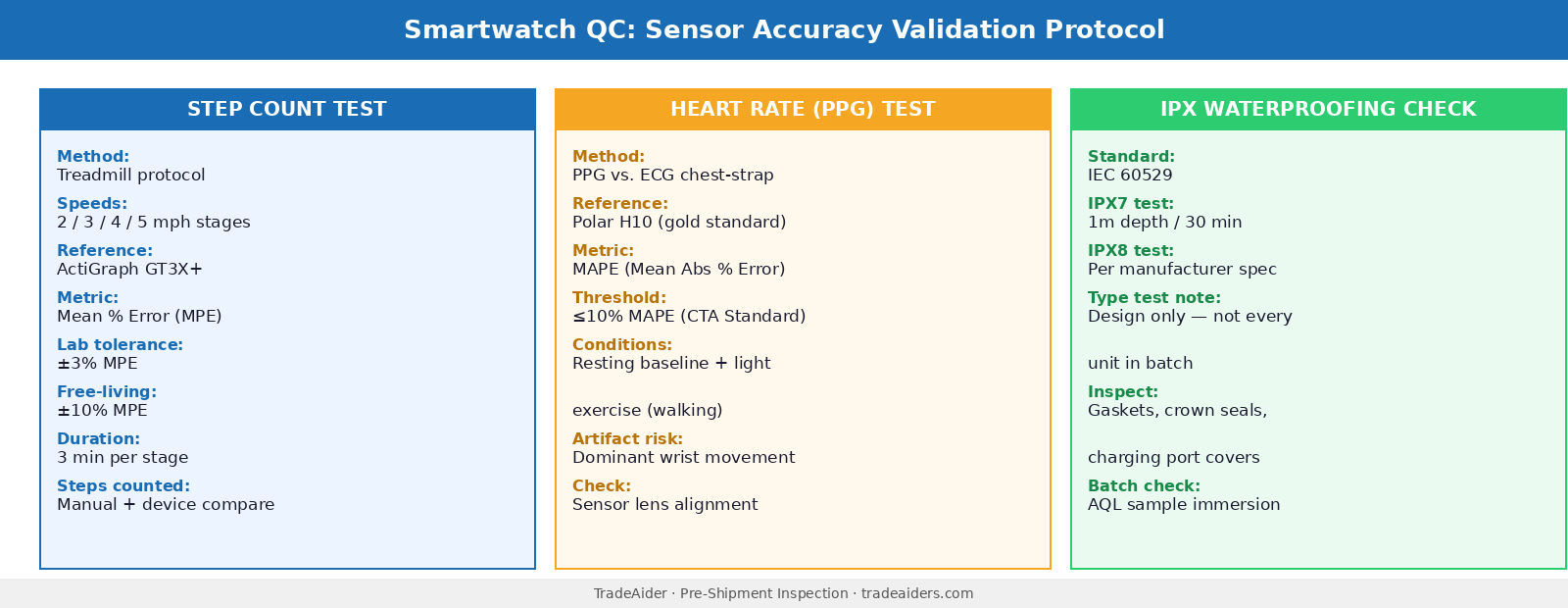
Smartwatch sensor validation protocol: step count treadmill stages and heart rate PPG vs. ECG comparison with industry-standard MAPE thresholds.
TradeAider's pre-shipment inspection service for electronics includes customizable on-site functional testing parameters. For smartwatch orders, buyers can specify sensor accuracy test requirements in their product checklist, and inspectors will record comparative measurements and flag units that deviate from the agreed golden sample baseline. See how TradeAider's pre-shipment inspection works →
IPX Waterproofing: What the Rating Means and How to Verify It
Understanding IEC 60529 for Wearables
The IPX waterproofing standard most commonly seen on smartwatches — IPX7 and IPX8 — is defined by IEC 60529, the international standard published by the International Electrotechnical Commission. The "IP" stands for Ingress Protection, and the "X" in "IPX" indicates that dust protection was not tested (only water resistance). The numeral indicates the test severity level.
| IPX Rating | Test Condition | Typical Use Case | Pass Criterion |
|---|---|---|---|
| IPX4 | Splash from any direction | Sweat resistance, rain | No harmful water ingress |
| IPX5 | Water jet (12.5 L/min nozzle) | Running in rain | No harmful water ingress |
| IPX7 | Immersion at 1m depth, 30 min | Accidental submersion, hand-washing | Full function after immersion |
| IPX8 | Continuous immersion, depth & time per manufacturer spec | Swimming (with 5ATM) | Full function after immersion |
A critical point that many buyers overlook: achieving IPX8 does not automatically cover IPX5 or IPX6. These test different physical phenomena — static hydrostatic immersion pressure versus directed water jets — and a device may pass one and fail the other. If your product is marketed for rain running and swimming, it should be tested for both. Buyers should request the specific test report, not just the rating certificate.
What to Check on the Factory Floor
For a buyer conducting pre-shipment inspection on a smartwatch shipment with an IPX7 or IPX8 claim, the verification process has three layers. First, request the original type-test certificate from the factory. This should reference the IEC 60529 standard and specify the exact test depth and duration. Second, conduct a visual inspection of sealing components on the sampled units — crown gaskets, charging port covers, case-to-bezel joins, and any silicone or rubber seals. Any visible gaps, misalignment, or deterioration of sealing materials at the production stage is a direct predictor of field failure, even if the design passed its original type test. Third, consider specifying an AQL-based sample immersion check as part of the inspection protocol: a defined number of sampled units are submerged at the stated depth for the stated duration and then powered on to verify full function.
Wareable's industry guide on IP ratings notes that IPX8 testing is conducted under static water conditions, while swimming introduces dynamic pressure — a practically important distinction for fitness tracker buyers whose customers will actually use these devices in pools. For products marketed for swim use, the 5ATM rating (from the ISO watch water resistance standard) is more relevant than IPX8 alone, since ATM testing simulates water pressure from movement. Buyers should confirm which standard the factory used and whether the product carries both ratings.
The Aging Problem: Why Production Batch Inspection Matters More Than Type Test Certificates
The most important insight from IEC 60529 for importers is that it is a type test — it certifies a design, not a production run. Gaskets are compression-fit components. Over-tightening during assembly distorts them; under-tightening leaves gaps. Temperature variation during transit between Chinese factory and overseas warehouse can cause rubber compounds to contract. A type test conducted six months ago on a prototype does not tell you whether the 3,000 units now packed in cartons have consistent gasket compression.
A validation study on the Huawei Watch GT2 noted that accuracy metrics in daily life are typically lower than in controlled lab conditions — the same principle applies to physical integrity testing. Real-world conditions introduce variables that type tests are designed to exclude. This is exactly the gap that pre-shipment inspection is designed to close.
Building a Smartwatch QC Checklist: What to Include
Functional and Sensor Tests
Beyond sensor accuracy, a complete smartwatch inspection checklist should cover display calibration (brightness uniformity, dead pixels, touch responsiveness), connectivity (Bluetooth pairing stability, app sync), battery charge cycle, button and crown actuation, strap attachment mechanism, and packaging completeness. For products with health monitoring features such as SpO2 or ECG, additional functional tests should be specified. TestDevLab's functional testing guide for wearables recommends testing devices across both iOS and Android platforms and replicating actual end-user scenarios — not just lab-bench power-on checks.
Workmanship and Appearance
Cosmetic defects in smartwatches are a significant driver of returns in the e-commerce channel, particularly for premium-positioned products. Inspectors should check for scratches on the display glass, case parting line quality, strap surface finish, print quality on the dial and bezels, and consistency of coating color across the batch. Any cosmetic deviation from the approved golden sample should be classified per the agreed AQL defect severity table in the inspection checklist. TradeAider's Quality Inspection Standard outlines the AQL-based sampling methodology used for electronics inspections.
Packaging and Labeling
For Amazon FBA shipments, packaging compliance is as critical as product function. IPX rating claims on the packaging must match the actual certified rating. Barcode placement and scan quality, FNSKU labels, retail box integrity, and inner carton packing must all be verified before approval. As an official Amazon SPN partner, TradeAider specifically checks FBA compliance requirements during inspection — a level of verification that generic inspection services may not include. See TradeAider's Amazon FBA inspection solutions →
Frequently Asked Questions
How is step count accuracy tested during a factory inspection?
Step count accuracy is validated by comparing the device under test against a calibrated reference accelerometer during a standardized walking or treadmill protocol. Inspectors or test engineers count actual steps manually or use a research-grade hip-worn accelerometer as the reference measure. The acceptable tolerance in controlled lab conditions is ±3% mean percentage error, as established by systematic reviews of commercially available wearables. A simple on-site protocol — walking a fixed distance on a flat surface, counting steps against the device display — provides a quick comparative check for production batch consistency, even when full lab equipment is unavailable.
What does an IPX7 or IPX8 rating actually guarantee in a shipment?
An IPX7 or IPX8 rating guarantees that a representative design sample passed a specific immersion test defined by IEC 60529 at the time of type-testing. It does not guarantee that every unit in a production run has equivalent gasket integrity. The type test is conducted on a limited number of samples under controlled laboratory conditions and does not account for material aging, handling damage, or manufacturing variance across a large batch. Pre-shipment inspection should include visual verification of sealing components and — where feasible — an AQL-based sample immersion check to confirm batch-level waterproofing performance, not just design-level certification.
Should I request both an IPX certificate and an ATM rating for smartwatches marketed for swimming?
Yes — for swim-use products, both certifications serve different purposes and neither alone is sufficient. IPX8 certifies static immersion resistance under IEC 60529, while ATM (atmospheres) testing — governed by the ISO watch water resistance standard — simulates dynamic water pressure from movement. Swimming involves both immersion depth and the pressure generated by arm movement through water, which can force water past seals in ways that static immersion tests do not replicate. A product marketed for lap swimming should carry both an IPX8 certification and a minimum 5ATM rating, and the inspection checklist should request documentation for both.
What sensor defects should I watch for in a smartwatch pre-shipment inspection?
The most common sensor-related defects in smartwatch production include: misaligned PPG sensor lens causing elevated heart rate error, firmware build inconsistency across the batch leading to step count calibration drift, accelerometer sensitivity settings that differ from the golden sample, and display-sensor integration issues where the screen refresh rate interferes with optical sensor readings. These defects are rarely detectable through visual inspection alone — they require powered-on functional testing with a measurement reference. Specifying sensor accuracy tests in the inspection checklist, and providing the inspector with a reference device or golden sample for comparison, significantly increases the chance of catching these issues before shipment.

Похожие статьи


Развивайте свой бизнес с услугами TradeAider
Нажмите кнопку ниже, чтобы войти непосредственно в систему услуг TradeAider. Простые шаги от бронирования и оплаты до получения отчетов легко выполнить.

