
- О нас

- Наши услуги
- Ваша отрасль
- Ресурсы
- Новости и блог
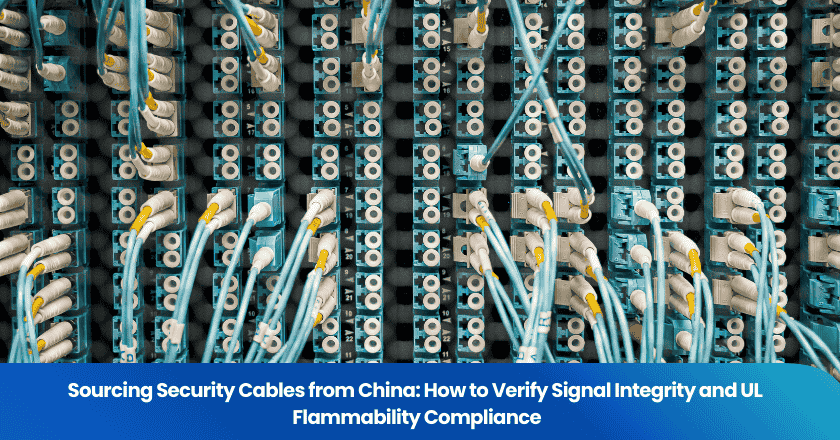
Security cables are one of the most commonly misrepresented products in China-sourced electronics shipments. A supplier may show you a UL-certified sample, but ship production batches with a cheaper jacket material that has never passed flammability testing. Signal performance specs on paper can look identical whether the conductor uses oxygen-free copper or a copper-clad aluminum substitute. If you are importing security cables for surveillance systems, access control, or alarm installations, you need to know exactly what to ask for — and how to verify it — before your shipment leaves the factory.
Key Takeaways
- UL certification on a sample does not guarantee the production batch uses the same materials. Always require traceability documentation linking the specific batch to tested and certified materials.
- Signal integrity failures — resistance deviations, shielding gaps, poor conductor quality — are not visible from photos. They require electrical testing at the factory.
- UL flammability ratings (VW-1, UL 1666, UL 94) are non-negotiable for most building codes in North America and Europe. A cable that fails these tests creates liability for you as the importer.
- Request certificates of conformance and material traceability records for every production batch, not just for the initial approved sample.
- A pre-shipment inspection that includes electrical testing and material conformity checks gives you independent proof of compliance before payment is released.
Why Cable Compliance Is a Bigger Sourcing Risk Than Most Buyers Realize
The Sample-to-Production Gap
Many buyers approve a cable sample, receive a UL certificate, and assume the production run will match. In practice, Chinese factories often source materials from multiple suppliers depending on availability and cost. The jacket compound, conductor purity, and shielding coverage can all vary between the approved sample and the bulk order — without any visible change in the finished product. You will not know until a cable fails in the field, a customer complains about signal interference, or worse, an inspector flags the product during a building compliance audit.
The most common substitutions TradeAider inspectors encounter in security cable shipments include: copper-clad aluminum (CCA) conductors passed off as pure copper, jacket materials that do not meet VW-1 vertical flame requirements, and shielding coverage below the specified percentage. Each of these substitutions reduces material cost for the factory while creating real-world safety and performance risk for your end users.
The Compliance Liability You Carry as an Importer
If you are selling into North American or European markets, building codes in most jurisdictions require cables installed in walls, ceilings, and plenum spaces to meet specific flammability ratings. As the importer, you are responsible for the compliance of the products you bring to market. If a fire investigation traces ignition or spread to non-compliant cable in a security installation, the liability exposure is significant. This is not a theoretical risk — it is one of the primary reasons buyers in this category should treat flammability compliance verification as mandatory, not optional.
Tip: Always check the cable's documentation for compliance with ISO, ASTM, or EN standards before accepting a shipment. A UL Certification Mark on the box means nothing if you cannot trace it to the actual batch of material used in production.
What Signal Integrity Testing Covers
Key Electrical Tests Buyers Should Require
Signal integrity describes how accurately a cable transmits data from one end to the other without distortion, loss, or interference. For security applications — CCTV, IP cameras, access control — poor signal integrity shows up as video artifacts, dropped frames, unreliable card reads, or alarm communication failures. These problems are often misdiagnosed as device or software issues, when the root cause is substandard cable. The following electrical tests should be part of your inspection checklist for any security cable order:
- Pin continuity testing: Confirms correct wiring and identifies open or short circuits before the batch ships.
- DC resistance testing: Measures resistance deviations that indicate conductor substitution (CCA instead of pure copper significantly increases resistance).
- Insulation resistance testing: Detects leakage currents that disrupt signal quality and increase risk of electrical faults.
- Grounding resistance testing: Verifies effective fault current dissipation and protection against electrical noise.
- Shielding coverage verification: Confirms shielding percentage matches specification — critical for cables running near power lines or other interference sources.
- Conductor and shielding material check: Internal inspection to verify materials match the technical data form and purchase order.
| Test | What It Catches |
|---|---|
| DC Resistance | Conductor substitution (CCA vs. pure copper), undersized gauge |
| Insulation Resistance | Jacket material defects, leakage current risk |
| Pin Continuity | Wiring errors, open circuits, short circuits |
| Shielding Coverage | Below-spec shielding that causes interference in the field |
| Grounding Resistance | Improper grounding that causes noise and safety risk |
UL Flammability Compliance: What Buyers Need to Know
UL Flammability Ratings Explained
UL flammability ratings define how a cable jacket behaves when exposed to flame. For security cables sold into North American markets, you need to understand which rating applies to your product's intended installation environment. The main ratings and their requirements are:
| Rating | Test Method | Required For |
|---|---|---|
| VW-1 | Vertical flame test — cable must self-extinguish and not ignite indicators above or below | Most general-purpose security cable installations |
| FT2 | Horizontal burn test — no burning particles allowed to fall | Flexible cables in exposed positions |
| UL 1666 (Riser) | Flames must not reach 12-foot height after 30 minutes | Vertical riser installations between floors |
| UL 910 (Plenum) | Strictest rating — low flame spread and low smoke generation | Air-handling spaces, plenum ceilings |
If your customers are installing cables in plenum spaces or vertical risers, the rating requirement is determined by building code, not by preference. Shipping non-compliant cable into these applications is a compliance violation that can result in forced product removal, fines, and liability exposure for you as the importer.
How to Verify Flammability Compliance Before You Pay
The UL Certification Mark on a cable reel tells you that at some point, that cable design was tested and approved. It does not tell you whether the production batch you are receiving used the same jacket compound and the same conductor material as the tested design. Material substitution in cable manufacturing is one of the hardest quality failures to detect without proper documentation and testing.
Here is what to require from your supplier before accepting any production batch:
- Certificate of conformance for the jacket material, showing composition, lot number, and UL status.
- Material traceability records linking the specific production batch to the tested and approved materials.
- UL Certification Mark on every reel or box — UL requires a holographic label for listed communications cable.
- Third-party test report if you have any reason to doubt the factory's self-declaration.
Tip: Always ask for material certificates and traceability documents at the batch level, not just the product level. A certificate that covers the "product design" but cannot be traced to the actual materials in your production run does not protect you.
UL Listed vs. ETL Listed: Does It Matter?
You may encounter suppliers offering ETL-listed cables as an alternative to UL-listed. Both certifications are valid under U.S. Federal Law — ETL tests to the same UL standards and carries equal legal authority as an OSHA-recognized NRTL. The key difference is market perception: some government procurement and commercial construction projects specify UL by name, which can affect your customers' ability to use ETL-listed cable in those projects. For general commercial and residential security installations, ETL-listed cable is fully compliant and often comes with shorter certification lead times and lower cost.
| Aspect | UL Listed | ETL Listed |
|---|---|---|
| Safety Standards | Original standard creator | Tests to identical UL standards |
| Legal Authority (US) | Full OSHA acceptance | Full OSHA acceptance |
| Market Preference | Required by some gov/commercial specs | Widely accepted for commercial/residential |
| Certification Cost/Speed | Higher cost, longer lead time | Lower cost, faster turnaround |
How to Structure Your Pre-Shipment Inspection for Security Cables
Documents to Request Before Inspection Day
A well-structured pre-shipment inspection for security cables combines document review with hands-on electrical and material testing. Before your inspector visits the factory, you should have the following documents from your supplier:
| Document | What It Confirms | Red Flag if Missing |
|---|---|---|
| Certificate of Conformance | Material composition, lot number, UL/ETL status | Cannot verify batch-level compliance |
| UL/ETL Test Report | Flammability test results for the approved design | Certification claim cannot be verified |
| Material Traceability Record | Links this production batch to tested materials | Substitution cannot be ruled out |
| Conductor Spec Sheet | Confirms copper type, gauge, and purity | CCA substitution risk is unresolved |
On-Site Inspection Steps
During the factory inspection, TradeAider's inspectors perform both document verification and physical testing. The inspection follows established international sampling protocols and specific client requirements, while the testing scope strictly aligns with the cable verification items described above (label verification, traceability checks, electrical testing, and internal construction inspection).
1. Sampling & AQL Standard
Inspections are conducted either by random sampling or 100% full inspection, depending on client requirements. TradeAider applies the internationally recognized ANSI/ASQ Z1.4-2008 (AQL) Single Sampling Plan, aligned with ISO 2859-1, to ensure consistent and objective quality evaluation.
Defects are classified as critical, major, or minor. If the number of defects exceeds the permitted AQL limits, the batch fails inspection.
2. Key Inspection & Testing Items (Cable-Focused)
Inspection items are determined according to product characteristics. For cable products, checks include:
Quantity & Packaging Verification
- Order quantity confirmation
- Carton count, reel length verification
- Shipping marks, carton dimensions, and pallet condition inspection
Workmanship & Marking Compliance
- Visual inspection for surface defects (cuts, dents, contamination)
- Verification of embossed or printed UL / ETL / CE / RoHS marks
- Confirmation of manufacturer name, batch code, and production date
- Durability (rubbing) test for printed safety markings
Product Conformity Review
- Cross-check against purchase order, technical data sheet, and approved samples
- Verification of cable type, color, structure, and documentation consistency
Electrical Performance Testing (On-Site)
- Continuity testing
- DC resistance measurement
- Insulation resistance testing
- Grounding resistance testing
- Withstand voltage (Hi-Pot) testing when specified
All results are compared directly with technical data forms and contractual tolerances.
Internal Cross-Section Inspection
- Conductor material verification (e.g., pure copper vs. CCA)
- Strand count and cross-sectional area measurement
- Insulation thickness check
- Shielding type and coverage confirmation
3. Documentation, Reporting & Rectification
Inspectors document all findings with photos, measurements, and test data. Results are uploaded in real time to the TradeAider Service System, allowing clients to monitor progress during inspection.
A formal report (Pass / Fail / Pending) is issued within 24 hours. If non-conformities are found, clients receive immediate notification and may decide on acceptance, on-site rectification under supervision, or rejection — ensuring issues are controlled before packing or shipment.
Security cable compliance is one area where the consequences of a missed defect go beyond a product return. Non-compliant flammability ratings create building code violations. Poor signal integrity creates system failures that are hard to trace. Conductor substitution creates both problems at once while being nearly invisible to the naked eye. The most effective protection is a pre-shipment inspection that combines electrical testing, material conformity checks, and certification document verification — on every batch, not just the first order.
Ready to inspect your next security cable shipment from China? Contact TradeAider to set up a customized inspection that covers signal integrity and UL flammability compliance.
FAQ
How do I know if my supplier's UL certificate applies to the actual production batch?
Ask for a certificate of conformance with the lot number of the specific production batch, plus traceability records that link that lot to UL-tested and approved materials. A generic UL certificate covering the "product design" does not guarantee the materials in your production run are the same. TradeAider inspectors verify these documents on-site and flag any gaps in traceability.
What is the difference between UL and ETL certification for security cables?
ETL tests cables to the same UL standards and carries identical legal authority under U.S. OSHA regulations. Both marks confirm flammability and safety compliance. UL is sometimes required by name in government or certain commercial project specifications. For most general commercial and residential security installations, both are equally acceptable.
Why do cables fail signal integrity even when the DC resistance looks normal?
DC resistance only catches conductor gauge and material issues. You also need insulation resistance testing to detect leakage, shielding coverage checks to confirm interference protection, and grounding resistance tests to verify fault current dissipation. A cable can pass a basic resistance check and still have shielding at 60% of spec, which will cause interference problems in high-noise environments.
What documents prove cables meet UL and ETL standards?
You need a certificate of conformance, a third-party test report referencing the specific UL or ETL standard, and material traceability records linking the batch to tested materials. Inspectors check these records on-site during pre-shipment inspection to confirm compliance before shipment.
Can one cable carry both UL and ETL marks?
Yes. Some cables are tested by both organizations and carry both marks. Dual-listed cables offer the broadest market acceptance and are useful if your customers operate across different project types with varying specification requirements.
Похожие статьи
Развивайте свой бизнес с услугами TradeAider
Нажмите кнопку ниже, чтобы войти непосредственно в систему услуг TradeAider. Простые шаги от бронирования и оплаты до получения отчетов легко выполнить.

