
- О нас

- Наши услуги
- Ваша отрасль
- Ресурсы
- Новости и блог
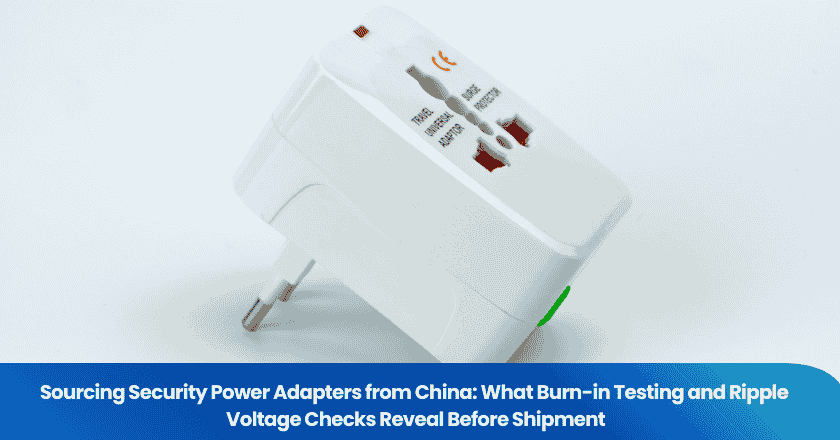
Power adapters are the component that buyers most often under-specify and under-inspect when sourcing security hardware from China. They ship in bulk, they look identical across good and bad units, and their failure mode is delayed — an adapter that passes a basic output voltage check at the factory may overheat and fail after six months of continuous operation in a CCTV installation. Burn-in testing and ripple voltage measurement are the two inspection methods that surface these latent defects before your product ships. This guide explains what these tests reveal, what pass/fail thresholds to require, and how to use inspection findings to make better sourcing decisions.
Key Takeaways
- A basic output voltage test at no load will pass nearly every adapter. Burn-in testing under full load — sustained over time — is what separates reliable units from ones that will fail in the field.
- Ripple voltage above safe limits causes CCTV camera image flickering and video instability that your customers will trace directly back to your product. Require ripple to be measured at full load, not just at idle.
- The most common cost-cutting substitution in Chinese-manufactured power adapters is lower-quality capacitors. This does not affect basic function tests but shows up immediately in ripple voltage measurements and in long-term thermal behavior.
- Require certifications — UL, CE, FCC, RoHS — on production units, not just on the sample. Confirm the certification mark is genuine and traceable to the specific model being shipped.
- Pre-shipment inspection results for power adapters should include measured values — actual voltage readings, actual ripple levels — not just pass/fail checkboxes.
Why Power Adapter Quality Failures Are Hard to Catch and Easy to Prevent
The Gap Between Factory Testing and Real-World Failure
Most Chinese factories that produce security power adapters run a basic output test on every unit before shipment: connect to the rated load, measure output voltage, confirm it is within a broad tolerance. This catches obvious faults — dead units, short circuits, severely out-of-spec voltage. It does not catch the defects that cause field failures, because those defects only manifest under conditions the factory test does not simulate: sustained full load over extended time, temperature rise in an enclosed installation space, and voltage ripple that accumulates to a disruptive level.
The result is a quality pattern buyers know well: adapters pass factory QC, pass a visual inspection, arrive correctly labeled, and then start generating warranty claims six to twelve months after installation. Customers complain about camera image quality — flickering, color shifts, intermittent video loss. Installers check cameras, check cabling, check the NVR. Eventually someone measures the power supply output with an oscilloscope and finds ripple at 200 mV when the spec says 100 mV. The adapter was substandard when it left the factory. No one checked.
Note: Capacitor quality is the single biggest variable between a reliable security power adapter and one that will degrade over time. Lower-grade capacitors reduce manufacturing cost by a small amount per unit and are invisible in basic function testing — but they produce higher ripple voltage and fail sooner under thermal stress. This substitution is very common in Chinese-manufactured adapters and is exactly what ripple voltage testing and burn-in testing are designed to detect.
Common Defects Found During Inspection of Security Power Adapters
The defects that pre-shipment inspection most frequently surfaces in this product category, and that factory QC most frequently misses, are:
- Ripple and noise above specified limit — typically caused by lower-quality output capacitors than the approved sample.
- Voltage accuracy outside ±1.0% tolerance under full load — the output is correct at idle but sags under real operating conditions.
- Overheating during sustained operation — thermal stress reveals poor heat dissipation design or component substitution in transformers or regulators.
- Load regulation failure — output voltage changes more than ±1.0% as load varies between 10% and 100%, causing instability in connected cameras.
- Missing or non-functional overload and short-circuit protection — the adapter does not shut down safely when the load exceeds rated capacity.
- Certification marks on label that do not match actual certified model or are counterfeit.
Full-Load Burn-in Testing: What It Reveals and What to Require
What Burn-in Testing Actually Tests
A full-load burn-in test runs the adapter at its maximum rated output — connected to a load bank that simulates real surveillance equipment — for a sustained period while measuring voltage, current, and temperature at intervals. The purpose is not to simulate the adapter's entire service life. It is to accelerate the failure modes that would otherwise show up after weeks or months in the field, so they are detected at the factory instead.
Components that are marginal — a capacitor running at the edge of its rated temperature, a transformer core with insufficient thermal mass, a voltage regulator that can sustain rated output at 25°C but not at 60°C — will either fail during the burn-in test or produce measurable deviation from specification. Either outcome gives you actionable information before the batch ships.
The Pass/Fail Parameters Buyers Should Require
When specifying burn-in test requirements for your supplier or your inspection checklist, the following parameters define whether an adapter is acceptable for shipment:
| Parameter | Required Specification | Why It Matters to Your Buyers |
|---|---|---|
| Voltage Accuracy | ±1.0% of rated output at full load | Out-of-spec voltage causes camera instability and accelerates camera hardware wear. |
| Load Regulation | ±1.0% from 10% to 100% load | Poor regulation causes voltage fluctuation when camera load changes, producing video artifacts. |
| Efficiency | Minimum 90% at full load | Lower efficiency means more heat generation, accelerating thermal degradation of components. |
| Hold-up Time | ≥10 ms at 110 Vac; ≥40 ms at 220 Vac | Ensures cameras stay online briefly during power interruptions rather than rebooting immediately. |
| Overload Protection | Must activate and recover correctly at 110% and 150% of rated load | Confirms the adapter protects connected cameras rather than failing dangerously under overload. |
| Component Temperature | No component exceeds rated temperature during sustained full-load operation | Thermal excess during burn-in predicts early field failure — reject any unit that overheats. |
Tip: Require that inspection reports include actual measured values — not just "pass." An adapter that shows voltage accuracy at ±0.8% and ripple at 85 mV gives you a different confidence level than one that shows ±0.95% and 98 mV, even though both technically pass. Measured data also helps you identify systematic issues across a batch before they become a field problem.
Ripple Voltage: What It Is and Why It Matters for Camera Performance
What Ripple Voltage Is and How It Affects Your Product
Ripple voltage is the residual AC variation superimposed on the DC output of a power adapter — the imperfection that remains after converting AC mains power to DC. Every switching power supply produces some ripple. The question is whether it stays within a level that connected equipment can tolerate.
For security cameras, the tolerance is tight. Camera image sensors and processing circuits are sensitive to power supply noise. When ripple voltage exceeds safe limits, the effect on camera output ranges from subtle — a faint horizontal banding or slight color inconsistency — to obvious: image flickering, rolling lines, or intermittent video dropouts. Your customer sees the camera performance issue. They do not see the power supply ripple causing it. By the time the root cause is identified, the product has already generated complaints, returns, and negative reviews. The industry standard limit for security camera power adapters is ≤100 mV ripple and noise at operating temperature (0°C to 70°C), rising to ≤150 mV at cold temperatures (-30°C to 0°C). Any adapter that exceeds these limits at full load should be rejected.
What Ripple Voltage Testing Involves
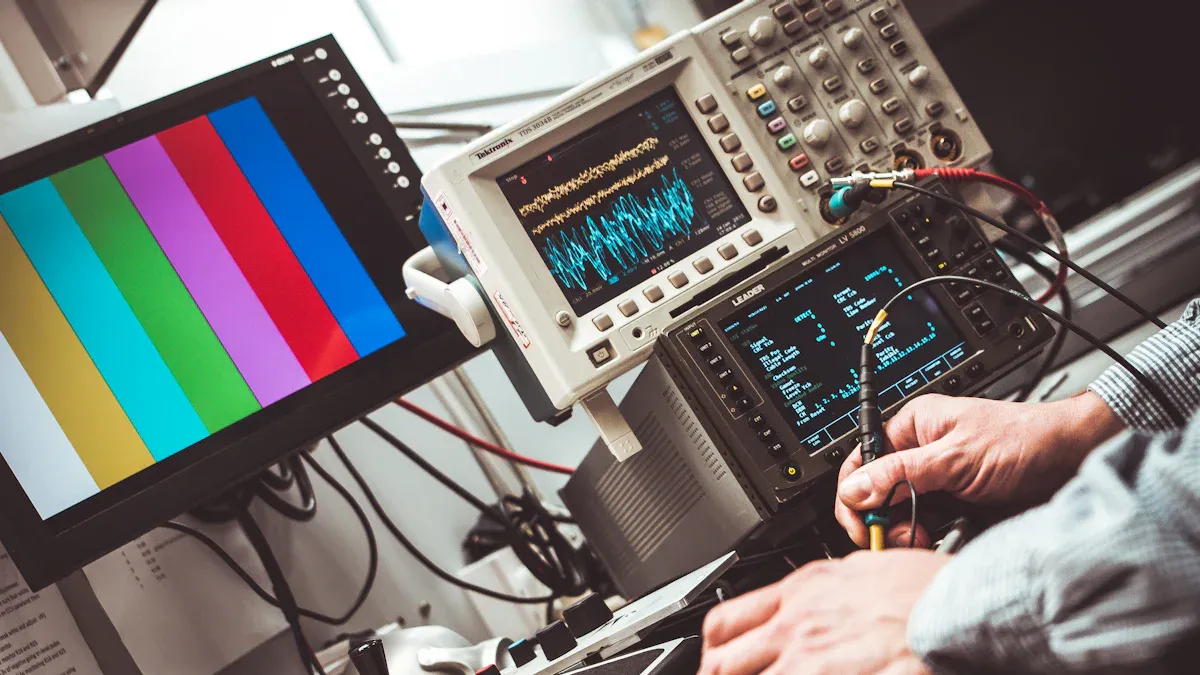
Ripple voltage is measured with an oscilloscope at the adapter's output terminals while the adapter is running at full load. This is a critical detail: ripple at idle or light load looks much better than ripple at full load. Factories that run ripple tests at 50% load and report the result as the adapter's specification are presenting misleadingly optimistic data. Require that all ripple measurements be taken at 100% rated load.
The test also includes insulation resistance testing to verify that the adapter's internal isolation between the AC input and DC output is intact — a failure here is a safety hazard. Withstand voltage testing confirms the adapter can sustain the specified isolation voltage without breakdown. Leakage current measurement ensures the adapter does not present a shock risk to connected equipment or users.
| Test | What a Failing Result Means for Your Product |
|---|---|
| Ripple and noise at full load | >100 mV: camera image flickering and video instability in the field. |
| Output voltage accuracy at full load | Outside ±1.0%: camera performance degradation or damage to sensitive components over time. |
| Insulation resistance | Below spec: safety hazard; adapter should not ship under any circumstances. |
| Withstand voltage | Breakdown at test voltage: isolation failure that creates shock risk for end users. |
| Leakage current | Above limit: compliance failure for CE and UL certification; regulatory non-compliance in most markets. |
Certifications: What to Require and How to Verify Them
Which Certifications Matter for Your Target Market
Security power adapters sold into different markets require different certifications. The table below shows the key certifications by market and what each covers. Require the certifications applicable to your target market to be verified on production units — not just shown on the initial sample:
| Certification | Market | What It Covers |
|---|---|---|
| UL | North America | Electrical safety — construction, insulation, overload protection, temperature limits. |
| CE | European Union | Electromagnetic compatibility (EMC) and low voltage directive compliance. |
| FCC | United States | Electromagnetic emissions — prevents interference with other devices and communication systems. |
| RoHS | EU and increasingly global | Restriction of hazardous substances — required for legal sale in most regulated markets. |
| ISO 9001 | Supplier-level | Quality management system certification — indicates process discipline, not product compliance. |
How to Verify Certifications Are Genuine
Counterfeit certification marks are a genuine problem in Chinese-manufactured power supply products. A UL mark printed on a label does not mean the adapter has been tested and listed by UL. To verify authenticity, ask your supplier for the UL file number for the specific model and check it against UL's online product database. For CE, request the declaration of conformity and the test report from an accredited laboratory. If the factory cannot provide a test report from a named accredited lab with a report number traceable to your model, the certification claim is unverified.
Your inspector should check certification marks on production units against the documentation provided, flag any marks that are present on the label but absent from the certification documentation, and photograph label markings as part of the standard inspection record.
How to Use Inspection Findings to Protect Your Sourcing Decisions
What Good Inspection Reports Look Like
A useful pre-shipment inspection report for security power adapters is not a checklist of pass/fail marks. It is a document with measured values, photos of test setups and label verification, and clear identification of any batch that requires hold or corrective action. When you receive an inspection report from TradeAider, it includes actual voltage readings, ripple measurements, thermal observations during burn-in, and photo documentation of the certification labels checked. This gives you data you can compare across orders and suppliers, not just a point-in-time pass/fail.
Real-time reporting through the TradeAider Web App means you see these findings as the inspection progresses — not in a report delivered after the factory has already packed the goods. If ripple voltage fails on the first tested unit, you know before the rest of the batch is touched, and you can instruct the inspector to expand sampling or hold the shipment pending factory investigation.
Recommended Inspection Scope by Order Situation
| Order Situation | Recommended Inspection Scope |
|---|---|
| First order with new supplier | Factory audit plus full pre-shipment inspection including burn-in test on sampled units and ripple measurement at full load. |
| Repeat order, established supplier | Pre-shipment inspection with AQL sampling, including voltage accuracy and ripple measurement on each sampled unit. |
| Large container load | Full inspection with expanded AQL sample; include burn-in test on a representative sub-sample to verify batch consistency. |
| After supplier component change | Treat as first order — require fresh burn-in and ripple testing. Capacitor or transformer changes invalidate previous inspection history. |
Security power adapters are a low-visibility product with high-consequence failure modes. The testing methods that matter — burn-in under full load, ripple voltage measurement at full load, thermal observation, safety electrical tests — are straightforward and available on every pre-shipment inspection. The reason buyers experience power-supply-related field failures is not that the tests are difficult. It is that the tests are not specified in the purchase order and not included in the inspection scope. Fix both of those, and you eliminate the most common root cause of field failures in CCTV and surveillance power supply products.
FAQ
What is the main purpose of a full-load burn-in test for security power adapters?
A full-load burn-in test runs the adapter at maximum rated output for a sustained period to surface latent defects — component degradation, thermal instability, and voltage regulation failures — that only appear under real operating conditions. It distinguishes between adapters that pass a basic function check and adapters that will reliably survive months of continuous operation in a security installation.
How does ripple voltage affect CCTV camera performance?
Ripple voltage above the safe limit (≤100 mV at full load for standard security camera power adapters) causes AC noise on the DC supply line that the camera's image sensor detects as a visual artifact. The effect ranges from subtle horizontal banding to obvious image flickering and intermittent video loss. These symptoms are frequently misdiagnosed as camera or cabling problems, making ripple voltage a particularly costly defect to trace back to the power supply after installation.
Why do security power adapters fail in the field even when they passed factory QC?
Factory QC for power adapters typically runs a basic output voltage test at light load for a short duration. This catches dead units and gross faults but misses latent defects in capacitor quality, thermal management, and load regulation. Burn-in testing under full load and ripple measurement at full load are the tests that catch these defects. If they are not part of the factory's QC process or your pre-shipment inspection, they will not be caught before shipment.
How do I verify that the UL or CE mark on a power adapter is genuine?
For UL, ask your supplier for the UL file number and verify it against the UL online product database for the specific model. For CE, request the declaration of conformity and the underlying test report from a named accredited laboratory. Your TradeAider inspector verifies certification marks against documentation during pre-shipment inspection and flags any marks that cannot be traced to verifiable test records.
Should I inspect every batch of power adapters from an established supplier?
Yes — particularly for electrical products where component substitution is common and the failure mode is delayed. A supplier who performed well on your last three orders may change a capacitor supplier on the current batch without notifying you. Ripple voltage and voltage accuracy measurements take relatively little time per unit and provide the ongoing verification that your product quality has not drifted. The cost of inspection is small compared to a field recall or warranty campaign driven by a batch of substandard adapters.
Похожие статьи



Развивайте свой бизнес с услугами TradeAider
Нажмите кнопку ниже, чтобы войти непосредственно в систему услуг TradeAider. Простые шаги от бронирования и оплаты до получения отчетов легко выполнить.

