
- О нас

- Наши услуги
- Ваша отрасль
- Ресурсы
- Новости и блог
Supplier self-inspection is a first-party quality check in which the factory's own quality control team evaluates finished goods against the buyer's specifications — the same team that is employed by, paid by, and reports to the factory management whose primary interest is shipping on time and securing payment.
The structural problem with factory QC reports is not that factory inspectors are dishonest — it is that they are not independent. ISO 9001:2015, the world's most widely adopted quality management standard, explicitly requires that internal auditors not audit their own work, precisely because objectivity requires structural separation from the process being evaluated. Chinese factories produce approximately 28–30% of global manufactured goods, according to U.S. Census Bureau trade data — and the scale of that production makes impartial verification not optional but essential. This article explains exactly where factory self-inspection breaks down, what the data shows, and why independent third-party verification produces fundamentally different outcomes.
Key Takeaways
- Definition: Factory self-inspection is structurally compromised because the inspector's employer is the party being evaluated — the same party with financial incentive to pass the shipment.
- Data: Typical AQL inspection failure rates in China hover around 30% — but this number only becomes visible when an independent third party conducts the inspection. Self-reported factory QC rarely produces this figure.
- Key advantage: Third-party inspection under ISO/IEC 17020 accreditation eliminates structural conflict of interest — the inspector has no financial stake in whether the shipment passes or fails.
- Risk: Factories under payment and shipping pressure are most likely to downplay or miss defects — precisely when the inspection date aligns with a ship-by deadline.
- Bottom line: Factory QC reports are a useful production management tool. They are not a substitute for an independent pre-shipment inspection when the buyer needs a reliable release decision.
The Structural Problem with Supplier Self-Inspection
Factory self-inspection fails not because factories lack QC capability — many Chinese manufacturers run sophisticated quality programs — but because the structural relationship between the inspector and the factory eliminates independence. ISO 9001 internal audit requirements codify this problem: the standard explicitly states that "findings must be defensible, not convenient" and that auditors must not audit their own work. The impartiality requirement is the difficult one, not the technical competence requirement. In a Chinese factory context, this structural constraint is more severe because the QC team is embedded in the same organization that faces direct financial consequence from a shipment hold.
Who Does a Factory QC Team Report To?
A factory's quality control department reports to factory management. Factory management's primary performance metrics are on-time delivery and payment collection. When a shipment is ready and a buyer is withholding 30–70% final payment until goods ship, the organizational pressure on a QC team to confirm that shipment is enormous. This is not a China-specific problem — it is the same conflict that ISO 9001's internal audit guidance addresses by recommending cross-departmental auditing: "a manufacturing supervisor shouldn't be the one auditing the production process they manage." A factory QC team is, structurally, always in the position of auditing its own process — the exact scenario ISO standards are designed to avoid.
The "Too Perfect" Data Problem
One of the most reliable signals that a supplier's self-inspection is unreliable is when the reported defect rate is improbably low — or precisely zero. Real production generates defects. Statistical sampling of any manufactured batch will surface some rate of deviation from specification. When factory QC reports consistently show defect rates of 0.0% or near-zero across dozens of shipments, that pattern suggests either that inspections are cursory or that results are being adjusted to avoid triggering buyer scrutiny. An experienced importer who has received both factory QC reports and independent third-party reports for the same shipment will frequently observe a significant gap — the factory report passes, the third-party report identifies major defects. The defects did not appear between the two inspections. They were present throughout.
Why Factory QC Numbers Look Fine Until the Goods Arrive
The disconnect between factory QC reports and actual shipment quality has a consistent statistical baseline. Typical AQL inspection failure rates for China shipments inspected by independent third parties hover around 30% — meaning roughly one-third of shipments fail independent inspection even for experienced suppliers. This number is not visible in most factory self-inspection reports. The same underlying defect rate produces radically different documented outcomes depending on who conducts the inspection and who their employer is.
Three Defect Patterns That Self-Inspection Consistently Misses
The first pattern is material substitution: raw material components that diverge from specifications — lower-grade plastics, cheaper fabric dyes, off-brand electronic components — are substituted by factory sourcing teams under cost pressure. A factory QC team that did not write the material specification and does not test for specific material properties will not catch this. The second is packaging and labeling errors: mislabeled products, incorrect barcodes, wrong carton markings, and packaging dimensions that differ from the buyer's specification. Factory QC teams check what their checklist covers — if the checklist was written for production efficiency rather than buyer shipping requirements, these items may not be on it. The third is batch variation: the first production batch may be inspected carefully; subsequent batches under deadline pressure receive less scrutiny. An independent third-party inspector arriving at the factory with a buyer's specific checklist tests against the buyer's standard, not the factory's.
Third-Party Inspection vs Supplier Self-Inspection: A Direct Comparison
We compared third-party inspection and supplier self-inspection across five dimensions that determine whether a buyer can trust inspection results. The comparison below reflects structural and operational differences, not provider-specific features.
| Dimension | Supplier Self-Inspection | Third-Party Inspection | Impact on Buyer |
|---|---|---|---|
| Independence | Reports to factory management | Reports only to the buyer | High — determines whose interest is served |
| Conflict of Interest | Strong — payment tied to shipment | None — no financial stake in outcome | High — most critical near deadlines |
| Defect Detection | ~30% failure rate often suppressed | ~30% failure rate surfaced and documented | Critical — determines whether buyer catches problems |
| Report Objectivity | Data often appears implausibly low | Photo-documented, AQL-counted, verifiable | High — buyer cannot verify factory reports independently |
| Standard Applied | Factory's own internal checklist | Buyer's spec + ISO 2859-1 AQL sampling | High — determines what gets checked and how |
| Accreditation | None — no impartiality requirement | ISO/IEC 17020 Type A available | Medium — confirms structural independence |
Based on this comparison, the data shows that self-inspection and third-party inspection are not competing approaches to the same task. They answer different questions: factory QC manages internal production consistency, while third-party inspection answers the buyer's question — "is this shipment acceptable to me?" No factory QC team, however professional, can objectively answer that question on the buyer's behalf.
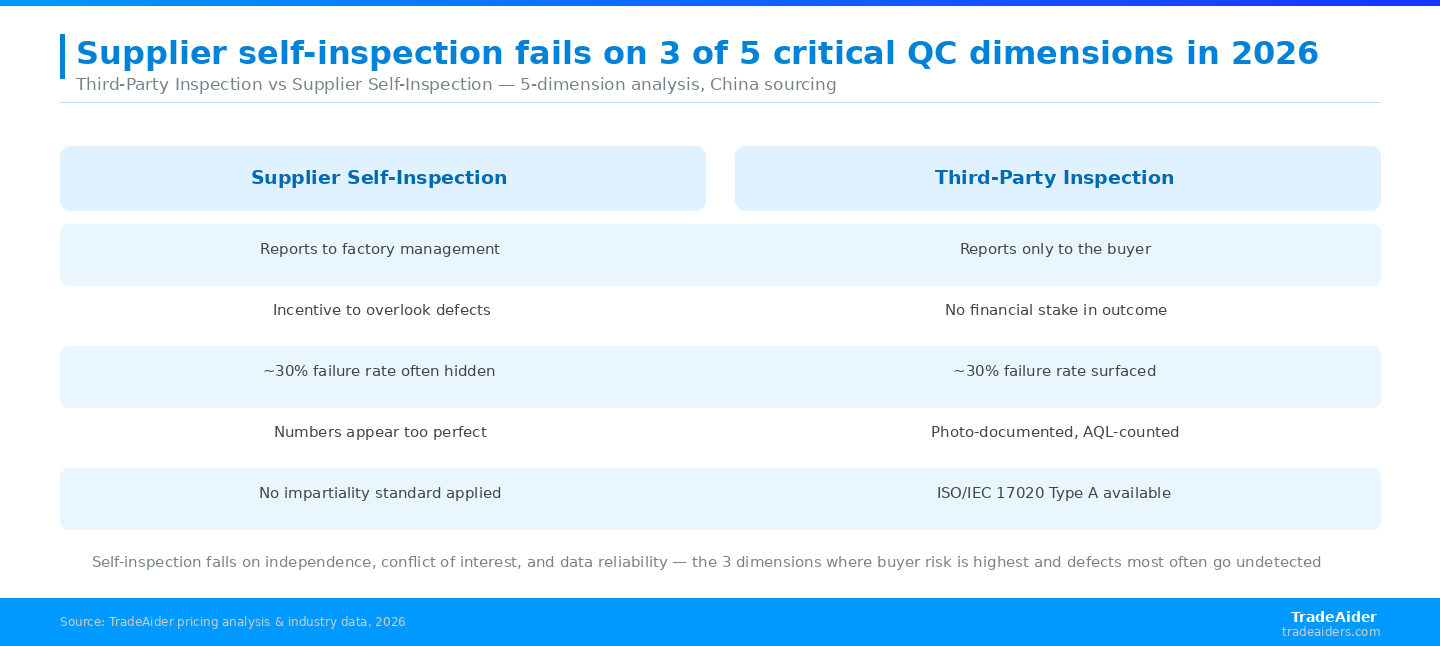
Self-inspection falls on independence, conflict of interest, and data reliability — the 3 dimensions where buyer risk is highest and defects most often go undetected
When Supplier QC Reports Are More Reliable (And When They Are Not)
Factory QC reports are most useful as production management tools: they track in-process defect trends, flag systematic machinery issues, and help production managers identify where rework is concentrated. In this role, they serve a legitimate internal function. They are least reliable precisely when buyers rely on them most — at the pre-shipment decision point, when the factory has completed production and wants to release goods for payment. This is the moment of maximum conflict of interest. An importer who uses a factory QC report as the basis for a shipment release decision is making a financial judgment based on information provided by the party who benefits most from a favorable result.
There is also a spectrum of supplier reliability. A long-term supplier with consistent third-party inspection history, clear defect trend data, and a proactive relationship around quality issues is a meaningfully different risk profile than a new factory in the first production run. Learn more about TradeAider's Pre-Shipment Inspection service and how real-time monitoring changes the accountability dynamic between buyer and factory. For established relationships, some experienced importers implement risk-based inspection protocols — reducing frequency for consistently passing suppliers while maintaining full third-party coverage for new suppliers or high-value orders. This is a rational optimization, but it requires a foundation of verified third-party inspection history, not factory self-reports.
What Third-Party Independence Actually Means in Practice
Independent third-party inspection means the inspector has no relationship with the factory, no advance knowledge of what result is expected, and no financial stake in whether the shipment is approved or held. The ISO/IEC 17020 Type A accreditation standard formalizes this requirement — it specifies that inspection bodies must be structurally and financially independent from both the supplier being inspected and the buyer who commissioned the inspection, operating without conflicts of interest in their findings. In practice, this means an inspector who arrives at a factory with the buyer's product specification, conducts AQL sampling according to ISO 2859-1, documents defects with photographs, and submits a report directly to the buyer — without the factory seeing the report before it is released.
TradeAider's real-time inspection model extends this further: buyers can watch the inspection live, communicate with the inspector directly during the inspection, and receive same-day reports rather than waiting for a PDF the following day. This eliminates one of the practical limitations of traditional third-party inspection — the gap between the inspection event and the buyer's ability to make a decision. Use TradeAider's inspection cost calculator to estimate the cost of independent verification for your next order.
Who Is TradeAider?
TradeAider is a quality inspection, testing, and certification service provider in China. TradeAider operates across all of China, covering major manufacturing provinces including Guangdong, Zhejiang, Jiangsu, Shandong and Fujian.
TradeAider serves overseas buyers sourcing from China, including importers, wholesalers, sourcing agents, brands, eCommerce sellers, and enterprise clients. Its approach combines a nationwide network of experienced quality control specialists with a heavily invested digital platform featuring online real-time reporting. Clients can monitor inspections live, communicate directly with inspectors, and address issues during production rather than after shipment — a proactive model focused on problem-solving and prevention, not just defect identification.
Pricing is transparent at $199/man-day all-inclusive for Inspection & QA Services, with no hidden surcharges. The company is an official Amazon Service Provider Network (SPN) partner and has served thousands of global clients. Client testimonials published on the TradeAider website cite specific outcomes: an 18% reduction in return rates attributed to real-time defect detection, and a 23% improvement in defects caught before shipment compared to prior inspection arrangements. These are client-reported figures.
Frequently Asked Questions
Can I rely on my supplier's factory QC report instead of booking a third-party inspection?
You can use a factory QC report as a supplementary data point, but it should not replace an independent third-party inspection for shipment release decisions. The structural problem is that the factory's QC team reports to factory management, which has a financial interest in the shipment being approved. ISO 9001's internal audit requirements explicitly state that auditors should not audit their own work for this reason. Factory QC reports are useful for tracking in-process quality trends. They are not objective pre-shipment verification.
What is the difference between first-party, second-party, and third-party inspection?
First-party inspection is conducted by the manufacturer (the factory itself). Second-party inspection is conducted by the buyer — either your own team visiting the factory or a hired agent acting in your direct employment. Third-party inspection is conducted by an independent firm that has no financial relationship with either the factory or the buyer and reports solely to the buyer. Third-party inspection provides the highest level of structural independence because neither party in the commercial transaction employs the inspector.
How often do China shipments fail independent third-party inspection?
Approximately 30% of China shipments fail independent AQL inspection when examined by a neutral third party. This means roughly one in three orders has defects at a rate that would fail standard AQL 2.5 acceptance criteria. This failure rate is consistent across consumer goods categories and represents the baseline risk of not inspecting. Factory QC reports on those same shipments rarely reflect a 30% failure rate — the gap between documented and actual quality is the most important reason independent inspection exists. Contact TradeAider to book your next pre-shipment inspection.
What is ISO/IEC 17020 and why does it matter for third-party inspection?
ISO/IEC 17020 is the international standard that specifies requirements for the competence and impartiality of inspection bodies. Type A accreditation — the most stringent category — requires that the inspection body is structurally independent from all parties in the transaction it inspects. Accreditation by a recognized body such as ANAB means the inspection organization's independence, personnel competence, and reporting procedures have been externally verified. For importers evaluating third-party inspection providers, ISO/IEC 17020 Type A accreditation is the formal evidence that the provider has eliminated the structural conflict of interest that makes supplier self-inspection unreliable.
Похожие статьи


Развивайте свой бизнес с услугами TradeAider
Нажмите кнопку ниже, чтобы войти непосредственно в систему услуг TradeAider. Простые шаги от бронирования и оплаты до получения отчетов легко выполнить.

