
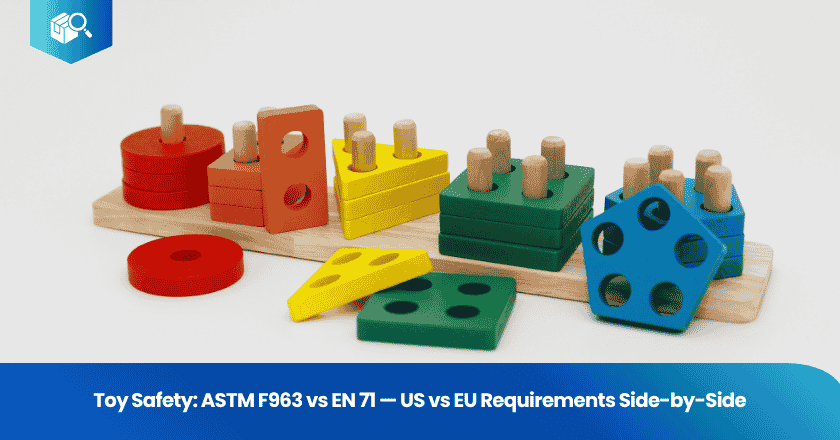
ASTM F963 and EN 71 are not interchangeable toy safety labels; ASTM F963 supports the US toy safety path, while EN 71 supports the EU toy safety path. A toy that looks identical at the factory can require different certificates, labels, warnings, and technical files depending on whether it is sold in the US or EU.
The importer should treat dual-market toy sourcing as two evidence files attached to one physical product. Two markets multiplied by five evidence fields creates ten match checks before a toy lot should be released.
For China-sourced toys, the factory may describe a product as "tested" without explaining which market, age grade, version, or label the test supports. The buyer needs to connect the toy, report, certificate, packaging, warning, and tracking evidence before shipment.
- US path: ASTM F963 evidence is commonly connected to US toy safety and CPSC certification context.
- EU path: EN 71 evidence is commonly connected to EU toy safety and CE-route documentation.
- Shared factory risk: The same sample can drift from both evidence files if materials, age grading, or packaging change.
- Release timing: A PSI is conducted when 100% of the order quantity is completed and at least 80% is packed for export.
The Direct Answer
Use ASTM F963 for the US toy safety evidence path and EN 71 for the EU toy safety evidence path; do not use one as a generic substitute for the other.
TradeAider separates toy safety control by market version because the same plush toy, puzzle, or activity kit can need different labels, warnings, tracking details, and report references for US and EU release.
The buyer should ask the factory which exact toy version, age grade, material, and packaging the report covers. A report for a plush toy does not support a plastic toy. A report for a 3+ version may not support a different age claim. A report for one paint, coating, magnet, sound module, or small-part configuration may not support a changed production version. Toy safety evidence follows the product details that children can touch, bite, pull, swallow, or misuse.
According to ASTM F963 information, ASTM F963 is a consumer safety specification for toy safety. According to the European Commission toy safety harmonised standards page, EU toy safety relies on harmonised standards in the European context. The so what for buyers is that destination market must be declared before evidence is accepted.
ASTM F963 vs EN 71 Side-by-Side
The side-by-side comparison should tell the buyer what each standard path proves and what still needs to be checked at the factory.
| Area | ASTM F963 / US Path | EN 71 / EU Path | Importer Check |
|---|---|---|---|
| Market fit | US toy safety evidence path | EU toy safety evidence path | Do not use one report as universal proof |
| Certificate or declaration | CPC context for children's products when applicable | EU conformity and technical-file route when applicable | Match certificate or declaration to model and age grade |
| Labels and warnings | US warning and tracking evidence must match product | EU label, warning, and CE-route evidence must match product | Check package artwork before mass printing |
| Factory sample | Must match tested version | Must match tested version | Reject report if material or accessory changed |
| Shipment release | Verify packed goods match US evidence file | Verify packed goods match EU evidence file | Inspect model, labels, warnings, barcode, and packaging |
The comparison reveals that ASTM F963 and EN 71 both support toy safety decisions, but they do not travel through the same market evidence system. The importer can use one physical production lot for both markets only if the label, warning, certificate, report, and packaging controls are separated clearly enough to prevent mixed evidence.
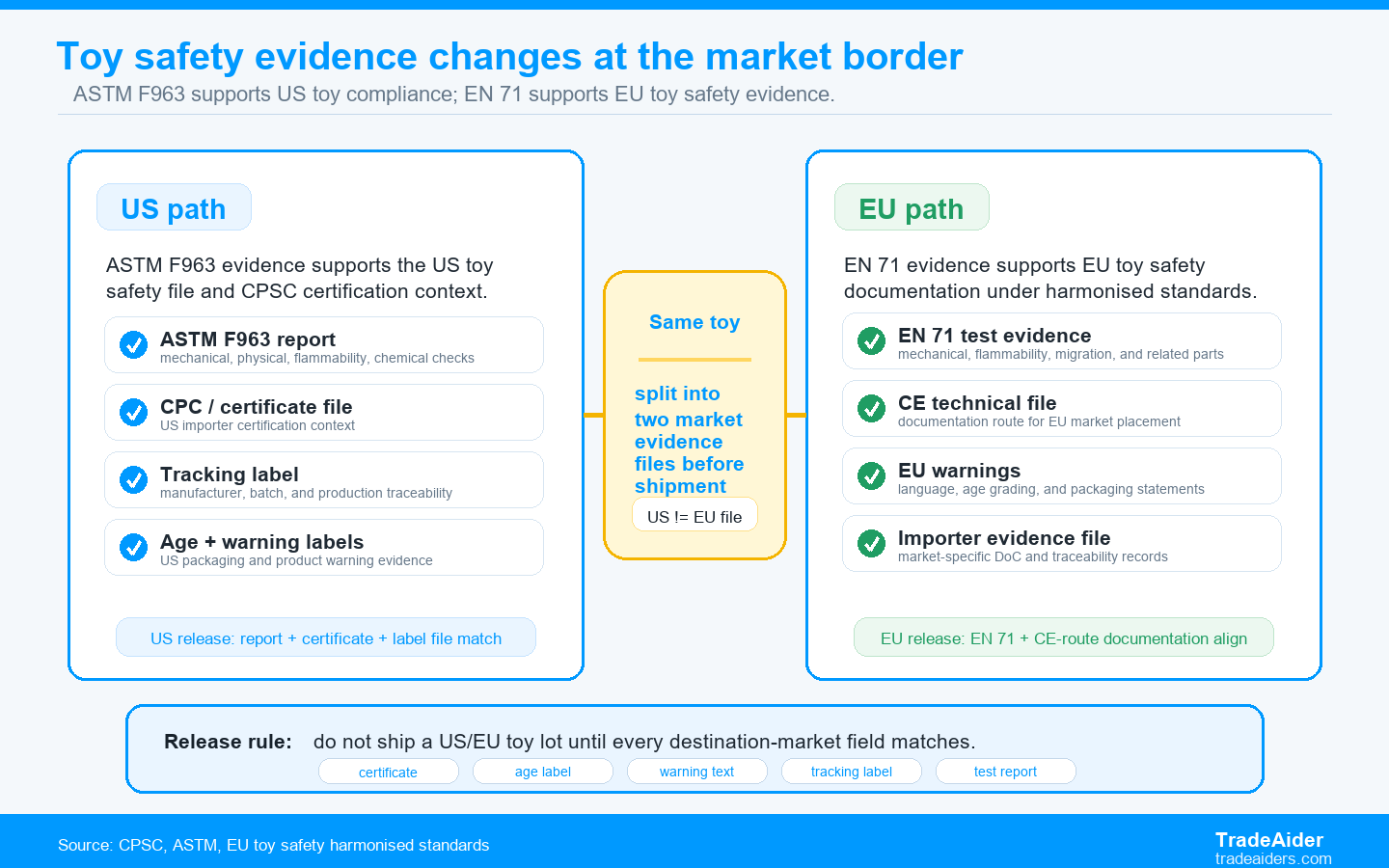
US and EU toy safety evidence should be managed as two market paths, not one generic report file.
Where Toy Safety Evidence Breaks
Toy safety evidence breaks when the report describes one toy and the factory ships a slightly different toy.
According to CPSC toy safety guidance, toy safety is a product-specific compliance issue. According to CPSC Children's Product Certificate guidance, children's products may need certificate evidence. The buyer should therefore manage evidence by exact production version. A small change can matter: paint, small parts, magnets, batteries, cords, sound modules, stuffing, fabric, surface coating, warning label, or age grade.
US evidence breaks when the CPC and toy version do not match
The US path often turns on whether the certificate and test evidence match the actual toy. If the certificate names one factory but production moves to another site, the buyer should investigate. If the test report covers a red toy and the order uses a new coating, the evidence may not be enough. If the age grade changes from 6+ to 3+, the risk profile changes. The importer should compare product name, model, age grading, materials, tracking label, warnings, factory name, and production date before release. The document must describe the toy being shipped, not the toy the supplier used to sell.
EU evidence breaks when EN 71 is treated as a single checkbox
The EU path can involve several EN 71 parts depending on toy type and risk. The buyer should not write "EN 71 passed" without knowing which parts, materials, age grade, and product version were tested. According to the European Commission CE marking page, CE marking connects to applicable EU legislation. According to EU conformity assessment guidance, conformity assessment depends on applicable requirements. That means the toy file should connect EN evidence, declaration, label, warnings, technical file, and market destination. In practice, the buyer should ask which EN 71 parts were tested before approving artwork, age grading, warning language, or bundle configuration for the EU version.
Factory release breaks when US and EU versions are mixed
Dual-market toy orders can fail at the packing table. A factory may pack EU warnings in US cartons, print the wrong age grade, use one barcode for two market versions, or mix manuals during final packing. According to GS1 barcode standards, barcode identity supports supply chain identification, so SKU identity should separate market versions when labels differ. The original estimate is simple: 2 markets x 5 evidence fields equals 10 match checks. Inspection should verify report version, certificate or declaration, age label, warning text, and tracking label before the toy lot is released.
How Importers Should Control Toy Safety Before Shipment
The safest toy workflow separates US and EU evidence before production, then verifies the packed lot against the right file.
Toy importers should freeze the destination market before packaging artwork is printed. If the same toy will sell in both markets, the buyer should create two evidence folders: US evidence and EU evidence. Each folder should include product name, model, age grade, material list, test report, certificate or declaration, label, warning, manual, barcode, carton mark, and approved sample. The factory should not have to decide which label belongs to which market during final packing.
Review reports before the purchase order becomes packaging
Report review should happen before mass packaging production. If the report is missing, outdated, or tied to the wrong toy, the buyer still has time to test, redesign, relabel, or change the order. The buyer should ask for report number, lab name, tested sample description, test date, product model, materials, age grade, and applicable sections. A report that arrives after cartons are printed can still be useful, but it may create rework if labels or warnings need change. Toy safety evidence should control packaging, not chase it. The risk is highest when marketing wants to change the age claim, accessory count, or gift-box language after the test sample has already been approved.
Use inspection to catch version and label errors
TradeAider's Pre-Shipment Inspection cannot replace toy safety testing, but it can verify that the finished toy lot matches the evidence file. The inspector can check product version, size, color, accessories, labels, warnings, tracking label, barcode, manual, carton mark, and package count. According to ISO 2859-1 sampling procedures and ASQ sampling resources, lot decisions depend on defined sampling and acceptance logic. For toy safety, that lot evidence should be tied to the correct market file before shipment. This means the inspector should not only count visual defects; the inspector should confirm which market version each carton belongs to and whether mixed US/EU packaging has entered the same export lot.
Separate corrective action by market version
If a toy lot fails label or warning checks, the corrective action should name the affected market version. A wrong US warning does not automatically mean the EU version is wrong; a wrong EU CE-route label does not automatically mean the US carton is wrong. The buyer should ask the factory to sort by market version, count affected cartons, correct labels, and verify the fixed lot. If 3% of a 5,000-unit dual-market toy lot has mixed warning labels, 150 units may need sorting before release. The result is operational, not theoretical. The buyer insight is that market-specific label control can protect a physically good toy from becoming commercially unusable in one destination while still releasable in the other.
SPAR Scenario: One Toy, Two Markets, One Mixed Label Problem
Dual-market toy orders fail when the factory treats different evidence files as one packing task.
Situation: A toy brand orders 5,000 magnetic drawing boards from a factory in Guangdong. The buyer plans to split the order between the US and EU, using ASTM F963 evidence for the US and EN 71 evidence for the EU.
Problem: During PSI, the inspector finds that some EU cartons use the US warning panel and some US cartons use the EU manual insert. The toy itself appears physically consistent, but the market evidence files no longer match the packed product.
Action: The buyer holds release, asks the factory to sort cartons by market version, reprints the affected inserts, and verifies the fixed cartons through reinspection. The buyer also changes the packing instruction so market version is checked before carton sealing.
Result: The shipment loses 4 days and the factory absorbs part of the relabeling cost. The trade-off is necessary because a toy with mixed warnings can create marketplace, customs, customer, and recall exposure. The remaining limitation is that future dual-market toy orders need separate packaging lines or a stronger final check.
Toy Safety Control Checklist
Do not release a toy lot until the market evidence file and the packed toy describe the same product.
- Separate US and EU evidence files before packaging artwork is approved.
- Match ASTM F963 or EN 71 evidence to product model, age grade, material, and production version.
- Check certificate or declaration, warning label, tracking label, barcode, manual, and carton mark.
- Use TradeAider product testing support when report coverage is unclear.
- Use inspection to verify finished toy lots against the correct destination-market file.
If one toy SKU will ship to both US and EU channels, send TradeAider the CPC or EN 71 reports, market-specific warning files, tracking-label artwork, PO, sample photos, and packing status. The next step is to ask TradeAider to separate the toy safety evidence into market-specific release checks so mixed US/EU labels do not reach export cartons.
Frequently Asked Questions
Is ASTM F963 accepted in the EU?
ASTM F963 is a US toy safety standard path, not a substitute for EU EN 71 evidence. EU toy sales should be checked against the applicable EU requirements and harmonised standard route.
Can one toy test report support both US and EU sales?
Sometimes the same physical sample can support more than one test program, but the buyer still needs market-specific evidence, labels, warnings, and certificates or declarations. Do not assume one report is enough without checking scope.
Can inspection replace toy safety testing?
No. Inspection cannot replace ASTM F963, EN 71, or other required testing. It can verify that the finished lot matches the tested version and the correct market packaging before shipment.
Похожие статьи
Развивайте свой бизнес с услугами TradeAider
Нажмите кнопку ниже, чтобы войти непосредственно в систему услуг TradeAider. Простые шаги от бронирования и оплаты до получения отчетов легко выполнить.

