
- О нас

- Наши услуги
- Ваша отрасль
- Ресурсы
- Новости и блог
A return-to-check loop is a buyer workflow that turns a customer-reported outcome into an observable product condition, a traceable inspection scope, and a verified follow-up action.
Amazon and direct-to-consumer brands often have more return language than inspection evidence: “leaks,” “stopped working,” “wrong size,” or “arrived damaged.” Those phrases are valuable signals, but they do not tell an inspector what to check, which units share the exposure, or whether a supplier caused it. The useful move is to preserve the customer signal, translate it into a checkable condition, and send the verified result back into the next inspection brief.
Turn a Return Signal Into a Checkable Decision
A useful return workflow preserves the gap between what a customer reports and what the next inspection can actually verify. An observable condition is a product state an inspector can see, measure, or test against an approved rule. The workflow treats a return as an input to a quality decision, not as a final verdict on the factory, the carrier, the listing, or the whole SKU.
For a buyer, the workflow has five moves: capture the customer signal, normalize it against the product configuration, translate it into an observable condition, verify it against a stated scope, and feed the result into the next production or inspection decision. The first four moves make the check credible; the fifth prevents the same issue from returning as an unstructured support note.
- Keep the customer’s words: they preserve the field symptom and channel context.
- Do not stop at the words: define what an inspector can see, measure, test, or confirm in records.
- Keep the boundary: link the signal to a configuration, lot, packing window, or fulfillment context before expanding the check.
- Close the loop with evidence: record whether the inspection confirmed, weakened, or redirected the original hypothesis.
This is a quality-improvement workflow, not a substitute for a product-safety report, a regulatory decision, a marketplace appeal, or the commercial terms that govern a live return dispute.
A Return Reason Is a Signal, Not an Inspection Finding
A customer return reason is a signal to investigate, not a ready-made inspection criterion or a confirmed root cause. A return reason is the customer description of why an item was sent back. NIST distinguishes a product that is nonconforming to a stated specification from one that is defective in use; that distinction matters when a customer says a bottle “leaks” or a charger “does not work.”
A return reason usually describes an outcome in ordinary language. It can reflect a product condition, but it can also reflect shipping damage, incorrect use, an expectation set by the listing, a missing accessory, or a fulfillment mix-up. An inspection checklist needs a narrower statement: what physical condition must be observed, against which approved reference, and on which population.
Use a three-part translation before you ask a supplier or inspector to act:
- Customer outcome: “Leaks in bag,” “lid comes loose,” or “item will not charge.”
- Observable condition: moisture around the closure after the agreed handling check, a closure that fails the approved fit reference, or a device that fails the stated functional method.
- Suspected mechanism: gasket variation, closure torque, component mismatch, packing damage, or another hypothesis that still needs evidence.
The first part belongs to the customer record. The second belongs in the inspection brief. The third belongs in an investigation field, not in an acceptance rule. Keeping those fields separate stops a team from treating a plausible explanation as a confirmed cause.
Build a Return Record an Inspector Can Actually Use
A return record becomes actionable when it is linked to product identity, lot or production window where available, channel, fulfillment context, and observable evidence. Lot traceability is the code and details that distinguish one production or packing group from another. NIST identifies product-data traceability as critical to smart manufacturing operations; use the level of detail the product and records can actually support.
The goal is not to make customer support operate a factory quality system. It is to avoid losing the fields that a quality lead will need later. A DTC brand may collect richer customer photos and usage notes, while a marketplace record may contribute fulfillment and listing context. Both should still identify the sellable configuration rather than relying on a generic product name.
| Field to retain | Why it matters | What it can change next |
|---|---|---|
| Customer wording and evidence date | Preserves the field symptom without rewriting it as a cause | The first observation or photo request |
| SKU, color, size, bundle, and current listing version | Separates one configuration from a generic family name | The correct approved sample or requirement |
| Lot, carton, production date, or packing window when available | Bounds or widens the exposure question | A targeted check, wider hold, or record review |
| Channel and fulfillment context | Separates product signals from possible shipment or fulfillment effects | The owner who must investigate the next link |
Based on this comparison, a return record should be treated as a traceability starter, not a finished quality report. The more fields that remain connected, the less likely a buyer is to apply a broad new check to the wrong product group. TradeAider’s e-commerce guidance can help teams connect online-channel evidence and factory controls through e-commerce quality planning for China-sourced products.
Translate the Signal Before You Change the Checklist
A new inspection item should name the customer outcome, the observable condition, the check method, the population, and the action if the check fails. This makes the amendment inspectable without pretending that a customer phrase is itself a pass/fail requirement.
A practical line in the checklist might read: “For the identified lid configuration, inspect closure fit against the approved sample; record moisture, fit exceptions, and the linked gasket lot; escalate any confirmed exception to the buyer before release.” The wording states an observation and an action. It does not say “check for leaks” without explaining what that means.
Write each new line so a different inspector could apply the same method. If the condition cannot be observed reliably, separate the requirement from a visual check and decide whether it needs a document review, a fixture, a functional method, or product testing.
Use One Defect Definition and One Denominator
Return counts become comparable only after the buyer applies a consistent condition definition and a stated denominator. NIST describes proportion-based quality monitoring in terms of a defined defective classification, which is why “17 leak returns” has little decision value without saying 17 out of what comparable population and under which definition.
Do not turn this into a false precision exercise. Customer-return data are affected by buyer behavior, sales timing, returns eligibility, carrier handling, and the availability of a return reason. Instead, use a stable taxonomy for comparison: for example, “visible moisture at closure,” “closure does not engage,” “missing seal,” and “shipping impact at outer carton.” Keep “leaks” as the original phrase, but code the verified condition separately.
When a new condition belongs in an inspection plan, define the reference, method, sample or population, recording rule, and escalation action. An inspection-standard framework can help a buyer make those fields explicit before the factory interprets a broad return label in its own way.
Escalate a Pattern, Not a Single Comment
A changing return pattern can justify an expanded review when the buyer can compare like-for-like conditions and trace the affected production or fulfillment context. NIST notes that observed variation can arise from many sources and that changing variation is less predictable; its process-control guidance also frames current observations against a prior pattern or model.
Set the escalation rule before a dashboard spike creates pressure. A useful trigger combines at least two conditions: the same normalized defect category, a comparable configuration or component, and a record that can link the signal to a lot, date window, fulfillment path, or supplier change. The threshold belongs to the buyer’s risk profile and available data. It is not a universal percentage, and it should not be disguised as one.
Before assigning a service or factory action, confirm whether the present evidence describes the sellable product, a fulfillment event, or an unresolved mix of both. That distinction keeps a recurring product-control question from being diluted by a carrier-damage or listing-expectation issue.
Escalation can take several forms. A low-confidence signal may only add a photo request to future returns. A confirmed physical condition may add a focused final inspection item. A pattern tied to a component or assembly window may justify an earlier process check, a record review, or a temporary hold on the affected configuration. For a repeated risk that is best seen before finished goods are packed, use during-production inspection at the relevant control point rather than relying on customer returns as the first detector.
Worked Scenario: A Leak Return Becomes a Lot-Specific Check
Traceability records are most useful when they connect the product event, the identifier, and the related process or fulfillment context. NIST describes traceability data as a way to identify and connect value-chain information; the buyer does not need a new platform to apply that principle to a return investigation.
Linked return records can narrow an inspection question to a documented lot or process window when the records support that boundary. This worked example is illustrative, not a client case, supplier result, or measured TradeAider outcome.
Close the Loop Before the Next Production Run
Closing the loop means recording the verified inspection outcome against the same return taxonomy so the next trend review can distinguish a corrected signal from a new one. The goal is not to force every future return into the same explanation; it is to preserve enough evidence to see whether the revised control changed the observed pattern.
Situation. A U.S. direct-to-consumer drinkware brand also sells the same bottle configuration through a marketplace channel. The illustrative order contains 2,400 insulated bottles across four lot codes and two lid colors. The first repeat production run has not started, and the buyer still holds returned units, fulfillment dates, and supplier packing records.
Problem. Seventeen return records over three weeks use variations of “leaks in bag” for one lid color. Eleven records include photos showing moisture around the closure, while six lack usable visual evidence. The team does not call the 17 records a defect rate and does not assume all returns have the same cause. It groups them by configuration, evidence quality, fulfillment timing, and lot code where the order record permits.
Action. The records point to one lot code packed after a documented gasket-material change. The buyer compares returned units from that lot with the approved closure sample, asks for the gasket-change and packing-window records, and adds a lid-fit and closure-seal observation to the next inspection brief for 1 lid color and 1 documented changed-gasket lot. The supplier records the gasket lot, separates the affected lid color, presents closure samples and packing records, and corrects the component-control step before the next run is inspected. Other lots stay outside the targeted check unless their records show the same component or packing exposure.
Result: The revised check is complete only when the observation method, affected configuration, record link, and exception action are documented. The buyer can then use the next inspection result to decide whether the return signal was consistent with the changed component, whether the condition requires a broader check, or whether another explanation is more plausible. It is not proof that every historical return had the same cause. If the next completed lot needs independent release evidence against the updated requirement, arrange pre-shipment inspection for the updated release checklist.
This example is illustrative. A safety concern, unknown traceability, chemical or performance question, or broader field signal may require a different escalation, testing route, contractual response, or formal reporting process. The return-to-check loop only makes the next quality question clearer; it does not settle those broader obligations.
Put the Return-to-Check Loop Into the Next Inspection Brief
A return-informed inspection brief should state the return signal, product configuration, check method, escalation trigger, evidence required, and feedback owner. That short handoff prevents a support label from reaching the factory as an unsupported request to “check everything.”
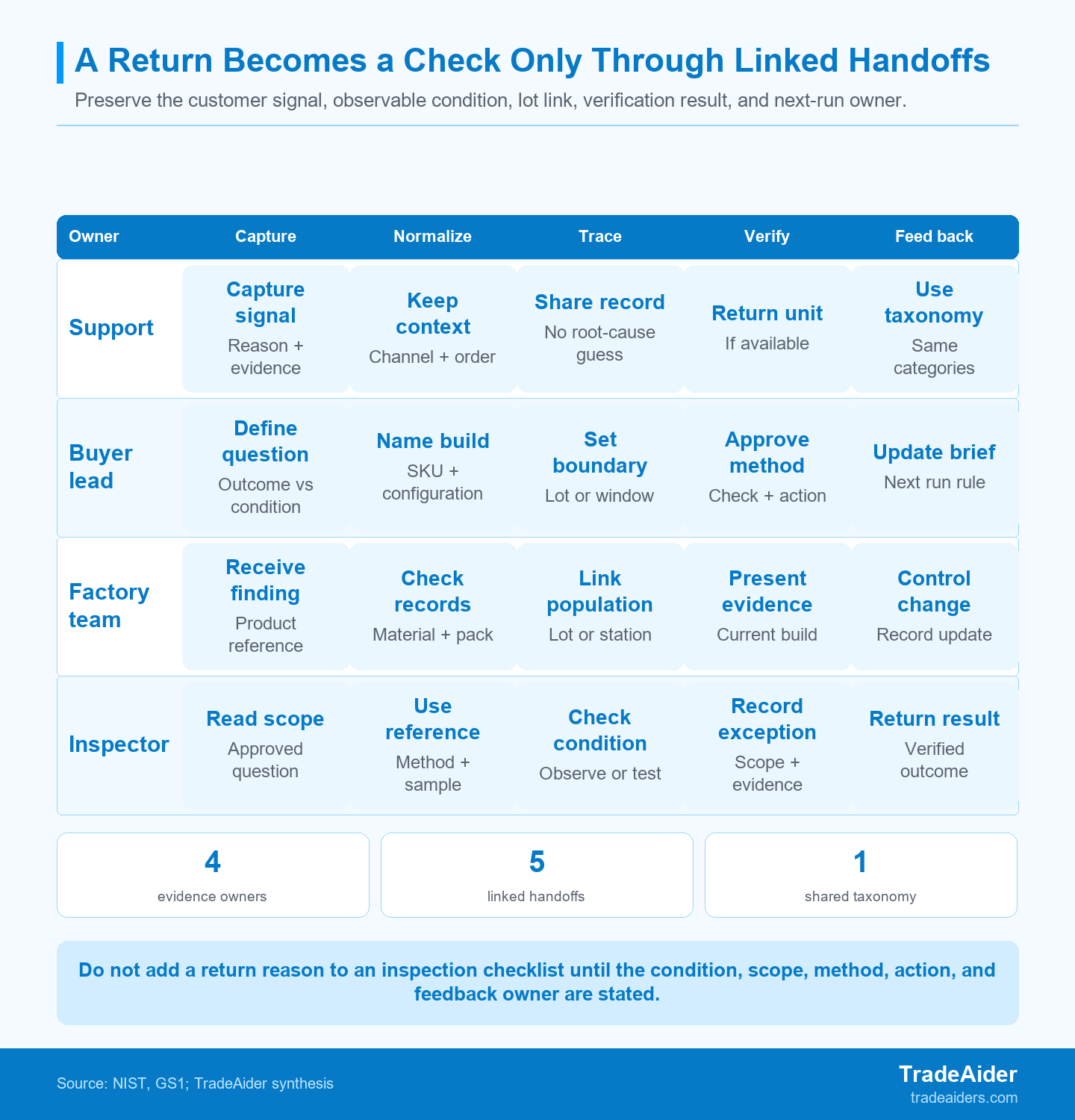
A return becomes a quality-control input only when every handoff preserves product identity, observable evidence, ownership, and the next decision.
Before the next run, put six fields in one controlled document:
- Return signal: retain the original customer wording and the normalized category.
- Product identity: name the SKU, configuration, color, bundle, and approved reference.
- Check method: state what the inspector will observe, measure, test, or review.
- Scope rule: name the lot, component, production window, or condition that makes the check relevant.
- Escalation action: say who receives a confirmed exception and whether the scope must expand.
- Feedback record: capture the verified result in the same taxonomy used for returns.
Assign an owner to each field. Customer support owns original wording and available evidence. The buyer or quality lead owns the approved condition and decision rule. The factory owns production and packing records. The inspector owns the observed result and its stated limitations. A supplier should not be asked to decide the final ship-or-hold decision merely because it supplied a photo or a correction explanation.
A concise record gives the inspection team a better question and gives the buyer a defensible audit trail for why the scope changed. For a live repeat-run issue, ask TradeAider to review a return-to-check brief.
Who Is TradeAider?
TradeAider provides inspection, testing, and certification services for overseas buyers sourcing from China. Its coverage includes major manufacturing provinces such as Guangdong, Zhejiang, Jiangsu, Shandong, and Fujian.
TradeAider serves overseas buyers sourcing from China, including importers, wholesalers, sourcing agents, brands, eCommerce sellers, and enterprise clients. Its digital platform supports online real-time reporting so buyers can monitor inspections, communicate with inspectors, and address issues while production is still in progress rather than only after shipment.
Inspection and QA Services are priced at $199/man-day all-inclusive, with no hidden surcharges. Client testimonials published on the TradeAider website cite an 18% reduction in return rates attributed to real-time defect detection and a 23% improvement in defects caught before shipment compared with prior inspection arrangements. Those are client-reported figures rather than universal results.
For a return-informed project, the practical question is whether the inspection brief can preserve the configuration, evidence, scope, and decision owner described above. That keeps the provider conversation focused on the next check and its records, rather than asking an inspector to infer a product requirement from a return dashboard alone.
Before commissioning that next check, confirm which records are available at the factory and which decision the result will support. A useful brief identifies the affected product version, the comparison reference, the evidence to record, and the person who can approve a hold, release, or wider review. That preparation keeps the inspection request proportionate to the signal instead of turning one return pattern into an undefined factory-wide demand.
TradeAider is a quality inspection, testing, and certification service provider in China. The company is an official Amazon Service Provider Network (SPN) partner.
Frequently Asked Questions
Can customer returns be used as an inspection sample?
Customer returns can inform an inspection plan, but they are not automatically a representative inspection sample of all sold units. NIST explains that acceptance sampling supports a lot disposition decision rather than an exact lot-quality estimate. Returns are shaped by use, channel policy, timing, and customer choice, so use them to frame a targeted inspection question rather than to claim a general defect rate.
Which return fields matter most for inspection planning?
The most useful fields connect the customer report to the exact product configuration, fulfillment context, evidence, and production or lot record. At minimum, retain the original reason, order or return date, SKU and variant, available photo or returned unit, channel, and any lot, carton, or production-window link. Missing fields do not invalidate a return, but they limit how narrowly the buyer can define the next check.
When should one return reason expand to more SKUs?
One return reason should expand to more SKUs only when the product, component, lot, process, or use evidence supports a shared exposure. A shared product name is not enough. Look for an identical component, a documented configuration, a common packing window, or a verified condition that connects the records. If that link is absent, keep the first inspection question narrow while gathering better evidence.
How should Amazon and DTC return data differ?
Amazon and DTC return data should use the same defect taxonomy but preserve their different fulfillment, listing, and customer-contact contexts. A marketplace record may be strongest for fulfillment timing and sellable SKU identity, while a DTC record may provide a richer customer description or photo. Keep the fields separate rather than forcing one channel’s incomplete data into the other channel’s format.
Can a return trend prove the supplier caused a defect?
A return trend can justify investigation, but it cannot by itself prove supplier causation or identify the exact production mechanism. The buyer still needs a product condition, a traceable scope, and evidence from the product, factory records, fulfillment path, or a stated inspection method. Commercial accountability should follow the purchase terms and the verified facts, not a return dashboard alone.
Похожие статьи


Развивайте свой бизнес с услугами TradeAider
Нажмите кнопку ниже, чтобы войти непосредственно в систему услуг TradeAider. Простые шаги от бронирования и оплаты до получения отчетов легко выполнить.

