
- О нас

- Наши услуги
- Ваша отрасль
- Ресурсы
- Новости и блог
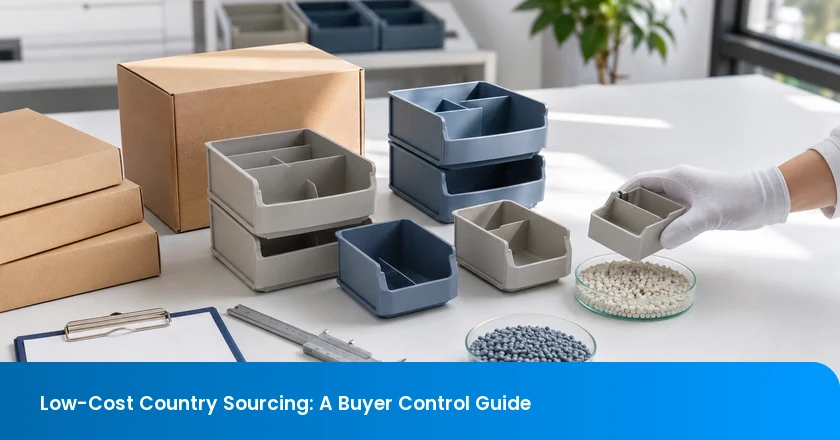
A lower-cost order can become expensive when its commercial scope changes after award or when the packed goods cannot be connected to the approved product. The safer choice is the offer whose assumptions can be checked before production and traced through the final shipment.
A Low Quote Is Not Yet a Low-Cost Decision
A low-cost country sourcing decision is reliable only when every supplier quote describes the same product, delivery scope, evidence duties, and correction exposure. Low-cost country sourcing can help a buyer widen the supplier pool, but a low unit price is not enough by itself. Until the comparison is complete, the price gap is a question to investigate rather than a reason to award.
Start with the decision the order must support: which supplier can provide the approved product version, at the stated handoff, with enough evidence to show what was made and what must happen if something changes? This avoids treating a country or supplier label as a guarantee. The buyer still owns the specification, commercial choice, and release decision.
Put the Same Scope Behind Every Quote
A quote comparison becomes misleading when suppliers price different product configurations, Incoterm responsibilities, packaging, test scope, or change-control duties. Here, configuration means the approved combination of material, colour, component, packaging, and stated requirements. It also fails when the delivery term shifts responsibility without being visible. ICC explains that Incoterms allocate delivery obligations between seller and buyer; that allocation belongs beside the price, not in a separate email thread.
| Comparison field | What to name | Buyer question |
|---|---|---|
| Product reference | Material, colour, component, packaging, revision | Are both suppliers pricing the same goods? |
| Delivery scope | Named handoff, freight assumption, duties, fees | Who carries each cost and handoff? |
| Evidence duty | Sample, test, production record, carton map | What will show that the order matches the reference? |
| Change rule | Approval owner, affected SKU, verification, hold action | What happens if the supplier proposes a cheaper alternative? |
Ask every supplier to complete the same fields. If an item is unavailable, mark it as unknown rather than assuming it is included. A quote can still be attractive with open fields, but it is not yet comparable.
Name the Handoff and Delivery Costs
A buyer should compare delivery terms and charge responsibilities together because the offer price alone does not show the complete cost to receive the goods. In plain language, landed cost is the full amount payable before the shipment reaches the named destination, not only the invoice price. Trade.gov's landed-cost guidance lists product price, insurance, freight, tariffs or taxes, and other fees among the components that can matter.
Use the same currency date, order quantity, delivery term, freight assumption, duty treatment, inland handoff, and named service fees for every supplier. Do not force a false precision when freight or duty is uncertain. Use a range, record the assumption, and show whether the lower quote survives the high end of that range. That makes the commercial uncertainty visible before it becomes an invoice dispute.
Use a Total-Cost Threshold Before You Award
The lower unit price stops being savings when the likely cost of preventable correction, sorting, delay, or replacement exceeds the initial price gap. Import charges must remain visible in that comparison: Trade.gov notes that tariffs and fees can be part of an importer's cost. The buyer should therefore test the price advantage against realistic, order-specific exposure instead of against an assumed defect rate.
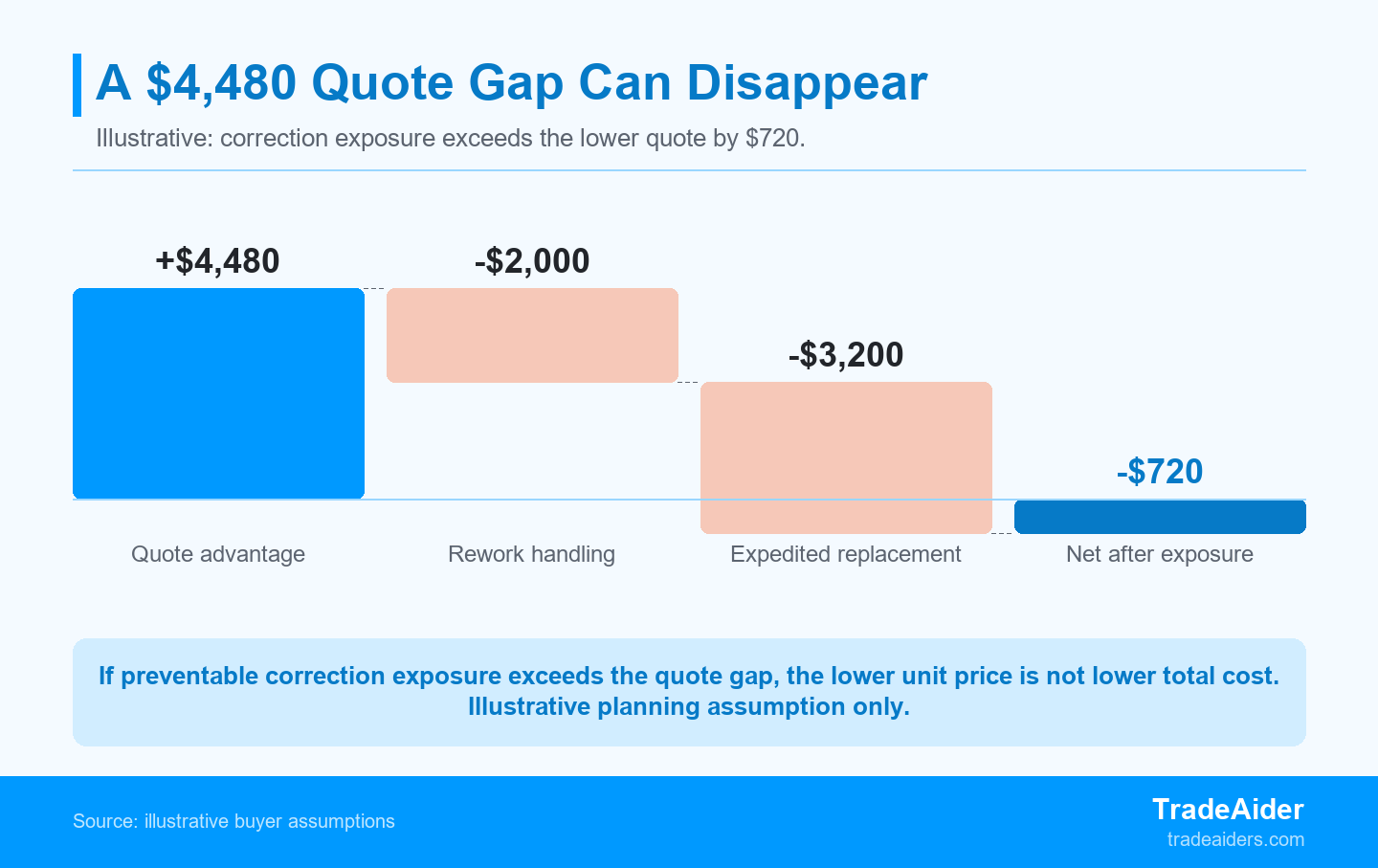
In this illustrative calculation, preventable correction exposure exceeds the lower quote by $720; the figures are planning assumptions, not a forecast.
Consider this illustrative calculation, not a forecast. A supplier quotes $4.20 for each of 16,000 organizers; another quotes $4.48. The first quote is lower by $0.28 per unit, or $4,480 for the order. If an avoidable material mismatch creates $2,000 of rework handling and $3,200 of expedited replacement or rebooking, the preventable exposure is $5,200. It is $720 above the original price advantage.
The lesson is not that every order needs a $5,200 contingency. It is that the buyer should name the threshold at which the lower quote no longer wins. For a narrow gap, require stronger evidence before award: a confirmed material reference, a defined packaging requirement, a credible production-control point, or a better-defined delivery assumption. For a wide gap, the buyer can still make an informed choice, but should record which assumptions make it viable.
Make Supplier Evidence Part of the Award
Supplier claims become more useful when they are tied to the buyer's stated product, production control point, and responsible-business risk questions. ISO's overview of ISO 9001 says supply-chain organizations seek confidence that relevant requirements will be met. That is a useful boundary: a quality-system reference is not evidence that this order meets the buyer's requirements.
Ask for evidence in the sequence that changes the decision. First, confirm that the supplier has priced the exact product reference. Next, request records that identify the material, component, packaging, or process that carries the most risk for this order. Then decide what must be checked before production, during production, and against the packed lot. For goods entering a regulated market, identify the applicable product-specific requirements with the appropriate authority or specialist; do not use a generic supplier declaration as a substitute.
Keep the request proportional. A buyer ordering unbranded storage organizers may need material, colour, dimensions, packaging, and carton-mark evidence. A buyer ordering a regulated electrical product may need a different technical and compliance scope. The principle is the same: every requested document must answer a named order risk.
Freeze the Configuration Before Production
A low-cost substitution can be evaluated only when the approved configuration, changed element, affected scope, and verification requirement are recorded before production continues. A family-level data sheet may be useful background, but it cannot prove that every ordered SKU still matches the approved product version. U.S. Customs and Border Protection identifies import safety as a trade priority, but that statement does not tell a buyer which test, certificate, or technical requirement applies to a particular product.
Use one approval record that names the product reference, revision, requested change, commercial effect, technical review owner, affected order quantity, and next verification step. If the buyer needs an independent early check of the agreed reference, a pre-production inspection scope can be set around the exact product and risk points. TradeAider can provide observations against that scope for the buyer's review; it does not approve a substitution or make the final release decision.
For applicable U.S. import-safety questions, the product-specific scope still matters. Confirm the relevant rule before treating a cost-saving change as commercially harmless. Put the review outcome beside the proposed material, the SKUs that may use it, and the order lots that could be affected. That discipline makes a supplier's cost-saving suggestion visible to commercial, technical, and operations owners before it becomes physical output.
Choose the Inspection Stage That Can Still Contain the Risk
Inspection evidence is most useful when its timing matches the risk: approve the reference before production, check recurring issues during production, and compare packed goods with the order before shipment. Check the approved reference when a material or packaging choice could alter the promised goods. Compare packed goods with the order when carton identity, count, condition, and final records matter.
For a lower-cost source, timing also changes the commercial options. A concern found before production may allow the buyer to revise the order, approve an alternative, or stop an unsuitable purchase before volume exists. The same concern found after packing may leave only sorting, rework, replacement, delay, or a difficult acceptance decision. Choose the earliest control point that can still alter the result.
A final report cannot repair an unrecorded substitution that happened weeks earlier. Where a repeat issue, colour change, or production drift needs attention while correction is still possible, a during-production inspection can focus on the named checkpoint. The buyer should define what observation would trigger a hold, rework request, recheck, or commercial review before the visit begins.
Keep the request narrow enough to produce a decision. Name the product reference, the part of the order being checked, the agreed acceptance condition, the production window, and what document or carton mark should connect the observation to the order. If the check finds a mismatch, the team can then isolate a known scope instead of opening a broad dispute over every unit.
Illustrative Scenario: A Cheaper Resin Change After Award
When a lower-cost material change is not tied to the approved colour SKUs and packed lots, the buyer should contain the changed scope before deciding whether it can proceed. The following is an illustrative example, not a TradeAider client case or a regulatory finding.
Split the Affected Lots Before You Decide
A buyer can consider a split decision only when the changed configuration and the unaffected configuration can each be identified in the production and packing records. GS1's traceability standard explains why lot identification distinguishes one production lot from another, even when the product type is the same. The buyer should use that distinction to contain the evidence gap rather than guess its size.
An illustrative importer is preparing a retail order of modular storage organizers with two colour variants. The planned order is 16000 organizers in four 4000-unit lots, with two colours and a named polypropylene resin grade in the approved reference. The order is awarded. Two lots are moulded when the supplier proposes a lower-cost resin for the two blue-colour lots and sends a revised material sheet that names only the product family. The approved reference specifies the resin grade and colour configuration, but the revised sheet does not identify the blue SKUs. The supplier says the change affects two 4000-unit lots, yet the carton map has not been reconciled to the moulding dates. Lot traceability means the record connection showing which production or packed quantity a change or result applies to.
The buyer does not know whether the proposed resin changes the approved configuration, compliance scope where applicable, or the exact 8000 units in question. The revised sheet is useful for starting review, but it is not evidence that the changed lots match the approved product or that the remaining lots are unaffected. The buyer puts the two potentially changed lots on hold, asks the supplier to map resin receipt, colour SKU, moulding date, and cartons, and confirms whether the proposed material needs a revised technical or product-specific compliance review. The other lots are not released on assumption; they move to review only after the lot map separates them. The supplier segregates the identified cartons, supplies the approved and proposed material records, corrects the colour-SKU and carton mapping, and completes the agreed verification for the changed configuration before a final evidence review. The buyer can reconsider the changed 8000-unit scope only when the material record, approved configuration, verification result, and carton identifiers describe the same lots. This illustrative example shows evidence containment and a buyer decision path. It does not establish a product defect, a regulatory result, or TradeAider client data.
Send a Control Packet With the Next Purchase Order
A concise control packet makes the low-cost sourcing decision reviewable by naming the specification, delivery term, evidence request, change rule, and release records before the order moves. Attach those five items to the purchase order or controlled order file. Make any mismatch an explicit buyer review point rather than an informal factory conversation.
The packet also improves a request for independent evidence. TradeAider can report observations against an agreed scope; it does not select the supplier, certify the supplier, or make the buyer's award or release decision. Before sharing a product reference and a defined inspection scope, a buyer can review TradeAider's inspection approach.
Before that service conversation, finish the buyer-side review. Confirm that the commercial owner accepts the delivery assumptions, the product owner accepts the approved reference, and the operations owner can identify the cartons or lots that the final check will cover. If any owner cannot see the same order scope, the right next step is clarification, not a broader promise from the supplier or inspector.
Four Buyer Controls for Low-Cost Sourcing
Low-cost country sourcing works best when the buyer compares the same scope, tests the price gap against correction exposure, freezes configuration changes, and connects final evidence to the lot. Use these four controls before the next award:
- Compare the same configuration and delivery scope, not just unit prices.
- State the correction exposure that would erase the initial price gap.
- Require written approval and a verification path for every material, component, colour, or packaging change.
- Connect the final evidence to the named packed lots before the buyer reviews release.
Before a final-lot review, reconcile the purchase order, approved product version, packing list, carton marks, and open-exception record. Decide in advance which mismatch requires a hold and who will review it. This protects the buyer from treating a clean-looking shipment as proof that an earlier price, material, or delivery assumption remains valid.
When the order file identifies the reference, the risk points, and the cartons to be checked, an independent final-lot review can give the buyer evidence about the physical shipment. TradeAider can report observations against that agreed scope. Keep the report beside the commercial, technical, and compliance records that apply to the order. When those records are ready, the buyer can request a scoped pre-shipment inspection.
Frequently Asked Questions
What does low-cost country sourcing mean for import buyers?
Low-cost country sourcing is buying from a location selected partly for a lower production or supplier cost. It is not a promise that the landed cost, quality outcome, or delivery result will be lower. A buyer still needs to compare the complete commercial scope and the controls that apply to the exact order before award, including the delivery term and the evidence each supplier will provide.
How should a buyer compare low-cost suppliers?
Put the same product configuration, delivery term, freight assumption, duty exposure, packaging, inspection scope, and change rule in every quote before comparing total cost. Record any unknown field separately. This lets the buyer see whether a lower price reflects a real advantage or simply a different responsibility, product, or evidence scope. It also gives the buyer a clear list of open questions before award.
Does a lower unit price always reduce sourcing cost?
No, a lower unit price does not always reduce sourcing cost. It reduces the quoted product price, but it may not reduce the buyer's total cost if correction, delay, extra freight, sorting, replacement, tariffs, or an uncontrolled change removes the gap. The useful comparison is the stated price advantage against the order-specific exposure that would make that advantage disappear.
Can a supplier change a material after the order is awarded?
The buyer should require written approval before a change proceeds and identify the affected configuration and lots. If the change may alter product quality, a technical requirement, compliance scope, packaging, or the final evidence record, hold the unverified scope until the changed condition and its verification path are documented. A family-level document is not enough if it cannot identify the ordered SKUs and lots.

Похожие статьи
Развивайте свой бизнес с услугами TradeAider
Нажмите кнопку ниже, чтобы войти непосредственно в систему услуг TradeAider. Простые шаги от бронирования и оплаты до получения отчетов легко выполнить.

