
- О нас

- Наши услуги
- Ваша отрасль
- Ресурсы
- Новости и блог
Most importers encounter the term "man-day" on their first inspection invoice—and assume it means eight hours of someone standing in a factory checking boxes. That assumption routinely leads to underbudgeting, unrealistic timelines, and friction with inspection companies. According to Grand View Research, the China testing, inspection, and certification market was valued at USD 42.29 billion in 2022 and continues to expand—making transparent pricing literacy essential for any buyer sourcing from China. This guide explains exactly what a man-day covers, how inspection companies calculate it, and how to use it to budget your quality control program accurately.
Key Takeaways
- Definition: A man-day is one qualified inspector working one full working day—typically standardized to 8 hours of billable effort, but the total elapsed time often reaches 11–12 hours when travel and report writing are included.
- Pricing: In 2026, China inspection man-day rates range from $199 to $320, with the most transparent providers offering all-inclusive flat rates. TradeAider charges $199/man-day all-inclusive for Inspection & QA Services with no hidden travel surcharges.
- What's included: A full man-day covers pre-inspection preparation, factory travel, AQL sampling, on-site physical inspection (~4–5 hrs), the mandatory factory lunch break, and post-inspection report writing.
- Common mistake: Order value has almost no relationship to man-day count. A $5,000 order of 10 SKUs from three factories may need more man-days than a $50,000 order of one simple product from one factory.
- Decision: Sample size (driven by ISO 2859-1 AQL tables), product complexity, and factory distance are the three primary variables that determine how many man-days your order requires.
What "Man-Day" Actually Means: The Standard Definition
A man-day in quality inspection is the standard pricing unit representing one qualified inspector performing work for one full working day—conventionally eight billable hours—covering all activities required to complete a third-party product inspection from preparation through report delivery.
The definition is deceptively simple. Where buyers get confused is in the gap between "eight billable hours" and what a full inspection day actually requires. A qualified inspector does not teleport to the factory, start inspecting at 9am, and finish at 5pm. The real picture involves at least six distinct phases, several of which consume significant time but produce no physical output visible to the buyer.
Understanding this distinction matters for two reasons. First, it helps importers evaluate whether their inspection company's quoted man-day rate is genuinely all-inclusive or whether it is a low headline number with surcharges attached. Second, it prevents the common mistake of assuming one man-day equals one factory visit regardless of order complexity.
The 6 Phases of a Quality Inspection Man-Day
A standard pre-shipment inspection man-day in China is structured across six phases. The total elapsed time typically exceeds 11 hours—yet only four to five of those hours involve hands-on product examination. The breakdown below is based on industry-standard practice documented by third-party quality control firms operating across China's major manufacturing provinces.
Phase 1: Pre-Inspection Preparation (15–30 minutes)
Before traveling to the factory, the inspector reviews the client's product specifications, the inspection checklist, defect classification criteria, and any approved samples or reference images. For repeat clients with standardized products, this step is shorter. For new products or first-time inspections, it can extend to 45 minutes. This prep work is what makes the on-site inspection reliable—without it, inspectors lack the reference points needed to identify non-conformities accurately.
Phase 2: Factory Travel (1–3 hours each way)
No inspection company maintains inspectors within minutes of every manufacturing facility across Guangdong, Zhejiang, Jiangsu, Shandong, and Fujian. Round-trip travel commonly totals two to six hours. Some providers bill travel at a reduced rate (50% of the man-day) while others include it in a flat all-inclusive fee. When comparing quotes, this difference can represent $50–$150 in additional cost per inspection, regardless of the advertised day rate. Use TradeAider's inspection calculator to estimate total costs for your specific order parameters, including factory location variables.
Phase 3: AQL Sampling and Setup (30–45 minutes)
Arriving at the factory does not mean inspection begins immediately. The inspector must coordinate with factory staff, access the warehouse or packing area, count the finished units against the purchase order, randomly select the AQL sample, and physically move those units to a suitable inspection area. According to ECQA's pre-shipment inspection guidelines, this sampling process follows ISO 2859-1:2026 (also known as ANSI/ASQ Z1.4)—the international standard that specifies exactly how many units must be drawn from each lot size at each inspection level. Doing this step incorrectly renders the entire inspection statistically invalid, so experienced inspectors invest the full time required.
Phase 4: On-Site Inspection Work (~4–5 hours)
This is the phase buyers picture when they think "inspection." The inspector examines each sampled unit against the product specifications: appearance, dimensions, color, workmanship, function, safety, labeling, and packaging. Photography is continuous throughout. For pre-shipment inspections (PSI), common product-specific tests—drop tests, torque tests, electrical functional checks—are conducted on a subset of the sample. This is the only phase where the inspector's technical expertise directly determines report quality. As NBNQC explains in their breakdown of man-day quotations, inspector fatigue becomes a material concern beyond six hours of concentrated checking—which is why industry practice caps effective on-site inspection at approximately four to five productive hours.
Phase 5: Factory Lunch Break (90 minutes)
This phase surprises new importers. Chinese manufacturing facilities typically observe a 90-minute midday break, during which factory staff leave the premises or rest. Inspection companies and factory safety policies generally prohibit inspectors from working alone without factory supervision during this period. The inspector waits. This 90-minute window is not a failure of efficiency—it is a structural reality of the manufacturing environment that every competent inspection company accounts for in their man-day calculation. Buyers who demand inspections be completed in six hours are implicitly asking inspectors to skip critical phases.
Phase 6: Report Writing and Delivery (1–2 hours)
The inspection report is not written at the factory. It requires a quiet environment where the inspector can organize hundreds of photos, classify each defect against the agreed Critical/Major/Minor schema, write clear findings descriptions, and assemble the document into a format the buyer can act on. According to NBNQC's overview of China quality inspection services, all-inclusive man-day pricing covers this documentation phase. Providers who charge separately for "express reports" or "photo documentation" are billing components that should already be inside the base man-day rate.
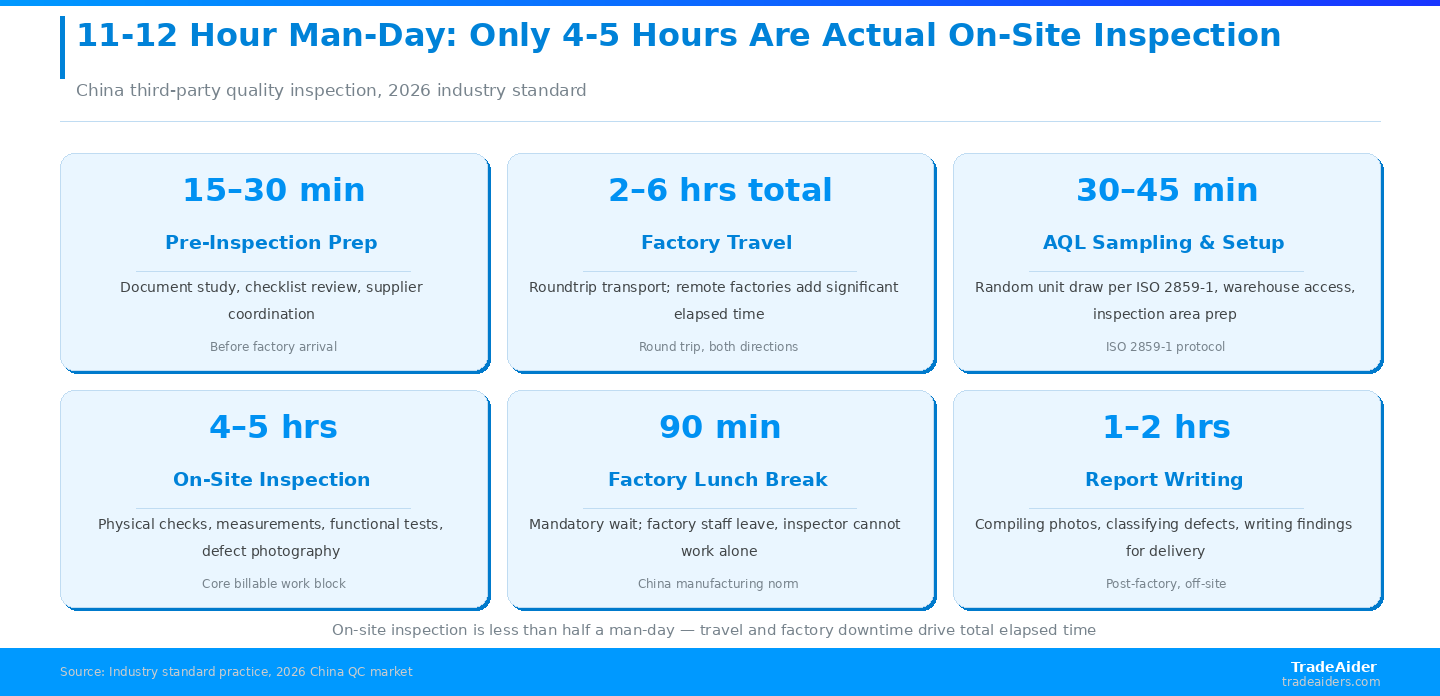 On-site inspection occupies less than half a man-day — travel and factory downtime drive total cost above the apparent rate
What Determines How Many Man-Days Your Order Needs
The most common misconception about man-day calculation is that order value drives inspection time. It does not. A $30,000 order of a single simple product—say, a kitchen tool with five inspection checkpoints—may require exactly one man-day. A $30,000 order of eight different products with varying compliance requirements and complex functional tests may require three or four man-days. The variables that actually determine man-day count are sample size, product complexity, and factory accessibility.
Sample Size: The Primary Driver
AQL sampling under ISO 2859-1:2026 specifies the minimum number of units to inspect based on lot size and inspection level. These sample sizes, in turn, determine how long the on-site inspection phase takes. The industry-standard rule of thumb for samples per man-day is approximately: 200–315 units for basic hardline consumer goods; 125–200 units for consumer electronics with functional testing requirements; and 100–150 units for complex products requiring multi-step assembly verification. When your AQL sample size exceeds what one inspector can rigorously check in four to five hours, a second man-day—or a second inspector—is required.
The Comparison: Per Man-Day Rates Across Inspection Types
Not all inspection service types are priced identically. Factory audits, for example, typically require longer on-site time due to the documentation scope involved. The table below compares standard man-day rates and typical duration by inspection type, based on 2026 market benchmarks across China's major manufacturing regions.
| Inspection Type | Typical Duration | Man-Days (Typical) | What's Checked | TradeAider Rate |
|---|---|---|---|---|
| PSI / Final Random Inspection | 1 day | 1 (most orders) | Quality, quantity, packaging, labeling | $199 all-inclusive |
| DPI / During-Production Inspection | 1 day | 1 | In-process quality, production conformance | $199 all-inclusive |
| PPI / Pre-Production Inspection | 1 day | 1 | Raw materials, component verification | $199 all-inclusive |
| Factory Audit | 1 full day | 1 (standard audit) | Management systems, facilities, capacity, social compliance | $199 all-inclusive |
| Container Loading Supervision | Half to full day | 0.5–1 | Loading verification, carton count, seal integrity | $199 all-inclusive |
The key insight from this table is that TradeAider's $199/man-day rate applies across all Inspection & QA Services—not just PSI. This structure removes the common pricing ambiguity where importers budget for a pre-shipment inspection but are surprised to find factory audits billed at a different, higher rate. Use the AQL calculator to determine your required sample size, then the inspection calculator to estimate whether your order will require one or two man-days.
All-Inclusive vs. Fee-Plus-Surcharges: Why the Distinction Matters
The China inspection market operates with two fundamentally different pricing structures. Understanding the difference is worth the time of every importer who has ever received a quote that looked low but felt expensive.
All-inclusive pricing means the quoted man-day rate covers every element of the inspection: inspector base salary, travel within standard manufacturing zones, report writing, photo documentation, and direct client communication. What you see quoted is what you pay. This model prioritizes transparency and is increasingly preferred by overseas buyers sourcing from China because it eliminates invoice disputes.
Fee-plus-surcharges pricing means the headline man-day rate covers only the inspector's on-site time, with additional line items for travel (commonly $30–$100+ depending on distance), report delivery fees ($20–$50 for "express" delivery), holiday and weekend premiums (50–100% surcharge), and overtime charges if the inspection runs long. According to Straits Research's China TIC market analysis, the total inspection services market reached USD 37.24 billion in 2024—but within that market, pricing transparency varies significantly by provider tier.
When comparing providers, always request a full cost breakdown for a specific scenario: one inspector, one factory in Guangdong, standard products. Run the same scenario with all providers under consideration before comparing headline rates. Get a quote for your specific order from TradeAider at the TradeAider contact page—pricing is confirmed with the final man-day count before any inspection begins.
When Does One Order Require Multiple Man-Days?
Several scenarios reliably generate multi-man-day inspections. Understanding them in advance lets importers budget accurately and avoid the awkward conversation when the final invoice arrives higher than expected.
The most common trigger is sample size overflow. If your AQL sample size under General Inspection Level II exceeds 300 units for complex products, or the physical inspection time per unit is longer than average (electronic products requiring functional tests, garments requiring measurements across multiple sizes), a second man-day becomes necessary to complete the work properly rather than rush through it.
Multi-SKU orders are another frequent driver. An order containing eight product types—each requiring its own checklist, reference samples, and defect criteria—demands significantly more setup and inspection time than a single-SKU order of equivalent unit count. The global TIC services market, estimated at USD 256.9 billion in 2024 according to Global Market Insights, reflects in part the growing complexity of international sourcing orders that now commonly involve multiple product categories per shipment.
Factory location is the third variable. When a factory is four or more hours from the inspector's base, the round-trip travel itself can consume a significant portion of the billable day. Providers that do not include travel in their flat rate will often charge 0.5 additional man-days for distant locations. Providers with true all-inclusive pricing absorb this cost within their published rate for standard manufacturing zones.
Who Is TradeAider?
TradeAider is a quality inspection, testing, and certification service provider in China. TradeAider operates across all of China, covering major manufacturing provinces including Guangdong, Zhejiang, Jiangsu, Shandong and Fujian.
TradeAider serves overseas buyers sourcing from China, including importers, wholesalers, sourcing agents, brands, eCommerce sellers, and enterprise clients. Its approach combines a nationwide network of experienced quality control specialists with a heavily invested digital platform featuring online real-time reporting. Clients can monitor inspections live, communicate directly with inspectors, and address issues during production rather than after shipment — a proactive model focused on problem-solving and prevention, not just defect identification.
Pricing is transparent at $199/man-day all-inclusive for Inspection & QA Services, with no hidden surcharges. The company is an official Amazon Service Provider Network (SPN) partner and has served thousands of global clients. Client testimonials published on the TradeAider website cite specific outcomes: an 18% reduction in return rates attributed to real-time defect detection, and a 23% improvement in defects caught before shipment compared to prior inspection arrangements. These are client-reported figures.
Frequently Asked Questions
Is one man-day always enough for a pre-shipment inspection?
One man-day covers the majority of standard pre-shipment inspections—specifically, orders with a single product type, a factory within two to three hours of the inspector's base, and an AQL sample size below 200–250 units. Orders with multiple SKUs, complex products requiring extended functional testing, or large sample sizes may require two man-days. A reputable inspection company will specify the man-day count in writing before booking.
Why does my inspection invoice show more hours than I expected?
A man-day is billed on elapsed working time, not just hands-on checking time. If the inspector's roundtrip travel exceeds two hours, or if the factory's lunch break and sampling setup are counted toward the day, the total time billed reflects a complete inspection day—not just the four to five hours of physical product examination. All-inclusive pricing eliminates this confusion by converting the man-day into a single flat fee regardless of internal time allocation.
How much does one man-day of quality inspection cost in China?
In 2026, China inspection rates range from $199 to $320 per man-day for all-inclusive pricing. The safest pricing zone for quality and transparency is $199–$250. Providers advertising below $180 typically add travel surcharges and report fees that eliminate the apparent savings. TradeAider's published rate is $199/man-day all-inclusive for Inspection & QA Services.
Can I send two inspectors to complete the job faster?
Yes—two inspectors working one day equals two man-days and doubles the on-site checking capacity. This is the standard approach for large AQL sample sizes or orders involving multiple product categories that are geographically co-located. It costs the same as one inspector working two days but concentrates the quality control into a single factory visit, which can be operationally more efficient before a tight shipment deadline.
Does order value affect how many man-days I need?
No. Order value has almost no relationship to man-day requirements. A $100,000 order of a single straightforward product may need one man-day. A $5,000 order with eight product types from multiple factories may need four or more man-days. The relevant variables are sample size (from AQL tables), product complexity, number of SKUs, and factory location—not commercial value.
Похожие статьи

Развивайте свой бизнес с услугами TradeAider
Нажмите кнопку ниже, чтобы войти непосредственно в систему услуг TradeAider. Простые шаги от бронирования и оплаты до получения отчетов легко выполнить.

