
- О нас

- Наши услуги
- Ваша отрасль
- Ресурсы
- Новости и блог

DUPRO, short for During Production Inspection, is a quality checkpoint carried out while an order is still moving through production. Its value is not simply that it can spot a defect before shipment. A useful visit gives the buyer time to decide what the observation means: whether the issue is isolated, which work in progress may share it, what the factory must correct, and what must be checked again before later output is treated as clear.
That makes DUPRO different from both approval before bulk production and release inspection after the order is complete. It is a decision point in the middle. The buyer gets the most from it when the product reference is current, the production window can be identified, and there is enough time left to correct the process and verify the result.
A DUPRO Visit Should Produce Four Decisions
A DUPRO visit should not end with a long list of observations and no agreed next move. It should give the buyer four usable decisions:
- Conformance: Does the sampled work match the current approved product and packing requirements?
- Population: Which line, station, time window, or quantity could share the same unverified condition?
- Correction: Who will correct the condition, and what record will show when the change was made?
- Recheck: What evidence must be reviewed before output made after the change is treated as clear?
This is a planning model, not a substitute for the buyer's specification or a statutory requirement. Its purpose is practical: it stops a report from becoming a detached warning. When the answer to any one of the four questions is missing, the buyer may know that a problem exists but still lack a defensible basis for holding, reworking, or continuing the affected output.
Choose a DUPRO Window That Leaves Time to Correct the Process
The best time for a DUPRO inspection is not a fixed universal percentage of production. It is the point at which enough work exists to reveal whether the process is following the current requirements, while enough unfinished output and schedule remain for a correction and recheck to matter. If the visit is too early, the relevant process, materials, packing method, or operator handoff may not yet be visible. If it is too late, the finding may describe a problem that is already embedded in most of the order. TradeAider describes its During Production Inspection (DPI / DUPRO) service as taking place when roughly 20-50% of goods are completed and packed.
Treat that as service context, not a rule to apply without thought. A short-run order, a late artwork change, a difficult assembly step, or a new packing operation may shift the useful checkpoint. Before booking, ask the factory for the current completed quantity, the next production milestones, the latest approved reference, and the amount of time available to correct and recheck a shared condition.
Confirm the Current Reference Before Sampling Work in Progress
An inspection result is only as clear as the reference used to judge it. Before the visit, identify the approved product sample or specification, the current artwork and label versions, any packing instruction, and the change owner. Then confirm which version is actually running on the line. A factory can honestly show a signed sample and still be using a later insert, component, or packaging file in bulk output.
Keep the reference short and usable. The inspector does not need every historical email. They need the version that controls the output in front of them and the acceptance points that matter for this order. When a change has been made, record its effective time or production window. That small piece of traceability is what later lets the buyer distinguish output made before a correction from output made after it.
Inspect a Bounded Work-in-Progress Population
A DUPRO result is actionable only when it is tied to a bounded work-in-progress population. In plain terms, the buyer should be able to say which output shares the condition being assessed. That may be a named production line, a packing table, a shift, a time window, a component batch, or a carton range. The exact boundary depends on the order records. The important point is that the result must not silently expand from a sample of current output into a verdict on every unit in the purchase order.
This is also the limit of sampling. NIST's acceptance-sampling guidance explains that the main purpose of acceptance sampling is deciding whether a lot can be accepted or rejected. It is not a promise that every unit is defect-free, and it is not a root-cause investigation. If the buyer uses Acceptance Quality Limit (AQL) sampling, define it once as a sampling-plan acceptance limit for the identified population. ISO 28590 provides introduction and selection context for the ISO 2859 inspection-by-attributes series. Neither source supplies a universal AQL value for every DUPRO visit.
For a mid-production check, ask the factory to name the units made since the last verified correct point and the units made after a corrective change. If that split cannot be shown, the conservative response is not to pretend the sample proves everything. It is to widen the hold or collect the records needed to create a meaningful population boundary.
Treat a Repeating Pattern as a Containment Signal
One damaged unit can be a local repair issue. The same defect appearing across several units, stations, or time points is different. It may indicate a shared material, instruction, setup, or handling condition. In that case, containment means holding and identifying the output that may share the unverified condition while the factory investigates. The purpose is not to punish the factory or to declare the full order defective. It is to prevent uncertain output from being mixed with later output that may have been corrected.
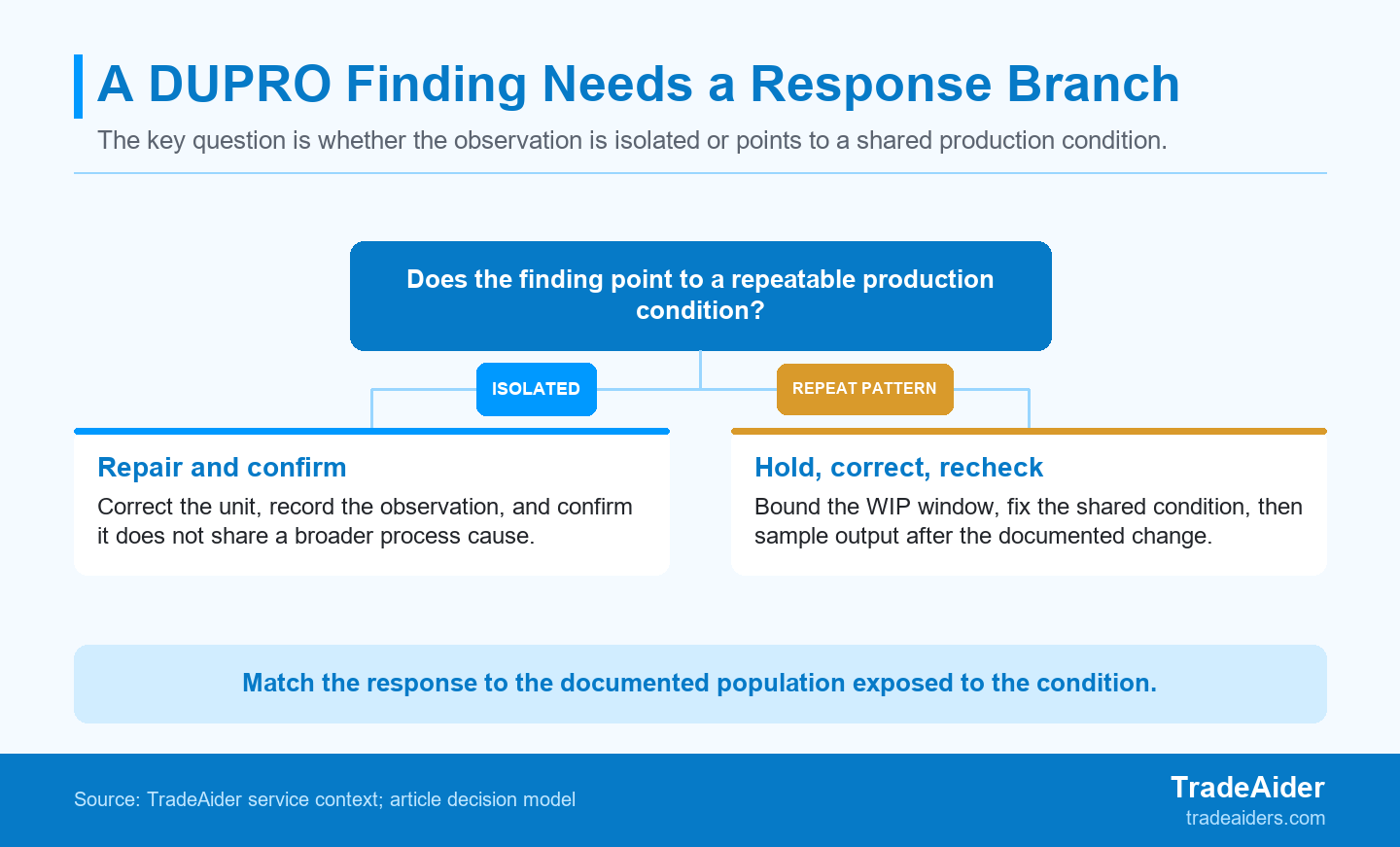
A mid-production finding becomes actionable when the response branch matches the evidence: repair an isolated unit, or contain the named production window and verify the correction.
Set the escalation rule in the order-specific plan. Some products need a response when a single safety or legal issue appears; others require evidence of recurrence before a process hold is justified. The recurring pattern matters because it changes the next question from "Can this unit be repaired?" to "Which other units were exposed to the same condition?"
Turn a Finding Into Containment, Correction, and Recheck
A productive response has three parts. First, contain the exposed output by marking the unverified population and keeping it separate from later cartons or units. Second, correct the shared condition. That may involve replacing a document pack, resetting a machine, revising an operator instruction, retraining a packing table, or sorting a named batch. Third, recheck after the change. The recheck should identify what changed, who confirmed it, and which new output represents the corrected state.
Sorting the units already found is not the same as correcting the condition that produced them. The report should therefore separate observed defects from the evidence needed for the next decision: the relevant production window, corrective owner, change record, and recheck population. This gives the buyer a defensible way to approve a controlled restart or keep the unresolved output on hold.
ISO 10005:2018 gives guidance for establishing and revising quality plans. In a DUPRO context, that supports a simple discipline: update the order-specific control record when the factory changes the condition being checked. The record need not be elaborate. It should make clear which reference applies, what population was exposed, what action was taken, and what evidence closes the recheck.
DUPRO Does Not Replace PPI or Final Inspection
A Pre-Production Inspection (PPI) addresses readiness before bulk production starts. It is where a buyer can confirm the product reference, materials, packing direction, and production understanding before large quantities exist. DUPRO answers a different question: is the process and current work in progress still aligned while there is time to intervene? A Pre-Shipment Inspection (PSI), often called a final inspection, answers a later question about a completed lot and its shipment-ready presentation.
TradeAider describes its pre-shipment inspection service for output that is 100% complete and at least 80% packed for export. That readiness point is why the service cannot simply be replaced by a mid-production visit. DUPRO may help the buyer correct a repeated issue before it reaches the finished lot; it does not establish that the final quantity, pack-out, documents, and presentation are ready for release. Keep the earlier approval, the in-process control, and the later lot decision distinct when the order needs all three.
Illustrative Scenario: Wrong Inserts Repeat Across Packing Tables
This is an illustrative operational scenario, not a TradeAider client case. The figures are used to show how a buyer can turn a recurring mid-production observation into a bounded hold, correction, and recheck decision without treating a small sample as proof that an entire order is defective.
How the Buyer Can Bound the Affected Units
In this example, the buyer does not need an immediate all-order rejection. The useful decision is to identify the output that may have used the wrong insert, keep that output separate, correct the source at the packing tables, and verify the corrected output before it is combined with later cartons.
Buyer context: An importer needs the care-and-use insert inside each kitchen accessory kit to match the approved product and customer instructions.
Order context: The illustrative order is 8,400 kitchen accessory kits moving through 3 packing tables while a revised insert is introduced during production.
Readiness state: At the visit, 1,950 kits are complete. The latest approved insert is available, but the packing record does not yet separate all cartons made before and after the revision change.
Observation: Six of 20 sampled completed kits contain an earlier care-and-use insert instead of the approved revision.
Second observation: The incorrect insert appears at 2 packing tables. That recurrence points away from a single damaged unit and toward a shared packing condition.
Analysis: The sample does not prove that all 8,400 kits are wrong. It does show that the buyer cannot treat the first 1,950 completed units as one clear population. The missing evidence is a table-and-time-window map showing where the old insert bundle remained in use.
Decision: Hold output from the last verified correct check through the point at which each affected table can show that the new bundle was installed. Keep those cartons out of any release population until their status is known.
Corrective action: Replace the insert bundles at both tables, record the time of change and supervisor, and sort the held cartons against the approved insert. The factory should keep the separated cartons identifiable while this work occurs.
Verification gate: Sample post-change output from each affected table and confirm that the approved insert is present. Reworked cartons are only added back after their sorting record and correct insert are both confirmed.
Boundary: This example does not prescribe a defect threshold, an AQL value, or the cause of the error. It shows the decision geometry: bound the process window, correct the shared condition, and verify the output made after the documented change.
Build a DUPRO Brief That Produces a Clear Factory Decision
A buyer can make a DUPRO visit more useful by sending a short control brief before the inspection. Include the current approved reference and revision, the product or packing points that need attention, the current completed and planned quantity, the line or station details needed to identify work in progress, the buyer's decision owner, and the condition for a recheck. If the order has had a late change, state when the change became effective and what output could have been made before it took effect.
The brief should also state the decision that the visit needs to support. For example: confirm whether the current packing process follows the approved insert revision; hold any output made after the last verified correct point if recurrence is found; and recheck output after the factory documents a change. That framing keeps the inspection team, factory, and buyer focused on evidence rather than vague assurances.
When the production date, reference, and correction window are clear, a buyer can discuss a DUPRO timing plan with TradeAider. Bring the brief to that conversation so the visit can be planned around the decision the order actually needs.
Frequently Asked Questions
When should a buyer schedule a DUPRO inspection?
Schedule DUPRO when enough work exists to inspect and enough production remains for a correction and recheck to matter. The right point depends on the product, the process that creates risk, any recent changes, and the time needed to separate affected output. A percentage can be useful service context, but the practical test is whether the visit can still change the outcome for unfinished or unverified units.
What does a DUPRO inspector check?
A DUPRO check normally compares current work in progress with the agreed product, process, packaging, and functional requirements for that order. The exact scope should come from the current approved reference and the buyer's inspection brief. It may include appearance, dimensions, components, labels, packing, functional points, or documents that affect the output then on the line. The value comes from tying observations to a defined production population.
Is DUPRO inspection the same as a final inspection?
No. DUPRO examines work while the factory can still correct the process, whereas final inspection supports a decision on a completed lot. A mid-production finding can help the buyer contain a recurring issue before it reaches most of the order. A final inspection has a different job: assessing the stable quantity and presentation that the buyer is preparing to release or ship. Many orders benefit from both controls.
What should happen after a DUPRO inspection finds defects?
The next step is to define the affected production window, agree the corrective action, and verify the corrected output before treating later units as clear. Start by separating what is known from what is uncertain: identify the shared line, station, time window, or batch; hold the exposed output where needed; document the factory's change; and inspect post-change output. A report becomes useful when it closes with that decision path, not only a defect count.

Похожие статьи

Развивайте свой бизнес с услугами TradeAider
Нажмите кнопку ниже, чтобы войти непосредственно в систему услуг TradeAider. Простые шаги от бронирования и оплаты до получения отчетов легко выполнить.

