
- About Us

- Our Services
- Your Industry
- Resources
- News & Blog
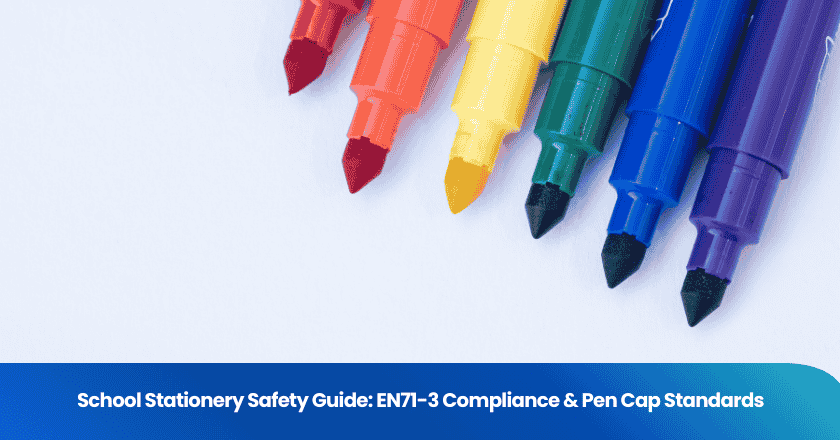
School stationery safety is a critical priority for parents, educators, and manufacturers alike. Concerns regarding hidden chemical hazards and potential choking risks in classrooms are valid and must be addressed. Products such as pens, pencils, and paints can contain heavy metals if not manufactured to strict standards. The EN 71 standard serves as a global benchmark, establishing rigorous rules for chemical safety. Furthermore, physical design elements, like pen cap ventilation, are essential for preventing accidents. Through regular inspections and certified testing reports, we can ensure that school supplies remain safe tools for learning.
Key Takeaways
- Check for safety labels and certifications on stationery packaging to verify compliance.
- Look for the CE marking, which indicates the product meets EU safety regulations for children's items.
- Ensure pens have ventilation holes in their caps to mitigate choking risks.
- Request test reports from manufacturers to verify EN71-3 heavy metal compliance.
- Prioritize water-based and PFAS-free art supplies to minimize chemical exposure.
School Stationery Safety Overview

Key Risks for Children
Children interact with stationery daily, often in ways that increase risk, such as chewing on pen caps or erasers. Because of this behavior, products marketed to children must adhere to standards similar to toys. The "Toy Safety Directive" underscores the need to control chemical hazards. Heavy metals like lead and cadmium can migrate from paints or plastics into the body. Physical risks are equally concerning; small parts like detached erasers or non-ventilated caps can become choking hazards.
Note: Stationery designed for children is often classified under toy safety regulations to ensure maximum protection.
Why Safety Standards Matter
Safety standards provide a framework to protect children from chemical and physical harm. Standards like EN 71 require manufacturers to rigorously test for heavy metals and verify safe design features. Adherence to these rules allows parents and teachers to trust the products in their classrooms. It also enables inspectors to identify and reject unsafe items before they reach the market.
| Safety Standard | Purpose | Applies to |
|---|---|---|
| EN 71 | Chemical and physical safety | Toys, School Stationery |
| Toy Safety Directive | Legal framework for child safety | Products marketed to children under 14 |
| CPSIA | Regulates hazardous substances (US) | Children's products, School supplies |
EN 71 Chemical Safety Standards
Heavy Metal Migration Testing
EN 71-3 is the specific standard governing chemical migration. It sets strict limits for the migration of 19 heavy metals, including lead, cadmium, mercury, and arsenic. Migration refers to how easily a chemical can transfer from the product (e.g., a crayon or pen coating) into a child's body through saliva or gastric fluids.
Manufacturers must follow chemical testing protocols to verify conformity. Advanced techniques like ICP-MS (Inductively Coupled Plasma Mass Spectrometry) are used to detect trace elements with high precision. This ensures that even microscopic amounts of harmful substances are identified.
Note: Heavy metal migration testing is mandatory for items like paints, crayons, and painted pencils, as these are frequently mouthed by young students.
Compliance Frameworks (EN 71, CPSIA)
While EN 71 is the primary standard for Europe, the CPSIA (Consumer Product Safety Improvement Act) governs the US market. Both frameworks aim to eliminate lead and phthalates from children's products.
- EN 71: Comprehensive EU standard covering mechanical, flammability, and chemical properties.
- CPSIA: US federal law focusing on lead limits, phthalates, and third-party testing requirements.
Compliance is demonstrated through documentation. In Europe, the CE marking indicates conformity with health, safety, and environmental protection standards. In the US, a Children's Product Certificate (CPC) is required based on passing test results.
| Component | Description |
|---|---|
| Maximum limits | Specifies concentration thresholds for hazardous substances (e.g., Lead < 90ppm). |
| Marking requirements | Mandates clear labeling, including CE marks or tracking labels. |
| Safety usage | Requires instructions for safe use, especially for chemistry sets or paints. |
Testing Methods and Limits
Inspectors prioritize testing for the most toxic elements. The process involves scraping materials from the stationery (like the paint off a pencil) and subjecting it to simulated gastric acid to measure how much chemical is released.
| Heavy Metal | Focus Area | Standard Reference |
|---|---|---|
| Lead (Pb) | Brain development risks | EN 71-3 / CPSIA |
| Cadmium (Cd) | Kidney toxicity | EN 71-3 / REACH |
| Mercury (Hg) | Nervous system risks | EN 71-3 |
| Chromium (Cr) | Allergic reactions | EN 71-3 |
Physical Safety: Pen Cap Ventilation
Choking Hazard Prevention
Pen caps pose a significant choking hazard. Historically, accidents occurred when children accidentally swallowed caps that blocked their airway. To prevent asphyxiation, international standard ISO 11540 (and BS 7272) requires pen caps to be designed with ventilation.
Ventilated caps allow air to pass through them even if they become lodged in a windpipe, providing precious time for medical intervention. This design standard is mandatory for writing instruments intended for children up to 14 years of age.
Tip: Always check for a visible hole at the top of the pen cap or air channels along the side before purchasing for school use.
Inspection and Labeling
Inspectors verify compliance by testing airflow and physical dimensions. The cap must allow a minimum airflow of 8 liters per minute. Additionally, the fit between the cap and the pen barrel must be secure but not impossible to remove.
| Requirement Type | Specification |
|---|---|
| Pen cap size | Must be too large to pass through a 16mm ring gauge OR be ventilated. |
| Ventilation area | Minimum continuous air passage of 6.8 mm². |
| Airflow rate | At least 8 Liters/Min at 1.33 KPa pressure. |
Real-Time Quality Control
On-site quality control teams perform visual and mechanical checks to identify defects such as blocked ventilation holes (flash from molding) or sharp edges. If critical safety defects are found, the batch is flagged immediately. This real-time intervention prevents unsafe products from shipping.
Ensuring Compliance and Safe Choices
What Parents and Schools Should Check
Parents and educators are the last line of defense. When selecting school supplies, look for:
- Non-toxic Labels: Specifically "AP" (Approved Product) or "CL" (Cautionary Label) seals for art materials.
- Water-based Products: For paints and markers to avoid solvents.
- Physical Safety: Ventilated caps on pens and markers.
- Material Safety: BPA-free plastics and fabric options over vinyl to avoid phthalates.
Manufacturer Responsibilities
Manufacturers must ensure their products pass all relevant tests before distribution. This involves engaging third-party inspectors to validate both chemical composition and physical safety. Detailed technical files must be maintained to prove compliance in case of audits or recalls.
Verifying Product Safety Reports
Before bulk purchasing, schools should verify that products meet specific standards relevant to stationery:
- ASTM D4236: Standard practice for labeling art materials for chronic health hazards.
- EN 71-3: Migration of certain elements (Heavy Metals).
- ISO 11540: Safety requirements for caps on writing instruments.
- CPSIA: Lead and phthalate compliance for the US market.
School stationery safety relies on strict adherence to chemical and physical standards. By following regulations like EN 71 and ensuring proper design features like ventilated caps, we create a safer learning environment.
| Aspect | Benefit to Safety |
|---|---|
| Regulatory Compliance | Ensures products meet legal safety benchmarks (EN 71, CPSIA). |
| Hazard Identification | Detects risks like heavy metals or choking hazards early. |
| Proactive Testing | Prevents unsafe batches from reaching the market. |
FAQ
What is EN 71-3 heavy metal migration testing?
EN 71-3 is a test that simulates digestion to determine if harmful heavy metals (like lead, cadmium, or mercury) can migrate from a product into a child's body if swallowed or chewed.
Why do pen caps need ventilation holes?
Ventilation holes allow air to pass through the cap if a child accidentally inhales it and it becomes lodged in their windpipe, preventing suffocation.
How can parents check if school stationery is safe?
Look for safety labels like the CE mark, ASTM D4236 (for art supplies), and warnings regarding small parts. Ensure pens have vented caps.
Which certifications show that stationery meets safety standards?
Key certifications include the CE Marking (EU safety), ASTM D4236 (US art safety), and the AP Seal (non-toxic art materials).
Related Articles
Grow your business with TradeAider Service
Click the button below to directly enter the TradeAider Service System. The simple steps from booking and payment to receiving reports are easy to operate.

