
- About Us

- Our Services
- Your Industry
- Resources
- News & Blog
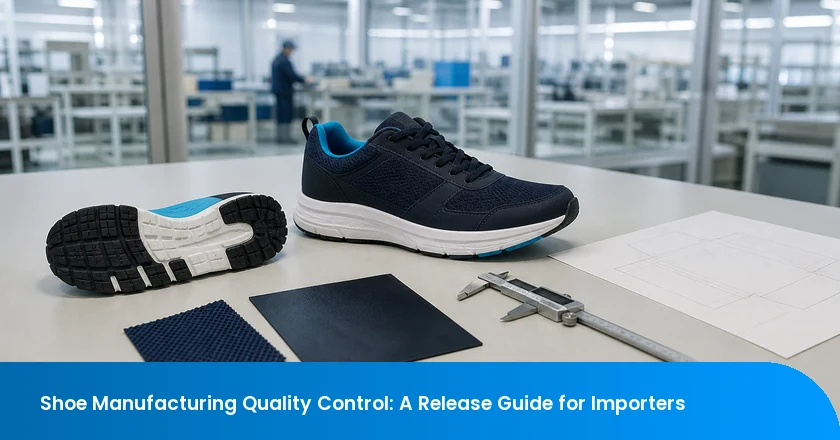
A shoe lot can look clean at final inspection and still be unsafe to release. The usual gap is not the visible pair; it is the missing connection between that pair, the approved product, the production run, the market claims, and the cartons awaiting shipment.
Shoe manufacturing quality control should preserve one approved product definition as materials, construction, labeling, packing, and records move through the factory. When one part changes, release, hold, or recheck the affected scope instead of stretching a sample result across the whole purchase order.
The Release Decision Comes Before the Defect List
A shoe release is defensible only when the approved reference, production build, market-facing claims, and traceable packed lot all describe the same release population. The release population is the group of pairs and cartons that the current evidence can actually support. These four conditions are not interchangeable. A strong visual result cannot repair the wrong material record, and a correct label cannot prove that an unmapped carton came from the approved build.
- Freeze the physical shoe and its revision-controlled records before bulk work.
- Check production while repeated drift can still be tied to a line, date, size run, or colorway.
- Define the finished lot and packing status before setting the sample plan.
- Hold only the scope that lacks matching evidence, then verify it before release.
An independent provider should make this evidence easier for the buyer to see, not turn a report into a blanket promise. Importers comparing that working model can review how TradeAider structures independent quality control.
Define the Shoe Before the Factory Starts
The approved shoe reference should connect the physical pair, bill of materials, construction notes, size and color range, label artwork, packing rule, and defect classifications before bulk production starts. Every item needs the same revision identity so the factory, buyer, and inspector do not work from different versions.
First, Freeze the Physical Build and Pairing Rules
The approved physical reference must make materials, construction, size, appearance, and left-right pairing observable before bulk work. A golden sample is the buyer-approved physical reference used to compare production. It should carry a revision number that also appears on the bill of materials, artwork, and inspection brief.
For a typical shoe, record the upper material and finish, lining, insole, outsole compound and profile, stitching pattern, bonding areas, reinforcements, logo position, size marking, and accessories. Add pairing rules for color, shape, outsole pattern, lace length, and left-right size. Hidden construction or performance requirements may need drawings or test evidence because a photograph cannot show an outsole compound or heel reinforcement.
Defect classifications should be approved at the same time. A detached outsole, wrong size label, loose eyelet, excess adhesive, and minor color variation do not create the same buyer risk. Define the observable condition, the agreed category, and the evidence that closes it. That is how an importer can set the footwear inspection standard before bulk work.
Then, Make Labels and Claims Match the Approved Shoe
For footwear sold in the EU, the label must describe materials for the upper, lining and insole, and outer sole. The official EU footwear-label guidance also explains the two-main-material rule when no material reaches the stated threshold. The buyer therefore needs component records that match the final shoe, not a generic description from an early quotation.
UK footwear guidance uses an 80 percent component-material threshold and requires the two main materials when no single material reaches that threshold. The current UK government guidance makes the artwork review a product-record check. It is not enough for a supplier to call the upper “synthetic” if the approved material and label symbols no longer agree.
The FTC states that its Guides for Select Leather and Imitation Leather Products cover footwear. That FTC category guidance is a US-specific boundary, not a universal labeling rule. It tells the importer to confirm which claims apply to the exact product and selling market.
A 2026 FTC enforcement announcement involving footwear shows why unqualified origin claims need evidence from actual components and assembly. The FTC announcement is a practical reason to approve origin wording before inner boxes and cartons are printed. Importers should verify product-specific obligations rather than treat these examples as legal advice.
Control the Build Before Defects Spread
A footwear control point is most useful before the affected production scope becomes expensive or impossible to identify. The sequence is prevention first, then containment: freeze risky inputs before bulk work and map repeated drift while production records still show where it spread.
Use Pre-Production Checks to Stop Unapproved Substitutions
Pre-production control is where the buyer can stop an unapproved material, label, or construction change before it becomes a bulk-lot problem. Compare production materials, molds, components, artwork, packaging, and the pilot output with the approved reference. A proposed substitute should trigger a documented choice: approve it, reject it, revise the label, or obtain new evidence before bulk assembly.
For child products covered by 16 CFR Part 1107, a material change in design, manufacturing process, or component sourcing can affect compliance evidence. The current eCFR text defines this change boundary. It does not mean every shoe follows the same test plan. It means visual inspection cannot replace a product-, age-, material-, and market-specific compliance review.
Use During-Production Checks to Bound Repeated Drift
During production, the practical question is not only whether a defect exists but which build run, colorway, size range, or carton group it can reach. A loose thread on one upper may need local repair. Repeated sole separation, shifted stitching, wrong size marks, or an unapproved heel construction needs a production-scope answer.
Start at the joints where footwear parts meet: upper-to-sole bonding, stress-point stitching, heel counters, toe caps, eyelets, straps, and detachable decoration. Then compare left and right shoes for shape, color, size, logo, outsole pattern, and lace length. Record the line, date, shift, component batch, size, and colorway for each repeated finding. Those facts determine whether the factory can isolate a build window or must widen the hold.
If the affected run is still open, correction can be checked before more cartons inherit the uncertainty. Buyers who need independent evidence at this stage can add a during-production inspection checkpoint.
Build the Final Inspection Around a Real Lot
NIST explains that acceptance sampling uses a random sample from a defined lot to support a lot-disposition decision, not to estimate the quality of every unit. The NIST Engineering Statistics Handbook makes the boundary clear: the sample informs an accept-or-reject decision for the lot named in the plan.
AQL, or acceptance quality limit, is an index used with a sample plan to make an acceptance decision for a defined lot. Before inspection, state the lot size, inspection level, AQL values, defect categories, and acceptance or rejection rule. Do not calculate the sample from the purchase-order quantity when some pairs are unfinished, separated for rework, or outside the current carton map.
TradeAider’s Pre-Shipment Inspection definition requires 100 percent of the order quantity to be completed and at least 80 percent packed for export. The 80 percent threshold refers to export packing, not production completion. Ask the factory for the current quantities finished, packed, unpacked, held, and reworked, then reconcile them with the purchase order and packing list.
The following inputs keep a final result tied to a real decision:
| Inspection Input | Buyer Must Confirm | Hold Trigger |
|---|---|---|
| Lot identity | Sizes, colorways, build runs, and quantities | Records cannot explain which pairs belong to the lot |
| Packing status | Completed, packed, unpacked, and rework quantities | Sampled cartons do not represent the final export population |
| Acceptance plan | Sample size, defect classes, AQL values, and decision rule | Criteria are added only after findings appear |
| Carton map | Carton numbers tied to products and production records | A build group cannot be located for correction or recheck |
Once those inputs agree, the buyer can calculate the AQL sampling plan for the defined lot.
Release Only the Population the Evidence Covers
A passing sample should not be used to release cartons or build groups that cannot be tied to the same approved reference, production records, and packing status. The sample finding has a lot boundary. The approved reference and carton map establish whether that boundary covers the physical shoes awaiting release.
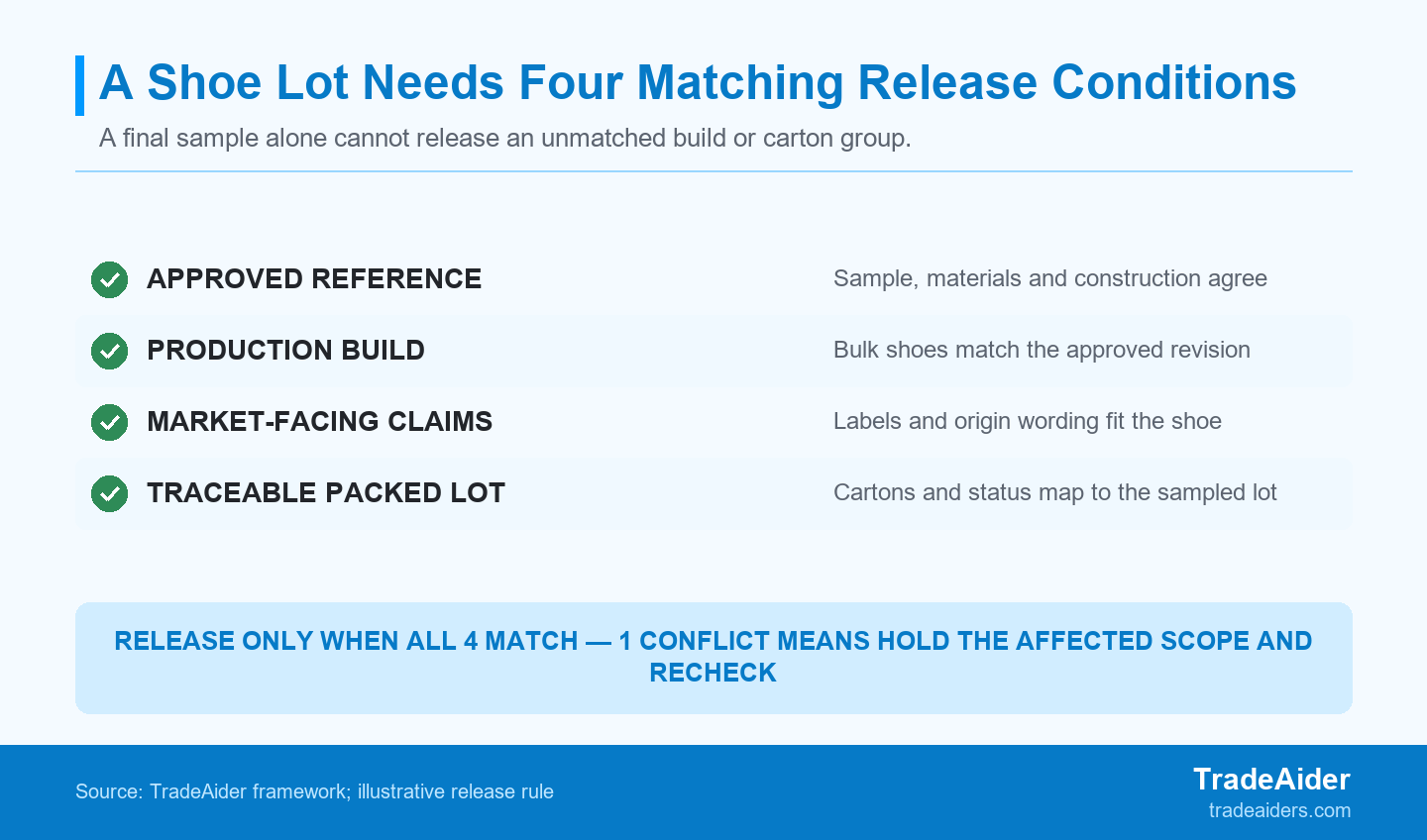
A final sample is not a substitute for an unmatched reference, unverified production build, incorrect market claim, or unmapped carton group.
NIST describes acceptance sampling as a random-sample decision about whether to accept or reject a defined lot. The NIST lot-acceptance explanation supports that boundary; the buyer should then confirm that the sampled lot and cartons awaiting release remain the same traceable group.
Use four statuses instead of one vague all-order “pass.” Release the matched population when the product, build, claims, and packing evidence agree. Hold a traceable subset when one build group lacks proof. Widen the hold when records cannot show where the change stopped. Recheck a corrected subset before adding it back to the release population.
This rule does not promise that every released pair is defect-free. It prevents a valid sample result from being stretched across evidence it never tested. When the order is fully produced and sufficiently packed, buyers can schedule the pre-shipment release check.
Illustrative Scenario: Six Cartons Fail the Reference Match
In this illustrative order, six cartons tied to an adhesive-only heel construction cannot borrow approval from the stitched-heel reference. The mismatch changes the evidence boundary even if the remaining visual checks are acceptable.
Traceability Earns a Smaller Hold—Not an Automatic Pass
A private-label importer is sourcing women’s casual sneakers from a factory in China. The order contains 1,200 pairs in two colorways, packed as 30 pairs per carton across 40 cartons. All pairs are finished, but only 34 cartons are packed when the final review starts.
The approved sample uses a stitched heel reinforcement, while a production check finds an adhesive-only construction on a later build run. Build-date and carton records connect six cartons to the later run, but the supplier has not shown a rework verification for those cartons.
The six-carton hold covers 180 pairs until the corrected heel construction and carton records pass focused reinspection. The arithmetic is simple: six cartons multiplied by 30 pairs equals 180 pairs. The decision is narrower than rejecting 1,200 pairs, but only because the records identify the changed subset.
The buyer holds the six cartons because their construction conflicts with the approved reference. The other cartons are not released automatically; they remain subject to the agreed inspection plan. If the build records become unreliable, the hold must widen until the supplier can show where the adhesive-only run started and stopped.
The factory separates the 180 pairs, restores the agreed reinforcement where feasible, records the affected pairs, and repacks them under the same carton identities. A focused follow-up compares the correction with the approved reference and confirms the six-carton list before the subset can return to release. This is an illustrative composite, not a TradeAider client case. Actual classifications, contract remedies, and reinspection scope depend on the shoe and buyer specification.
Prepare an Inspection Brief That Can Produce a Release Decision
A decision-ready footwear inspection brief names the approved reference, construction risks, target market, lot map, packing status, sample plan, and needed reports. It should let the inspector identify the controlling revision, the included population, and the evidence that causes release, hold, correction, or reinspection.
- Attach the approved shoe, bill of materials, construction notes, and current artwork.
- Identify critical materials, joints, size and pairing rules, and defect classifications.
- Name the destination market and any product-specific compliance evidence.
- Provide the build-run, size, colorway, quantity, packing, and carton records.
- State the sample plan, release authority, correction evidence, and recheck rule.
If the current order packet is ready, send the purchase order, reference, reports, and packing status to contact TradeAider to scope the footwear inspection.
Frequently Asked Questions
What is the most important quality check for shoes?
The most important check is whether the finished shoe, approved reference, and current lot records describe the same product and release population. Visual workmanship still matters, but it cannot resolve a changed material, construction, label, or unmapped carton group. Start with the controlled reference and evidence scope, then apply defect checks to the population those records identify.
When should footwear be inspected during production?
Footwear should be inspected before bulk production, during active assembly, and again only when the finished order is sufficiently packed for release. Pre-production checks stop substitutions, while during-production checks contain repeated drift. The final check evaluates the defined finished lot. The exact timing should follow the feature that becomes most expensive or difficult to verify later.
Can an AQL inspection guarantee every pair of shoes?
No. It cannot guarantee every individual pair. The buyer should approve the lot, inspection level, defect categories, AQL values, and decision rule before inspection, then interpret the result only for that scope. Cartons or build groups outside the evidence need a separate hold, additional check, or reinspection decision.
What records should a shoe inspection brief include?
A shoe inspection brief should include the approved reference, bill of materials, size and color range, packaging rules, lot status, and test needs. Add revision-controlled label artwork, construction notes, critical defect definitions, production identifiers, packing quantities, carton map, and the agreed sample plan. These records let the result answer a release question instead of only describing sampled pairs.

Related Articles
Grow your business with TradeAider Service
Click the button below to directly enter the TradeAider Service System. The simple steps from booking and payment to receiving reports are easy to operate.

