

A Singapore-bound electrical-goods order is not ready merely because a factory can show a test report or a label artwork file. The real pre-shipment question is whether the exact controlled-good decision, Singapore registration owner, current model, SAFETY Mark reference, retail package, and packed cartons still describe the same product build.
That distinction matters when a power adaptor, plug, rating plate, instruction leaflet, or retail-pack revision changes late in production. The item may retain the same sales SKU, while the supporting evidence and the physical goods are no longer clearly connected. A buyer needs a release method that identifies the mismatch early and sends the regulatory question to the right party—without pretending that a factory or third-party inspection can grant market approval.
What Must Match Before Singapore Electrical Goods Ship?
Before a Singapore consumer-electrical-goods shipment is treated as ready, the controlled-good decision, responsible registrant, current model record, SAFETY Mark reference, and defined packed population should point to the same build.
Use that statement as a matching test, not as a document checklist. A route may be right for the product category but belong to a different importer. A valid-looking mark may be printed on an older package. A report may name an earlier adaptor. And a carton count can hide a small group of changed units. Each record becomes useful only when it can be linked to the product that will actually be supplied.
- Scope: is this exact product configuration a Controlled Good, rather than simply an item in a broad “electronics” range?
- Ownership: who is the Singapore Registered Supplier and who can make the compliance escalation?
- Identity: what model, rating information, plug or adaptor, accessories, and packaging revision are in the finished order?
- Traceability: which cartons contain that configuration, and can the physical mark or package be compared with the record?
Confirm Whether the Exact Electrical Good Is Controlled
Controlled-good scope must be determined from the published category definition and the actual product attributes, rather than from a broad consumer-electronics sales description. CPSO controlled-goods categories
Singapore’s Consumer Product Safety Office (CPSO) lists 33 categories of Controlled Goods under the Consumer Protection (Safety Requirements) Regulations (CPSR), with low-, medium-, and high-risk routes. The list contains defined products and applicable standards; it is not a generic rule that all electrical goods use the same route. For example, the category descriptions distinguish product function, intended household use, and attributes such as voltage. Start with the current Controlled Goods list, then compare it to the actual model rather than to a marketing name.
Make a short scope sheet before asking the factory for documents. It should state the product type, model code, rated voltage, power source, plug or adaptor supplied, household-use purpose, and any variant that changes the retail configuration. This is not a substitute for the registrant’s assessment. It prevents the more basic mistake of assuming that a report for a nearby model, or a generic “consumer electronics” category, settles the question.
If the factory describes a product as “the same fan” but the export configuration now includes another adaptor or a revised rating plate, record that as a comparison point. The buyer does not need to decide the legal outcome on the factory floor; the buyer does need to know that the physical comparison has changed.
Name the Singapore Registrant and Conformity Route
The CPSR route combines a controlled-good registration with responsibility held by the registered supplier, while the conformity evidence differs by risk category. The CPSR covers 33 categories of Controlled Goods. CPSR overview; controlled-goods registration route; Registered Supplier responsibilities
The CPSR requires the relevant Controlled Goods to be tested to specified safety standards, registered with CPSO, and affixed with the SAFETY Mark before they can be sold in Singapore. CPSO explains that a model can be supplied after registration, while the registration route is based on a Certificate of Conformity (CoC) from a designated conformity assessment body or a Supplier’s Declaration of Conformity (SDoC) from a Registered Supplier, as applicable. See the current CPSR overview for the regulatory framing.
For shipment control, the owner matters as much as the form name. CPSO states that Registered Suppliers are responsible for the safety and compliance of Controlled Goods registered under their name. An importer, parallel importer, retailer, or manufacturer importing and selling Controlled Goods may generally need to register goods, depending on the arrangement. The exporter should therefore put the Singapore Registered Supplier, contact, and escalation path in the order file—not leave them as a vague “customer compliance” note. The current Registered Supplier guidance is the right place to verify that role.
Do not collapse the evidence routes into one supplier PDF. CPSO’s registration guidance says that low-risk Controlled Goods use an SDoC submission, while medium- and high-risk Controlled Goods require test reports and other documents to be reviewed by a certification body for a CoC route. The registration owner should confirm the exact category and current route before production changes are treated as a simple packing issue.
Build a Model-Specific Evidence File Before Packing
A defensible shipment evidence file needs to identify the current model and its supporting route materials, rather than treating an old report or generic declaration as proof for every variant.
Give the file one clear purpose: it should let the Singapore-side registrant, factory, and inspection team answer “what exact build are we looking at?” without decoding a chain of email attachments. The file does not create a SAFETY Mark. It preserves the evidence and identifiers that the responsible party needs to compare with the current product.
| Evidence field | What it should identify | Pre-shipment hold trigger |
|---|---|---|
| Controlled-good decision | Product definition and configuration reviewed by the responsible party | The actual product or use condition differs from the scope record |
| Registrant and route | Singapore Registered Supplier, contact, and current SDoC or CoC path where applicable | No named route owner can confirm the current variant |
| Model identity | Model code, rating plate, adaptor or plug, accessories, manual, and retail package revision | A finished unit differs from the described build |
| Mark and package reference | The visible SAFETY Mark information and where it is affixed | The model or registration record does not reconcile with the item being checked |
| Lot boundary | Carton numbers, quantities, and the configuration within each population | Changed units cannot be separated from unaffected cartons |
CPSO keeps the current information booklet and registration resources in one place; use the CPSR resources to refresh the route materials rather than relying on an old supplier archive. Where the model-specific technical evidence itself is unclear, TradeAider’s product-testing scope can help a buyer review the model-specific test evidence before packing, rather than waiting until the cartons are sealed.
A good file also distinguishes a fact from an assumption. “The retail box looks unchanged” is an observation. “The current adaptor is within the registered model scope” is a decision for the responsible registration route. Keeping those statements separate stops a visual factory observation from acquiring an authority it does not have.
Turn the File Into Factory Controls
The factory control should compare the current model record with what is being packed, so that a later configuration change becomes a defined evidence question rather than an undocumented production variation.
Factory control is the bridge between a Singapore evidence route and an export shipment. Assign one owner to release the current model record to the packing line, and another to record any change that may alter the physical comparison. The point is not to turn a factory checklist into a regulatory certificate. It is to stop a model, label, or adaptor change from disappearing into a shared SKU name.
Freeze the Retail Configuration Before Final Packing
The model record should freeze the identifiers that could change the regulatory or physical comparison: model code, rating plate, plug or adaptor, supplied accessories, manual revision, retail-pack artwork, and carton range.
Take this record from approved artwork and the current production build, not from a purchase-order shorthand. A visual check can compare the model code and rating information on a finished unit, confirm the supplied adaptor or plug, and note the manual and retail-pack version. If any element is not visible or cannot be sampled, record that limitation plainly. A report should say what was observed, not infer approval from an incomplete comparison.
Use a Carton Boundary When Anything Changes
When a changed adaptor, label, plug, or product configuration cannot be mapped to the current evidence record, isolate the affected cartons until the responsible registrant confirms the next route decision.
“We changed only one component” is not enough for a release decision. Ask which carton numbers contain the changed build, when the change began, whether the old and new builds were mixed, and whether the export carton mark can separate them. If the factory cannot draw that boundary, the change may affect the whole declared population for practical review purposes. If it can, the buyer can preserve the unaffected group while escalating only the identified subset.
Check the SAFETY Mark, Product, Package, and Lot Together
The SAFETY Mark register can be checked using the product model number or the mark’s registration number, and the returned product information should match the product being checked. CPSO SAFETY Mark checking guidance
CPSO describes the SAFETY Mark as a way to identify registered Controlled Goods. Its guidance says the mark may be checked through the register using either the model number or the eight-digit registration number, then compared with the product information returned. It also says the mark must be on the Controlled Good or its packaging in a prominent location. Use the official SAFETY Mark checking steps as the reference point for that comparison.
A pre-shipment inspection can record whether the agreed physical model, marking, packaging, and packed quantity are present; it cannot issue a SAFETY Mark or replace the registered supplier’s compliance responsibility.
That boundary protects both the buyer and the inspection report. A pre-shipment scope can document the observed model, rating plate, supplied adaptor, visible marking, retail package, carton markings, quantity, and the specific carton range sampled. It can also flag a mismatch for the registrant to review. CPSO’s supplier guidance puts primary responsibility for product safety on the supplier; no inspection observation should be written as if it transfers that responsibility. When the order reaches final packing, use the inspection scope to verify the packed electrical-goods lot before shipment, not to replace the formal Singapore route.
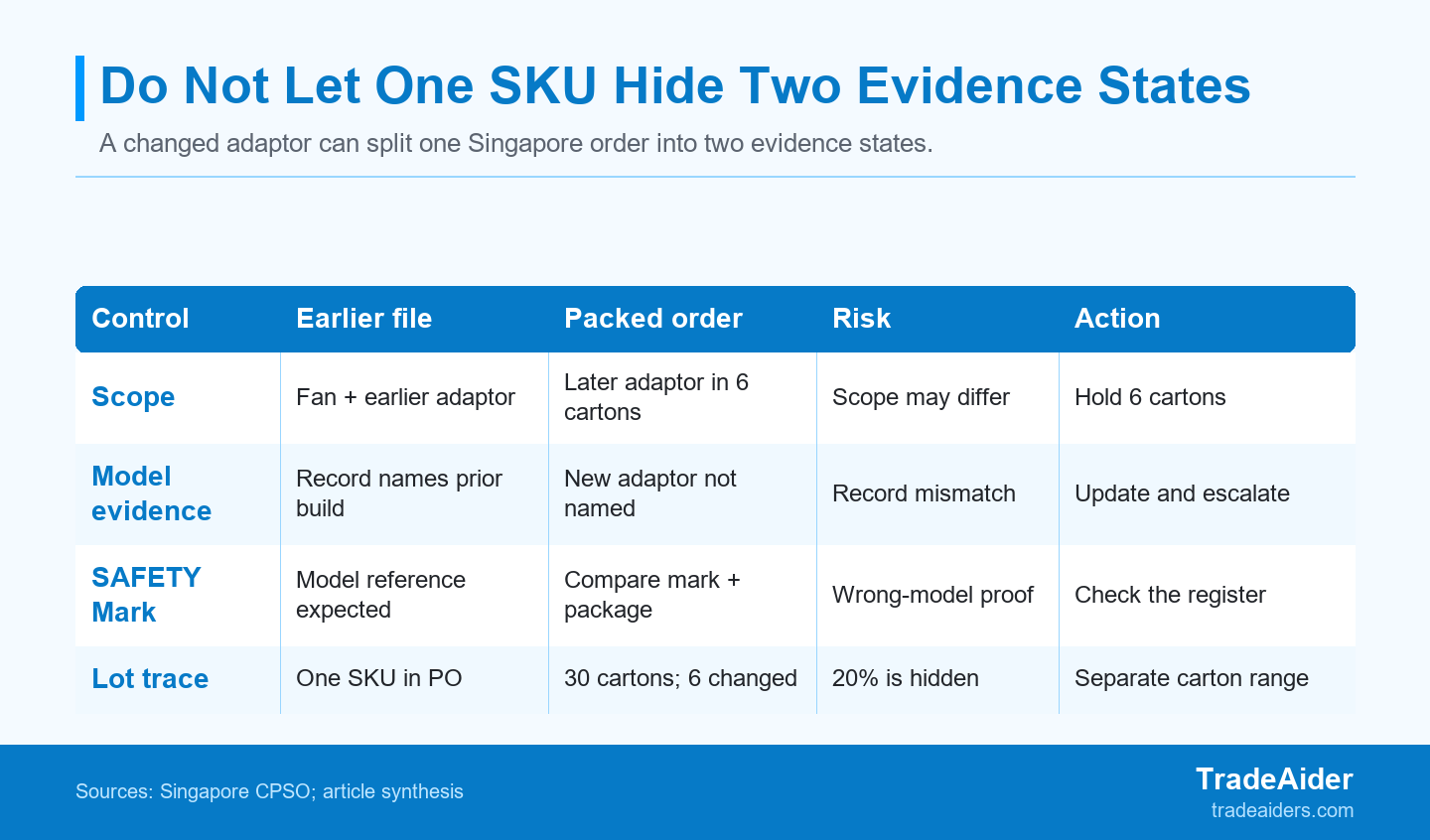
A SAFETY Mark route, current model evidence, and packed cartons must describe the same configuration; an unchanged SKU name is not enough.
Illustrative Scenario: Six Changed Cartons in a Fan Order
In an illustrative 240-unit portable-fan order packed in 30 cartons, an adaptor change in six cartons creates a 20% identifiable subset; that subset should not inherit the earlier model record until the current configuration is reconciled.
An exporter prepares a Singapore-bound portable-fan order with one retail SKU. The illustrative order has 240 units in 30 export cartons, with six cartons packed after an adaptor configuration change. The original model evidence record describes the earlier adaptor while the six later cartons retain the same retail artwork.
The visible SKU artwork is unchanged. The later adaptor is not named in the earlier model record. The six affected cartons are identifiable in the packing list.
The useful calculation is simple: 6 ÷ 30 = 20%. That does not mean the remaining 80% is automatically approved, and it does not determine the regulatory outcome for the changed 20%. It does create an operational boundary. Without a carton boundary, the team risks making a broad claim about 240 units from one document describing only an earlier build. Treat the six cartons as a defined subset and prevent automatic inheritance of the earlier release logic. The practical release record should show that 24 cartons match the stated configuration based on the agreed observation scope, while six cartons contain a later adaptor and remain on hold pending the responsible party’s review.
Isolate the six cartons, update the configuration record, and obtain the responsible registrant’s current category and evidence decision. Before shipment, compare current model identity, evidence reference, SAFETY Mark or package observation, and carton range together. This is an illustrative control method, not a TradeAider client case and not a finding that the changed product may or may not be supplied in Singapore.
Hand Off One Pre-Shipment Evidence Packet
A useful pre-shipment handoff names the registrant, current model, evidence reference, mark or package observation, carton population, and unresolved decision in one packet.
Send this packet before the final inspection date, not after an exception is found. CPSO’s supplier FAQ notes that at least one party in the supply chain must register for the SAFETY Mark and affix it before supply to consumers. That makes the chosen supply-chain relationship material to the handoff; the factory cannot fill a missing owner merely by sending another label image. Review the supplier FAQ when the business arrangement or registrant relationship is unclear.
| Packet item | Owner | Decision it supports |
|---|---|---|
| Exact model and configuration sheet | Factory and exporter | What build is physically packed? |
| Controlled-good and registrant status | Singapore Registered Supplier | Who owns the route and escalation? |
| Current evidence references | Registrant with technical support | What record is being compared with the build? |
| Mark, package, and carton observations | Factory or inspection team | Which physical population was checked? |
| Open mismatch and hold decision | Buyer and Registered Supplier | What can move, what is held, and what needs confirmation? |
If you already have the model list, evidence references, packing status, and carton range, TradeAider can help define an inspection-ready scope. The deliverable should state the physical comparison to make and the limits of that comparison; it should never promise to register a product or issue a SAFETY Mark. Request a Singapore shipment evidence review.
Frequently Asked Questions
Does every consumer electrical product need a Singapore SAFETY Mark?
No. The product must first be checked against the current Controlled Goods categories and its exact definition before a SAFETY Mark route is assumed. A broad “consumer electronics” description is not enough: product function, intended use, and relevant attributes can affect whether a category applies. Ask the responsible Singapore party to confirm the current scope for the exact model and supply configuration.
Who should be the Registered Supplier for Singapore controlled goods?
The business arrangement must identify the party that will be the Registered Supplier, because that party carries responsibility for controlled goods registered under its name. An exporter should record the Singapore-side owner, contact, and escalation path before final packing. That allocation should be documented in the commercial arrangement, not left to an informal email assumption. Do not assume the factory is the registrant merely because it holds technical documents.
Can a factory inspection confirm that a SAFETY Mark is valid?
An inspection can record the model, visible marking, packaging, and carton observations, but the mark’s validity must be checked against the relevant official register and responsible registration route. Treat the inspection as physical evidence for a defined order. It cannot issue, register, or approve a SAFETY Mark.
What should happen if the adaptor or label changes after testing?
Identify the affected cartons, stop treating them as automatically covered by the earlier model record, and ask the responsible registrant to confirm the current evidence and next route decision. Record precisely what changed and when. If the changed cartons cannot be separated, avoid a release statement that assumes all units share the earlier configuration or that hides a material build difference.
Related Articles


Grow your business with TradeAider Service
Click the button below to directly enter the TradeAider Service System. The simple steps from booking and payment to receiving reports are easy to operate.

