
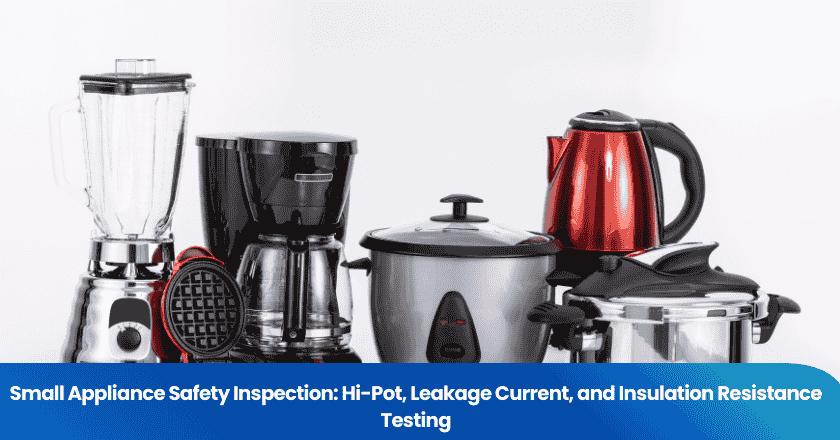
Electrical safety failures in small appliances — electric shavers, hair dryers, blenders, coffee makers — are the fastest path from a product complaint to a CPSC recall notice. The three root causes that inspectors find most consistently in Chinese factory production are insulation that fails under voltage stress, excessive leakage current reaching accessible surfaces, and inadequate insulation resistance in the wiring assembly. None of these defects are detectable by visual workmanship inspection alone. All three require dedicated electrical testing on sampled production units before goods leave the factory. This guide explains what each test checks, what standards apply to your target market, how to specify these tests when ordering pre-shipment inspection, and how to act on failures before they become your problem in the field.
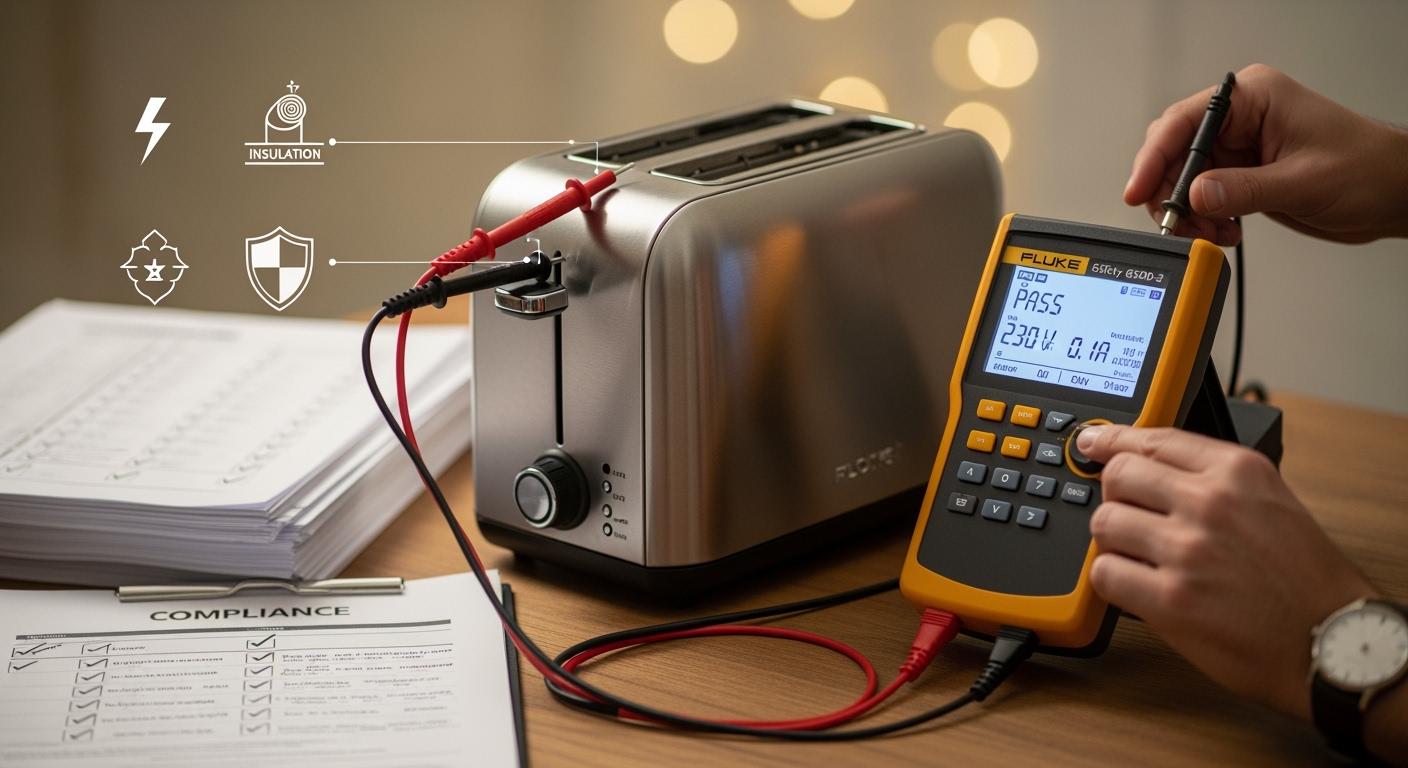
Key Takeaways
- Hi-Pot, insulation resistance, and leakage current testing must be explicitly specified in your pre-shipment inspection checklist. A standard workmanship inspection will not include them by default.
- All three tests carry critical defect status under AQL classification — zero tolerance. A single failing unit triggers a lot-level hold, not a unit-level replacement.
- Compliance with IEC 60335-1 and UL 60335-1 requires Hi-Pot testing at 500–2,400 VAC for 60 seconds. Production-line testing at 400–2,500 VAC for 1 second is acceptable as an alternative protocol, but must use calibrated equipment with traceable calibration records.
- Leakage current limits vary by product category: ≤ 0.5 mA for standard consumer appliances, ≤ 0.75 mA for 3-prong products with warning labels. Products exceeding these limits at the factory will exceed them in the hands of your customers.
- Certification marks (UL, CE, ETL) on the product label must be verified against actual test certificates during inspection. Label-only verification without document cross-reference is insufficient for compliance confirmation.
Why Electrical Safety Testing Must Be Part of Your PSI
What Standard Inspections Miss
A pre-shipment inspection that covers only workmanship — assembly quality, cosmetic finish, accessories count, packaging — leaves the three most consequential failure modes for electrical appliances completely undetected. Insulation that passes visual inspection can still break down under operating voltage. Leakage current above the safe limit is invisible until measured. Wiring with degraded insulation resistance may look acceptable from the outside while creating a shock risk at the user's hands. Importers who rely on workmanship-only inspection for small appliances are making a cost calculation that typically goes wrong at the worst possible time: during the peak sales season, after a full container has landed, when CPSC complaint volume triggers a review.
The more relevant business case is simpler: electrical safety testing during pre-shipment inspection costs a fraction of one recall event, one Amazon listing suspension, or one batch of return freight from a destination market. For any importer sourcing small appliances with mains-connected components from Chinese factories, specifying Hi-Pot, leakage current, and insulation resistance testing in the inspection checklist is basic supply chain risk management.
Three Tests, Three Distinct Failure Modes
Each test targets a different failure mechanism. Hi-Pot (dielectric withstand) testing stresses the insulation with voltage well above operating level to reveal breakdown points, pinholes, and assembly defects that would eventually fail in normal use. Insulation resistance testing measures the DC resistance of the insulation material itself — low values indicate degraded or contaminated insulation that will allow leakage current to increase over the product's service life. Leakage current testing directly measures the unintended current flow from live parts to accessible surfaces at operating voltage — the quantity that determines whether a user receives a harmful shock. All three are required for a complete electrical safety picture; none replaces either of the others.
| Test | What It Detects | Why It Matters for Importers |
|---|---|---|
| Hi-Pot (Dielectric Withstand) | Insulation breakdown, pinholes, pinched wiring, assembly defects | Catches production defects that will cause in-use failures; required by IEC 60335-1 and UL 60335-1 |
| Insulation Resistance (IR) | Degraded, contaminated, or undersized insulation material | Predicts long-term reliability; low IR values signal insulation that will deteriorate faster than rated lifespan |
| Leakage Current | Unintended current flow to accessible surfaces at operating voltage | Direct measure of shock risk to end users; exceeding limits means the product fails compliance regardless of visual appearance |
Hi-Pot (Dielectric Withstand) Testing
What Hi-Pot Testing Checks
Hi-Pot testing applies a high voltage between the live parts of the appliance and its accessible metal enclosure, far above the rated operating voltage, to stress the insulation and reveal any weakness. The insulation must withstand the test voltage for the full duration without breakdown — no sudden current surge, no arcing, no flashover. The test reveals insulation breakdown, pinholes in insulation material, pinched wiring from assembly, poorly crimped connections, and any assembly defect that places a live conductor too close to an accessible surface. These defects are typically systematic production issues — caused by tooling problems, incorrect insulation material, or assembly process gaps — meaning they are likely to recur across a percentage of the full production lot, not isolated to the unit where they are first detected.
Test Parameters and Standards
Inspectors verify that the factory conducts Hi-Pot testing to the following parameters on the production lot being inspected. Where the factory is conducting production-line testing, inspectors verify that the equipment is calibrated and that records are available for the tested batch. Where production-line testing is not in place, inspectors conduct Hi-Pot testing directly on the sampled units.
| Test Protocol | Voltage Range | Duration | Pass Criterion |
|---|---|---|---|
| IEC 60335-1 (Type Test) | Rated V + 2,400 VAC (500–2,400 VAC range) | 60 seconds | No insulation breakdown; no current surge above trip threshold |
| UL 60335-1 (Type Test) | Rated V + 2,400 VAC (500–2,400 VAC range) | 60 seconds | No insulation breakdown; no current surge above trip threshold |
| Production-Line Testing | 400–2,500 VAC | 1 second | No breakdown; leakage current within 5–30 mA trip setting |
Any unit that fails Hi-Pot testing is classified as a critical defect. If the failure rate in the sampled lot exceeds zero, the entire lot is held. Inspectors document the failure with the specific voltage applied, the measured breakdown current, and the physical location of the failure on the unit — information that allows the factory to identify the root cause in the production process.
Note: Hi-Pot testing permanently stresses insulation. Do not request 100% Hi-Pot testing on sampled units that you intend to sell — production-line Hi-Pot testing records from the factory should be the primary verification source, with inspectors confirming the factory's test records and equipment calibration during PSI.
Insulation Resistance Testing
What Low Insulation Resistance Tells You About a Production Lot
Insulation resistance testing measures the DC resistance of the insulation between conductors and accessible metal parts using a megohmmeter (typically at 500V DC). While Hi-Pot testing is a pass/fail stress test, insulation resistance gives a quantitative measurement of insulation quality. Low insulation resistance values indicate insulation material that is degraded, contaminated with moisture or conductive residue, or simply insufficient in thickness or grade for the application. Products with borderline insulation resistance that pass Hi-Pot testing today may fail it — or exceed leakage current limits — after six months of customer use. For importers who depend on product reliability within the warranty period, insulation resistance testing provides an early indicator of batches that will generate disproportionate warranty claims.
Inspectors use a calibrated megohmmeter, confirm ambient temperature and humidity at the time of testing (both affect readings and should be recorded alongside measurements), and verify that the instrument calibration is current. Minimum acceptable insulation resistance for standard household appliances is 1 MΩ at 500V DC under IEC 60335-1; values below this threshold are a major defect. Readings below 0.5 MΩ are a critical defect.
Leakage Current Testing
Leakage Current Limits by Product Category
Leakage current is the most direct measure of shock risk from an electrical appliance. It is the unintended current that flows from live conductors through degraded insulation, moisture paths, or capacitive coupling to the accessible surfaces a user can touch. Inspectors measure leakage current at rated line voltage following the test network specified in IEC 60335-1 and UL 60335-1. The following limits apply to the most common product categories:
| Product Category | Leakage Current Limit | Test Conditions | Primary Standard |
|---|---|---|---|
| Standard Consumer Appliances | ≤ 0.5 mA | At rated line voltage | IEC 60335-1, UL 60335-1 |
| 3-Prong Products with Warning Label | ≤ 0.75 mA | At rated line voltage | UL 2089 |
| Industrial Equipment (240V) | ≤ 3 mA | Grounded products | UL 508, IEC 60204-1 |
| IT Equipment | ≤ 3.5 mA | Touch current limits | IEC 62368-1 |
| Medical Devices (General) | ≤ 0.1 mA | Patient connection points | IEC 60601-1 |
Leakage Current Test Procedure
Inspectors perform the leakage current test on sampled units at the factory using a calibrated leakage current meter with the measurement network specified in the applicable standard. The procedure for each sampled unit:
- Confirm the unit is assembled per production specification and in normal operating configuration.
- Connect the leakage current meter between the accessible metal surfaces and the reference ground per the standard's test network.
- Apply rated line voltage and allow the unit to reach thermal equilibrium if the test requires it (some standards specify measurements at cold start and after warmup).
- Record the measured leakage current. Compare against the applicable limit for the product category.
- Repeat with the supply polarity reversed where required by the standard.
- Any reading exceeding the limit is a critical defect. Record the numerical value, the test conditions, and the specific unit identifier in the inspection report.
Tip: Leakage current above the limit is almost always caused by one of three root causes in Chinese factory production: insulation material substituted for a lower-grade version, wiring routing too close to the metal chassis, or a missing earth connection. Ask the factory for a root cause analysis before authorising rework — the fix must address the cause, not just the symptom.
Testing Procedures: What Inspectors Verify at the Factory
Equipment Calibration Verification
Inspectors verify that the factory's test equipment — Hi-Pot tester, megohmmeter, leakage current meter — carries a current calibration certificate from an accredited calibration laboratory. Equipment without traceable calibration is a non-conformity: test results produced by uncalibrated equipment cannot be accepted as compliance evidence regardless of the numerical values shown. For factories without calibrated equipment on-site, inspectors bring calibrated instruments and conduct the tests directly during the inspection visit.
Safety Precautions During Electrical Testing
High-voltage testing in a factory environment requires strict safety controls, which inspectors verify are in place before testing begins. The test area must be isolated from foot traffic with visible warning indicators. The Hi-Pot tester must be equipped with interlocks and current-limiting protections. Operators must be trained in the test procedure and in emergency response. Inspectors verify these controls before commencing any electrical testing and document the test environment in the inspection report.
| Safety Control | What Inspectors Verify |
|---|---|
| Test Area Isolation | Physical barriers and warning indicators in place; no non-essential personnel within test zone |
| Equipment Safety Features | Tester equipped with interlocks, palm switches, and automatic discharge on test completion |
| Operator Competence | Operator can demonstrate correct test connection procedure and explain emergency response |
| Equipment Calibration | Current calibration certificate present and covering the test voltage range being used |
| Live-Dead-Live Verification | Meter function verified before and after each test session on a known reference source |
Compliance Standards and Certification Verification
Key Standards by Market
Small appliances for the consumer market are subject to mandatory safety standards that specify the Hi-Pot, insulation resistance, and leakage current test requirements. The primary standards by market are:
| Standard | Market | Scope | Key Requirement for Importers |
|---|---|---|---|
| IEC 60335-1 / UL 60335-1 | Global / US | Safety of household and similar electrical appliances | Mandatory type test records for Hi-Pot, leakage current, and temperature rise; required for CE and UL/ETL listing |
| UL Listed / ETL Listed | North America | Third-party certification by NRTL | Certificate model number must match production unit; verify against current certificate, not just label |
| CE Mark (LVD + EMC) | EU / UK* | Self-declaration against EN 60335-1 | Manufacturer must hold test reports from accredited lab; self-generated test reports are high-risk for importers |
| CSA | Canada | Third-party certification for Canadian market | Required for retail sale in Canada; separate from UL certification |
*UK requires UKCA marking post-Brexit; CE marking no longer accepted for UK market since January 2023.
Additional Safety Verifications
Beyond the three core electrical tests, a complete pre-shipment inspection for small appliances should also cover grounding resistance (for Class I products with earth connection), power consumption verification against rated wattage, thermal performance check to confirm no component overheats under normal operation, and label compliance verification that all required safety marks, wattage ratings, and application specifications match the purchase order and the test certificate. These checks support overall compliance and prevent the specific situation where a product passes electrical safety tests but fails at customs or retailer inspection due to a labelling non-conformity.
AQL Defect Classification and Corrective Action
How to Classify Defects for Small Appliance Electrical Safety
| Defect Type | Classification | AQL | Examples |
|---|---|---|---|
| Critical | Zero tolerance — one failing unit holds the lot | 0 | Hi-Pot breakdown; leakage current above standard limit; insulation resistance below 0.5 MΩ; missing earth connection in Class I product |
| Major | Likely to cause return, complaint, or non-compliance | 2.5 | Missing or mismatched certification mark; insulation resistance 0.5–1 MΩ; label wattage incorrect; damaged cord insulation |
| Minor | Cosmetic; unlikely to affect safety or function | 4.0 | Minor surface finish inconsistency; packaging print quality; minor label alignment |
What to Do When Critical Defects Are Found
When any sampled unit fails Hi-Pot, leakage current, or insulation resistance testing, the correct response is to hold the lot immediately and require the factory to identify the root cause before any rework begins. Root cause analysis for electrical safety failures is important because the defect is almost always systematic — insulation material substitution, incorrect assembly tooling, or a wiring routing change — meaning it affects a predictable percentage of the full lot, not just the sampled units. Rework must address the root cause, not just replace the individual failing units. Once rework is complete, a full re-inspection by a third party — not a factory self-inspection — is required to confirm the corrective action has been effective across the full lot.
Note: Do not authorise shipment of a lot where electrical safety failures were found based on a factory promise to rework. The only acceptable confirmation that a corrective action has worked is a third-party re-inspection showing zero critical defects in the new sample.
FAQ
What is a Hi-Pot test and why is it needed for small appliances from China?
Hi-Pot testing applies high voltage across the insulation of an assembled appliance to confirm the insulation will not break down under operating conditions. For products sourced from Chinese factories, it is particularly important because insulation material substitution — where a factory uses a lower-grade insulation compound than specified to reduce cost — is one of the most common quality deviations found during inspection. Hi-Pot testing detects this substitution where visual inspection cannot.
How should I specify electrical safety testing when ordering a pre-shipment inspection?
Include Hi-Pot testing, insulation resistance measurement, and leakage current measurement as explicit line items in your inspection checklist when placing the inspection order. Specify the applicable standard (IEC 60335-1 or UL 60335-1) and confirm with your inspection provider whether they will conduct the tests directly during the visit or verify the factory's production-line test records. For factories where production-line testing is not in place, direct testing during PSI is the only reliable option.
What happens if an appliance fails a leakage current test during PSI?
The failing unit is classified as a critical defect and the entire lot is placed on hold. The factory must submit a root cause analysis explaining why the unit exceeded the leakage current limit, propose a corrective action, and implement the correction across the full lot. A third-party re-inspection is then conducted to confirm the corrective action is effective before shipment is authorised.
Is a CE or UL label on the product sufficient to confirm electrical safety compliance?
No. The label confirms someone applied the mark; it does not confirm that the production unit matches the tested model or that the test certificate is still current. Inspectors must cross-reference the model number on the production unit against the actual test certificate, including the certifying laboratory name and certificate validity date. This is particularly important for CE marking, where the manufacturer self-declares conformity — the test reports behind that declaration must be verified by the importer, not assumed to exist.
At what stage of production should electrical safety testing be conducted?
Pre-shipment inspection (PSI) — when at least 80% of production is complete and units are being packed — is the standard intervention point for electrical safety testing. For first-time orders with a new supplier, or for appliances with complex electrical assemblies, adding a during-production inspection (DPI) at 20–30% completion allows inspectors to verify that the correct insulation materials, wiring gauges, and assembly processes are in place before the full batch is produced. Systematic defects caught at DPI stage cost a fraction of what the same defects cost when found in a completed production lot.
If you source small appliances or consumer electronics from China and need Hi-Pot, leakage current, and insulation resistance testing included in your pre-shipment inspection, TradeAider's inspection service covers the full electrical safety compliance test suite for household appliances. Inspectors upload real-time photos and test results from the factory floor during the inspection, and you receive the official report within 24 hours of completion — giving you a clear ship or hold decision before your goods are loaded.
Related Articles
Grow your business with TradeAider Service
Click the button below to directly enter the TradeAider Service System. The simple steps from booking and payment to receiving reports are easy to operate.

