
- About Us

- Our Services
- Your Industry
- Resources
- News & Blog

Sourcing support outsourcing means hiring outside help for supplier search, RFQ follow-up, sampling, factory coordination, inspection, or logistics support while the importer keeps control of final supplier approval, specifications, quality standards, payment release, and shipment decisions. It works only when responsibility is split clearly.
CIPS frames outsourcing as a procurement and supply topic that must be managed through clear responsibilities, supplier relationship discipline, and risk control. For importers, that means outsourcing should reduce workload without hiding supplier risk.
ISO 20400 provides guidance on integrating sustainability into procurement decisions and processes. Even when a buyer is outsourcing only sourcing support, the procurement decision can still affect quality, compliance, social responsibility, and long-term supplier reliability.
The common mistake is to hire a sourcing helper, then let that helper become the buyer's only evidence channel. If every supplier claim, sample result, inspection note, and shipment update passes through one commercial intermediary, the importer may lose visibility exactly when risk increases.
- Outsource tasks, not accountability: the buyer should keep final supplier, specification, payment, and release authority.
- Separate sourcing from verification: the person finding the supplier should not be the only source of quality evidence.
- Use inspection as an independent control: audits, PPI, DPI, PSI, and testing reduce dependence on supplier or agent claims.
- Write the handoff rules: every outsourced task should state evidence, deadline, owner, and escalation action.
What Is Sourcing Support Outsourcing?
Sourcing support outsourcing is the use of an external partner to help with supplier search, RFQs, sampling, factory communication, order follow-up, inspection coordination, or logistics support while the importer keeps decision rights over supplier approval, specifications, quality control, payment release, and shipment.
It is useful when the buyer lacks local language support, supplier access, category knowledge, factory follow-up capacity, or inspection coordination time. It becomes risky when the buyer treats the outsourcing partner as a substitute for due diligence.
CIPS sourcing resources point to sourcing as a procurement discipline rather than a simple buying errand. Importers should therefore treat outsourced sourcing support as part of a controlled procurement process, not only as a way to find a cheaper factory.
OECD responsible business conduct guidance emphasizes risk-based due diligence across operations, supply chains, and business relationships. Even if the buyer is not in a high-risk category, the idea is relevant: identify, assess, prevent, mitigate, and track supplier risk instead of relying on one introduction.
What to Delegate and What to Keep In-House
The outsourcing boundary should protect buyer control over quality and release risk.
| Area | Can Be Outsourced? | Buyer Should Keep | Control Evidence |
|---|---|---|---|
| Supplier search | Yes | Final shortlist and approval criteria | Supplier profile, factory license, category fit |
| RFQ collection | Yes | Target cost model and specification priorities | Quote comparison, MOQ, lead time, exclusions |
| Sample follow-up | Yes | Approval decision and version control | Sample photos, test notes, approved version ID |
| Factory audit | Outsource to independent provider | Decision on supplier acceptance | Audit report, findings, corrective action |
| Quality inspection | Outsource to independent inspector | Defect rules and release decision | AQL, photos, counts, report, hold rule |
| Payment and shipment release | No | Final commercial authority | Inspection result, document match, rework evidence |
The table shows why sourcing support and quality control should not be merged blindly. The sourcing partner may help find a factory and coordinate the order, but an independent inspection report helps the buyer avoid relying only on the same party's supplier relationship.
The World Bank supply chain management guidance explains that procurement leverage can be created by conducting supply chain analysis and due diligence at each stage. Importers can apply the same idea in private sourcing: build leverage before payment, not after defects arrive.
The outsourcing agreement should also define data ownership. Supplier lists, quote history, sample photos, inspection reports, corrective actions, and production timelines should remain accessible to the buyer. If the outsourced partner keeps all records in private chats or informal spreadsheets, the buyer may lose continuity when the relationship changes.
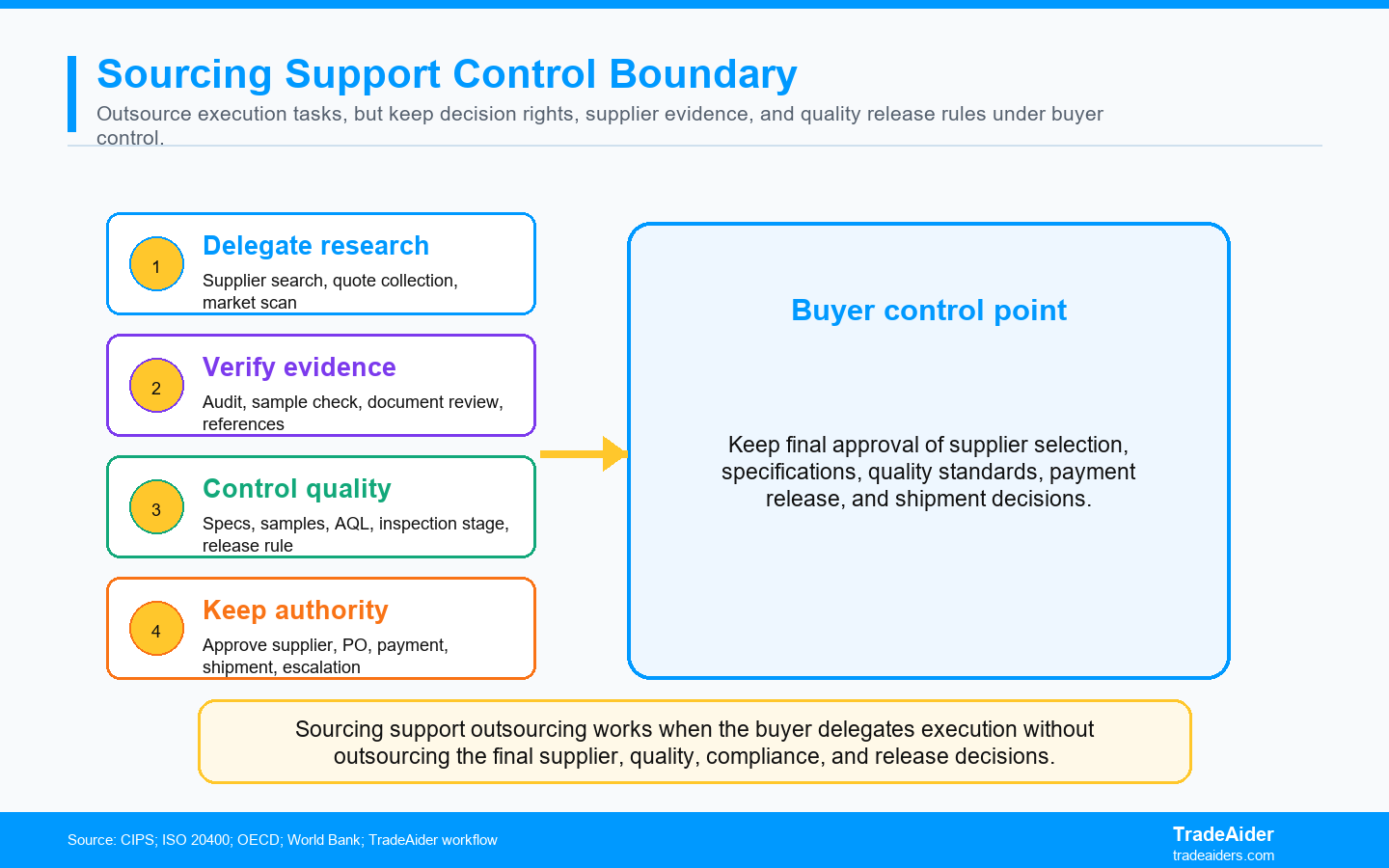
Sourcing support outsourcing works when the buyer delegates execution without outsourcing the final supplier, quality, compliance, and release decisions.
Outsourcing Sourcing Support Is Not the Same as Outsourcing Judgment
The buyer can delegate work, but the buyer should not delegate the final risk decision.
The sourcing partner should not become the only evidence channel
A sourcing agent or support partner may be helpful for supplier search, language, sampling, factory follow-up, and logistics coordination. But if the same partner controls supplier discovery, sample feedback, inspection updates, and payment pressure, the buyer may receive filtered information.
The safer structure is to split roles. Let sourcing support handle communication and task execution, while independent inspection, testing, audit, and buyer review create separate evidence. This keeps the buyer from making release decisions based only on commercial reassurance.
Decision rights should be written before the PO
The buyer should define who can approve a supplier, approve a sample, change a material, accept a defect, release balance payment, book shipment, or approve rework. If these rights are not written, the outsourcing partner may make practical decisions by default.
A simple decision-rights table prevents confusion. It also protects the sourcing partner, because the partner can execute tasks without being blamed for decisions the buyer never clearly retained or delegated.
Decision rights should include escalation thresholds. For example, a material substitution, new subcontractor, failed sample, missed production date, or repeated major defect should trigger buyer approval rather than a quiet workaround by the supplier or sourcing support partner.
Supplier Risk Control Starts Before the First Sample
The lowest-cost supplier can become expensive if the buyer skips verification before production.
Supplier screening should include capability and identity
A sourcing support partner can find many suppliers quickly, but the buyer should still verify whether the company is a manufacturer, trader, subcontractor, or mixed model. The right choice depends on category risk, volume, customization, compliance, and communication needs.
Factory audit, document review, product history, production capability, sample consistency, and quality-system evidence help separate a promising quote from a supplier that can actually deliver. The buyer should not wait until the first failed shipment to learn that the factory outsourced key steps.
Sample approval must control version drift
Samples often look better than mass production because they are made slowly, with special handling, or from materials that later change. Outsourced sourcing support should maintain a sample-version file: photo set, material, color, dimension, packaging, test result, and approval date.
If the supplier changes material, component, mold, packaging, or subcontractor after sample approval, the buyer should treat the order as a new risk event. The outsourced partner can help coordinate, but the buyer should approve the change and decide whether PPI, DPI, or testing is needed.
Version drift is especially common when the supplier is trying to meet a price target. A small change in adhesive, fabric weight, plastic grade, carton board, or accessory source may look harmless in a message but affect durability, color consistency, packaging strength, or compliance evidence.
Inspection Is the Control That Keeps Outsourcing Honest
Independent inspection prevents outsourcing support from becoming blind trust.
Use PPI, DPI, and PSI for different sourcing risks
Pre-Production Inspection is useful when supplier readiness, materials, sample alignment, or packaging artwork is uncertain. During Production Inspection is useful when process drift, workmanship, or early defect patterns could still be corrected. Pre-Shipment Inspection is useful when finished goods need release evidence before payment or shipment.
These stages are not interchangeable. A sourcing support partner may say production is going well, but DPI can show whether the first production units match the approved sample. A supplier may say the goods are ready, but PSI can verify packed cartons, labels, quantities, and defect counts.
Outsourcing needs a measurable handoff
Every outsourced task should have a handoff rule: what evidence is due, who reviews it, by when, and what action follows if the evidence is weak. Without this rule, outsourcing creates more messages but not more control.
An illustrative scenario: if a 5,000-unit order saves $0.40 per unit through a new supplier, the gross saving is $2,000. If weak quality control creates a 4% return problem at $12 handling cost per unit, 200 affected units can consume $2,400 before reputation impact. The saving disappears if verification is skipped.
KPIs for sourcing support should therefore include more than quoted price. Track sample approval cycle time, supplier response accuracy, defect recurrence, inspection pass rate, on-time corrective action, and document completeness. Those metrics show whether outsourcing support is improving sourcing quality or simply moving work out of sight.
Where TradeAider Fits in Sourcing Support Outsourcing
TradeAider helps importers add independent quality, supplier, and shipment evidence around outsourced sourcing support.
When a buyer is evaluating a new supplier found through outsourcing support, factory audit service can help check supplier capability, documentation, production conditions, and risk signals before a large order is placed.
When the order moves into production, TradeAider can support Pre-Production Inspection, During Production Inspection, and Pre-Shipment Inspection so the buyer is not relying only on supplier or agent updates.
If the product has hidden safety, chemical, or performance requirements, product testing services can be coordinated with inspection. TradeAider's real-time reports also help buyers make release decisions before the order loses leverage.
SPAR Scenario: The Sourcing Agent Found the Factory, but Inspection Protected the Order
The buyer kept sourcing speed while adding independent release evidence.
Situation: A Shopify brand outsources supplier search for 9,000 home storage products and receives a strong quote from a new factory.
Problem: The first sample is acceptable, but the supplier changes the carton insert before mass production to save cost.
Action: The buyer asks TradeAider to run DPI, compare the insert against the approved sample, and photograph the new packout before production is completed.
Result: The buyer rejects the insert change, accepts a two-day material correction, and prevents 9,000 units from shipping with weaker retail packaging.
Sourcing Support Outsourcing Checklist
Use this checklist before delegating sourcing tasks.
- List which tasks are outsourced and which decisions stay with the buyer.
- Keep supplier approval, sample approval, payment, and release authority clear.
- Require supplier identity, capability, and quotation evidence.
- Separate sourcing communication from independent inspection evidence.
- Use PPI, DPI, PSI, audit, or testing based on the risk stage.
- Write escalation rules for material changes, defects, delays, and rework.
Outsourcing support should make the buyer faster and better informed. If it makes the buyer less able to verify supplier claims, the outsourcing model needs tighter controls.
A healthy outsourcing model creates two kinds of speed: faster supplier execution and faster buyer decisions. If the model only increases message volume while delaying evidence, the buyer has outsourced activity but not improved control.
The cleanest handoff is a shared tracker with supplier status, sample version, open risks, inspection stage, document owner, and next decision date.
That tracker should be updated before every payment milestone.
The buyer should also reserve the right to trigger independent inspection when supplier statements and shipment timing no longer match. That reserve clause prevents the sourcing partner from becoming the only evidence channel at the exact moment leverage matters most.
Keep commercial negotiation and quality verification separate when possible. A sourcing partner may be excellent at price, lead time, and supplier communication, while an independent inspection provider is better positioned to challenge physical evidence without protecting the supplier relationship.
If your sourcing support partner has found a supplier but you need independent evidence before deposit, production, or shipment release, send TradeAider the supplier profile, product spec, sample file, PO, and current production stage. The next step is to add independent inspection to your outsourced sourcing process.
Frequently Asked Questions
What is sourcing support outsourcing?
Sourcing support outsourcing means using an external partner to help with supplier search, RFQs, samples, factory communication, follow-up, inspection coordination, or logistics support.
What should importers not outsource?
Importers should keep final authority over supplier approval, specifications, sample approval, payment release, quality standards, and shipment release decisions.
How do I control supplier risk when outsourcing sourcing?
Use supplier screening, factory audit, sample version control, testing where needed, PPI, DPI, PSI, and clear escalation rules for defects or changes.
Is a sourcing agent enough for quality control?
No. A sourcing agent can coordinate tasks, but independent inspection and testing evidence are needed when quality, compliance, or shipment release risk is material.
When should TradeAider inspect an outsourced sourcing order?
Use TradeAider before production for readiness, during production for drift, before shipment for release, and during supplier approval when factory capability is uncertain.
Related Articles

Grow your business with TradeAider Service
Click the button below to directly enter the TradeAider Service System. The simple steps from booking and payment to receiving reports are easy to operate.

