
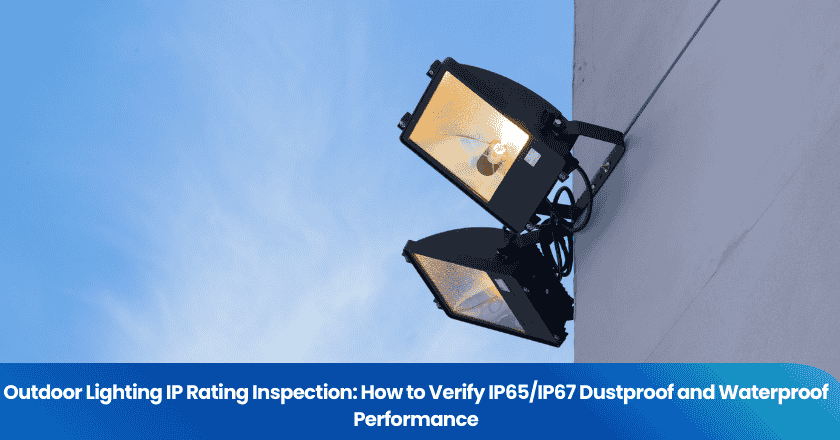
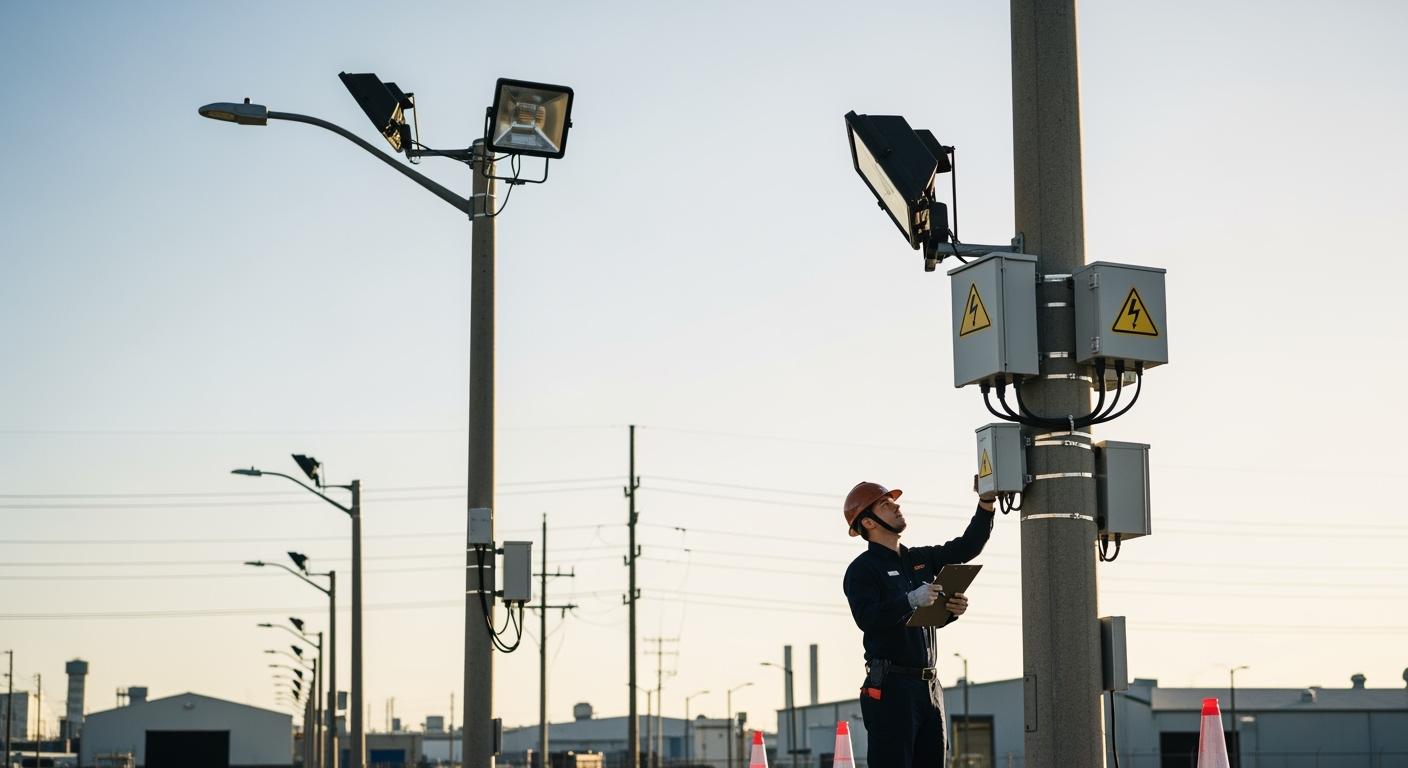
Street and industrial lighting are high-value, long-lifecycle products — and among the most complaint-prone categories sourced from Chinese factories when surge protection is inadequately specified or improperly assembled. LED drivers are far more vulnerable to transient overvoltages than the legacy HID ballasts they replaced, and the surge protective device (SPD) integrated into each fixture is the only component standing between a voltage spike and a failed driver. When SPDs are undersized, improperly connected, or built with counterfeit MOV components — all documented issues in factory production — the result is premature driver failures at scale, warranty claims, and replacement costs that dwarf the original savings from skipping a thorough pre-shipment inspection. This guide explains exactly what your inspection must cover for street and industrial lighting with integrated surge protection, what standards apply, and how to classify and act on defects before goods leave the factory.
Key Takeaways
- SPD assembly quality — MOV component rating, connection integrity, and ground continuity — must be explicitly verified during pre-shipment inspection. These failures are not detectable by visual workmanship checks alone.
- Grounding resistance within the fixture assembly must be below 0.5 ohm between the SPD ground terminal and accessible metal parts. Readings above this threshold indicate a critical defect that prevents the SPD from functioning correctly in the field.
- Compliance with UL 1449 (North America) and IEC 61643-11 (international/EU) must be verified against test certificates, not just markings. Counterfeit or expired certificates are a documented risk in Chinese factory supply chains for this product category.
- IK impact rating claims — especially IK08 and IK10 for outdoor and industrial fixtures — must be confirmed through calibrated impact tests on production samples, not accepted based on factory-provided spec sheets alone.
- Pre-shipment inspection for street and industrial lighting should include SPD functional verification, grounding resistance measurement, insulation resistance testing, and IK rating spot checks as minimum requirements. Standard visual inspection will miss all four.
Understanding SPDs in Factory-Assembled Street and Industrial Lighting
How SPDs Are Integrated in Chinese-Made Luminaires
In street and industrial lighting fixtures produced in China, the SPD is typically a separate module connected between the mains input terminals and the LED driver. The SPD contains one or more Metal Oxide Varistors (MOVs) that clamp transient overvoltages by dropping to near-zero resistance when voltage exceeds the clamping threshold, diverting surge energy to ground before it reaches the driver circuit. A thermal fuse or disconnector protects the MOV from destruction during sustained overvoltage. An indicator light — usually green for operational, red or off for failed — shows device status.
The failure modes that inspectors look for at the factory fall into three categories. The first is component substitution: suppliers use undersized or off-spec MOVs to reduce cost, resulting in a device that passes visual inspection but cannot handle rated surge energy. The second is connection error: the SPD ground terminal is not connected to the fixture earth, so the device cannot discharge surge energy to ground regardless of how well the MOV performs. The third is labelling fraud: the fixture label claims an SPD with a rated discharge current (e.g. 10kA) that is not present or not rated to that level in the actual assembly.
Note: Indicator lights confirm power is present, not that the SPD retains adequate clamping capacity. An SPD that has absorbed previous surges during factory testing may show green but have significantly degraded MOV capacity. Functional testing is the only reliable verification.
Why LED Drivers Make SPD Quality Non-Negotiable
LED drivers contain sensitive switching circuits operating at low voltages that are far more susceptible to transient overvoltages than legacy HID ballasts. A single surge event strong enough to cause immediate driver failure is relatively rare; what is far more common — and far harder to detect before it becomes a returns problem — is repeated low-level surges causing cumulative degradation that produces driver failures three to twelve months after installation. By that point, the product is already deployed in the field, the original inspection is long complete, and the importer bears the warranty cost. This is why SPD quality verification at the factory, before shipment, is the only cost-effective point of intervention.
SPD Inspection Methodology at the Factory
Surge Immunity Functional Testing
Surge immunity testing applies controlled transient overvoltages to sampled units using a calibrated surge generator to verify that the SPD performs as specified. The test evaluates three key performance parameters: response time (how quickly the SPD clamps the surge), clamping voltage (the peak voltage allowed through to the driver after clamping), and let-through energy (total energy absorbed by the SPD). Results are compared against the manufacturer's rated specifications and the applicable standard requirements for the product's surge category.
For street lighting products sold into the North American market, the relevant surge immunity standard is ANSI C82.77-5-2015, which specifies a minimum immunity level of 2.5 kV / 0.75 kA for luminaire electronics. Products sold internationally or into the EU market are tested against the IEC 61643-11 performance requirements. Any SPD that fails to clamp within specification, or shows visible damage to MOV components (discolouration, swelling, or burn marks) after testing, is classified as a critical defect with zero-tolerance status.
Grounding and Insulation Verification
A correctly specified SPD that is not properly grounded within the fixture assembly provides no protection. Inspectors verify grounding and insulation integrity on every sampled unit using the following protocol:
- Confirm the SPD ground terminal is connected to the fixture earth conductor, not shared with neutral or floating unconnected.
- Measure point-to-point resistance between the SPD ground terminal and accessible metal parts of the fixture housing. Resistance must be below 0.5 ohm per NETA standards. Any reading above 0.5 ohm is a critical defect.
- Conduct insulation resistance testing from each phase terminal to ground using a 500V DC megohmmeter. Minimum acceptable reading is 2 MΩ; readings below this threshold indicate compromised wiring insulation within the fixture assembly.
- Inspect all terminal connections visually for loose crimps, undersized wire gauge, and corrosion at connection points — any of which adds impedance to the ground path and degrades SPD performance.
- Document all numerical readings in the inspection report with photographs of the test setup and meter display.
Compliance Certification Verification
Certification claims for SPDs and luminaires in Chinese factory production require document-level verification, not just label inspection. The following standards are the primary requirements inspectors verify for each target market:
| Standard | Market | What Inspectors Verify | Common Fraud Risk |
|---|---|---|---|
| UL 1449 (4th Ed.) | North America | Test certificate from NRTL; model number on certificate matches production unit; nominal discharge current rating confirmed | Expired certificates; certificate for different model applied to current production |
| IEC 61643-11 | International / EU | Test report from accredited lab; Up (protection level voltage) and Iimp/In ratings match spec sheet | Self-issued test reports; lab not accredited to IEC 17025 |
| ANSI C82.77-5 | US / Global | Surge immunity level (2.5kV/0.75kA minimum) confirmed through functional test or test report | Spec sheet claims without supporting test data |
| NEC Article 285 | North America | SPD type classification (Type 1/2/3) matches installation requirement in purchase order | Type 3 device sold as Type 2; incorrect MCOV rating for system voltage |
Tip: Request the factory's UL 1449 or IEC 61643 test certificate, including the lab accreditation number, before placing your order. Cross-reference the model number on the certificate against the SPD module installed in the production units during inspection. Mismatches are a red flag for substitution.
Mechanical Durability: IK Rating and Enclosure Verification
Why IK Rating Verification Matters for Importers
Street and industrial lighting fixtures are routinely sold with IK08 or IK10 impact resistance claims that are never independently verified during production. The IK rating system (IEC 62262) quantifies a fixture's resistance to mechanical impact — IK08 means the housing withstands a 5-joule impact; IK10 means 20 joules. These ratings are mandatory for streetlights in many public procurement specifications and are increasingly required by commercial facility buyers. If the production units do not actually meet the claimed IK rating, the importer is liable for misrepresentation and potentially for any safety incident that follows a housing failure in the field.
Inspectors verify IK ratings through calibrated pendulum or drop-mass impact tests on housing samples taken from the production lot. The housing and lens must absorb the rated impact energy without cracking, shattering, or deforming in a way that compromises IP (ingress protection) rating validity or exposes live internal parts. An IK rating failure is a critical defect.
| IK Rating | Impact Energy | Typical Application | Inspection Method |
|---|---|---|---|
| IK07 | 2 J | Covered outdoor areas, low-risk environments | Pendulum or drop-mass per IEC 62262 |
| IK08 | 5 J | Standard street lighting; general outdoor commercial | Pendulum or drop-mass per IEC 62262 |
| IK09 | 10 J | High-traffic areas; sports facilities | Pendulum or drop-mass per IEC 62262 |
| IK10 | 20 J | Industrial environments; areas with vandalism risk | Pendulum or drop-mass per IEC 62262 |
Enclosure Material and Corrosion Resistance
Material conformity verification is a standard component of factory inspection for outdoor luminaires. Inspectors cross-reference production samples against the approved technical drawings and material specifications, checking die-cast aluminium alloy grade, housing wall thickness, coating type and thickness, lens material (UV-stabilised polycarbonate or tempered glass), gasket material, and fastener grade. For coastal or chemical-industrial applications where the purchase order specifies enhanced corrosion resistance, inspectors verify that the factory holds current salt spray test reports (typically 500 to 1,000 hours per IEC 60068-2-11) for the production materials, not just historical samples.
A common production deviation inspectors catch is substitution of standard aluminium alloy for the specified marine-grade or higher-purity alloy specified in the BOM, particularly when raw material prices increase mid-production. This substitution is invisible to visual inspection and only detectable by cross-referencing material certificates against purchase order specifications.
AQL Defect Classification for Street and Industrial Lighting
How to Structure Your Defect Classification
Correct AQL defect classification for street and industrial lighting ensures that inspection results translate directly into a clear ship or hold decision without ambiguity. The following classification applies ANSI/ASQ Z1.4-2008 at General Inspection Level II:
| Defect Type | Classification | AQL | Examples for This Product |
|---|---|---|---|
| Critical | Zero tolerance — one unit fails, lot is held | 0 | SPD ground not connected; grounding resistance >0.5 Ω; surge immunity test failure; IK rating failure; insulation resistance <2 MΩ; hi-pot breakdown |
| Major | Likely to cause field failure or non-compliance | 2.5 | Missing or mismatched certification mark; SPD rated current below PO spec; missing fuse; IP gasket unseated; wiring insulation damage; label wattage incorrect |
| Minor | Cosmetic; unlikely to affect function or safety | 4.0 | Surface finish inconsistency; minor label print quality; packaging damage not affecting product |
If critical defects exceed zero in the sample, or major defects exceed the AQL 2.5 acceptance number for your lot size, do not authorise shipment. Require the factory to identify the root cause, perform 100% rework of the affected defect type across the full lot, and schedule a third-party re-inspection to confirm the corrective action is effective. For SPD-related critical defects, root cause analysis should identify whether the failure is a component sourcing issue (wrong MOV specification) or an assembly process issue (missed connection step), as the corrective action differs significantly for each.
What to Specify in Your Pre-Shipment Inspection Checklist
A standard workmanship inspection will not cover any of the electrical safety or SPD performance items described in this guide. When ordering pre-shipment inspection for street or industrial lighting with integrated surge protection, specify the following as explicit checklist items to your inspection provider:
- SPD visual inspection: indicator status, terminal connection, ground wire presence and gauge
- SPD grounding resistance measurement (0.5 Ω limit) with numerical results documented per test point
- Insulation resistance test at 500V DC (2 MΩ minimum) with readings documented
- SPD certification verification: compare installed SPD model number against UL 1449 or IEC 61643-11 certificate
- IK impact rating spot test on housing samples per IEC 62262, if IK08 or higher is claimed
- Enclosure IP rating visual check: gasket seating, cable gland sealing, lens-to-housing seal integrity
- Label check: wattage, SPD discharge current rating, IP and IK claims, certification mark text
- Carton and packaging check: rated quantity, product model consistency
Tip: For large orders or new suppliers, consider a during-production inspection (DPI) at 20–30% production completion in addition to PSI. SPD assembly errors are systematic — catching them at DPI stage prevents the full lot from being built with the same defect.
FAQ
What is the most common SPD-related defect found during factory inspection of Chinese street lights?
The most frequently documented issue is an SPD ground terminal that is not connected to the fixture earth conductor. The device is present in the assembly and the indicator light is green, but the ground path is open, meaning the SPD cannot discharge surge energy to ground. This defect is not detectable by visual inspection alone and requires a grounding resistance measurement to identify. It is typically a systematic assembly process failure, not a random one.
Is a UL 1449 listing mark on the fixture label sufficient to confirm SPD compliance?
No. The listing mark on the label confirms that someone applied the mark; it does not confirm that the SPD installed in the production unit matches the tested model. Inspectors must cross-reference the model number on the installed SPD module against the actual UL 1449 test certificate, including verifying the lab name and certificate validity date. This step is the only reliable confirmation that the certificate applies to the current production.
How does SPD type (Type 1, 2, or 3) affect what inspectors check?
SPD type determines the discharge current rating and installation position in the power distribution system. Type 1 devices handle higher energy (direct lightning coupling) and are installed at the service entrance; Type 2 at distribution panels; Type 3 at point of use within luminaires. For fixtures claiming an integrated Type 2 SPD, inspectors verify that the nominal discharge current (In) and maximum discharge current (Imax) ratings on the installed device match the purchase order specification. Substituting a Type 3 device in a fixture sold as containing a Type 2 SPD is a major defect with direct field performance implications.
Do I need surge protection inspection for both street lighting and indoor industrial lighting?
Yes, though the risk profile differs. Street lighting faces higher external surge exposure from lightning and grid switching events. Indoor industrial lighting faces more frequent but lower-energy internal transients from motor starts, drive switching, and load changes on shared circuits. Both product categories benefit from SPD verification during pre-shipment inspection, with the specific surge immunity test levels adjusted to match the application environment specified in the purchase order.
At what production stage should I order the inspection?
Pre-shipment inspection is most effective when at least 80% of the production run is complete and units are being packed. For street and industrial lighting with integrated electronics, also consider a factory audit before production begins if you are working with a new supplier — verifying that the supplier actually has the production capability and component sourcing for the SPD specification in your purchase order prevents problems that no amount of end-of-line inspection can correct.
If you source street lighting, high-bay industrial fixtures, or other outdoor luminaires from China and need SPD performance verification, grounding resistance testing, and IK rating checks included in your pre-shipment inspection, TradeAider's inspection service covers the full electrical and mechanical safety test suite for lighting products. Inspectors upload real-time results from the factory floor, and you receive the official report within 24 hours of inspection completion — giving you a clear ship or hold decision before your goods are loaded.

Related Articles

Grow your business with TradeAider Service
Click the button below to directly enter the TradeAider Service System. The simple steps from booking and payment to receiving reports are easy to operate.

