
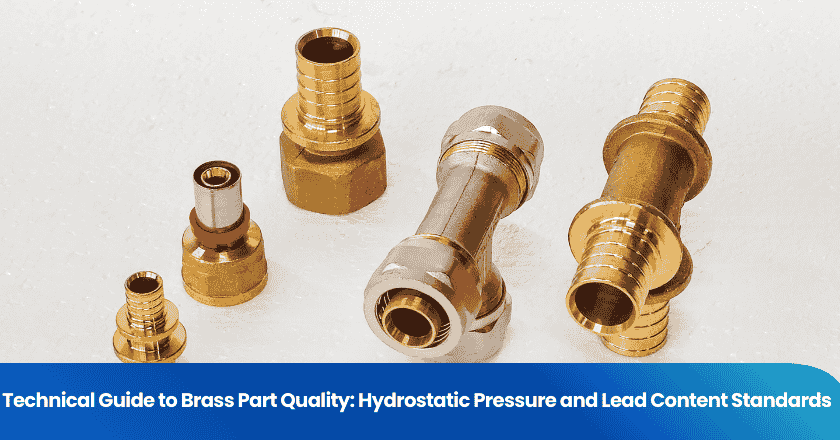
In the global plumbing and industrial infrastructure sectors, brass remains a preferred material due to its exceptional machinability, corrosion resistance, and thermal conductivity. However, the operational safety of brass components—ranging from residential faucets to high-pressure industrial valves—is contingent upon two technical pillars: structural integrity under hydraulic load and the minimization of toxic leaching. Hydrostatic pressure testing serves as the definitive method for validating volumetric integrity, while lead content analysis ensures compliance with stringent "lead-free" mandates like NSF/ANSI 372. As global regulations tighten, understanding the metallurgical science and laboratory protocols behind these tests is essential for manufacturers, importers, and public health stakeholders.
Key Takeaways
- Hydrostatic pressure testing is critical for detecting casting porosities and welding defects before system deployment.
- Lead content in plumbing brass must not exceed a weighted average of 0.25% for wetted surfaces under RLDWA standards.
- ASME B31 and ISO standards dictate the safety factors and holding times for pressure-bearing brass hardware.
- Advanced chemical analysis using ICP-OES provides the high-precision data required for regulatory certification.
- Professional quality inspections are the only way to ensure that mass-produced components match laboratory-grade prototypes.
- Traceability and comprehensive test documentation are mandatory for market entry in the US and EU.
The Physics of Hydrostatic Pressure Testing
Hydrostatic testing is a non-destructive verification process where a component is filled with an incompressible fluid (usually water) and pressurized to a specific level—often 1.5 times the maximum rated working pressure. Unlike pneumatic testing (using air), hydrostatic testing is significantly safer as water stores very little energy under compression, minimizing the risk of explosive failure during the test.
Hoop Stress and Structural Limits
During a pressure test, the brass walls of the component experience "Hoop Stress" (circumferential stress). If the brass alloy has internal impurities or if the wall thickness is inconsistent due to poor casting, the material may reach its "Proportional Limit." Engineers monitor for permanent deformation or "seepage" at joints. For industrial and hardline products, failure to maintain pressure during a 15-to-30 minute hold period indicates structural instability.
| Application Type | Standard Reference | Typical Test Pressure | Technical Objective |
|---|---|---|---|
| Residential Plumbing | ASME A112.18.1 | 125 - 150 PSI | Verify joint sealing and finish integrity |
| Process Piping | ASME B31.3 | 1.5x Design Pressure | Validate casting density and weld strength |
| Refrigeration Fittings | ASME B31.5 | 600+ PSI | Ensure gas-tight volumetric integrity |
| High-Pressure Valves | API 598 | Class Rated (e.g. 2000 PSI) | Measure seat leakage and shell strength |
Metallurgical Integrity and Leaching Kinetics
The addition of lead (Pb) to brass was historically common to act as an internal lubricant, facilitating high-speed machining. However, lead is not soluble in the copper-zinc matrix; it exists as discrete globules that can leach into water, especially in "aggressive" water conditions (low pH or high chloride levels). This poses a severe neurological risk, particularly to developing fetuses and young children.
Dezincification Resistant (DZR) Brass
When engineering high-quality parts, manufacturers often move toward DZR brass. Standard brass can suffer from "dezincification," where the zinc is selectively leached out, leaving a porous, brittle copper structure. This process not only causes mechanical failure but also opens pathways for lead particles to enter the water stream. Utilizing comprehensive factory audits ensures that the correct DZR alloys are used in production.
Expert Insight: The transition to "Eco-Brass" (Silicon-based or Bismuth-based brass) has solved the lead leaching problem but introduced new challenges. These alloys are significantly harder and more brittle, requiring specialized tooling and slower machining speeds to prevent internal micro-cracking that can cause failures during hydrostatic testing.
Chemical Analysis Protocols for Lead Verification
To verify that a component is "Lead-Free," labs utilize the weighted average calculation defined in NSF/ANSI 372. This involves mapping every wetted surface of a fixture and determining the lead percentage of each sub-component.
Analytical Methods: XRF vs. ICP-MS
For rapid screening during standardized product inspections, handheld X-ray Fluorescence (XRF) is used. While fast, XRF only measures the surface of the metal. For definitive regulatory compliance, Inductively Coupled Plasma Mass Spectrometry (ICP-MS) or Optical Emission Spectroscopy (ICP-OES) is required. The brass is dissolved in acid, and the resulting solution is atomized to provide an element-by-element breakdown with accuracy in the parts-per-billion (ppb) range.
| Method | Detection Limit | Destructive? | Technical Use Case |
|---|---|---|---|
| ICP-OES / ICP-MS | < 1 ppb | Yes | Formal certification and legal compliance |
| Handheld XRF | ~ 100 ppm | No | In-factory sorting and incoming material QC |
| Atomic Absorption (AAS) | 10 - 50 ppb | Yes | Routine batch testing for single elements |
Global Regulatory Standards and Certification
Compliance is a moving target. In the United States, the Safe Drinking Water Act (SDWA) was amended by the Reduction of Lead in Drinking Water Act (RLDWA) in 2014, lowering the allowable lead content from 8.0% to 0.25%. Similar trends are seen in Europe under the REACH and RoHS directives. For companies procuring quality technology solutions, staying ahead of these curves is a competitive necessity.
The Importance of Certification Markings
Legitimate brass plumbing hardware should carry markings from accredited third parties such as IAPMO (R&T) or CSA. These marks indicate that the factory has been inspected and that the product design has passed both the structural pressure tests and the chemical leaching audits. Without these marks, an importer faces significant liability risks and potential shipment seizure by customs authorities.
Integrating Testing into the Quality Management System
Quality is not inspected into a product; it is built into the process. A robust quality assurance framework for brass parts must include:
- Raw Material Verification: Checking the Mill Test Report (MTR) for every heat of brass ingot.
- In-Process Hydro-Checks: Pressurizing parts immediately after machining to catch tool-chatter defects or thin-wall errors.
- Spectrographic Analysis: Randomly sampling one out of every 500 units for chemical breakdown.
- Hold-Point Inspections: Mandating a pressure hold test on the final assembly before packaging.
For high-risk potable water systems, a "Time-Pressure Chart" should be generated during testing. This digital record serves as evidence that the part was held at the required pressure without the operator "pumping up" the system to mask a slow leak.
Frequently Asked Questions (FAQ)
What is the difference between hydrostatic and pneumatic testing?
Hydrostatic testing uses water, which is incompressible and safe for high pressures. Pneumatic testing uses air or nitrogen, which stores energy like a spring. If a part fails under air pressure, it can explode. Pneumatic testing is usually reserved for very low pressures or specialized gas systems.
Can I use a lead-containing brass valve for hot water?
Technically, lead leaching increases with temperature. Under modern laws, any valve used in a system intended for "human consumption" (which includes hot and cold potable water) must meet the lead-free standard of 0.25% weighted average.
How can I identify a lead-free faucet by looking at it?
You cannot. Lead-free and lead-containing brass look identical. Verification requires checking for the "LF" or "NSF-372" stamp on the product body or reviewing the laboratory test reports from the manufacturer.
Why do some brass fittings leak even if they passed a factory test?
This is often due to "Stress Corrosion Cracking" (SCC) or "Season Cracking." If the brass was not properly stress-relieved during manufacturing, environmental ammonia or moisture can cause the part to crack weeks or months after installation.
What is the typical turnaround for lead content laboratory testing?
Standard laboratory turnaround is typically 3 to 7 business days. This includes sample preparation (dissolving the metal), calibration of the ICP-MS system, and data verification. Expedited testing is possible but increases procurement costs.

Related Articles

Grow your business with TradeAider Service
Click the button below to directly enter the TradeAider Service System. The simple steps from booking and payment to receiving reports are easy to operate.

