
- About Us

- Our Services
- Your Industry
- Resources
- News & Blog
Managed fulfillment can shorten the distance between a seller's stock and a buyer, but it does not make product facts self-correcting. Before inventory is handed to a platform or assigned operator, the seller still needs to know which listing version, market route, product variation, labels, cartons, and evidence apply to the stock that is moving. If one of those records belongs to an earlier version, the handoff can turn a small factory correction into a harder warehouse, return, or compliance problem.
Program details can differ by account, category, destination, and date. The current seller portal, signed agreement, and destination-market rules should control the release decision. Before stock moves, make sure those instructions and the physical inventory point to the same listing, label, carton range, and evidence file.
Managed Fulfillment Changes the Handoff, Not the Seller's Evidence Duty
Managed fulfillment is a model in which a platform or assigned operator receives and handles inventory after the seller hands it over. The public Temu Seller Center presents product management, order management, logistics, returns, and fulfillment-method choices as connected seller workflows. That is a useful reminder that the handoff is not just a freight appointment. It is the moment when the product information used by the listing, the warehouse, and the seller's support team needs to refer to the same stock.
Temu's site-specific terms say products should conform to their description and have the quality and performance reasonably expected for their type. That is not a universal summary of every Temu agreement. It does explain why a seller should not let an old listing, a substitute component, or a changed package travel into managed fulfillment without a fresh comparison. The safe question is simple: can the team show that this defined stock population still matches the final buyer-facing promise?
Start with a boundary, not a vague order number. Identify the SKU, variation, factory or packing run, final listing version, destination market, and numbered cartons. If those references are missing, a seller cannot tell whether a later issue concerns ten cartons, one colorway, or the entire handoff. A platform's operational convenience never turns an untraceable population into a proven one.
The Eight Checks That Make Inventory Handoff Safer
A reliable inventory handoff needs eight connected checks: product identity, listing version, market route, product proof, label proof, carton scope, evidence ownership, and a hold rule. The list is not a claim that every product faces the same regulation. It is a way to prevent different teams from approving different versions of the same stock.
- Identity and listing: lock the SKU, variation, contents, material or functional facts, and the exact buyer-facing title, images, warnings, dimensions, and promises.
- Route and product proof: identify the destination market, current requirements, approved sample, controlled specification, and other physical reference.
- Label and carton proof: confirm the unit and package use the approved route-specific version, then map the identified stock to numbered cartons.
- Evidence owner and hold rule: name the person or system that can retrieve the final file and the decision that stops a known mismatch from moving forward.
The practical test is whether a buyer-facing claim can be traced through the physical product and back to a defined file. When it cannot, pause the affected decision before the stock is handed over. This is usually cheaper than trying to rebuild the evidence after inventory is mixed with other receiving activity.
Treat Temu and SHEIN Rules as Current Operating Inputs
SHEIN says its merchant agreements and policies require merchants to comply with applicable product-safety laws and regulations in the markets where products are sold. Its governance page also describes product-safety monitoring, testing, and enforcement. The operational lesson is not that one public page replaces a seller's account rules. It is that a managed-fulfillment plan should include a recurring check for the current market, category, restricted-product, and evidence requirements before inventory moves.
SHEIN's public responsible-sourcing statement says its program requires manufacturing suppliers to follow its Supplier Code of Conduct and uses independent audits in supplier compliance management. Read the statement as a supplier-management boundary, not as proof that a particular carton or marketplace seller has met every requirement. A seller still needs the current product file, final market route, and physical evidence for the stock at hand.
Build a short change-control trigger into the handoff. Reopen the file when the destination changes, a listing claim changes, the bill of materials changes, packaging changes, or a supplier uses a substitute label or insert. The trigger should name the person who can approve the new version and the cartons that the new version covers. It prevents a well-intended late change from becoming an undocumented change.
Build One Inventory-Handoff File for Each Market Route
SHEIN says its marketplace seller education covers product safety, restricted products, quality, intellectual property, and operational compliance across onboarding, listing, and day-to-day operations. That broad scope is why a seller should organize information before the first receiving scan. The public education update is useful context, but the live seller portal and the product's destination-market rules remain the detailed source of truth.
A managed-fulfillment handoff is controllable when the released inventory, listing version, market route, label and carton references, and retained evidence all point to the same product population. Here, a market route is the destination market plus the listing, label, document, and product requirements tied to it. A carton range is the numbered cartons that contain the same named inventory population. These two definitions keep a good record from being stretched across stock it does not actually describe.
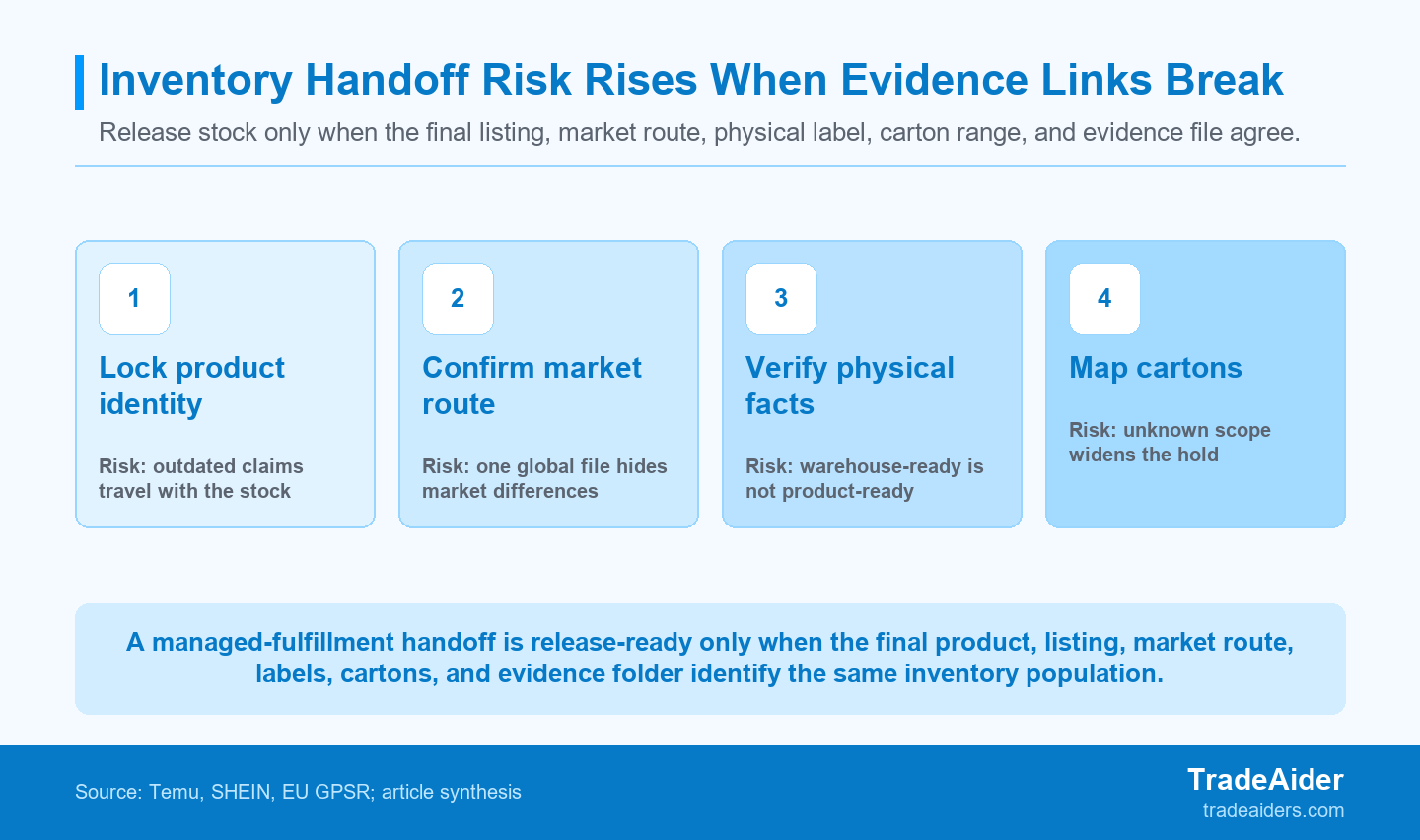
Managed-fulfillment inventory is safest to release when the final product, market route, labels, cartons, and evidence all identify the same stock population.
Use one file per route rather than a single global spreadsheet with unmarked exceptions. The file may be a controlled folder, an approved product-information system, or a simple record set. What matters is that it has a version, a named owner, and a link to the physical reference. Before bulk production, TradeAider can help a seller verify the approved product and label reference before bulk production when the listing or packaging depends on details that are easy to change later.
| Handoff file field | Physical or system reference | What it proves | Decision if it differs |
|---|---|---|---|
| SKU, variation, and contents | Approved sample, bill of materials, and controlled images | The stock has the product identity buyers will see | Hold the affected variation and correct the product or listing |
| Listing and market route | Final listing version, destination record, and current account instructions | The claim and route are current for the released stock | Do not hand off until the current route is confirmed |
| Label and package facts | Approved artwork, unit photos, and package check | Physical information matches the intended route | Relabel or isolate stock with a superseded version |
| Carton range and handoff record | Carton marks, packing list, and inspection record | The evidence has a defined population | Expand the hold if the population cannot be identified |
Lock Product Identity Before the Warehouse Receives Stock
Product identity is controlled when the SKU, variation, customer-facing facts, approved reference, and final listing version are tied to the same inventory population. Do not use an order name as a substitute. If black and navy units have different labels, inserts, dimensions, or customer claims, each needs an explicit version reference. This gives the factory, listing team, and receiving team a common answer when a substitute component or a late artwork revision appears. It also prevents a correct approval for one color or package from being silently applied to every other variation. Record a specific approver and effective date whenever a product fact changes.
Keep Product Proof Separate From Warehouse-Readiness Proof
Warehouse-ready proof establishes that inventory can be received and located; it does not by itself prove that the physical product and customer-facing claims are correct. A carton count, barcode scan, inbound appointment, and location record are all valuable, but they answer a different question from whether the material statement, contents, warning, package facts, or destination-market file is right. Keep both proof sets in the handoff file so a smooth receipt is not mistaken for a complete product release. The receiving team needs the first set to locate stock; the seller needs the second set to support a buyer-facing claim. Both should use the same SKU and carton references.
Add the Destination-Market Evidence Before Inventory Moves
For consumer products in GPSR scope, the European Commission lists composition, packaging, labels, warnings, and instructions among the product-safety considerations, and says there must be a responsible economic operator in the EU. Its Access2Markets guidance is a reason to treat the destination route as a physical-product decision. It is not a substitute for confirming whether the GPSR and any sector-specific rules apply to a particular item and member state.
The European Commission's GPSR Q&A says distance-sale offers should display manufacturer information and, where relevant, responsible-person contact information. That creates a useful pre-handoff comparison: the information on the final online offer, the approved label or package artwork, and the retained product record should not contradict one another. If one record is changed for an EU route, ask whether the associated listing and carton population need the same update.
The UK government's GPSR summary describes fulfillment service providers among the economic operators with product-related obligations. A market route is not always a platform route. The exact role and evidence obligation will depend on the product and place of sale, but the distinction matters: a fulfillment handoff may add an operator to the chain without removing the need for correct product information and records.
For each destination, list the product-specific questions that must be answered before handoff: Is this product in scope? Which listing fields, warnings, language, responsible-person details, certificates, test reports, or technical records are required? Which company owns each record? If the answer is uncertain, resolve it before treating the stock as ready. A warehouse can receive a carton while the seller still has an open market-evidence question.
Place Inspection Where a Correction Is Still Possible
A pre-shipment inspection can compare agreed finished-product and packing facts with a defined inventory population; it cannot determine platform acceptance or replace category-specific legal review. The useful scope is based on the final listing claims, market route, variation, label and package facts, required photos, carton marks, and the records the seller expects to retrieve after handoff.
Use the stage that fits the risk. A pre-production inspection can compare the sample and proposed packaging before bulk commitments are locked. A during-production inspection can help a seller check product, label, and packaging changes while production can still be corrected. A pre-shipment inspection (PSI) is the final check of finished goods and packing shortly before shipment. For PSI, production should be 100% complete and at least 80% packed for export. The 80% threshold refers to packing readiness, not to production being only 80% complete.
Write the physical checks as observable questions. Instead of “inspect quality,” specify “compare the navy variation's final insert to approved version 4,” “photograph the EU-route label on named cartons,” or “confirm the count and carton marks against the final packing list.” This allows an inspector to report against the actual handoff decision rather than a generic scorecard.
Treat Packaging and Labels as Release Evidence
Packaging and labels should be checked as physical release evidence because buyers, regulators, and warehouse teams can rely on them after inventory has moved. Inspect the current label or insert against the final route file, not against an old artwork approval. Confirm the SKU, variation, language, warnings, traceable lot or carton marks, and package contents that matter to the product. Record the exact revision and the cartons it covers.
A simple three-way comparison catches most late mistakes: the final online claim, the physical unit and package, and the carton or packing record. If all three identify the same version, the stock has a coherent evidence path. If the physical label is correct but the carton map points to an old file, the handoff file still needs correction. If the records are right but the unit carries an old label, the physical stock needs containment.
Use a Hold Boundary That Follows the Evidence
A proportional hold follows the smallest inventory population that can be identified by current product, label, route, and carton records; missing records require a wider hold. This is more defensible than releasing a whole order because most cartons look correct, and more efficient than treating every unit as affected when the evidence proves a smaller boundary.
Set the boundary using real factory records: carton numbers, packing-list lines, production dates, version-controlled artwork, inner-pack codes, and photos. Do not invent a batch label after the discrepancy is found. If cartons were mixed or a changeover point cannot be verified, say so and enlarge the hold. The decision is not a punishment for the factory; it is a way to keep the release claim no broader than the evidence.
Illustrative Scenario: A Superseded Label File at Inventory Handoff
The following example shows how a document conflict can be contained without making unsupported assumptions about platform acceptance or a product's legal status.
A Known Carton Boundary Makes a Staged Decision Possible
A marketplace seller is preparing finished stock for a managed-fulfillment handoff and needs one product file that the factory, warehouse, and listing team can all use. The illustrative order contains 1,800 reusable travel organizers: 900 navy and 900 black. The final plan assigns 600 black units to an EU market route, while the remaining stock follows a different route. Finished stock, physical labels, and numbered cartons are available for a final check before inventory is handed over. The controlled file records the current variation, contents, material statement, route-specific label reference, and final listing version.
The approved product and listing files identify the color, contents, material statement, and route-specific label reference. A late warehouse request prompts the factory to print new carton labels for the 600 black EU-route units. The handoff check finds that cartons 041-060 carry a superseded label file, while cartons 001-040 have the current reference and the physical product itself is unchanged. In the illustrative order, a superseded product-label file is used on one identifiable carton range after the target-market route changes. This is a document-to-product conflict with a known physical boundary. The issue does not prove that every organizer is defective. It does mean the seller cannot extend the current route file to the 200 black units in cartons 041-060 until the label evidence is corrected and checked.
Stop cartons 041-060 from moving, confirm that the final route and product offer have not changed again, and keep those cartons separate from the current-file population. The rest of the order remains a separate decision because its evidence boundary is different. Withdraw the superseded file from use, relabel the held cartons if the approved route requires it, update the carton map, and preserve before-and-after label photos with the final approved version.
The held cartons may move only after the physical labels, current product file, market route, and carton-range record all match in a focused recheck. If the range cannot be proven, widen the hold until it can. This is an illustrative release-control decision, not a platform finding, a legal conclusion, or a prediction of an account or shipment outcome.
Release Only the Cartons With a Matching File
The correctly labeled, traceable cartons can be released only after the file and physical product match; the superseded-label carton range remains on hold pending relabeling and a focused recheck. In this scenario, the 400 black units in cartons 001-040 may move if their final product, label proof, route file, and carton map agree. Cartons 041-060 stay separate until the corrected label and record have been rechecked. This staged release prevents a known document conflict from being hidden inside an otherwise orderly handoff. If the boundary cannot be proven, widen the hold rather than guessing where the old version stops.
Turn the File Into an Inspection Scope Before Handoff
An inspection scope is most useful when it names the product variation, market route, final listing version, required physical checks, carton boundary, and required evidence photos or records. Give the inspection team the current controlled file, not a general product name. Ask the report to show which evidence covers which cartons and which findings prevent release. This creates a cleaner handoff between factory, seller, warehouse, and customer-service teams.
When the order is finished and packed, TradeAider can help a seller compare the finished packed inventory with the current handoff file through a scoped pre-shipment inspection. If a particular SKU, route, or carton boundary needs independent review, request an inspection scope for the affected market route and carton range.
Frequently Asked Questions
Does Managed Fulfillment Remove the Seller's Quality-Control Duty?
Managed fulfillment can change the inventory handoff, but it does not make an inaccurate product, label, or listing record safe to release. The seller should still control the final product identity, market route, evidence file, and carton boundary before stock moves. Public platform information can set a useful operating boundary, while the live seller agreement and destination-market rules determine the requirements that apply to the account and product. Keep records retrievable after the handoff so a later question can be tied to a defined population.
What Should Be Checked Before Temu or SHEIN Inventory Handoff?
Check the final SKU and variation, listing version, market route, labels, package facts, carton map, required product documents, and the evidence owner before handoff. The important step is to compare the same version across the physical unit, package, listing, and records. Do not rely on a generic platform checklist when a product or destination has its own restrictions or information requirements. When a change affects only part of the stock, record the exact cartons before deciding whether a focused hold is possible.
Can a Pre-Shipment Inspection Approve a Marketplace Listing?
A pre-shipment inspection can document agreed product and packing facts, but it cannot approve a marketplace listing or decide a platform or regulatory outcome. Its value is practical: it can compare finished, export-packed goods with the agreed product file, required labels, package facts, variations, and carton references. Define the exact checks before the inspection, then use the results to correct the product, records, or listing before the affected inventory is released.
When Should a Seller Hold Inventory Instead of Updating a Listing?
Hold identifiable inventory when the physical product, labels, market evidence, or cartons no longer match the final claims that buyers will see. The UK government's GPSR summary includes fulfillment service providers in the set of economic operators with product-related obligations. That does not decide the answer for every product, but it reinforces the need to resolve a real conflict before handoff. Update the listing only when it will accurately describe the compliant product population that remains available for sale.

Related Articles



Grow your business with TradeAider Service
Click the button below to directly enter the TradeAider Service System. The simple steps from booking and payment to receiving reports are easy to operate.

