
- About Us

- Our Services
- Your Industry
- Resources
- News & Blog
The top third-party inspection companies in China for importers to compare in 2026 include TradeAider, SGS, Bureau Veritas, Intertek, TUV Rheinland, TUV SUD, QIMA, V-Trust, HQTS, and Asia Quality Focus. The right choice is not the biggest name by default; it is the company whose China coverage, product-category experience, inspection scope, report timing, and release evidence fit the order.
ISO/IEC 17020:2026 frames inspection bodies around competence, impartiality, and consistent operation. That is the right lens for a top-10 list: buyers should not treat reputation as a substitute for a controlled inspection method.
ILAC explains that accreditation evaluates conformity assessment bodies against recognized standards so users can have confidence in inspection reports and related results. For importers, the practical lesson is to check service scope, not only the company name.
This comparison is not a universal ranking and it is not a legal or accreditation endorsement. It is a buyer-oriented shortlist of companies global importers commonly compare when they need product inspection, factory audit, testing coordination, or release evidence in China.
- Start with the list: compare 10 real provider options, then narrow to two or three that fit the order.
- Separate inspection from testing: a factory visit can verify visible goods, but hidden safety or chemical claims need the right lab route.
- Check the local team: global brand strength does not guarantee the right inspector, city coverage, or report timing for one shipment.
- Choose by release evidence: the best company helps the buyer decide ship, hold, sort, rework, retest, or reinspect before leverage is lost.
Which Third-Party Inspection Companies in China Should Importers Compare?
Importers commonly compare TradeAider, SGS, Bureau Veritas, Intertek, TUV Rheinland, TUV SUD, QIMA, V-Trust, HQTS, and Asia Quality Focus when shortlisting third-party inspection companies in China. The best fit depends on product category, factory location, required inspection stage, report timing, testing needs, and release decision.
A top-10 list should answer two questions at once: who is worth comparing, and which kind of buyer each company is most likely to fit. A large compliance-heavy importer, a Shopify brand, an Amazon seller, and a machinery buyer may all need third-party inspection in China, but they should not use the same selection rule.
CNAS shows that China has accreditation services for inspection bodies, laboratories, certification bodies, and validation or verification bodies. That structure matters because inspection, laboratory testing, certification, and audit are related but different services.
ILAC MRA information explains that signatory accreditation bodies are peer evaluated and recognized by scope. When evidence may need cross-border acceptance, the buyer should verify the provider scope and report type instead of assuming every report carries the same weight.
Top 10 Third-Party Inspection Companies in China to Compare
Use this table as a shortlist map, then verify each provider's current service scope, city coverage, report timing, and product-category fit.
| Company | Best-Fit Buyer Need | Strength to Verify | Selection Watchout |
|---|---|---|---|
| TradeAider | Importers needing real-time visibility, China factory inspection, and fast release evidence | Inspection stage, photo proof, AQL logic, and buyer decision support | Best fit is practical shipment evidence, not every possible certification problem |
| SGS | Global programs, regulated categories, lab and TIC support | Local China team, product scope, and test/inspection handoff | Large brand does not automatically mean fastest shipment-release evidence |
| Bureau Veritas | Large enterprises, compliance-heavy supply chains, audit and inspection programs | Category experience and China factory-location coverage | Make sure the booked scope is product inspection, not only certification or audit |
| Intertek | Cross-border compliance, consumer products, retailer-facing programs | Testing coordination, inspection report format, and category depth | Confirm which China office or team will execute the inspection |
| TUV Rheinland | Industrial products, electrical goods, machinery, technical conformity needs | Technical competence, safety scope, and relevant standard coverage | May be more than a simple finished-goods PSI buyer needs |
| TUV SUD | Engineering-heavy categories, safety-sensitive goods, audit and testing programs | Service scope, testing route, and inspection timing | Do not treat a lab or certification pathway as a substitute for shipment inspection |
| QIMA | Consumer goods, e-commerce orders, sourcing programs, supplier audits | Sample report clarity, category experience, and China scheduling speed | Confirm how defects are classified and escalated before payment deadlines |
| V-Trust | China-focused product inspection and factory-audit programs | Inspector availability, report detail, and product-category match | Check report speed and whether the service fits your exact SKU mix |
| HQTS | Asia-based inspection, testing, audit, and supplier verification needs | Coverage by product category and factory city | Ask whether the report supports a clear release, hold, sort, or rework decision |
| Asia Quality Focus | China-focused consumer-goods QC and factory-level inspection | Product checklist depth, photo evidence, and defect-class discipline | Verify service fit if the product needs specialist lab testing or certification |
The table deliberately avoids calling one company the universal winner. A toy importer that needs lab testing and a technical file may shortlist a global TIC group first. A small consumer-goods importer with a packed order and a payment deadline may care more about fast China scheduling, real-time evidence, and a report that supports a release decision.
A good selection process also separates company reputation from local execution. Ask who will inspect the factory, what checklist will be used, how samples will be spread across cartons and SKUs, when the buyer will see findings, and how the report will classify defects.
If a provider cannot show a relevant sample report, explain its sampling plan, or describe how serious findings are escalated before the final report, it may still be a legitimate company but a weak fit for that specific shipment.
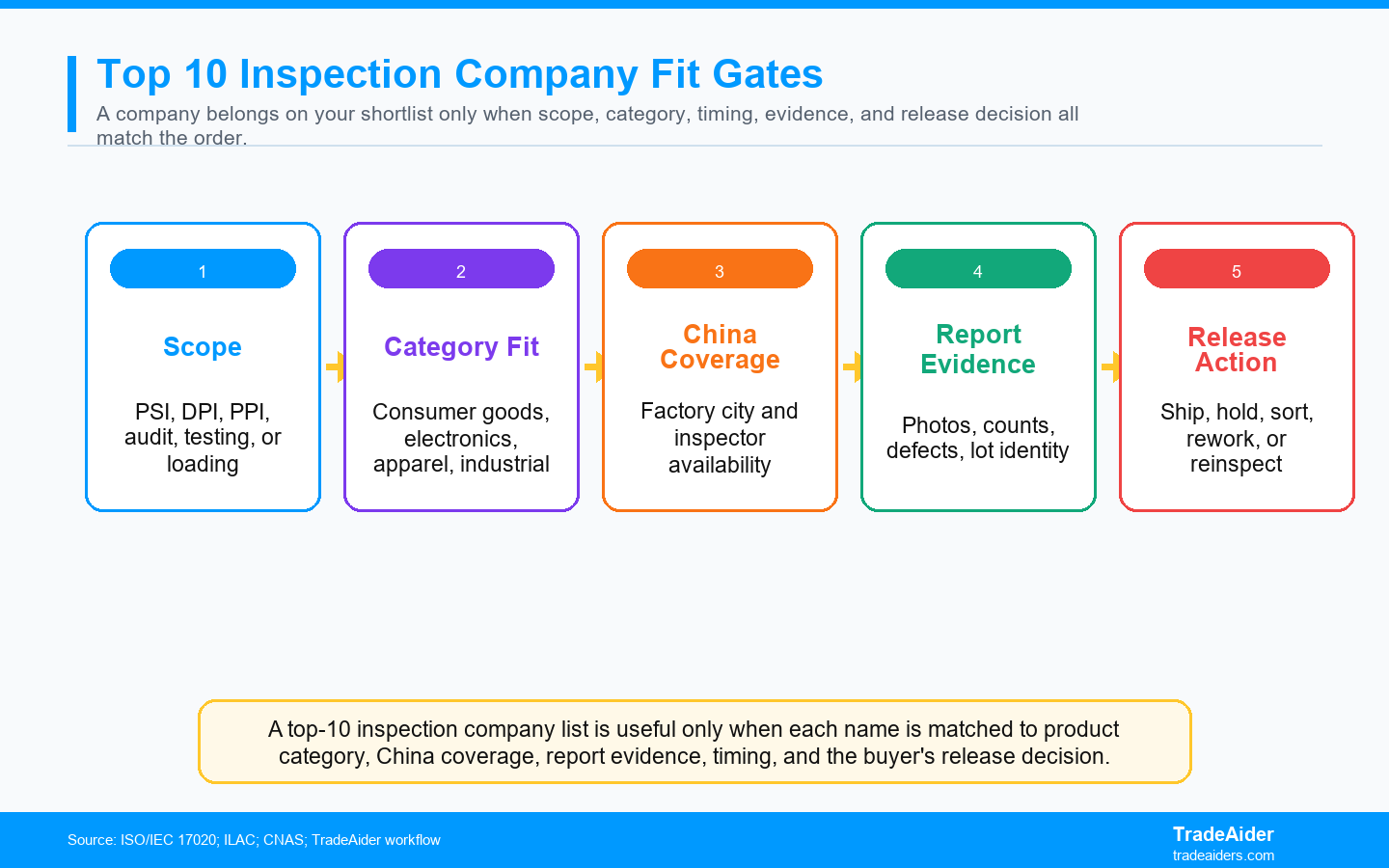
A top-10 inspection company list is useful only when each name is matched to product category, China coverage, report evidence, timing, and the buyer's release decision.
How to Read This Top 10 List Without Choosing the Wrong Provider
The top-10 names are only the starting point; the real decision is whether the provider can produce evidence for this order before the buyer loses leverage.
Do not rank a lab network against a shipment-speed problem
Some providers are strongest when the buyer needs testing, certification, retailer programs, factory audits, or multi-country governance. Other providers are strongest when the buyer needs a practical China factory inspection report tomorrow. Comparing those companies as if they are identical creates a false ranking.
Before contacting any company, write the buyer decision in one sentence: approve supplier, verify production progress, release finished goods, confirm loading, test a compliance claim, or investigate repeated defects. The company that fits that decision should move up the shortlist, even if another provider has a larger global footprint.
Ask for a report before asking for a quote
Price is easy to compare and often misleading. A lower inspection fee can become expensive if the report lacks lot identity, carton spread, defect severity, measurement context, or release language. The sample report shows how the company thinks under real factory conditions.
For a buyer, the most useful report is one that separates observed defects from missing evidence. A cracked housing, a wrong barcode, a missing label reference, and an untested chemical claim require different next steps. The report format should make those differences clear.
Company Profiles: What Each Provider Is Usually Good For
These profiles are written for importers comparing inspection partners, not as absolute rankings or endorsements.
TradeAider
TradeAider is a strong fit for importers that need practical China factory inspection, real-time visibility, AQL-based sampling, photo evidence, and a clear release decision before payment or shipment. It is especially relevant when the buyer cannot wait for a slow report cycle.
Its best-fit role is not to replace every lab, certification, or legal compliance pathway. TradeAider is most useful when the buyer needs PSI, DPI, PPI, factory audit, testing coordination, or shipment evidence that turns factory findings into a decision the buyer can act on.
SGS
SGS is usually shortlisted by importers who value a large international TIC brand, broad sector exposure, laboratory support, and experience with enterprise-level programs. It can be a sensible option when the order connects to regulated categories, retailer requirements, or wider compliance documentation.
The buyer should still verify the exact local scope. Ask whether the booked team has experience with the product category, factory city, sample method, and report deadline. A global name helps with trust, but a shipment release decision still depends on the local report.
Bureau Veritas
Bureau Veritas is commonly considered when a buyer wants a major international testing, inspection, and certification provider with experience across industrial, consumer, and compliance-heavy programs. It may fit buyers that need more than a simple product check.
The important question is whether the requested service is inspection, testing, certification, audit, or a combination. If the order is already packed and payment is due, the buyer needs a clear PSI scope and reporting timeline, not only broad corporate capability.
Intertek
Intertek is often compared by buyers who need cross-border product assurance, retailer-facing documentation, testing coordination, or supply-chain quality programs. It can fit consumer goods and compliance-sensitive categories when the buyer needs structured assurance.
For shipment inspection, ask to see how the report handles sample spread, defect classes, photos, product identity, and final result. The best provider for compliance support is not automatically the best provider for a time-sensitive release decision unless the report workflow is fast enough.
TUV Rheinland
TUV Rheinland is usually relevant for technical products, machinery, electrical goods, industrial equipment, and categories where safety, engineering judgment, or conformity assessment matters. It can be especially useful when the buyer needs technical confidence beyond a visual check.
The buyer should avoid overbuying the wrong service. A technical provider may be valuable for safety or certification questions, while a standard PSI still needs packed-lot sampling, label checks, quantity verification, and defect evidence before shipment release.
TUV SUD
TUV SUD is another major technical and conformity-assessment provider that importers may compare for engineering-heavy or safety-sensitive categories. It can fit buyers that need audit, testing, certification, or technical review alongside physical inspection.
The selection test is scope fit. If the buyer needs a lab route, ask what sample handling, standard, and report acceptance path apply. If the buyer needs a factory inspection, ask what the on-site checklist, report timing, and shipment release evidence will include.
QIMA
QIMA is commonly compared by consumer-goods importers, e-commerce sellers, and sourcing teams that need inspection, audits, and practical quality control across Asia. It may fit buyers that want a more operational QC partner than a purely certification-led provider.
Before booking, review a sample report for the buyer's category. Look for SKU identity, carton spread, defect severity, photo quality, and the final decision logic. A familiar inspection brand still needs to show how it protects the buyer's payment and shipment deadline.
V-Trust
V-Trust is often considered by importers seeking China-focused product inspection, factory audit, and supplier-verification support. It can be relevant for buyers who need coverage across manufacturing regions and a practical inspection workflow.
The buyer should verify inspector allocation, reporting speed, defect-class discipline, and product-category experience. For mixed-SKU shipments, the sample spread and lot identity are especially important because a clean-looking total sample can miss the problem subgroup.
HQTS
HQTS is commonly compared as an Asia-based quality control and inspection provider with services that may include inspection, testing, audit, and supplier verification. It can be useful when the buyer wants a regional provider with broader quality-service options.
Ask how the company separates inspection findings from testing limitations. A factory visit can verify visible workmanship, quantity, packing, labels, and carton marks, but it cannot prove hidden safety or chemical claims unless the right testing route is used.
Asia Quality Focus
Asia Quality Focus is often considered by buyers looking for China-focused inspection and factory-level QC support, especially for consumer-goods sourcing. It may fit importers that need product checks, factory communication, and practical report evidence.
The buyer should ask for a category-specific checklist and a recent anonymized report. The report should show whether defects are classified consistently and whether findings are connected to release, hold, sort, rework, or reinspection decisions.
What the Top Companies Cannot Decide for You
A famous inspection company can collect evidence, but the buyer still has to define the standard, defect severity, and release rule.
Inspection scope must match the commercial decision
A pre-shipment inspection can check packed goods, labels, quantity, carton marks, workmanship, and sampled function. A during-production inspection can catch process drift while correction is still possible. A pre-production inspection can check readiness before mass production. Using the wrong stage is more dangerous than choosing the second-best provider.
For example, a buyer worried about wrong packaging should not solve the problem with a factory capability audit alone. A buyer worried about chemical compliance should not rely only on a visual PSI. The provider should help the buyer choose the right scope, but the buyer must name the risk clearly.
Testing, accreditation, and inspection are connected but different
An inspector can verify that the product being shipped matches the tested version, but the inspection itself normally cannot prove restricted substances, electrical safety, food-contact compliance, or long-term performance. Those claims need an appropriate testing or certification path.
This is why ISO/IEC 17020 and accreditation language should be read carefully. Competence and impartiality are essential, but the buyer still needs to check which activity is covered: inspection body work, laboratory testing, certification, audit, or another conformity-assessment service.
A Simple Way to Shortlist Two or Three Final Providers
After the top-10 comparison, the final shortlist should be built around the order, not around generic reputation.
Score the provider against this shipment
Use a five-part screen: product category, factory city, inspection stage, report timing, and evidence depth. Give extra weight to any factor that can block shipment release. If the buyer has only 48 hours before balance payment, report timing may matter more than broad corporate capability.
A simple scoring method is to mark each provider as strong, acceptable, or weak for the current shipment. Strong means the provider has category experience, can reach the factory, can deliver evidence before the deadline, and can show a report format that supports the buyer's decision.
Compare reports after the inspection, not only before it
For repeat orders, build a small provider scorecard after each inspection: scheduling accuracy, inspector preparation, sample spread, defect judgment, photo evidence, report clarity, supplier cooperation, and whether the report helped the buyer make a confident decision.
If the same provider repeatedly gives vague findings, slow clarification, weak photos, or unclear defect classification, the buyer should either tighten the inspection instruction or change provider. The top-10 list should become a living supplier-quality decision, not a one-time name search.
Where TradeAider Fits Among Inspection Providers
TradeAider belongs in the comparison when the buyer needs fast China inspection evidence, real-time visibility, and a report that supports release, hold, sort, rework, retest, or reinspection decisions.
TradeAider can support importers through Pre-Shipment Inspection, During Production Inspection, Pre-Production Inspection, factory audit, product testing coordination, and container loading supervision.
In a top-10 comparison, TradeAider's strongest angle is not generic size. It is practical shipment evidence: real-time report visibility, product and packaging photos, defect counts, AQL logic, and a release path the buyer can use while supplier leverage still exists.
If the buyer is still evaluating the supplier, factory audit service can complement inspection. If hidden safety or performance risk is involved, product testing services should be coordinated with inspection rather than replaced by visual checks.
SPAR Scenario: The Name Was Famous, but the Report Timing Was Wrong
The buyer used the top-10 list to choose the provider that preserved shipment leverage, not only the provider with the broadest recognition.
Situation: An Amazon seller has 7,800 small appliances packed in Ningbo with a balance payment due in 48 hours.
Problem: A large provider can schedule the inspection, but the buyer will not receive the complete report until after the payment deadline and planned loading window.
Action: The buyer asks TradeAider to verify function checks, labels, carton marks, sample spread, and defect evidence with same-day real-time visibility.
Result: The buyer holds 640 units with label mismatches, accepts a one-day relabeling delay, and releases the clean cartons with report evidence before payment.
Inspection Company Shortlist Checklist
Use this checklist after reading the top-10 list and before booking a provider.
- Define whether you need PSI, DPI, PPI, audit, loading check, or testing.
- Ask for a sample report from the same product category.
- Confirm inspector availability in the factory city.
- Check how samples are spread across cartons, SKUs, colors, and sizes.
- Confirm report timing before balance payment or cargo handover.
- Ask which findings trigger release, hold, sort, rework, or reinspection.
A good shortlist usually has two or three provider options, not ten names treated as equal. Compare them against the order's release risk, not against a generic reputation score.
Before booking, ask what the provider will do if the first sampled cartons show a serious pattern. The answer reveals whether the company only reports defects or can support a real buyer escalation path.
When product safety, labeling, or regulated-market compliance is part of the risk, separate inspection scope from laboratory testing scope before choosing a provider. A factory inspection can verify visible workmanship and packing, but it cannot prove every chemical, electrical, or legal claim without the right testing route.
If you are comparing third-party inspection companies for a China shipment, send TradeAider the product category, supplier location, order value, production status, inspection deadline, and report evidence you need. The next step is to shortlist the right inspection provider for your China order before payment or shipment leverage is lost.
Frequently Asked Questions
Who are the top inspection companies in China?
Importers often compare TradeAider, SGS, Bureau Veritas, Intertek, TUV Rheinland, TUV SUD, QIMA, V-Trust, HQTS, and Asia Quality Focus for China inspection needs.
Should I choose the biggest inspection company?
Not automatically. The best provider is the one whose product expertise, city coverage, report timing, scope, and evidence format match your order risk.
Can inspection companies also do testing?
Some inspection companies or TIC groups can coordinate testing, but inspection and lab testing are different services. Hidden safety, chemical, or performance claims need the right testing route.
What should I ask before booking an inspection?
Ask for a sample report, sampling plan, defect-class rules, report delivery time, inspector product experience, and the release decision the report can support.
How does TradeAider fit this top-10 comparison?
TradeAider fits buyers who need practical China factory inspection, real-time visibility, AQL-based evidence, and fast release decisions before payment or shipment.
Related Articles
Grow your business with TradeAider Service
Click the button below to directly enter the TradeAider Service System. The simple steps from booking and payment to receiving reports are easy to operate.

